


























































































Module Calculation Methods in Rack and Pinion Gear Systems for Industrial CNC
📑 Table of contents (Click to open)
Introduction and Technical Analysis of Module Calculation Methods in Rack and Pinion Gear Systems
Rack and pinion gear systems, indispensable components of industrial automation and mechanical motion control, are critical mechanisms that precisely and powerfully convert rotary motion into linear motion. Thanks to their high load-carrying capacities, repeatability, and ability to offer long stroke distances, they are widely used in robotic arms, CNC machines, material handling systems, gantry systems, and various automation lines. One of the most fundamental parameters that play a decisive role in the design and performance of these systems is the module (m) value. The module is a universal measure that directly affects the size of the gears, the thickness of the teeth, the tooth spacing, and consequently the overall dimensions, load-carrying capacity, and precision of the system. Correct module calculation directly determines the lifespan, efficiency, noise level, and most importantly, the operational reliability of a rack and pinion gear system. An incorrectly selected module can lead to premature wear, excessive vibration, loss of precision, and even system failures. This technical article and field guide comprehensively covers module calculation methods in rack and pinion gear systems, related technical principles, field considerations, and solutions to common problems for engineers, designers, and maintenance specialists in the industrial automation sector. Our goal is to provide a comprehensive knowledge resource to overcome the challenges encountered in the design and application processes of this critical component.
Working Principle and Technical Data of Module Calculation Methods in Rack and Pinion Gear Systems
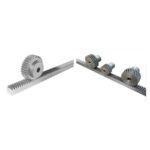
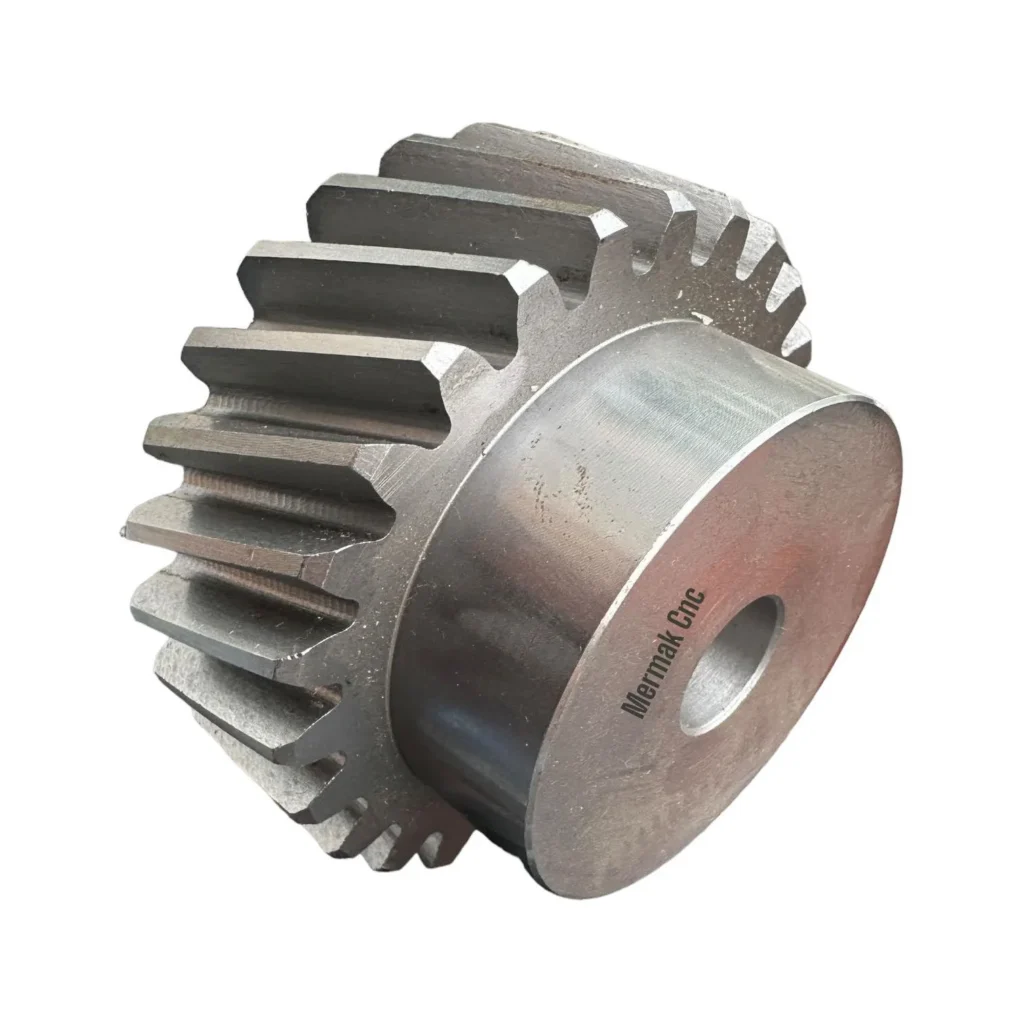
A rack and pinion gear system fundamentally consists of two main components: a pinion (gear wheel) and a rack (toothed bar). As the pinion is rotated by a motor or drive unit, its teeth remain in continuous contact with the rack’s teeth, converting rotary motion into linear motion. The efficiency and precision of this conversion depend on the geometric compatibility of the pinion and rack gears. The key to this compatibility is the module (m) parameter. The module is a ratio defined by international standards that expresses the size of the gears. For a gear wheel, the module is obtained by dividing the pitch diameter (d0) by the number of teeth (z): m = d0 / z. For a rack, since it is considered a gear wheel with an infinite radius, the module is directly related to the circular pitch (p). The circular pitch is the distance from a point on one tooth to the same point on the next tooth and is calculated by the formula p = π * m. This indicates that the rack will move linearly by π times for each module unit.
The correct selection of the module should be made according to the system’s performance expectations. Larger module values mean thicker teeth and, therefore, higher load-carrying capacity and durability. However, large modules can also result in larger gear dimensions, greater potential for backlash, and lower precision. Conversely, small modules offer thinner teeth, lower load capacity, but potentially higher precision and more compact designs. In industrial automation applications, module series conforming to ISO or DIN standards are typically used (e.g., 0.5, 1, 1.25, 1.5, 2, 2.5, 3, 4, 5, 6, 8, 10, 12…).
The module also forms the basis for other important gear geometry parameters:
- Addendum (ha): Typically taken as ha = m. This is the vertical distance from the pitch circle to the top of the tooth.
- Dedendum (hf): Typically taken as hf = 1.25 * m. This is the vertical distance from the pitch circle to the bottom of the tooth.
- Whole Depth (h): h = ha + hf = 2.25 * m. This is the total vertical distance from the top to the bottom of a tooth.
- Tooth Thickness (s): The width of the tooth on the pitch circle, ideally taken as s = p / 2 = π * m / 2.
- Clearance (c): The radial clearance between two meshing teeth, typically taken as c = 0.25 * m. This clearance provides space for lubrication and prevents the gears from binding, but excessive clearance can lead to a loss of precision (backlash).
- Pressure Angle (α): Generally standardized at 20 degrees. This angle determines the direction of the force applied by the teeth to each other and affects the shape of the tooth profiles.
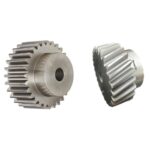
These parameters ensure that the pinion and rack mesh smoothly and provide the desired performance characteristics. In helical rack and pinion gears, module calculation is slightly more complex, distinguishing between normal module (mn) and axial module (mx). The helix angle (β) is also included in the equations, calculated with relationships such as mn = m * cos(β). Helical gears can offer quieter operation and higher load-carrying capacity compared to straight gears, but their manufacturing and assembly require greater precision.
When selecting the module, factors such as the system’s maximum carrying capacity, operating speed, desired positioning accuracy, overall system size, cost, and environmental conditions should be evaluated together. For example, larger modules are preferred for high-speed and high-torque applications, while smaller modules can be used in miniature and precise positioning applications. Additionally, the material of the rack and pinion gears (e.g., C45 steel, stainless steel) and whether they are heat-treated are important factors affecting load capacity and lifespan. Correctly determining the module is a fundamental step to ensure the reliability and sustainability of the system.
| Parameter | Value/Description |
|---|---|
| Module (m) | Fundamental ratio determining gear size (mm). d0/z for pinion, p/π for rack. |
| Circular Pitch (p) | Distance between teeth (p = π * m). Critical for linear motion of the rack. |
| Addendum (ha) | Height from pitch circle to tooth top (typically ha = m). |
| Dedendum (hf) | Height from pitch circle to tooth bottom (typically hf = 1.25 * m). |
| Whole Depth (h) | Total tooth height (h = ha + hf = 2.25 * m). |
| Clearance (c) | Radial clearance between meshing teeth (typically c = 0.25 * m). |
| Pressure Angle (α) | Angle of the tooth profile (standard 20°). |
| Pinion Number of Teeth (z) | Number of teeth on the pinion. Critical for meshing with the rack. |
Field Considerations for Module Calculation Methods in Rack and Pinion Gear Systems
- Material Selection and Heat Treatment: The material of the rack and pinion directly affects the system’s load-carrying capacity and lifespan. High-strength steels (e.g., C45, 42CrMo4) and appropriate heat treatments (induction hardening, carburizing) increase the wear resistance and durability of the gears. Hardened and ground racks offer higher precision and longer life. The correct combination of material and heat treatment should be selected according to the torque, speed, and operating environment conditions required by the application. Stainless steels provide corrosion resistance, while special coatings can reduce friction.
- Assembly Precision and Parallelism: The performance of rack and pinion gear systems largely depends on assembly precision. Securing the rack to the mounting surface with perfect parallelism and flatness is vital. Even the slightest parallelism error can lead to uneven load distribution, excessive friction, noise, and premature wear between the teeth. Correct centering of the pinion relative to the rack and preventing axial shift are also critically important. The accuracy of the assembly should be checked using laser alignment tools or precision gauges.
- Backlash Adjustment: Backlash is the small clearance between meshing teeth. Optimal clearance allows for lubrication and prevents the teeth from binding, while excessive backlash reduces positioning accuracy and causes vibration. When setting up the system, the manufacturer’s recommended backlash value should be precisely adjusted. Generally,
FAQ
What is the module in rack and pinion gear systems and how is it calculated?
The module (m) is a fundamental parameter that defines the size of gear teeth. For a pinion, it's calculated as the pitch diameter (d0) divided by the number of teeth (z). For a rack, it's related to the circular pitch (p) by the formula p = π * m. It directly influences tooth thickness, spacing, load capacity, and overall system precision.
What other geometric parameters are derived from the module in rack and pinion systems?
Key parameters include addendum (ha = m), dedendum (hf = 1.25 * m), whole depth (h = 2.25 * m), tooth thickness (s = π * m / 2), clearance (c = 0.25 * m), and pressure angle (typically 20°). These ensure proper meshing and desired performance.
What factors should be considered when selecting the appropriate module for an industrial application?
Factors such as maximum load capacity, operating speed, desired positioning accuracy, system size, cost, and environmental conditions must be considered. Larger modules offer higher load capacity but may reduce precision, while smaller modules provide higher precision in compact designs.
What are the most important field considerations for installing and maintaining rack and pinion systems?
Critical field considerations include selecting the correct material and heat treatment for durability, ensuring high assembly precision and parallelism to prevent uneven load distribution, accurately adjusting backlash for optimal performance, implementing regular and appropriate lubrication, and protecting the system from environmental factors like dust and moisture.
What are common problems encountered with rack and pinion systems and how can they be resolved?
Common issues include excessive noise/vibration (due to incorrect backlash or misalignment), tooth wear/breakage (from insufficient module, poor material, or lubrication), loss of precision (increased backlash from wear or loose components), and binding (from narrow backlash or thermal expansion). Solutions involve precise adjustment, material upgrades, proper lubrication, and environmental protection.