No products in the cart.
Wood CNC Router Bits: Prices, Lifespan, and Industrial Optimization – Field Guide
Contents
Wood CNC Router Bits: Prices, Lifespan, and Industrial Optimization – Field Guide
Introduction and Technical Analysis
In industrial automation, particularly within the woodworking sector, cutting tools—specifically wood CNC router bits—are the heart of CNC router machines. These bits have a direct and critical impact on production efficiency, product quality, and operational costs. These router bits are utilized across a wide range of applications, from furniture manufacturing and decorative panels to door and window production and custom-designed wooden products. However, selecting the correct bit, balancing price-performance, and maximizing lifespan often require complex engineering principles and extensive field experience. This guide provides industrial automation professionals with an in-depth look at the technical details of wood CNC router bits, market dynamics, factors affecting their lifespan, and cost optimization strategies. Our objective is to empower businesses to make more informed decisions in their production processes, thereby enhancing their operational efficiency. Advancements in cutting tool technology, particularly the use of advanced materials like Solid Carbide and Polycrystalline Diamond (PCD), have significantly boosted bit performance and lifespan, while also introducing diverse cost and application scenarios. In this context, the unique geometry, coating, and manufacturing material of each bit play a key role in determining its suitability for a specific application.
Operating Principle and Technical Data
The operating principle of wood CNC router bits relies on high-speed rotation to remove material. During this process, the bit’s geometry, material, and surface coating are decisive factors influencing cutting quality, chip evacuation, heat generation, and consequently, the bit’s lifespan. Fundamentally, bits are categorized according to different cutting needs:
- Straight Bits: Generally used for cutting grooves, edge profiling, and simple routing operations. They are known for being economical, but their performance can be limited in complex geometries or at high speeds.
- Spiral Bits: Designed to optimize chip evacuation. Up-Cut spiral bits pull chips upwards, improving chip evacuation and being effective in deep cuts, but they can cause tear-out on the top surface of the workpiece. Down-Cut spiral bits push chips downwards, ensuring a clean cut on the top surface of the workpiece, though chip evacuation might be more challenging. Compression Bits feature both up-cut and down-cut edges, minimizing tear-out by providing clean cuts on both surfaces, especially in laminated or veneered panels. These bits are among the most preferred types in industrial applications.
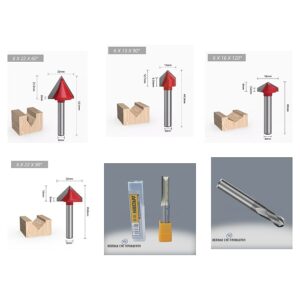
- V-Groove Bits: Ideal for precise operations such as decorative engraving, chamfering, and lettering. They are available in various angles (60°, 90°, 120°).
- Ball Nose Bits: Used for machining three-dimensional contours and molds. They reduce surface roughness, providing smoother transitions.
The material and coating of the bits directly affect their lifespan and performance:
- High-Speed Steel (HSS): A cost-effective option suitable for softer woods and lower RPMs. However, its wear resistance and heat tolerance are low.
- Solid Carbide: The most commonly used industrial material. It offers high hardness, wear resistance, and heat durability. It performs exceptionally well in machining hard woods, MDF, particleboard, and similar materials. Carbide bits, when used with correct cutting parameters, offer a long lifespan.
- Polycrystalline Diamond (PCD): Much harder than carbide and specifically designed for abrasive materials (e.g., melamine-faced panels, dense MDF, HPL). PCD bits can offer 30-50 times longer lifespan compared to carbide bits, but their initial cost is significantly higher. The return on investment can be very attractive for high-volume, continuous production facilities.
Surface coatings enhance the bit’s hardness, friction resistance, and heat dissipation, thereby extending its lifespan. The most common coatings are Titanium Nitride (TiN), Aluminum Titanium Nitride (AlTiN), and Zirconium Nitride (ZrN). AlTiN is preferred for machining hard materials due to its higher temperature resistance, while ZrN can provide a smoother surface, reducing chip adhesion.
Other engineering data affecting lifespan include:
- Cutting Speed (Vc): The peripheral speed of the bit. It must be optimized according to the material type and bit material.
- Feed per Tooth (Fz): The distance each cutting edge advances into the material. Too low a feed rate increases friction and heat, while too high a feed rate can lead to tear-out or bit breakage.
- Revolutions Per Minute (RPM): The rotational speed of the spindle motor. It is directly related to cutting speed and bit diameter.
- Chip Load: The amount of material removed by each cutting edge. Optimal chip load is critical for both cutting quality and bit lifespan.
- Depth of Cut: How much material is removed in a single pass. Excessive depth of cut can create undue stress on the bit.
Correct adjustment of these parameters ensures maximum lifespan by preventing premature wear or breakage of the bit. Manufacturer-provided tool paths and cutting parameter tables serve as essential reference points in this optimization process.
| Parameter | Value/Description |
|---|---|
| Bit Material | Solid Carbide – Industry standard, high performance. |
| Application Area | MDF, Particleboard, Plywood, Solid Wood, Acrylic, Laminated panels. |
| Typical Diameter Range | 3 mm – 25 mm (most common range in industrial use). |
| Average Lifespan (Solid Carbide) | 200-800 working hours (depends on material, parameters, and maintenance conditions). |
| Average Lifespan (PCD) | 6000-15000+ working hours (30-50x more than carbide in abrasive materials). |
| Coating Types | TiN, AlTiN, ZrN (reduces friction, increases hardness, enhances heat resistance). |
| Price Range (Solid Carbide Bit) | 20 USD – 200 USD (varies by diameter, length, brand, and coating). |
| Price Range (PCD Bit) | 300 USD – 2000 USD+ (varies by geometry, number of diamond segments, and manufacturer). |
| Resharpening Capacity | Carbide bits 3-10 times, PCD bits 5-15 times (depends on geometry and wear condition). |
Field Considerations
- Correct Tool Selection and Material Compatibility: Choosing the most suitable bit for each workpiece material and cutting operation is vital for both cut quality and tool life. For instance, PCD bits should be preferred for high-density melamine-faced panels, while AlTiN-coated solid carbide compression bits are ideal for standard MDF. Material hardness, abrasiveness, and the level of detail to be machined are key criteria in determining bit material, geometry, and coating. Incorrect tool selection leads to premature wear, poor cut quality, and increased costs.
- Optimal Cutting Parameters and Chip Load Management: Parameters such as CNC machine RPM, feed rate, and depth of cut must be set according to the bit manufacturer’s recommendations. Chip load is the amount of material removed by each cutting edge and directly impacts tool life. Too low a chip load increases friction, leading to heat buildup and dulling of the bit, while too high a chip load can cause bit breakage or tear-out. Optimal chip load represents an ideal balance that helps the bit cool itself and protects the cutting edges. Periodically checking and adjusting these parameters significantly extends tool life.
- Regular Maintenance, Cleaning, and Resharpening Processes: Regularly cleaning CNC router bits, especially removing resin buildup and chip residues, enhances cutting performance and lifespan. Timely and correct resharpening is critical to maintain the bits’ sharpness. Resharpening should be performed by specialized firms to avoid altering the bit’s original geometry and coating. Each resharpening slightly reduces the bit’s diameter, which may require compensation in the CNC program. Using damaged or excessively worn bits degrades product quality and can damage the machine. Proper storage of bits is also important; protecting them from moisture and impacts extends their life.
- Machine and Fixture Rigidity: The rigidity of the CNC machine’s beds, spindle motor, and fixtures is crucial for minimizing vibrations during the cutting process. High vibrations can lead to premature bit wear, breakage, and reduced cut quality. Periodically checking the machine and tool holders and making necessary adjustments improves bit life and machining accuracy.
- Cooling and Chip Evacuation: Especially when machining hard and abrasive materials, heat control in the cutting zone and effective chip evacuation are very important for bit life. Insufficient chip evacuation can lead to re-cutting of material, heat buildup, and premature dulling of the bit. Air blowing systems or vacuum systems must ensure effective chip removal.
Common Problems and Solutions
The main problems encountered in industrial wood CNC machining processes and proposed solutions are detailed below:
- Problem: Premature Bit Wear or Breakage.
- Possible Causes: Incorrect tool material selection (e.g., application requiring carbide or PCD instead of HSS), low feed rate at high RPM (insufficient chip load), excessive depth of cut, machine vibration, incorrect workpiece clamping, poor bit quality or manufacturing defect, worn tool holder.
- Solutions: Select bit material and geometry appropriate for the material to be machined. Adjust RPM and feed rates to ensure optimal chip load according to manufacturer recommendations. Gradually increase depth of cut. Check machine and tool holder rigidity. Securely clamp the workpiece. Work with reliable and quality bit suppliers.
- Problem: Poor Cut Quality (Tear-out, Chipping, Burning).
- Possible Causes: Dull bit, incorrect bit type (e.g., using an up-cut instead of a compression bit), insufficient or excessive feed rate, incorrect RPM, chip evacuation issues, poor quality or heterogeneous structure of the workpiece.
- Solutions: Check the bit, resharpen or replace if necessary. Use bit geometry suitable for the material and cut type (e.g., compression bit for laminates). Optimize cutting parameters (RPM, feed). Check and clean the chip evacuation system. Evaluate the quality of the material to be machined. In case of burning, you can increase the chip load by increasing the feed rate and decreasing the RPM.
- Problem: Resin or Chip Buildup on the Bit.
- Possible Causes: Machining soft or resinous woods, insufficient chip evacuation, low feed rate, inadequate bit cooling.
- Solutions: Regularly clean the bit (special resin remover sprays can be used). Improve the efficiency of the chip evacuation system. Optimize the feed rate to create larger chips. If necessary, try bits with better coatings (e.g., ZrN).
- Problem: Bit Slipping or Flying Out of the Tool Holder.
- Possible Causes: Incorrect tool holder selection, worn tool holder, insufficient tightening of the bit, damaged bit shank, excessive side forces.
- Solutions: Use the correct size and type of tool holder (e.g., ER collet). Check the wear condition of the tool holder and collets and replace if necessary. Tighten the bit to the appropriate torque (but avoid overtightening). Check the bit shank for damage. Review cutting parameters to reduce side forces.
Expert Advice
This detailed analysis of wood CNC router bit prices and lifespans clearly demonstrates that efficient and cost-effective production in the industrial automation sector is not limited to merely owning the right machine. Bit selection is a strategic decision that, beyond the initial investment cost, directly impacts production speed, product quality, scrap rates, and overall operational costs. Our field experience shows that the most expensive bit is not always the best solution, just as the cheapest bit can prove to be the most costly in the long run. The key is to select the bit that offers the optimal price-performance balance, suitable for the application’s requirements, the characteristics of the material being machined, and the production volume. Especially in high-volume production facilities, the initial investment in PCD bits can quickly pay for itself and even become profitable due to their longer lifespan, fewer tool changes, more consistent cut quality, and consequently lower unit costs. However, for low-volume or variable jobs, high-quality solid carbide bits, with the correct coating and cutting parameters, can deliver excellent results. It should be remembered that a bit’s lifespan is not only related to material quality but also closely linked to correct cutting parameters, regular maintenance, the condition of the tool holder, and the operator’s expertise. Industrial businesses need to continuously optimize by working closely with tool suppliers, following new tool technologies, and analyzing their own production data. This approach will not only reduce current operational costs but also create a more resilient and competitive structure against future production challenges. Remember, a well-managed tool inventory forms the foundation for your production line to operate seamlessly and profitably.
FAQ
What are wood CNC router bits?
Wood CNC router bits are cutting tools used in CNC router machines to shape, cut, and engrave various wood-based materials such as solid wood, MDF, particleboard, and plywood. They come in different geometries, materials (like solid carbide or PCD), and coatings to suit specific applications.
What factors affect the lifespan of a wood CNC router bit?
The lifespan of a wood CNC router bit depends on several factors, including the bit's material (solid carbide vs. PCD), the type and abrasiveness of the material being cut, cutting parameters (RPM, feed rate, depth of cut), proper maintenance, and machine rigidity. Solid carbide bits typically last 200-800 hours, while PCD bits can last 6,000-15,000+ hours in abrasive materials.
How can I optimize the performance and lifespan of my wood CNC router bits?
To optimize the performance and lifespan of your CNC router bits, ensure you select the correct bit material and geometry for your specific application and material. Always use optimal cutting parameters recommended by the manufacturer, including RPM, feed rate, and chip load. Implement regular cleaning and maintenance, and ensure timely resharpening by experts. Maintain machine and fixture rigidity to minimize vibrations, and ensure efficient chip evacuation and cooling.
What are common problems encountered with wood CNC router bits and how can they be solved?
Common problems include premature wear or breakage, poor cut quality (tear-out, chipping, burning), resin or chip buildup, and bits slipping from the tool holder. Solutions involve selecting the right bit, optimizing cutting parameters, regular cleaning and maintenance, checking machine rigidity, and ensuring proper tool holder condition.
What is the difference between HSS, Solid Carbide, and PCD router bits?
While HSS bits are economical for softer woods, solid carbide bits are the industrial standard for their hardness and wear resistance, suitable for most wood-based materials. PCD bits, though more expensive initially, offer significantly longer lifespans (30-50 times more than carbide) and are ideal for highly abrasive materials like melamine-faced panels and dense MDF in high-volume production.