No products in the cart.
Which Sigma Profile Should Be Preferred for a 3D Printer Chassis?
Contents
- Which Sigma Profile Should Be Preferred for a 3D Printer Chassis? Introduction and Technical Analysis
- Which Sigma Profile Should Be Preferred for a 3D Printer Chassis? Operating Principle and Technical Data
- Which Sigma Profile Should Be Preferred for a 3D Printer Chassis? Field Considerations
- Which Sigma Profile Should Be Preferred for a 3D Printer Chassis? Common Problems and Solutions
- Which Sigma Profile Should Be Preferred for a 3D Printer Chassis? Conclusion and Expert Advice
- FAQ
Which Sigma Profile Should Be Preferred for a 3D Printer Chassis? Introduction and Technical Analysis
In the industrial automation and manufacturing sector, 3D printers now play critical roles across a wide spectrum, from prototyping to mass production. One of the most fundamental components directly affecting the performance, print quality, and longevity of these machines is, undoubtedly, the chassis structure. A 3D printer’s chassis is the main skeleton that carries all mechanical and electronic components, ensures the precision of moving axes, and dampens dynamic forces generated during printing. In this context, aluminum sigma profiles have become one of the most frequently preferred structural elements for 3D printer chassis due to their modular design, high strength-to-weight ratio, ease of processing, and aesthetic appearance. However, the availability of numerous different sizes and types of sigma profiles in the market can turn the selection of the correct profile into a complex engineering problem. This guide thoroughly addresses the technical criteria, operating principles, and field experiences that industrial automation experts and engineers should consider when choosing the most suitable sigma profile for a 3D printer chassis. The aim is not merely to recommend a profile but to deeply analyze the engineering principles behind this choice and its potential performance impacts. The correct profile selection has a direct impact on print quality, speed, precision, and the machine’s durability. Especially in large-volume or high-speed 3D printers, chassis rigidity and vibration damping capacity are vital for final product quality. Therefore, factors such as the profile’s cross-sectional area, moment of inertia, material quality, and compatibility with fasteners must be meticulously evaluated.
Which Sigma Profile Should Be Preferred for a 3D Printer Chassis? Operating Principle and Technical Data
Sigma profiles are structural elements produced by extrusion, typically manufactured from 6063-T5 or similar aluminum alloys. Thanks to their unique “T-slot” or “V-slot” channels, they can be easily assembled, disassembled, and reconfigured with various fasteners, nuts, and accessories. This modular structure allows 3D printers to be quickly designed and built in different configurations, from the prototyping stage to mass production. The fundamental operating principle of sigma profiles is to form a skeleton, providing a solid foundation for all components and demonstrating resistance to external forces. In a 3D printer, especially during acceleration and deceleration of moving axes (X, Y, Z), the dynamic loads and vibrations generated test the chassis’s rigidity. A chassis with insufficient rigidity can lead to layer shifts (ghosting), surface roughness, and a general decline in overall print quality. Therefore, the profile’s bending resistance (moment of inertia) and torsional resistance are critical parameters.
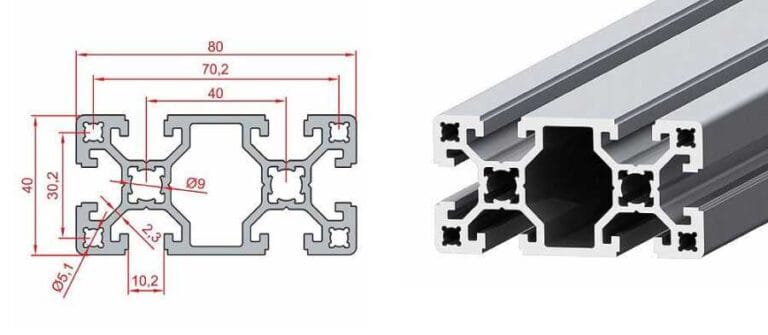
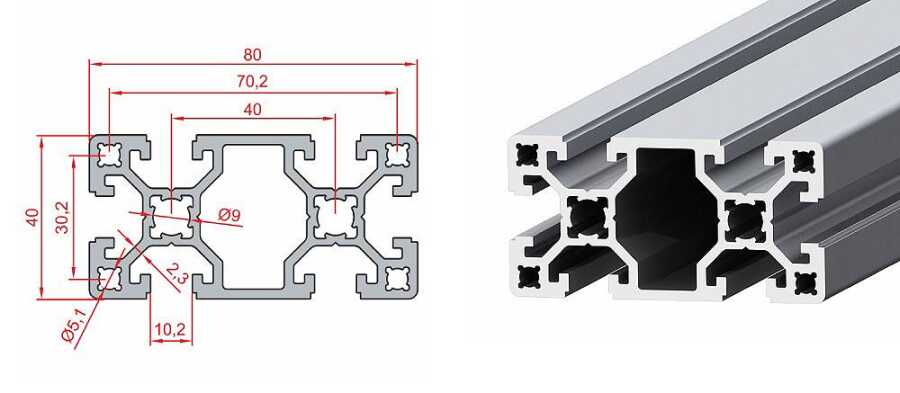
Profile dimensions are typically specified in millimeters, with the most common being square or rectangular cross-sections such as 20x20mm, 30x30mm, 40x40mm, and 40x80mm. Profiles with larger cross-sectional areas (e.g., 40x80mm compared to 40x40mm) generally have a higher moment of inertia and thus better bending and torsional resistance. This is a preferred choice, especially for 3D printers with large print volumes or high-speed moving axes. The support ribs within the profile’s internal structure also play an important role in increasing this rigidity. Anodized coating is commonly used for surface treatment. This coating enhances aluminum’s corrosion resistance, increases surface hardness, and provides an aesthetic appearance. The width of the T-slot channels is also an important factor; standard channels such as 6mm, 8mm, and 10mm ensure compatibility with different fastener series. For example, 20 series profiles typically have 6mm channels, while 30 and 40 series profiles may have 8mm or 10mm channels. This directly impacts the selection of fasteners and accessories to be used.
When selecting a profile for a 3D printer chassis, the following technical data and principles should be considered:
- Rigidity and Stability: This is the most important factor. The printer’s size, axis movement speed, and printing material (e.g., heavy filament spools) determine the profile’s load-bearing capacity and bending resistance. For large and fast printers, larger profiles such as 40x40mm, 40x80mm, or even 80x80mm should be preferred.
- Moment of Inertia (I): A measure of the profile’s bending rigidity. The higher the I value, the less the profile will bend. This value is critical for calculating the maximum expected deflection during the design phase.
- Cross-Sectional Area (A): Affects the profile’s weight and overall strength. A larger cross-sectional area generally means higher strength but also increases weight.
- Material Quality: Typically, 6063-T5 aluminum alloy is used. This alloy offers good mechanical properties, corrosion resistance, and workability.
- Vibration Damping: Aluminum’s natural damping properties reduce the propagation of vibrations to some extent. However, for high-speed movements, additional vibration damping elements or heavier, more rigid profiles may be required.
- Thermal Stability: Especially in printers with enclosed cabins and heated beds, the chassis’s coefficient of thermal expansion is important. Aluminum’s thermal expansion is relatively high, so thermal deformations in long profiles should be considered.
| Parameter | Value/Description |
|---|---|
| Profile Size (Example) | 40x40mm (Standard Series) |
| Material Alloy | EN AW-6063 T5 (Aluminum) |
| Surface Treatment | Anodized Coating, Natural Color |
| Cross-Sectional Area (A) | 5.14 cm² (Approximate) |
| Weight | 1.39 kg/m (Approximate) |
| Moment of Inertia (Ix, Iy) | 7.89 cm⁴ (Approximate, for both axes) |
| T-Slot Channel Width | 8 mm |
| Application Area | Medium and Large-Sized 3D Printer Chassis, CNC Machines, Automation Systems |
Which Sigma Profile Should Be Preferred for a 3D Printer Chassis? Field Considerations
- Correct Selection of Profile Size and Series: In the chassis design of a 3D printer, the size and series of the profile are fundamental decisions for the machine’s overall performance. For small desktop printers (e.g., 200x200x200mm print volume), 20x20mm or 30x30mm profiles may suffice, but for medium and large-sized (400x400x400mm and above) or industrial-grade printers, larger and more rigid profiles such as 40x40mm, 40x80mm, or even 80x80mm are essential. Especially for vertical profiles used in the Z-axis, the weight of the bed and print head, along with thermal expansion effects, must be considered, and profiles with high resistance to torsion should be preferred. Additionally, the ribs and wall thicknesses within the profile’s internal structure also affect rigidity; while “Light” series profiles are more economical and lightweight, “Standard” or “Heavy” series profiles offer higher mechanical strength.
- Quality and Type of Fasteners: The modular structure of sigma profiles reaches its full potential with the right fasteners. The quality of accessories such as corner brackets, T-nuts (hammer nut, drop-in nut), bolts, angle brackets, and end caps directly affects the overall rigidity and longevity of the chassis. Cheap or low-quality fasteners can loosen over time, leading to play in the chassis, vibrations, and consequently, printing errors. Especially in areas with intense dynamic loads, high-strength steel or cast aluminum corner brackets and self-locking nuts should be preferred. The number and placement of connection points are also important; a sufficient number of strategically placed connection points increase the chassis’s stability.
- Vibration Management and Damping: 3D printers are exposed to high-frequency vibrations caused by motors and moving axes. These vibrations can lead to “ghosting” and “ringing” effects, which degrade print quality. Although sigma profiles have natural damping capabilities, additional measures may be necessary in critical applications. Using vibration-damping rubber or special polymer feet on the chassis legs can help keep the chassis away from resonance frequencies. Additionally, optimizing profile cross-sections or filling them with damping materials like sand or epoxy can increase the profile’s mass and damping capacity.
- Assembly Quality and Precision: The cutting precision and assembly accuracy of the profiles forming the chassis directly affect the performance of the final 3D printer. Mounting profiles perpendicularly and parallel to each other is vital for correct axis alignment and smooth movement of the print bed. Precise cuts achieved with laser cutting or CNC machining minimize assembly errors. Tightening all bolts with equal and correct torque using a torque wrench during assembly increases chassis stabilization. It is recommended to check the chassis on a jig or reference plane after assembly to prevent possible deformations.
- Cable Management and Integration: 3D printers contain numerous sensors, motors, and heating elements, and the cables for these components must be routed neatly within the chassis. The channels of sigma profiles offer suitable spaces for cable ducts or cable carriers. Good cable management not only provides an aesthetic appearance but also reduces the risk of malfunction by preventing cables from wearing out, getting pinched, or snagging on moving parts. Cable clips or cover profiles suitable for the profile channels should be used to ensure cables are held securely and neatly.
Which Sigma Profile Should Be Preferred for a 3D Printer Chassis? Common Problems and Solutions
Here are some common problems encountered in sigma profile 3D printer chassis and their practical solutions from an industrial automation perspective:
1. Problem: Insufficient Chassis Rigidity and Vibration Problems (Ghosting, Ringing): Especially in printers with large print volumes or high-speed movements, print quality degradation, layer shifts, or surface ripples are observed due to insufficient chassis rigidity. This usually results from the profile size not meeting the mechanical strength required by the application.
Solution: First, consider switching to profiles with larger cross-sectional areas and higher moments of inertia (e.g., 40×40 or 40×80 instead of 20×20). Additional cross-braces or corner gussets can be added to strengthen the existing chassis. To increase torsional resistance, especially in long profiles, intermediate supports or reinforced fasteners can be used between profiles. Installing high-quality vibration-damping feet on the chassis legs or mounting the chassis on a heavier, damping base also reduces the transmission of vibrations to the print bed. Adding filling materials such as sand or epoxy resin to the internal voids of the profiles to increase mass and damping capacity is also an effective method, although this significantly increases the profile’s weight.
2. Problem: Loosening at Connection Points and Chassis Play: Over time or as a result of continuous dynamic loads, bolts at the connection points of sigma profiles can loosen. This destabilizes the chassis, affects axis alignment, and reduces printing precision.
Solution: During assembly, using quality, self-locking nuts (e.g., with nylon inserts) or spring washers helps prevent loosening. Ensure all connection bolts are tightened to the torque values recommended by the manufacturer; using a torque wrench is critical for this. During periodic maintenance routines, all connection points should be checked and re-tightened if necessary. Especially in areas exposed to high vibration, more robust, cast or machined steel corner brackets should be preferred. Stainless steel bolts and nuts reduce the risk of loosening due to corrosion.
3. Problem: Thermal Deformations and Print Layer Distortions: Especially in 3D printers with enclosed cabins and heated beds, chassis profiles are exposed to temperature changes. Since aluminum’s coefficient of thermal expansion is relatively high, thermal expansion or contraction in long profiles can cause small shifts in axis alignment and distortions in print layers.
Solution: During the design phase, thermal expansion effects should be considered, and profile lengths and connection points should be designed with a certain tolerance. For example, using sliding connections or expansion joints at some connection points can help distribute thermal stress. Calibrating the printer in an environment close to its operating temperature helps minimize thermal effects. Additionally, thermal insulation of the chassis or integration of an environment control system that minimizes temperature fluctuations can be considered. The use of materials with different thermal expansion coefficients should be avoided, or these differences must be carefully considered in the design.
Which Sigma Profile Should Be Preferred for a 3D Printer Chassis? Conclusion and Expert Advice
The correct selection of a sigma profile for a 3D printer chassis is not merely a cost-driven decision but a critical engineering choice with a direct impact on the machine’s overall performance, print quality, longevity, and operational efficiency. Our experience in the industrial automation sector clearly shows that this decision should not be taken lightly. Accurate analyses and selections made at the beginning of a project prevent costly revisions, production losses, and performance degradations that may arise in later stages. While 20x20mm or 30x30mm profiles may suffice for small, hobby-grade printers, for industrial applications, large print volumes, or systems requiring high speed/precision, profiles such as 40x40mm, 40x80mm, or even larger 80x80mm profiles are essential. The high moment of inertia and torsional resistance provided by these profiles ensure chassis stability even under dynamic loads, which directly translates to print quality.
As expert advice, when selecting a profile, attention should be paid not only to the cross-sectional size but also to the profile’s internal structure (ribs), wall thickness, the quality of the aluminum alloy used (typically 6063-T5), the type of surface treatment (anodized coating), and the precision of the T-slot channels. There are different qualities of sigma profiles on the market; profiles sourced from reliable and certified suppliers will offer the expected mechanical properties. The quality and correct selection of fasteners are at least as important as the profile itself. High-quality, self-locking nuts and bolts tightened to appropriate torque values prevent the chassis from loosening over time, ensuring long-term stability. Furthermore, maintaining modularity in the chassis design will offer flexibility for future upgrades or modifications. Elements such as vibration damping strategies, thermal management, and cable routing should also be planned in detail during the early stages of design, as they are vital for the machine’s overall performance and reliability. It should be remembered that the chassis, as the most fundamental and critical component of a 3D printer, is the backbone of the entire system, and the robustness of this backbone is key to the machine’s success.
FAQ
What size sigma profile is best for my 3D printer chassis?
For small, hobby-grade 3D printers with print volumes around 200x200x200mm, 20x20mm or 30x30mm sigma profiles are often sufficient. However, for industrial-grade printers, larger print volumes (400x400x400mm and above), or applications requiring high speed and precision, 40x40mm, 40x80mm, or even 80x80mm profiles are recommended for superior rigidity and stability.
Why is the moment of inertia important when choosing a sigma profile?
The moment of inertia (I) is a critical measure of a profile's bending rigidity. A higher 'I' value indicates that the profile will deflect less under load, which is essential for maintaining print accuracy and preventing issues like ghosting or layer shifts in 3D printing. It's crucial for calculating maximum expected deflection during design.
What are common issues with sigma profile 3D printer chassis and how can they be solved?
Common problems include insufficient rigidity leading to print quality issues, loosening of fasteners causing chassis instability, and thermal deformations affecting axis alignment. Solutions involve using larger, more rigid profiles, high-quality self-locking fasteners tightened to correct torque, and designing with thermal expansion in mind, possibly incorporating expansion joints or thermal insulation.
Are there other technical factors to consider besides the profile's dimensions?
Beyond size, consider the profile's internal structure (ribs), wall thickness, the quality of the aluminum alloy (e.g., 6063-T5), the type of surface treatment (anodized coating for corrosion resistance), and the precision of the T-slot channels. These factors collectively determine the profile's mechanical properties and overall suitability for your industrial application.
How can I ensure the fasteners used with sigma profiles maintain chassis stability?
High-quality, self-locking nuts (like those with nylon inserts) and spring washers are recommended to prevent loosening under dynamic loads. All bolts should be tightened to manufacturer-specified torque values using a torque wrench. For high-vibration areas, consider robust corner brackets made from cast or machined steel.