What is an ER Collet Set? How to Choose Collets for Spindle Motors?
📑 Table of contents (Click to open)
- What is an ER Collet Set? How to Choose Collets for Spindle Motors? Introduction and Technical Analysis
- What is an ER Collet Set? Operating Principle and Technical Data
- Detailed Definition and Structural Features of ER Collet Sets
- How to Choose Collets for Spindle Motors? Criteria and Approaches
- Practical Considerations for ER Collet Sets in Spindle Motors
- Common Problems and Solutions for ER Collet Sets in Spindle Motors
- Conclusion and Expert Advice on ER Collet Sets and Spindle Motor Selection
- FAQ
What is an ER Collet Set? How to Choose Collets for Spindle Motors? Introduction and Technical Analysis
In the world of industrial automation and precision machining, spindle motors are at the heart of manufacturing processes. One of the critical components directly impacting the performance, machining quality, and tool life of these motors are ER collet sets. ER collets, used to securely grip cutting tools with high precision within tool holders, play an indispensable role in a wide range of applications, from CNC router machines to robotic machining cells. Correct collet selection and maintenance not only enhance machining accuracy but also significantly boost overall efficiency by reducing machine downtime. This guide provides industrial automation professionals with a comprehensive roadmap by delving into the technical details, operating principles, and optimal collet selection for spindle motors, offering practical insights for field applications.
What is an ER Collet Set? Operating Principle and Technical Data
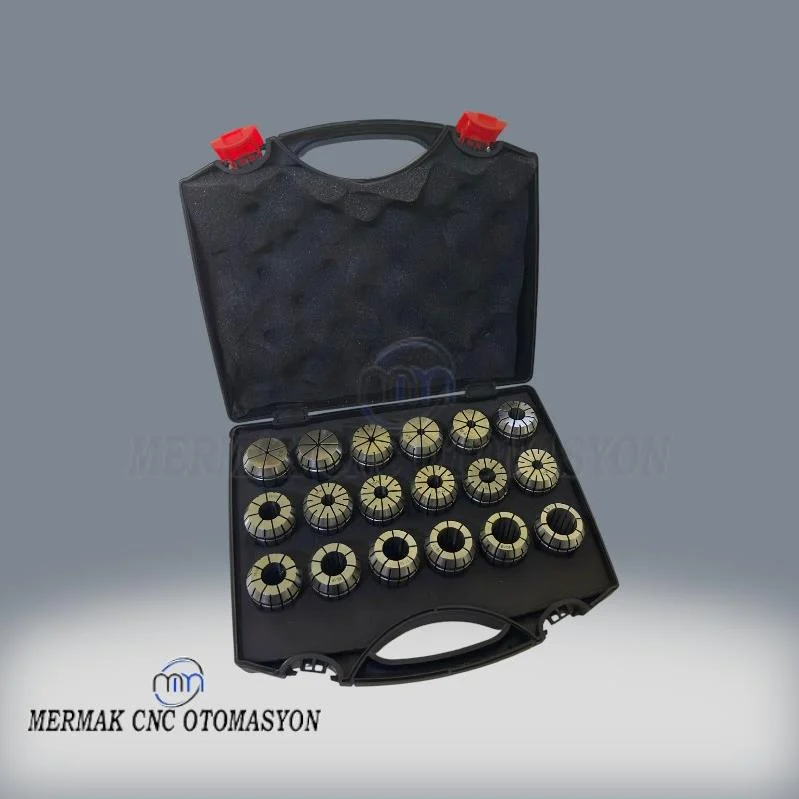
ER collets (Elastic Ring Collets) derive their name from the European standard abbreviation “ER” and are designed with a conical structure to securely grip cutting tools within a clamping nut (ER nut) and a collet chuck. These collets are developed for high-precision machining applications and adhere to standards covering a wide range of tool diameters.
Detailed Definition and Structural Features of ER Collet Sets
ER collets are typically manufactured from high-quality spring steel (e.g., 65Mn or 40CrMnTi) and undergo special heat treatment processes to achieve high hardness (typically HRC 44-48) and elasticity. The outer surface of the collet has a conical shape, and this taper, when force is applied by the clamping nut, seats into the inner conical surface of the tool holder, causing the collet’s inner bore diameter to reduce. The inner part of the collet features a cylindrical bore that grips the cutting tool, precisely ground according to the tool’s diameter. Slots around the collet ensure an even force distribution during clamping, allowing it to hold the tool centrally and firmly.
ER collets are generally referred to by the following size series, with each series covering a specific diameter range:
- ER8: 0.5 mm – 5 mm
- ER11: 0.5 mm – 7 mm
- ER16: 0.5 mm – 10 mm
- ER20: 0.5 mm – 13 mm
- ER25: 0.5 mm – 16 mm
- ER32: 2 mm – 20 mm
- ER40: 3 mm – 26 mm
- ER50: 6 mm – 34 mm
Each collet can typically hold tools approximately 0.5 mm smaller than its nominal diameter. For instance, an ER32-12 collet is designed to hold 12 mm diameter tools but can often securely grip tools between 11.5 mm and 12 mm. However, for the highest precision and clamping force, it is essential to use a collet that precisely matches the tool’s diameter. One of the most critical technical specifications of a collet is its T.I.R. (Total Indicated Runout) value. This value indicates how much the tool inside the collet deviates from its rotational axis and is vital for machining accuracy. Standard ER collets typically have a T.I.R. value of 0.015 mm, while high-precision (HP – High Precision or AA grade) collets offer T.I.R. values of 0.005 mm or lower.
How to Choose Collets for Spindle Motors? Criteria and Approaches
Selecting the correct collet for spindle motors directly impacts the success of the machining operation, tool life, and machining quality. The following factors should be considered during the selection process:
- Tool Diameter and Tolerance: The nominal diameter of the cutting tool (drill, end mill, reamer, etc.) to be used is the first and most fundamental criterion for collet selection. The collet must precisely match the tool’s diameter to ensure maximum clamping force and minimum runout (T.I.R.). For example, for a 10 mm diameter end mill, an ER20-10 or ER32-10 collet should be used. Never use a tool outside the recommended diameter range.
- Machining Type and Forces:
- High-Speed Machining (HSM): Collets and clamping nuts with low T.I.R. values and high dynamic balance should be preferred. Shorter tool extensions and robust collets are important to minimize vibration.
- Heavy Material Removal: Larger collet series (e.g., ER32, ER40) and thick-walled collets offering high clamping force and rigidity should be chosen. The collet’s material and heat treatment play a critical role here.
- Drilling/Reaming: Collets with very low T.I.R. values are mandatory for precise hole diameters.
- Required Machining Precision (T.I.R. Value): The surface finish and dimensional tolerances required by the application determine the T.I.R. class of the collet.
- Standard (G): Typically 0.015 mm T.I.R. tolerance. Suitable for general milling and drilling operations.
- High Precision (HP, AA, UP): Typically 0.005 mm or lower T.I.R. tolerance. Ideal for critical precision applications in sectors such as mold making, medical, and aerospace.
Low T.I.R. values extend tool life, improve surface quality, and reduce the risk of tool breakage.
- Spindle Motor Speed (RPM): For spindle motors operating at high RPMs, the dynamic balance of collets and clamping nuts is vital. An unbalanced collet or nut can cause vibration, runout, and premature wear in spindle bearings at high speeds. For such applications, clamping nuts with balance qualities like G2.5 or G6.3 and high-precision collets should be preferred.
- Cooling System: Some modern collet and clamping nut designs feature channels that allow coolant to pass through the tool (Coolant-Through ER Collets). If through-tool coolant is required, collets and nuts with this feature should be selected.
- Collet Material and Coating: High-quality spring steel directly affects the collet’s lifespan and performance. Some collets may have special coatings (e.g., titanium nitride – TiN) to reduce friction and increase corrosion resistance.
- Brand and Certification: Collets from reputable brands, manufactured and tested in accordance with international standards (DIN 6499), should be preferred. This is important for product quality and consistency.
| Parameter | Value/Description |
|---|---|
| Collet Type | ER (Elastic Ring) Collet – Conforms to DIN 6499 standard |
| Material | High-Quality Spring Steel (e.g., 65Mn, 40CrMnTi) |
| Hardness | HRC 44-48 (Heat Treated) |
| Surface Finish | Precision Ground (TiN coating if required) |
| T.I.R. (Total Indicated Runout) | Standard: < 0.015 mm; High Precision (AA): < 0.005 mm |
| Tool Diameter Range | Specific range for each collet series (e.g., 2mm – 20mm for ER32) |
| Maximum Speed (RPM) | 10,000 – 30,000+ RPM, depending on application and balance quality |
| Cooling System Support | External or through-tool coolant (Coolant-Through collets available) |
Practical Considerations for ER Collet Sets in Spindle Motors
- Correct Mounting Procedure: Proper mounting of the collet and tool directly impacts performance. It is essential to first insert the collet into the clamping nut, then push the tool into the collet, and finally tighten the nut to the recommended torque using a torque wrench. Overtightening shortens the life of the collet and nut, while insufficient tightening can cause the tool to slip. Ensure the spindle motor’s taper and tool holder are clean.
- Cleaning and Maintenance: Collets, clamping nuts, and tool holders should be cleaned before and after each use. Chips, dust, oil residues, or other contaminants can prevent the collet from seating properly, increasing the T.I.R. value and leading to tool slippage. Compressed air and appropriate cleaning fluids should be used for cleaning.
- Wear and Damage Inspection: Collets and nuts should be regularly inspected for signs of wear, cracks, deformation, or corrosion. Deformations, especially in the collet’s slots or inner diameter, reduce tool holding capacity and precision. Worn or damaged collets should be replaced immediately.
- Correct Tool Extension: The gripping depth of the cutting tool within the collet and its extension outside the collet are critical for machining rigidity and vibration. The tool should be pushed as deep as possible into the collet, and the external extension should be minimized. This reduces tool runout and increases machining stability.
- Storage Conditions: Unused collets should be stored in clean, dry, and appropriate storage boxes to prevent corrosion and protect them from damage. It is important to store collets in a way that prevents them from rubbing against each other or other metal parts.
- Spindle Motor Health: Collet selection and maintenance are also related to the overall health of the spindle motor. High T.I.R. or an unbalanced tool holder can put unnecessary stress on spindle bearings, shortening their lifespan. Therefore, the dynamic balance of collets and tool holders is a critical factor in protecting the spindle motor.
Common Problems and Solutions for ER Collet Sets in Spindle Motors
Below are some common problems encountered when using ER collet sets in industrial automation environments and practical solutions:
- Tool Slippage or Ejection:
- Problem: The cutting tool slips out of the collet or is completely ejected during machining.
- Possible Causes: Insufficient clamping torque, using a collet unsuitable for the tool diameter (collet too large), worn collet or clamping nut, accumulation of dirt/chips between the collet and nut, oily or slippery tool.
- Solution: Tighten to the recommended torque using a torque wrench, use a collet that precisely matches the tool diameter, regularly clean the collet and nut, replace worn parts, clean the gripping surface of the tool.
- High T.I.R. (Total Indicated Runout) and Vibration:
- Problem: Tool deviation from its rotational axis, marks on the machined surface, poor surface quality, excessive vibration and noise.
- Possible Causes: Low-quality or worn collet/nut, incorrect mounting of the collet into the tool holder, tool holder not seating properly in the spindle taper (dirty taper), bent tool, unbalanced assembly at high speeds.
- Solution: Take necessary measures to reduce T.I.R. value, clean all components and follow the correct mounting procedure, periodically inspect and clean the spindle taper, check tool accuracy, tighten the nut with a torque wrench.
- Tool Breakage or Premature Wear:
- Problem: Cutting tools break or wear excessively faster than normal.
- Possible Causes: High T.I.R., insufficient cooling, incorrect cutting parameters (speed, feed), collet not holding the tool rigidly enough, excessive tool extension.
- Solution: Take necessary measures to reduce T.I.R. value, use appropriate coolant and application methods, optimize cutting parameters, increase the gripping depth of the tool within the collet and reduce its extension.
- Collet or Nut Sticking/Difficulty Removing:
- Problem: Collet cannot be easily separated from the tool holder or nut from the tool.
- Possible Causes: Overtightening, contamination/corrosion of the collet or nut, deformation.
- Solution: Apply the correct tightening torque using a torque wrench, regular cleaning and light lubrication (if necessary), replace deformed parts.
Conclusion and Expert Advice on ER Collet Sets and Spindle Motor Selection
In the rapidly evolving and competitive environment of industrial automation, efficiency and quality are fundamental elements that must always be prioritized. ER collet sets play a key role in achieving these goals for spindle motor-based machining operations. As detailed in this guide, correct collet selection not only affects the precision at the point where the tool contacts the workpiece but also directly impacts the stability of the entire machining process, tool life, surface quality, and consequently, production costs. From an expert perspective, critical parameters such as tool diameter, machining type, spindle speed, and especially T.I.R. precision must be meticulously evaluated for each application. In applications requiring high-speed and precision machining, opting for high-precision (AA grade) ER collets instead of standard collets offers a performance increase that will ensure a quick return on investment. It should be remembered that even the highest quality collets cannot deliver expected performance without correct mounting, regular cleaning, and periodic wear inspection. Therefore, it is vital for every operator and engineer in the field to master these technical details and strictly adhere to established maintenance protocols. The care given to ER collet sets is an indispensable area of expertise for the overall success of industrial automation facilities, extending spindle motor life, minimizing tool breakages, and achieving consistent machining quality. With correct selection and continuous maintenance, you can guarantee maximum efficiency and reliability in your production processes. Request a quote on WhatsApp today!
FAQ
What is an ER collet set and what is its primary function in industrial CNC operations?
An ER collet set consists of precision clamping tools designed to securely hold cutting tools in spindle motors. They are made from high-quality spring steel and feature a conical design that, when tightened with a clamping nut, grips the tool with high accuracy and rigidity. ER collets come in various sizes (e.g., ER8, ER16, ER32, ER40) to accommodate different tool diameters and are crucial for achieving high-precision machining results in industrial CNC router machines.
What are the key factors to consider when choosing an ER collet for a spindle motor?
When selecting collets for spindle motors, consider the tool diameter, type of machining (e.g., high-speed, heavy material removal), required T.I.R. (Total Indicated Runout) precision, and the spindle motor's RPM. For high-precision applications, opt for AA-grade collets with lower T.I.R. values. Ensure the collet material and coating are suitable for your application, and always choose reputable brands that comply with international standards like DIN 6499.
How can I ensure optimal performance and extend the lifespan of my ER collets?
To maximize the lifespan and performance of ER collets, always follow proper mounting procedures, using a torque wrench for correct tightening. Regularly clean collets, clamping nuts, and tool holders to prevent contamination. Periodically inspect for wear, cracks, or deformation, and replace damaged components promptly. Store collets in a clean, dry environment to prevent corrosion and physical damage. Proper maintenance ensures consistent machining quality and extends the life of both the collet and the spindle motor.
What are common problems encountered with ER collets in industrial settings, and how can they be resolved?
Common issues include tool slippage, high T.I.R. leading to poor surface quality, tool breakage, and collets sticking. Tool slippage is often due to insufficient tightening or using the wrong size collet. High T.I.R. can result from worn collets, improper mounting, or a dirty spindle taper. Tool breakage might stem from high T.I.R., inadequate cooling, or incorrect cutting parameters. Sticking collets are usually caused by overtightening or contamination. Solutions involve correct mounting, regular cleaning, using appropriate collets, and replacing worn parts.
Why is the T.I.R. (Total Indicated Runout) value important for ER collets in precision machining?
T.I.R. (Total Indicated Runout) is a critical measurement that indicates the deviation of a tool from its rotational axis while clamped in the collet. A lower T.I.R. value signifies higher precision, which is crucial for achieving tight tolerances, superior surface finishes, and extended tool life. For standard applications, a T.I.R. of