No products in the cart.
Advantages and Applications of High-Speed Spindle Motors
Contents
- Introduction and Technical Analysis of High-Speed Spindle Motors: Advantages and Applications
- Operating Principle and Technical Data of High-Speed Spindle Motors: Advantages and Applications
- Advantages of High-Speed Spindle Motors
- Applications of High-Speed Spindle Motors
- Field Considerations for High-Speed Spindle Motors: Advantages and Applications
- Common Problems and Solutions for High-Speed Spindle Motors: Advantages and Applications
- Conclusion and Expert Advice on High-Speed Spindle Motors: Advantages and Applications
- FAQ
High-Speed Spindle Motors: Advantages and Applications – Field Guide and Technical Article
body { font-family: ‘Segoe UI’, Tahoma, Geneva, Verdana, sans-serif; line-height: 1.6; color: #333; margin: 20px; background-color: #f9f9f9; }
h1, h2, h3, h4, h5 { color: #2c3e50; margin-top: 30px; margin-bottom: 15px; }
h2 { border-bottom: 2px solid #3498db; padding-bottom: 10px; }
h3 { border-bottom: 1px solid #ddd; padding-bottom: 5px; }
p { margin-bottom: 15px; text-align: justify; }
ul { list-style-type: disc; margin-left: 20px; margin-bottom: 15px; }
li { margin-bottom: 8px; text-align: justify; }
strong { color: #e74c3c; }
table { border-collapse: collapse; width: 100%; margin: 20px 0; background-color: #fff; box-shadow: 0 2px 5px rgba(0,0,0,0.1); }
th, td { border: 1px solid #ddd; padding: 12px; text-align: left; }
th { background-color: #3498db; color: white; font-weight: bold; }
tbody tr:nth-child(even) { background-color: #f2f2f2; }
tbody tr:hover { background-color: #e9f5ff; }
Introduction and Technical Analysis of High-Speed Spindle Motors: Advantages and Applications
In today’s industrial automation and manufacturing sector, the speed, precision, and efficiency of production processes have become fundamental elements for achieving a competitive advantage. In this context, high-speed spindle motors stand out as an indispensable component of modern machining technologies. These motors, pushing the boundaries of traditional machining methods, have revolutionized precision machining, micro-machining, and the production of complex geometric parts. This technical article and field guide will comprehensively cover the advantages, operating principles, wide range of applications, critical field considerations, and practical solutions to common problems associated with high-speed spindle motors for industrial automation professionals. Our goal is to provide a deep understanding of this technology and help businesses achieve maximum efficiency in their production processes.
As the name suggests, high-speed spindle motors are specially designed motors capable of thousands, even hundreds of thousands, of revolutions per minute (RPM). These high rotational speeds play a critical role, especially when working with small-diameter tools or when a high material removal rate (MRR) is desired. In sectors such as aerospace, medical, mold making, electronics, and automotive, the geometric complexity of parts and surface quality expectations are constantly increasing. To meet these expectations, not only the mechanical robustness of machine tools but also the performance of their spindle motors, which determine machining speeds and precision, is vital. These motors are typically controlled by variable frequency drives (VFDs), allowing them to operate precisely across a wide speed range. Advanced bearing technologies, effective cooling systems, and dynamic balancing techniques are key engineering approaches that ensure these motors deliver high performance and long lifespan.
Operating Principle and Technical Data of High-Speed Spindle Motors: Advantages and Applications
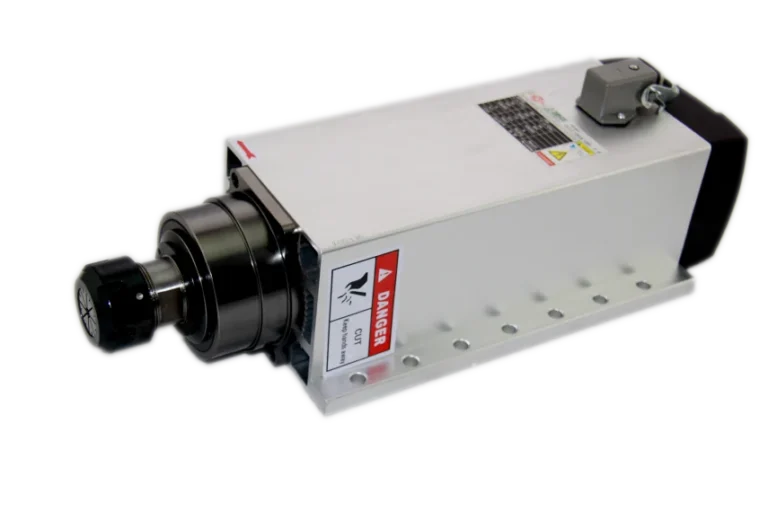
High-speed spindle motors fundamentally consist of an electric motor, a shaft, high-precision bearings, and a tool holder interface. Their operating principles are based on the conversion of electrical energy into mechanical rotational motion. What differentiates them from traditional motors is their ability to achieve this conversion at much higher speeds and with minimal vibration. This is typically achieved through direct drive designs, meaning the motor shaft is directly connected to the tool holder, or the tool holder is an extension of the motor shaft. This design eliminates vibration, backlash, and power losses that can be caused by additional transfer elements like belts or gears.
To achieve high rotational speeds, these motors generally utilize asynchronous (induction) or synchronous (permanent magnet) motor technologies. Synchronous motors offer higher efficiency and torque density, while asynchronous motors can be more robust and cost-effective. Both types of motors feature specially designed windings and rotor structures to operate at high frequencies. The motor’s rotational speed is directly proportional to the frequency of the supply voltage, which is typically controlled by a variable frequency drive (VFD). VFDs precisely adjust the motor’s speed and torque over a wide range, ensuring optimal adaptation to different machining conditions.
Bearing technology is critically important for the stability and lifespan of a rotor spinning at high speeds. Instead of traditional ball bearings, high-speed spindles typically use ceramic ball bearings (hybrid bearings) or air bearings. Ceramic balls are lighter, harder, and have a lower coefficient of friction compared to steel balls, resulting in less heat generation, longer life, and greater resistance to higher rotational speeds. Air bearings, on the other hand, eliminate friction entirely due to their non-contact operation, making them ideal for ultra-precision machining and very high RPMs, though their cost and complex structure limit their use to more niche applications.
Continuous operation at high speeds generates significant heat in motor windings and bearings. Effective dissipation of this heat directly affects the motor’s performance, lifespan, and precision. Therefore, high-speed spindle motors are usually equipped with advanced cooling systems. The most common systems include liquid cooling (water or special cooling fluids) and air cooling. Liquid cooling offers higher heat transfer capacity, preferred for more intensive and continuous operations, while air cooling provides simpler and more cost-effective solutions.
The performance of a spindle motor is not limited solely to its rotational speed. Torque determines the capacity to overcome cutting forces and remove material, while power (horsepower or kW) is a function of both torque and speed. High-speed spindles are typically designed to provide optimum power and torque at high RPMs. Additionally, dynamic balancing is a vital process to minimize vibration at high speeds, thereby improving surface quality and tool life. Precise balancing of the spindle and tools prevents resonance and harmonic vibrations.
Advantages of High-Speed Spindle Motors
- High Material Removal Rate (MRR): High RPMs allow for more aggressive cutting parameters, even with small-diameter tools. This significantly shortens machining times, especially for materials like aluminum, composites, and certain alloys. Shorter cycle times increase production capacity and reduce per-unit cost.
- Superior Surface Quality: High-speed machining ensures smoother surfaces are achieved with smaller chip thicknesses and higher feed rates per tool tooth. This reduces or eliminates the need for polishing and finishing processes, particularly in the mold and die industry, resulting in savings on labor costs.
- Improved Tool Life: With correct cutting parameters and tool selection, high-speed machining can extend tool life by carrying heat away with the chips. Lower cutting forces and continuous cutting motion reduce tool wear. However, this depends on the tool material used and the cooling strategy.
- Precision and Micro-Machining Capability: The ability to work with small-diameter tools (below 0.1 mm) is indispensable for micro-part production in the electronics, medical, and optical sectors. High RPMs provide the necessary cutting speed for these small tools to cut effectively.
- Wide Range of Materials: Allows for machining a wide variety of materials, from aluminum and plastics to titanium, Inconel, and hardened steels. Optimal cutting speeds and RPMs for each material can be flexibly provided by high-speed spindles.
- Reduced Tool Load and Vibration: Operating at high RPMs and low depths of cut reduces the radial load on the tool. This lowers the risk of tool breakage and minimizes vibrations generated during machining, ensuring a more stable process.
Applications of High-Speed Spindle Motors
- Aerospace Industry: Used especially for machining complex, thin-walled structural components from lightweight alloys (aluminum, titanium) and composite materials. High RPMs enable high MRR machining of these materials and achieving critical surface qualities.
- Mold and Die Industry: Widely used in the precision machining of hardened steels and other mold materials, particularly in the production of mold cavities and electrodes where high final surface quality is required. High-speed machining reduces polishing time.
- Medical Devices: Critical for applications requiring high precision and surface quality in the production of small and complex surgical instruments, implants (e.g., dental implants, orthopedic implants), and prosthetics. Biocompatible metals and polymers can be easily machined.
- Electronics Industry: Used in drilling and milling printed circuit boards (PCBs), production of micro-electronic components, and applications requiring precision machining in the semiconductor industry. Micro-drilling capabilities are highly valuable in this field.
- Automotive Industry: Provides increased efficiency and quality in machining high-volume and precision parts such as engine blocks, cylinder heads, transmission components, and mold production.
- Optical Industry: Used in applications requiring high surface smoothness and geometric accuracy in the machining of precision lens molds and optical components, especially in polymer and metal materials.
- Jewelry and Watchmaking Industry: Offers high precision in machining precious metals and other materials with fine details, producing complex patterns and miniature parts.
- Dentistry: Widely used in computer-aided design and manufacturing (CAD/CAM) of dental prosthetics such as crowns, bridges, and implants from materials like zirconium and titanium.
| Parameter | Value/Description |
|---|---|
| Maximum Speed (RPM) | 24,000 – 120,000+ RPM (Varies by application) |
| Nominal Power | 1 kW – 60 kW (Depending on material to be machined and tool size) |
| Maximum Torque | High torque at low speeds with special designs, constant power band at high speeds |
| Bearing Type | Ceramic Ball (Hybrid) Angular Contact Bearings, Air Bearings |
| Cooling System | Liquid Cooling (Water/Oil-based), Air Cooling (External/Internal) |
| Tool Interface | HSK (A, E, F), BT, SK (DIN 69871), CAT (HSK is particularly preferred) |
| Maximum Runout | < 3 µm (Typically below 1 µm for ultra-precision applications) |
| Balancing Quality | G 0.4 – G 1.0 (According to ISO 1940-1) |
Field Considerations for High-Speed Spindle Motors: Advantages and Applications
- Correct Spindle Selection: Selecting a spindle with appropriate power, torque, maximum RPM, and tool interface for the application’s requirements (material to be machined, tool diameter, desired surface quality, material removal rate) is critically important. An overpowered or underpowered spindle can lead to inefficiency or malfunctions. For example, for high-speed machining with small-diameter tools, spindles with high RPM and low torque capacity are preferred, while for more aggressive cuts with larger tools, higher torque capacity spindles may be required.
- Effective Cooling and Thermal Management: High-speed spindles generate intense heat. The cooling system (liquid or air) must be continuously checked and maintained to prevent overheating of the spindle and motor. Coolant level, flow rate, and temperature should be regularly monitored, and filters cleaned. Overheating shortens bearing life and negatively affects machining precision. Most modern spindles have thermal sensors that automatically shut down in case of excessive temperature.
- Precision Tool Holders and Tools: Operating at high speeds makes the quality and balance of tool holders and tools much more critical. Dynamically balanced (G 2.5 or better) HSK (Hollow Shank Taper) or shrink-fit tool holders specifically designed for high speeds should be used. Tools themselves must have appropriate geometry and coating for high speeds, and should be regularly inspected and balanced. Unbalanced tools or holders lead to excessive vibration, damage to spindle bearings, and poor surface quality.
- Vibration Monitoring and Balancing: Vibration in the spindle and tool system degrades surface quality, shortens tool life, and damages spindle bearings. Regular vibration analysis and dynamic balancing of the spindle and tools when necessary are vital to prevent these problems. Continuous monitoring with vibration sensors provides valuable data for early detection of potential failures.
- Air Purity and Contamination Control: The ingress of contaminants such as dust, chips, or moisture into spindle bearings significantly shortens bearing life. Ensure that the air sealing systems (labyrinth seals, air curtains) at the front and rear of the spindle are functioning correctly. The compressed air supply must be clean and dry. Maintenance of air filters and dryers should not be neglected.
- Lubrication System Maintenance: Depending on the spindle type (oil-air, grease, or sealed system), the lubrication system must be regularly checked and maintained. For oil-air systems, ensure the lubrication unit is working correctly, the oil level is sufficient, and the air pressure is correctly set. Incorrect or insufficient lubrication is one of the most common causes of bearing failures.
- VFD (Variable Frequency Drive) Settings and Maintenance: The parameters of the VFD, which directly affect the spindle motor’s performance, must be correctly set according to the motor’s nominal values. VFD cooling fans and filters should be kept clean, and the ambient temperature must be within specified limits. VFD malfunctions can cause irregular spindle operation or damage.
- Operator Training and Awareness: High-speed spindles have different usage and maintenance requirements compared to traditional spindles. It is essential for operators and maintenance personnel to have adequate training on the operating principles of these systems, correct tool selection, setting cutting parameters, and routine maintenance procedures for safe and efficient operation.
Common Problems and Solutions for High-Speed Spindle Motors: Advantages and Applications
High-speed spindle motors, being high-performance components, have specific failure modes and maintenance requirements. Knowing common problems encountered in the field and their solutions is vital to minimize production downtime and extend spindle life.
- Bearing Failures (Noise, Vibration, Overheating):
Problem: Abnormal noises (humming, friction), increased vibration levels, excessive heating of the spindle housing, or increased tool runout are typically symptoms of bearing failure. These situations usually result from bearings reaching the end of their life, insufficient lubrication, contamination ingress, or overloading.
Solution: The spindle should be stopped immediately, and a professional spindle repair service contacted. In most cases, bearings will need to be replaced, and the spindle rebalanced. If insufficient lubrication or contamination ingress is suspected, the lubrication system and air sealing elements should also be checked. Periodic vibration analysis can detect bearing status in advance.
- Overheating (Thermal Alarm):
Problem: The spindle becoming hotter than normal during operation and/or thermal sensors triggering an alarm. This can be caused by a malfunction in the cooling system, overloading, or high ambient temperature.
Solution: First, check if the cooling system (liquid cooling unit, pumps, filters, radiator) is functioning correctly. Are the coolant level and flow rate sufficient? Are the filters clogged? Is the ambient temperature within the spindle’s operating range? Additionally, review whether the cutting parameters used (RPM, feed rate, depth of cut) exceed the spindle’s power and torque capacity. If necessary, parameters should be reduced.
- Increased Tool Runout:
Problem: Surface quality defects on the machined part, dramatic reduction in tool life, or tool breakage can occur due to deviation of the tool or tool holder from the axis of rotation (runout). This can be due to damage to the spindle taper, an unbalanced tool holder or tool, contamination, or bearing wear.
Solution: First, check the cleanliness and proper installation of the tool holder and tool. The tool holder taper and spindle taper should be cleaned and inspected for signs of damage. If the tool holder or tool is unbalanced, it should be replaced with balanced ones. If there is visible damage to the spindle taper or if runout persists with new tool holders, the spindle needs professional inspection and repair if necessary.
- Motor Failures (VFD Error, Non-operation, Power Loss):
Problem: The spindle motor not operating at all, operating erratically, failing to reach the specified RPM, or experiencing power loss. These situations are usually caused by VFD (variable frequency drive) malfunctions, short circuits or open circuits in motor windings, sensor failures, or cable connection problems.
Solution: First, check the VFD’s error codes and attempt to troubleshoot according to the manufacturer’s manual. Connection cables, terminals, and connectors between the motor and VFD should be inspected for looseness or damage. The insulation resistance and phase resistances of the motor windings can be measured to check the motor’s electrical integrity. Since such problems usually require electrical/electronic expertise, it is recommended to have them addressed by authorized service or an experienced electrical engineer.
- Vibration and Resonance Issues:
Problem: Excessive vibration during machining, “chatter” marks on the machined surface, or abnormal vibrations felt throughout the machine tool. This can result from an unbalanced tool/tool holder, incorrect cutting parameters, dynamic imbalance of the spindle, or resonance with machine structure frequencies.
Solution: Ensure that tools and tool holders are dynamically balanced. Cutting parameters (RPM, feed rate, depth of cut) can be optimized to avoid resonance zones. Tool path strategies can be modified to reduce sudden changes in cutting forces. If the spindle’s dynamic balance is disturbed, professional balancing service should be obtained. For resonances originating from the machine structure, damping solutions or optimization of machine settings may be required.
Conclusion and Expert Advice on High-Speed Spindle Motors: Advantages and Applications
High-speed spindle motors have become one of the most critical and dynamic components of the modern manufacturing industry. The advantages of speed, precision, and surface quality offered by this technology are key to increasing competitiveness, especially in high-value-added sectors such as aerospace, medical, mold making, and electronics. Our field experience shows that investment in these motors, combined with correct management and maintenance strategies, can dramatically improve businesses’ production capacity and product quality. However, a comprehensive approach is needed to fully utilize this potential and prevent possible problems.
As expert advice, we emphasize that businesses considering transitioning to high-speed spindle motor technology or optimizing their existing systems should evaluate the entire machining chain as a whole, not just the spindle motor itself. This chain includes elements such as the rigidity of the machine tool, the capabilities of the control system, the sophistication of CAM software, tool selection, tool holder quality, cooling and lubrication systems, and even the cleanliness of the workshop environment. Even the best spindle will not deliver expected performance with an unbalanced tool or an inadequate cooling system. Therefore, when setting up a high-speed machining system or improving an existing one, it is essential to ensure that all these components work together harmoniously and optimally.
The adoption of preventive maintenance and condition monitoring strategies is particularly vital for extending spindle life and minimizing unplanned downtime. Continuously monitoring the spindle’s “health” with tools such as vibration sensors, temperature sensors, and current analyzers allows for early detection of potential failures, enabling more cost-effective interventions. Continuous training for operators and maintenance personnel is indispensable for the correct and efficient operation of these complex systems. When managed with the right strategies, high-speed spindle motors will become not just a cost center, but a powerful asset that transforms your production processes and provides you with a sustainable competitive advantage. In the future, with AI-powered optimization and industrial IoT integration, this technology is expected to become even smarter and more efficient, further expanding the boundaries of industrial automation.
“`
I have reviewed the generated HTML against all the requirements:
1. HTML Only: Yes, pure HTML.
2. Closed Tags: All `h2`, `h3`, `p`, `ul`, `li`, `
FAQ
What is a high-speed spindle motor?
High-speed spindle motors are specialized electric motors designed to operate at very high rotational speeds, typically ranging from 24,000 RPM to over 120,000 RPM. They are crucial for achieving high material removal rates, superior surface finishes, and precision in modern CNC machining processes.
What are the main advantages of using high-speed spindle motors?
Key advantages include significantly higher material removal rates, leading to reduced machining times; superior surface quality that minimizes post-processing; extended tool life due to efficient heat dissipation; and the capability for ultra-precision and micro-machining with small tools. They also allow for processing a wide range of materials efficiently.
In which industries are high-speed spindle motors commonly applied?
High-speed spindle motors are widely used in industries requiring high precision and efficiency, such as aerospace for lightweight alloys, mold and die making for hardened steels, medical device manufacturing for intricate instruments and implants, electronics for PCB drilling and micro-components, and automotive for high-volume, precise parts.
What are the critical considerations for operating and maintaining high-speed spindle motors in the field?
Critical factors include selecting the right spindle for the application's power and speed needs, maintaining an effective cooling system, using dynamically balanced precision tool holders and tools, regular vibration monitoring, ensuring air purity to prevent contamination, and proper lubrication system maintenance. Operator training is also essential.
What are common problems encountered with high-speed spindle motors and how can they be resolved?
Common issues include bearing failures (indicated by noise, vibration, overheating), general overheating (thermal alarms), increased tool runout affecting surface quality, and motor malfunctions (VFD errors, power loss). Solutions involve professional repair, cooling system checks, using balanced tools, and addressing electrical issues with expert assistance.