No products in the cart.
Stepper Motor Vibrations: Is Resonance Always the Cause?

Contents
Stepper motors are crucial for precise motion control in industrial automation. However, vibrations at specific speeds can significantly impact performance. This article delves into the causes of stepper motor vibrations, focusing on resonance and other contributing factors. We’ll explore how inertia, mechanical system characteristics, and driver settings can lead to these issues and provide practical solutions for maintaining optimal performance in your CNC machinery.
Mermak CNC Technical Guide
Practical notes for CNC router, automation and industrial motion systems.
Stepper motors are indispensable actuators in industrial automation, widely used in applications demanding precise positioning and speed control. However, a common issue encountered is vibration or “chatter” at specific operating speeds, which can severely degrade system performance and even lead to production downtime. This article examines whether resonance is the sole cause of stepper motor vibrations, explores the underlying mechanisms, identifies other potential sources of vibration, and outlines comprehensive solutions for industrial automation professionals.
The inherent step-by-step motion of stepper motors, rather than continuous rotation, introduces a potential for vibration. In applications requiring high precision and dynamic performance, these vibrations can shorten the mechanical lifespan of components, reduce positioning accuracy, and generate undesirable noise levels. Therefore, accurately diagnosing the root cause of stepper motor vibration and implementing the most effective countermeasures is vital for efficient and uninterrupted automation processes.
Stepper Motor Operating Principles and Vibration Mechanisms
Stepper motors operate by sequentially energizing stator windings, altering the magnetic field to rotate the rotor in discrete steps. Each pulse command causes the rotor to advance by a specific angle (step angle). While this provides precise positional control, it also generates instantaneous torque fluctuations that can induce vibrations within the system. This effect is particularly noticeable in full-step mode or with low microstepping counts, where the rotor stops and starts with each step, imposing a pulsed load on the system.
The relationship between the rotor’s inertia and the inertia of the connected load significantly influences the motor’s vibrational behavior. The intermittent motion of the rotor, stopping and starting for each step, creates an oscillating movement. These oscillations can stem from the motor’s internal mechanisms (instantaneous magnetic field changes, rotor-stator interaction) and the natural frequencies of the coupled mechanical system. This phenomenon manifests as a noticeable “tremor” or “vibration” when the motor operates at certain speeds.
Resonance Phenomenon and Its Impact on Stepper Motors
Resonance occurs when a system is excited by an external force at a frequency close to its natural frequency, causing a dramatic increase in the amplitude of oscillations. In stepper motors, this happens when the motor’s stepping frequency or stepping rate aligns with a natural vibration frequency of the motor itself or the connected mechanical load. This alignment amplifies normally small vibrations to significant levels, leading to severe performance issues.
Stepper motor resonance is typically observed within specific speed ranges, often at low to medium speeds. In these “critical speed zones,” motor vibrations can become so intense that the motor may lose steps, produce excessive noise, or even cause damage to mechanical components. A critical consequence of resonance is a sudden drop in the motor’s torque output, hindering its ability to move the load or maintain position, which is unacceptable for precision automation tasks.
Symptoms and Identification of Resonance
The presence of resonance in stepper motor systems is indicated by several distinct symptoms. A common sign is an abnormally high and unpleasant noise level when the motor operates at certain speeds, often described as a whining, humming, or ringing sound, significantly different from the motor’s normal operating noise. The intensity of the vibration can often be felt by touching the motor housing or observed in the connected mechanical components.
Another critical indicator of resonance is lost steps. This means the motor fails to achieve the expected position despite receiving the correct number of pulses from the controller. A noticeable decrease in positioning accuracy, failure to reach target positions, or degraded repeatability are strong indicators of severe resonance. Excessive vibrations can also cause a sudden drop in the motor’s nominal torque, leading to difficulties in moving the load or complete stalling. Correctly identifying these symptoms is the first step in determining if resonance is the root cause.
Key Causes of Resonance
Several factors contribute to stepper motor resonance, and understanding them is crucial for developing effective solutions. A primary cause is the mismatch between motor and load inertia. Stepper motors are designed to operate most efficiently within a specific inertia ratio. If the connected load’s inertia is significantly lower or higher than the motor’s inertia, the system’s natural frequency can coincide with the motor’s stepping frequency, triggering resonance. Generally, a load inertia exceeding 10 times the motor inertia increases the risk of resonance.
Another significant factor is the natural frequency of the mechanical system. All mechanical components, including the motor mount, couplings, lead screws, or belt drives, possess their own natural vibration frequencies. When the motor’s operating frequency matches one of these natural frequencies, energy transfer is maximized, leading to intense vibrations. Additionally, driver settings can also trigger resonance. Incorrect microstepping settings or inadequate current adjustments can shift resonance zones to different speeds or amplify their intensity. Finally, structural issues like loose mechanical connections or worn bearings reduce system rigidity, altering natural frequencies and potentially exacerbating vibrations.
Solutions for Mitigating Stepper Motor Vibrations
Addressing stepper motor vibrations requires a multi-faceted approach, focusing on mechanical optimization, electronic control, and proper parameter tuning. One of the most effective methods is inertia matching. Selecting a motor with an inertia ratio appropriate for the load, or using a gearbox to increase motor inertia relative to the load, can significantly dampen vibrations. Gearboxes, particularly planetary gearboxes, can also increase torque and reduce speed, potentially moving operation away from critical resonance zones. For example, a Nema 34 planetary gearbox can be paired with a suitable stepper motor to improve performance in high-load applications.
Mechanical damping is another crucial strategy. Ensuring all mounting points are rigid, using flexible couplings to isolate the motor from the load, and properly balancing rotating components can reduce the transmission of vibrations. Regular maintenance to check for loose fasteners, worn bearings, or misalignment in systems like mechanical components such as lead screws or linear guide rails is essential.
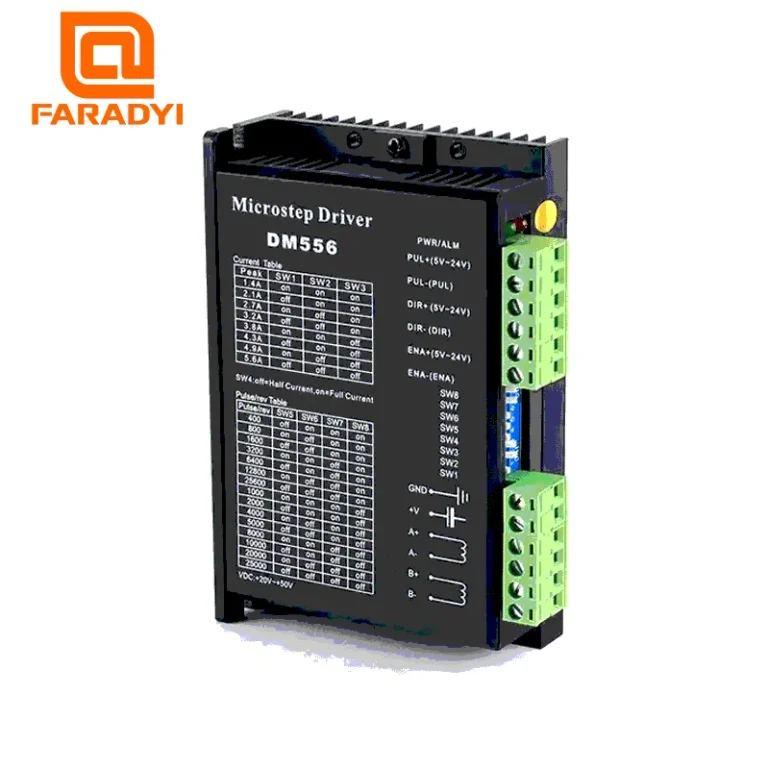
From an electronic standpoint, optimizing driver settings is key. Utilizing higher microstepping resolutions (e.g., 256 or 512 steps per revolution) can smooth out the motor’s motion and push resonance frequencies to higher, often less problematic, speeds. Advanced stepper motor drivers often feature built-in anti-resonance algorithms that actively counteract vibrations. Adjusting the motor current and tuning the PID (Proportional-Integral-Derivative) control parameters within the driver can also help stabilize operation. For instance, ensuring the correct stepper motor driver is selected and configured properly for the specific motor and application is paramount.
Beyond Resonance: Other Vibration Sources
While resonance is a common culprit, other factors can induce vibrations in stepper motor systems. Electrical issues, such as uneven winding currents or noise in the control signals, can cause erratic motor behavior. Ensuring clean power supply and proper shielding of motor and encoder cables is important. Mechanical imbalances in the rotor itself or the connected load, even if not severe enough to cause resonance, can lead to persistent, low-level vibrations. This is particularly relevant in high-speed rotary applications or systems with non-uniform mass distribution.
Bearing wear or damage within the motor or connected components can introduce play and friction, leading to irregular motion and vibration. Similarly, misalignment between the motor shaft and the driven component (e.g., a lead screw or pulley) creates side loads that can cause vibration and premature wear. Addressing these issues involves inspecting and maintaining bearings, ensuring precise alignment of shafts and linear guide rails, and verifying the integrity of the entire motion transmission system.
Conclusion
Stepper motor vibrations, while often attributed to resonance, can stem from a complex interplay of mechanical, electrical, and control factors. Understanding the fundamental principles of stepper motor operation, identifying the specific symptoms, and systematically investigating potential causes—from inertia mismatch and mechanical natural frequencies to driver settings and component wear—is crucial for effective troubleshooting. By implementing appropriate solutions such as inertia matching, mechanical damping, gearbox integration, and optimized driver configurations, industrial users can significantly mitigate vibrations, enhance the reliability and precision of their CNC router machines, and ensure smooth, efficient operation.
If you are experiencing persistent vibration issues with your stepper motor systems or require expert consultation for optimizing your industrial CNC router’s performance, our team is ready to assist. Request a quote on WhatsApp for tailored solutions and high-quality components.