No products in the cart.
Speed vs. Torque in Stepper Motor Systems: Which Takes Priority?
Contents
Choosing between speed and torque in a stepper motor system is crucial for optimal performance. For applications requiring high positioning accuracy, heavy load capacity, and strong holding force, torque is paramount. Conversely, systems that need continuous, rapid movement with lighter loads benefit more from prioritizing speed. Many industrial automation scenarios demand a careful balance between the two.
Mermak CNC Technical Guide
Practical notes for CNC router, automation and industrial motion systems.
Understanding the Speed vs. Torque Dilemma in Stepper Motor Systems
In the realm of industrial automation, stepper motors are indispensable due to their precise positioning and control capabilities. A common challenge when designing or optimizing a stepper motor system is determining whether speed or torque should be the primary performance criterion. The answer hinges on the specific application’s demands, the nature of the load, the desired motion profile, and overall system efficiency.
Stepper motors convert electrical pulses into precise mechanical rotation. Their defining characteristic is their ability to move in fixed, discrete steps, enabling highly accurate positional control. This makes them ideal for robotics, CNC machines, 3D printers, labeling machines, conveyor systems, and medical devices. However, stepper motors have an inherent speed-torque curve: they typically offer high torque at low speeds, but this torque capacity diminishes significantly as speed increases. This fundamental characteristic is key to the selection process.
Key Technical Concepts: Torque and Speed
Stepper motors operate by energizing stator windings in a specific sequence, which attracts the rotor and causes it to rotate by a precise angle. Each electrical pulse corresponds to a step, allowing for exact position control. This precision is directly linked to the motor’s dynamic performance.
Torque is the rotational force a motor can produce. It dictates the motor’s ability to turn a load, accelerate it, or hold it in position. Key torque definitions for stepper motors include:
- Holding Torque: The maximum torque the motor can exert to keep the rotor stationary when energized. This is typically the motor’s highest torque value.
- Pull-in Torque: The maximum torque at which the motor can start from zero speed and accelerate to a certain speed without losing steps, under load.
- Pull-out Torque: The maximum torque the motor can sustain while running at a specific speed without losing steps. This value decreases as speed increases, defining the motor’s speed-torque curve.
Speed is measured in steps per second or revolutions per minute (RPM). Stepper motors excel at providing excellent torque at low to medium speeds. However, at higher speeds, overcoming rotor inertia and keeping pace with rapid magnetic field changes becomes challenging, leading to a noticeable drop in torque. This relationship is clearly illustrated by the motor’s speed-torque curve, a critical performance metric.
Application-Specific Considerations
When selecting a stepper motor, consider these scenarios:
- Torque-Centric Applications:
- Heavy Load Handling: Lifting, moving, or positioning heavy components (e.g., Z-axis on a CNC machine, large robotic arms).
- High Holding Force: Maintaining a load’s position when the motor is stationary (e.g., vertical axis systems, locking mechanisms).
- Low Speed, High Precision: Systems requiring slow, precise movements with very small steps (e.g., microscope stages, focusing mechanisms).
- High Inertia Loads: Accelerating and decelerating loads with significant inertia (e.g., large rotary tables).
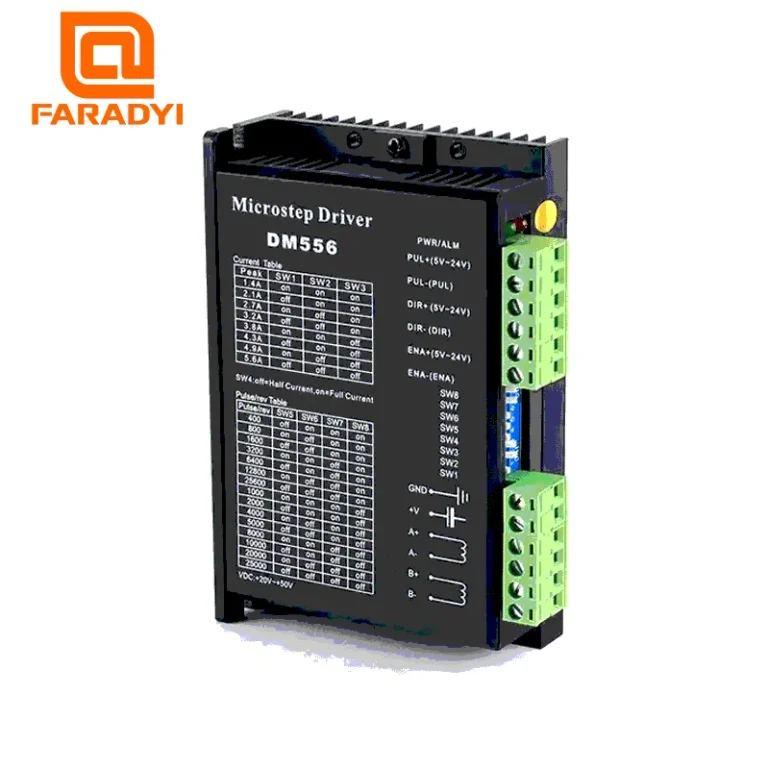
For these applications, larger frame-size stepper motors capable of operating at higher currents are often preferred. Driver selection should focus on current control capabilities to maximize motor torque.
- Speed-Centric Applications:
- Light Loads, Rapid Movement: Situations where high-speed, continuous motion is critical, and the load is relatively light (e.g., labeling machines, small pick-and-place robots, printer head movements).
- Short Cycle Times: Minimizing processing time on a production line through rapid positioning.
- Lower Positional Accuracy Tolerance: Applications where a certain level of accuracy is sufficient, but speed is the primary concern.
In these cases, motors with lower inductance or higher voltage drivers might be beneficial to maintain adequate torque at higher speeds. Micro-stepping techniques can offer smoother motion and reduced vibration but may decrease the motor’s effective speed or torque, requiring careful balancing.
Ultimately, the optimal choice depends on a thorough analysis of your specific industrial CNC router or automation system’s requirements. Balancing the speed-torque characteristics of the stepper motor with the demands of the application ensures efficient and reliable operation.
For more information on selecting the right components for your industrial automation needs, explore our range of stepper motors and drives.