No products in the cart.
What Happens If Power is On During Stepper Motor Connection?

Contents
Connecting a stepper motor while the power is on can cause severe, permanent damage to the motor, its driver, and the control system. This often results in high current surges, burnt coils, and electronic board failures. Always disconnect power before making connections to ensure safety and equipment integrity.
Mermak CNC Technical Guide
Practical notes for CNC router, automation and industrial motion systems.
The Dangers of Connecting a Stepper Motor with Power On
In industrial automation, stepper motors are essential for applications requiring precise positioning and speed control. However, correctly connecting these motors and their electronic drivers is crucial. Attempting to connect a stepper motor to its driver or control system while the power is on poses significant risks to both equipment and personnel. This mistake typically leads to sudden current surges (inrush current), voltage spikes, and short circuits. These events can cause overheating and burning of the motor coils, failure of sensitive electronic components like power transistors (MOSFETs or IGBTs) on the driver board, and damage to the control system’s input/output ports. Such an error not only causes immediate malfunction but also reduces the overall system reliability, leading to unexpected production downtime and substantial financial losses.
Operating Principle and Technical Considerations
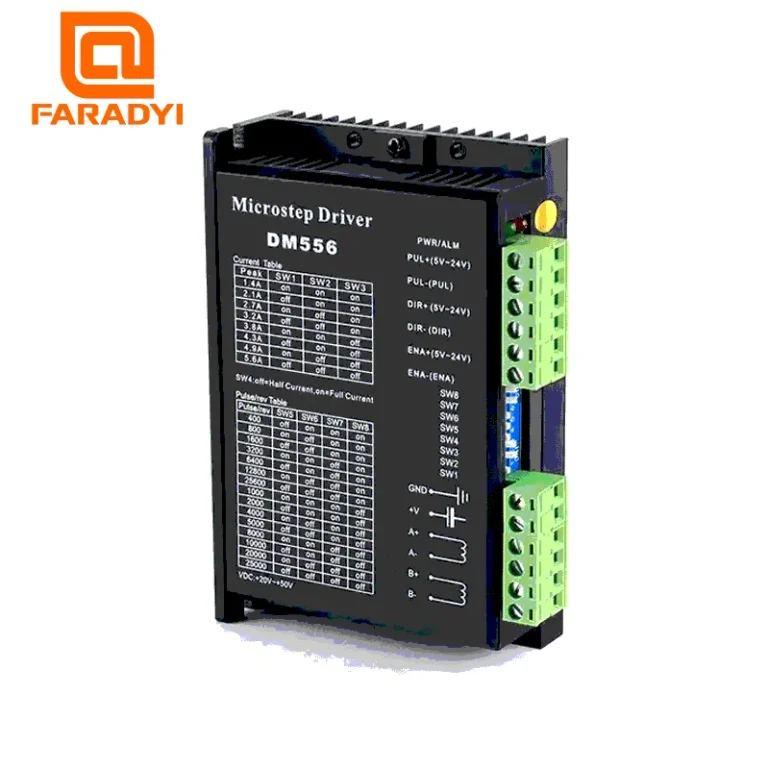
Stepper motors are brushless DC motors that rotate in precise steps by sequentially energizing internal coils. This allows for accurate angular movement with each step. Specialized stepper motor drivers are required to energize these coils in the correct sequence with controlled current, enabling the motor to move at the desired speed and position. Drivers typically use Pulse Width Modulation (PWM) to finely regulate the current supplied to the motor coils. When a connection is made with the power on, the high inductive nature of the motor coils and the driver’s internal capacitors can cause a massive inrush current. This current can exceed the driver’s nominal capacity, pushing the power MOSFETs or IGBTs in the H-bridge structure beyond their thermal limits, leading to permanent damage. If the motor coils are subjected to incorrect voltage or a short circuit during this process, their insulation can fail, rendering the motor unusable. These incidents severely impact system stability and lifespan.
| Parameter | Value/Description |
|---|---|
| Motor Type | Bipolar/Unipolar Stepper Motor (e.g., NEMA 17, NEMA 23) |
| Driver Type | Microstepping Current Controlled Driver |
| Nominal Coil Current | 0.5A – 5A (Varies by motor model) |
| Supply Voltage | 12V – 80V DC (Depending on driver and motor compatibility) |
| Coil Inductance | 1mH – 50mH (Affects inrush current response) |
| Risk of Live Connection | High (Permanent driver and motor damage) |
| Recommended Connection State | All system power must be off (LOTO procedure required) |
| Observed Damages | MOSFET burnout, coil burning, control board failure, fuse blowing |
Field Safety Precautions
- Lockout/Tagout (LOTO) Procedure: Before working on any electrical equipment, ensure the relevant circuit is completely de-energized and locked out to prevent unauthorized re-energization. This is vital for equipment safety and personnel protection against electric shock.
- Adherence to Correct Wiring Diagrams: Each stepper motor and driver combination has a specific wiring diagram. Correctly connecting the motor phases (e.g., A+, A-, B+, B-) to the driver’s terminals is critical. Incorrect wiring can lead to poor motor performance, vibration, or even damage to both the motor and driver due to overcurrent. Always refer to manufacturer datasheets and manuals.
- Proper Cable Gauge and Length: Given the currents involved with stepper motors, using appropriately sized cables is essential. Undersized cables can cause overheating, voltage drops, and energy loss, reducing motor performance and posing a fire hazard. For long cable runs, shielded cables are recommended to maintain signal integrity and reduce electromagnetic interference (EMI), along with proper grounding.
- Secure Connections and Insulation: Ensure all cable connections are tight and secure to prevent issues from vibration or external factors. Loose connections can cause intermittent contact, arcing, and overheating. Use proper insulation materials (e.g., heat shrink tubing) to cover exposed conductors, eliminating short circuit risks and electric shock hazards.
- Grounding and EMI Protection: Proper grounding of drivers, motors, and control systems is crucial for both safety and electromagnetic compatibility (EMC). This helps prevent electrical noise and ensures stable operation.
Always prioritize safety and follow established procedures when working with industrial machinery. For reliable stepper motor solutions and expert advice, explore our range of products and contact us.
Ready to optimize your CNC machine’s performance? Request a quote on WhatsApp today!