No products in the cart.
How to Check Stepper Motor Driver Compatibility

Contents
- The Critical Role of Stepper Motor Driver Compatibility in Industrial Automation
- Understanding Key Stepper Motor Technical Parameters
- Rated Current (Anma Akımı)
- Phase Resistance and Inductance (Faz Direnci ve Endüktansı)
- Rated Voltage (Anma Gerilimi)
- Step Angle and Steps per Revolution (Adım Açısı ve Adım Sayısı)
- Key Features of Stepper Motor Drivers and Compatibility Factors
- Ensuring Compatibility in Industrial Applications
- Frequently Asked Questions
Selecting the correct stepper motor driver is crucial for the performance and reliability of any industrial automation system. This guide explains the essential technical parameters of stepper motors and drivers, focusing on how to ensure compatibility for optimal operation. Learn about rated current, phase resistance, inductance, and voltage, and how they influence driver selection. Proper matching prevents overheating, ensures maximum torque, and achieves desired speed profiles, contributing to efficient and durable machinery.
Mermak CNC Technical Guide
Practical notes for CNC router, automation and industrial motion systems.
The Critical Role of Stepper Motor Driver Compatibility in Industrial Automation
In industrial automation, precise motion control is fundamental to the efficiency, accuracy, and reliability of production processes. Stepper motors, a key component in these systems, translate digital signals into mechanical motion, enabling exact positioning and speed control. However, for a stepper motor to operate at its full potential and ensure a long service life, it must be correctly paired with a compatible driver. An incorrect driver choice can lead to a range of issues, from reduced system performance to permanent hardware damage.
This article provides an in-depth guide on how to check stepper motor driver compatibility, detailing the technical parameters that must be considered and how to prevent potential problems in practical applications. Designed for industrial automation engineers, technicians, and system integrators, this review emphasizes the importance of selecting the right components to ensure systems operate with optimal efficiency. Compatibility ensures not just motor rotation, but the ability to meet specified torque, speed, and precision requirements.
Understanding Key Stepper Motor Technical Parameters
To accurately assess stepper motor driver compatibility, a thorough understanding of the motor’s fundamental technical parameters is essential. These parameters define the motor’s electrical and mechanical behavior and dictate the power and control capabilities required from the driver. Each parameter plays a critical role in driver selection; overlooking any can result in performance degradation or system failure. Therefore, carefully examining each value on the motor’s datasheet is paramount.
Parameters such as rated current, phase resistance, inductance, step angle, and rated voltage are directly related to the driver’s ability to supply power and control the motor. Matching these parameters correctly prevents motor overheating, ensures maximum torque production, and enables the motor to achieve desired speed profiles. Additionally, the motor’s physical dimensions and mounting interface are important considerations for mechanical integration.
Rated Current (Anma Akımı)
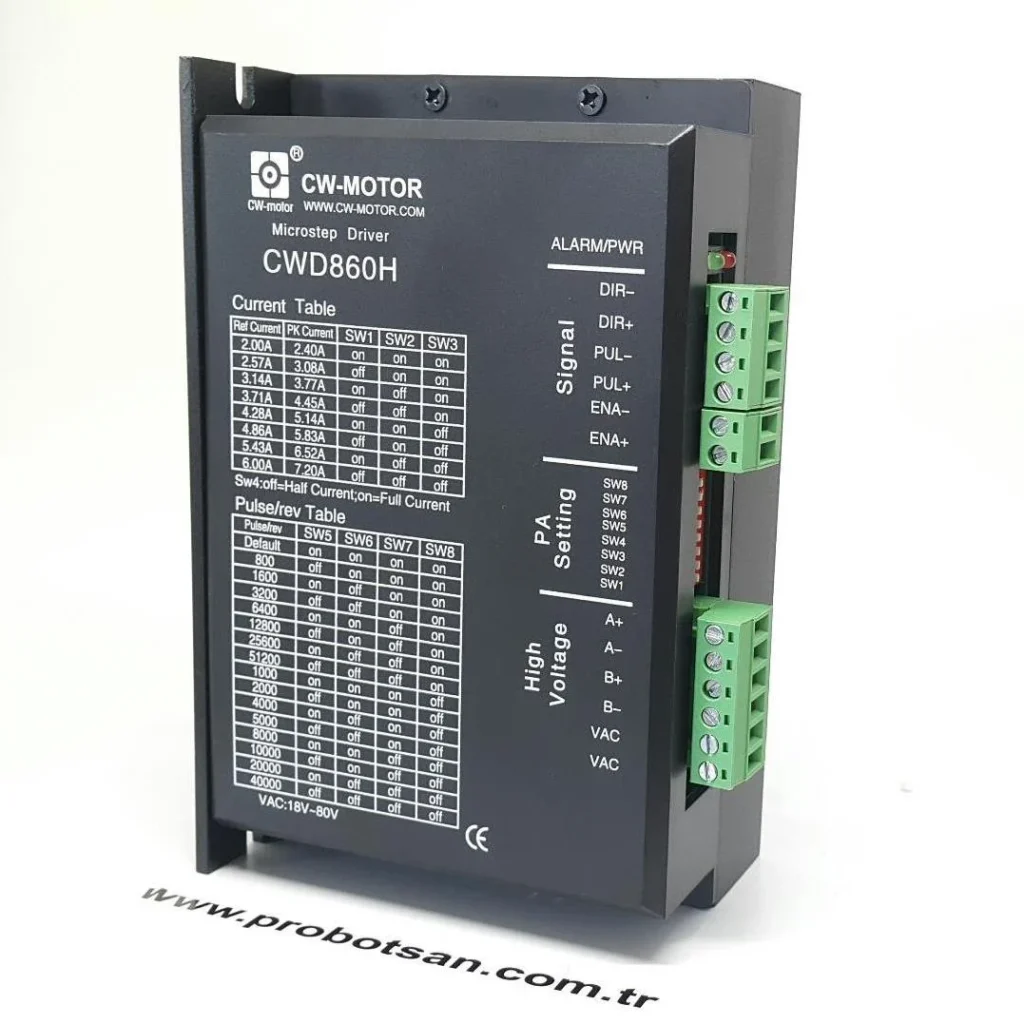
Each stepper motor has a specific rated current per phase, indicating the maximum current that can be safely passed through its coils without overheating. The driver’s output current capability should match or slightly exceed the motor’s rated current. If the driver provides too little current, the motor will not produce sufficient torque, leading to performance loss. Conversely, excessive current can cause the motor to overheat, damaging its coils and shortening its lifespan, or causing immediate failure.

Phase Resistance and Inductance (Faz Direnci ve Endüktansı)
Phase resistance and inductance determine the motor’s electrical impedance and directly affect the driver’s ability to control the motor at high speeds. Motors with low inductance generally perform better at high speeds due to faster current rise and fall times. In contrast, motors with higher inductance tend to provide higher torque at lower speeds. The driver’s current control algorithm must be compatible with these inductance values to optimize the motor’s dynamic response. Driving high-inductance motors at high speeds often requires a higher supply voltage.

Rated Voltage (Anma Gerilimi)
While stepper motors have a rated voltage, this typically refers to the voltage drop across the coils when drawing maximum current. Stepper motor drivers, however, are often powered by significantly higher voltages. The driver’s supply voltage is critical for maintaining motor torque at high speeds. A higher supply voltage allows current to rise faster in the motor coils, counteracting the effect of back EMF and preventing torque drop-off at high speeds. It is essential not to exceed the driver’s maximum input voltage rating, as this can cause permanent damage.

Step Angle and Steps per Revolution (Adım Açısı ve Adım Sayısı)
The step angle defines the angular distance the motor rotates with each full step (e.g., 1.8 degrees). The steps per revolution indicate the total number of steps required for one full rotation (e.g., 200 steps/revolution). The driver’s microstepping capability allows it to divide these basic steps into smaller increments, resulting in smoother motion and higher resolution. The required precision and smoothness for an application determine the microstepping rate the driver must support. For instance, 1/16 microstepping with a 1.8-degree motor allows for steps of 0.1125 degrees.
Key Features of Stepper Motor Drivers and Compatibility Factors
Stepper motor drivers are complex electronic devices that directly influence motor performance and play a central role in the overall operation of the system. Ensuring compatibility involves understanding the driver’s capabilities and how they align with the motor’s specifications. Key driver features to consider include its voltage and current output ranges, microstepping capabilities, and control interface. For instance, a driver must be able to supply the necessary current to the motor without exceeding its limits, and its voltage output should be suitable for achieving the desired speed and torque characteristics. The choice of driver also impacts the smoothness of motion, with higher microstepping resolutions generally providing more fluid movement, which is crucial for applications like CNC routing where precision is paramount. When selecting a driver, it’s also important to consider its thermal management capabilities and protection features to ensure reliable operation in demanding industrial environments. A mismatch in any of these areas can lead to suboptimal performance, increased wear, or system failure. Always consult the datasheets for both the motor and the driver to verify compatibility before integration.
Ensuring Compatibility in Industrial Applications
Proper stepper motor and driver selection is vital for the reliable operation of industrial machinery, including CNC router machines. When integrating these components, consider the following:
- Voltage and Current Matching: Ensure the driver’s output voltage and current ratings are appropriate for the stepper motor’s specifications. The driver’s supply voltage should be higher than the motor’s rated voltage to achieve good high-speed performance.
- Microstepping: Select a driver that supports the microstepping resolution required for your application’s precision needs. Higher microstepping counts lead to smoother motion and reduced resonance.
- Control Signals: Verify that the driver’s control interface (e.g., step/direction, CW/CCW) is compatible with your motion controller or PLC.
- Environmental Factors: Consider the operating environment. Drivers should be rated for the ambient temperature and potential electrical noise present in the industrial setting.
By carefully evaluating these factors, you can select a stepper motor and driver combination that ensures optimal performance, longevity, and reliability for your industrial CNC router or other automated systems. For assistance in selecting the right components for your specific needs, our experts are ready to help.
Frequently Asked Questions
What happens if a stepper motor driver is not compatible with the motor?
If a stepper motor driver is not compatible, it can lead to several issues. The motor might not receive enough current, resulting in insufficient torque and poor performance. Conversely, too much current can cause the motor to overheat, damaging the windings and significantly reducing its lifespan. Incompatibility can also manifest as erratic movement, loss of steps, or complete failure of either the motor or the driver. Ensuring correct voltage, current, and impedance matching is crucial.
Can I use a higher voltage driver with a stepper motor?
Yes, it is often beneficial to use a driver with a higher supply voltage than the stepper motor’s rated voltage. This allows the driver to overcome the motor’s back EMF at higher speeds, maintaining torque and enabling faster operation. However, it is critical that the driver’s maximum input voltage rating is not exceeded, and that the driver itself is capable of current limiting to protect the motor.
How does motor inductance affect driver selection?
Motor inductance influences how quickly current can change in the motor windings. Motors with lower inductance allow for faster current changes, which is beneficial for high-speed operation. Drivers must be designed to handle the motor’s inductance. If a driver is used with a motor that has significantly higher inductance than it’s designed for, the current rise time will be slower, limiting the motor’s speed and torque output, especially at higher RPMs.