No products in the cart.
Spindle Motor Overheating and the Importance of Cooling Systems in CNC Machines

Contents
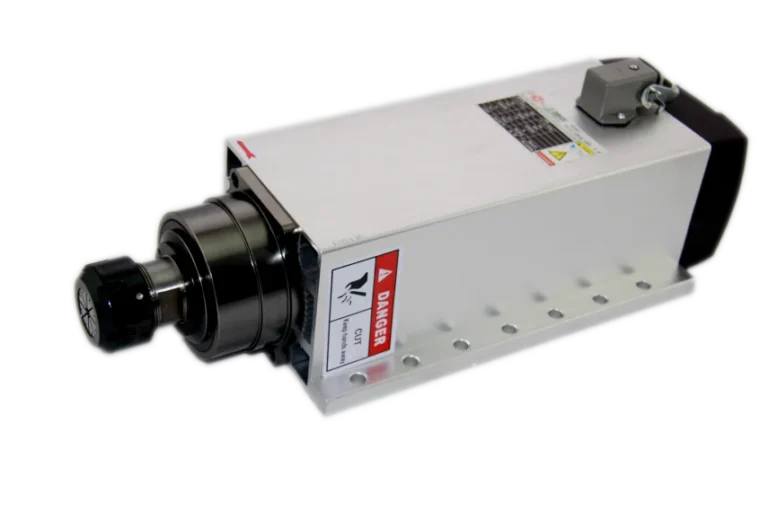
- Introduction and Technical Analysis At the heart of industrial automation, high-performance machines such as machining centers, CNC router machines, and robotic systems rely on spindle motors for critical operations. These motors enable high-speed cutting, drilling, and grinding across a wide range of applications, including metalworking, woodworking, mold making, glass processing, and even precise electronic component manufacturing. The precision, speed, and torque of spindle motors directly impact the final product quality and production efficiency. However, an unavoidable consequence of this high performance is heat generation, which stands as one of the most significant factors threatening the lifespan, performance, and operational reliability of spindle motors. Excessive overheating can lead to insulation breakdown in motor windings, wear in bearings, rotor expansion, and consequently, a loss of machining precision. This can result in unexpected failures, production downtime, high maintenance costs, and even irreversible motor damage. Therefore, the thermal management of spindle motors and the importance of an effective cooling system are undeniable engineering imperatives in the industrial automation sector. This guide will provide a technical analysis of spindle motor overheating problems, detail the operating principles of cooling systems, and offer practical solutions for field experts. Operating Principle and Technical Data
- Field Considerations
- Common Problems and Solutions
- Expert Advice
- FAQ
Introduction and Technical Analysis
At the heart of industrial automation, high-performance machines such as machining centers, CNC router machines, and robotic systems rely on spindle motors for critical operations. These motors enable high-speed cutting, drilling, and grinding across a wide range of applications, including metalworking, woodworking, mold making, glass processing, and even precise electronic component manufacturing. The precision, speed, and torque of spindle motors directly impact the final product quality and production efficiency. However, an unavoidable consequence of this high performance is heat generation, which stands as one of the most significant factors threatening the lifespan, performance, and operational reliability of spindle motors. Excessive overheating can lead to insulation breakdown in motor windings, wear in bearings, rotor expansion, and consequently, a loss of machining precision. This can result in unexpected failures, production downtime, high maintenance costs, and even irreversible motor damage. Therefore, the thermal management of spindle motors and the importance of an effective cooling system are undeniable engineering imperatives in the industrial automation sector. This guide will provide a technical analysis of spindle motor overheating problems, detail the operating principles of cooling systems, and offer practical solutions for field experts.
Operating Principle and Technical Data
Spindle motors are specialized electric motors designed to operate at high RPMs and under continuous load. They typically feature an asynchronous or synchronous motor structure, transmitting power to the machining tool either through direct drive or a belt-pulley mechanism. Heat generation is a natural consequence of the motor’s operating principle and primarily originates from three main sources:
- Copper Losses (Joule Losses): These are resistance losses (I²R) caused by the current flowing through the motor windings. As the motor draws more current under load, these losses increase significantly.
- Iron Losses (Core Losses): These are hysteresis and eddy current losses caused by magnetic flux changes in the motor’s stator and rotor cores. They increase with higher frequency and magnetic field intensity.
- Mechanical Losses: These losses arise from friction in bearings, air friction (aerodynamic losses), and friction in shaft seals. Aerodynamic losses become particularly significant at high RPMs.
These losses are dissipated as heat rather than being converted into useful energy, leading to an increase in the motor’s internal temperature. The optimal operating temperature for spindle motors is generally in the range of 40-60°C. Exceeding this range negatively impacts the motor’s performance curve and shortens its lifespan. Therefore, various cooling systems are employed to efficiently dissipate the generated heat from the motor:
- Air Cooling: This is the simplest method. Air circulation is provided by fins on the motor housing or an external fan. It is typically used for low-power or intermittently operating spindle motors. It may be insufficient for high-power and precision applications because it is dependent on ambient temperature, and precise temperature control is difficult.
- Liquid Cooling (Water or Oil): This is the most common and effective method for high-performance spindle motors. A specialized cooling fluid (usually a water-glycol mixture or special cooling oils) circulates around the motor housing or stator windings, absorbing heat. This fluid is then cooled by an external chiller unit and recirculated back to the motor.
- Chiller Unit: A closed-loop cooling system consisting of a compressor, condenser, expansion valve, and evaporator. It can precisely control the temperature of the cooling fluid, ensuring the motor remains at its optimal operating temperature. Chiller capacity (kW or BTU/hr) must be correctly selected based on the maximum heat load generated by the motor.
- Cooling Fluid: Deionized water with corrosion inhibitors, antifreeze, and biocide additives, or special cooling oils, are used. The pH value, conductivity, and cleanliness of the fluid are critically important.
- Circulation Pump: Continuously circulates the cooling fluid between the motor and the chiller.
- Flow Sensors and Thermostats: Monitor the flow rate and temperature of the cooling fluid to ensure the system is operating correctly.
- Oil Spray or Oil Mist Cooling: Used particularly in high-speed bearings to reduce friction and simultaneously provide cooling. Oil is sprayed or delivered as a fine mist to the bearings, then collected, cooled, and recirculated.
An effective cooling system maintains the motor’s nominal operating temperature, preventing winding insulation degradation, extending bearing life, minimizing precision losses due to thermal expansion, and increasing overall system reliability. This translates to a longer motor lifespan, reduced maintenance, and higher production quality.
| Parameter | Value/Description |
|---|---|
| Nominal Motor Power | 5 kW – 30 kW (varies by application) |
| Maximum Speed (RPM) | 18,000 – 60,000 RPM (higher for high-speed models) |
| Cooling Type | Liquid Cooled (Water-Glycol) |
| Optimal Operating Temperature | 35°C – 45°C (Must be checked against manufacturer datasheet.) |
| Cooling Water Flow Rate | 5 – 20 L/min (varies by motor power) |
| Chiller Cooling Capacity | Determined by the motor’s heat load (e.g., 1.5 kW – 10 kW) |
| Cooling Water pH Value | 6.5 – 8.0 (Must be checked against manufacturer datasheet.) |
| Bearing Type | Ceramic Ball Angular Contact Bearings (For high speed and precision) |

Field Considerations
- Correct Cooling System Selection and Sizing: The cooling system (especially the chiller unit) must be correctly sized, considering the spindle motor’s nominal power, maximum RPM, duty cycle (continuous/intermittent), and ambient conditions. An undersized chiller cannot maintain the motor at its optimal temperature, while an oversized system can lead to unnecessary energy consumption. The heat dissipation values in the motor’s datasheet play a key role in chiller capacity selection. Always adhere to manufacturer recommendations and conduct thermal analyses when necessary.
- Cooling Fluid Quality and Maintenance: The quality of the cooling fluid is vital for the system’s lifespan and efficiency. The water used should be deionized or distilled and contain antifreeze, corrosion inhibitors, and biocide additives to prevent corrosion, scale formation, and biological contamination. The pH value and conductivity of the cooling fluid should be regularly checked and changed if they fall outside the recommended ranges. Clogged filters or contaminated fluid can reduce flow rate, decreasing cooling efficiency and potentially causing motor overheating. Therefore, cooling fluid filters should be periodically inspected, cleaned, or replaced.
- Periodic Maintenance and Monitoring: All components of the cooling system (chiller, pump, fan, hoses, sensors) should be included in a regular maintenance schedule. Chiller condenser and evaporator coils must be kept free of dust and dirt to maintain heat transfer efficiency. Pump performance should be checked, and hoses inspected for cracks or leaks. Flow sensors and temperature sensors should be regularly calibrated to ensure accurate readings. In modern systems, integrated temperature and flow monitoring systems provide early detection of potential issues, enabling preventive maintenance. Abnormal vibrations or noises can be early indicators of bearing problems or pump failures.

Common Problems and Solutions
Problems encountered in spindle motor cooling systems typically lead to motor overheating and performance degradation. Here are common issues and their solution approaches:
- Insufficient Cooling Flow:
- Problem: Cooling fluid flow rate is low or completely cut off. This could be due to blockages in the motor’s cooling channels or chiller filter, pump failure, or kinks/blockages in hoses.
- Solution: Check flow sensor data. Clean or replace the chiller filter. Check the cooling fluid level and top it up if necessary. Ensure the circulation pump is operating and providing sufficient pressure; replace the pump motor or pump if needed. Inspect hoses and connections for blockages or kinks.
- Degradation of Cooling Fluid Quality:
- Problem: Cooling fluid is dirty, cloudy, contains algae, or shows signs of corrosion. The pH value or conductivity level is outside normal ranges. This reduces cooling efficiency and increases the risk of corrosion/blockage in the system.
- Solution: Completely drain the cooling fluid, flush the system with clean water and an appropriate cleaner. Refill with new, high-quality cooling fluid recommended by the manufacturer. Monitor pH and conductivity values through regular fluid analysis. Regularly check and replenish corrosion inhibitors and biocide additives.
- Chiller Unit Malfunctions:
- Problem: The chiller cannot provide the desired cooling capacity. The compressor is not running, there is a refrigerant leak, condenser or evaporator coils are dirty, the chiller fan is faulty, or the thermostat is giving incorrect readings.
- Solution: Check the chiller unit’s power supply. Clean condenser coils with compressed air or a brush. Ensure the fan is operating correctly. Have the refrigerant level checked and, if there’s a leak, have it repaired and refilled (by authorized service personnel). If the compressor or other main components are faulty, call authorized service. Check the thermostat’s calibration.
- Thermal Sensor Malfunction or Incorrect Reading:
- Problem: Spindle motor or cooling fluid temperature sensors are giving incorrect readings, causing the cooling system to either not cool the motor adequately or run unnecessarily.
- Solution: Check sensor connections. Verify calibration by comparing sensor readings with a reference thermometer. Replace faulty sensors. Ensure control system parameters are correctly set.
- Excessive Heat Generation Within the Motor Itself:
- Problem: The motor overheats despite the cooling system operating correctly. This can be caused by motor overload, worn or damaged bearings, partial short circuits in stator windings, or incorrect motor parameter settings.
- Solution: Check the motor’s current draw and load condition. Avoid overloading. Listen to the bearings for noise and vibration; bearing replacement may be necessary if abnormal sounds are present. Measure the insulation resistance of the motor windings. Check drive parameters (e.g., PWM frequency, acceleration/deceleration ramps) to ensure the motor is operating at optimum efficiency.
Expert Advice
Spindle motor overheating problems pose an undeniable threat in the world of industrial automation, where precision and efficiency are paramount. As detailed in this guide, an effective cooling system not only prevents motor failure but also directly impacts machining quality, tool life, and overall production efficiency. For field experts and technicians, understanding the thermal dynamics of spindle motors and meticulously approaching the maintenance of cooling systems is critical for operational continuity and cost-effectiveness. Spindle motors operating at high RPMs are sensitive to even the slightest temperature changes; therefore, every detail, from cooling fluid quality to chiller capacity, sensor calibration to periodic maintenance routines, must be carefully managed. It is crucial to remember that preventive maintenance is far more economical than reactive troubleshooting and provides significant long-term advantages for businesses. Always adhering to manufacturer specifications, using high-quality spare parts and cooling fluids, keeping technical personnel’s knowledge up-to-date with regular training, and investing in modern monitoring systems will extend the life of your spindle motors and guarantee the uninterrupted operation of your production line. With the data-driven approaches brought by Industry 4.0, continuous monitoring and analysis of cooling system data will enable proactive detection of potential issues, serving as the key to maximizing reliability and efficiency in your production processes.
FAQ
What are the primary causes of heat generation in spindle motors?
Spindle motors generate heat due to copper losses (I²R), iron losses (hysteresis and eddy currents), and mechanical losses (friction in bearings and air resistance). This heat, if not properly dissipated, can lead to overheating.
What are the common types of cooling systems used for industrial spindle motors?
The main types of cooling systems are air cooling and liquid cooling (water or oil). Liquid cooling, often using a chiller unit, is preferred for high-performance industrial CNC router machines due to its superior temperature control and efficiency.
How can I prevent my CNC spindle motor from overheating?
To prevent overheating, ensure the cooling system is correctly sized for the motor's load, maintain high-quality cooling fluid (deionized water with additives), perform regular maintenance on the chiller and pump, and monitor sensor readings for any anomalies. Avoid motor overloading.
What are the warning signs of an overheating spindle motor?
Signs include a hot motor housing, reduced machining precision, unusual noises from the motor or bearings, and alarms from the CNC control system indicating high temperature. Monitoring integrated temperature sensors is also crucial.
What maintenance is required for a liquid cooling system for a spindle motor?
Regularly check and clean chiller filters, inspect hoses for kinks or leaks, verify pump operation, and ensure cooling fluid levels and quality (pH, conductivity) are within manufacturer specifications. Calibrate temperature and flow sensors periodically.