No products in the cart.
Sigma Profile T-Slot Channel Sizes (Channel 6, Channel 8, Channel 10): What Do They Mean?
Contents
- Sigma Profile T-Slot Channel Sizes (Channel 6, Channel 8, Channel 10): Introduction and Technical Analysis
- Sigma Profile T-Slot Channel Sizes (Channel 6, Channel 8, Channel 10): Operating Principle and Technical Data
- Sigma Profile T-Slot Channel Sizes (Channel 6, Channel 8, Channel 10): Field Considerations
- Sigma Profile T-Slot Channel Sizes (Channel 6, Channel 8, Channel 10): Common Problems and Solutions
- Sigma Profile T-Slot Channel Sizes (Channel 6, Channel 8, Channel 10): Conclusion and Expert Advice
- FAQ
Sigma Profile T-Slot Channel Sizes (Channel 6, Channel 8, Channel 10): Introduction and Technical Analysis
As indispensable building blocks of industrial automation and modern manufacturing facilities, aluminum sigma profiles are used in a wide range of applications, from machine frames to conveyor systems, workbenches to safety barriers. One of the most critical parameters in selecting these profiles is the “channel size,” typically expressed as Channel 6, Channel 8, or Channel 10. These terms specify the width of the profile’s T-slot channel in millimeters and directly influence the type of fasteners to be used, the system’s load-bearing capacity, and overall mechanical compatibility. For industrial automation specialists, a deep understanding of what these channel sizes mean, in which scenarios each channel should be preferred, and their technical details is vital for project success and efficiency.
This technical article and field guide will explain the engineering logic behind sigma profile channel sizes, detailing the advantages, disadvantages, and application areas of different channel types to provide a comprehensive roadmap for industry professionals. Correct profile selection not only saves costs and time but also guarantees the safety, durability, and future modification flexibility of the installed systems. Therefore, by addressing Channel 6, Channel 8, and Channel 10 concepts in all their aspects, we aim to help you make informed decisions in your industrial automation projects.
Sigma Profile T-Slot Channel Sizes (Channel 6, Channel 8, Channel 10): Operating Principle and Technical Data
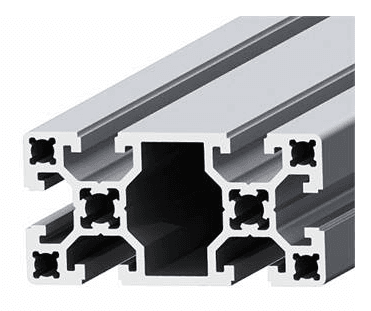
Sigma profiles are modular and lightweight structural elements, typically made from aluminum alloys, produced by the extrusion method. Their main feature is the T-shaped channels on their surfaces. These channels allow for easy mounting of other profiles, fasteners, panels, or accessories via special nuts (T-nuts) and bolts. The term “channel size” refers to the width of this T-slot channel at its narrowest point, expressed in millimeters. This width directly determines the system’s overall mechanical properties and the compatibility of the fasteners to be used. The most common channel sizes used in industrial applications are 6 mm, 8 mm, and 10 mm.
Channel 6 Profiles: Typically found in smaller cross-section profiles such as 20×20 mm and 20×40 mm. These profiles are generally preferred for applications like light-load structures, small automation systems, electronic enclosures, light machine frames, or laboratory equipment. Channel 6 profiles offer more compact designs and occupy less space. The T-nuts and fasteners used are also smaller, which may sometimes require more precise work during assembly. They are ideal for projects where high strength or heavy load-bearing is not required, but modularity and aesthetics are paramount. They provide an economical solution for environments with low vibration and minimal dynamic loads. Their moment of inertia values are generally lower, indicating less bending and torsional strength compared to other channel types.
Channel 8 Profiles: This is the most common and versatile channel size used in the industrial automation sector. It is typically found in medium to large cross-section profiles such as 30×30 mm, 40×40 mm, and 40×80 mm. Channel 8 offers an excellent balance for both light and medium-weight applications. It is preferred in many areas, including machine frames, conveyor systems, workbenches, safety cages, robot cells, and automation equipment. A vast number of Channel 8 compatible fasteners, accessories, and modules are available on the market, providing designers and engineers with great flexibility. Channel 8 T-nuts have a wider contact surface, allowing for higher tightening torques and thus more robust connections. This increases the overall stability and vibration resistance of the system. Moment of inertia values are higher than Channel 6, meaning better bending and torsional strength.
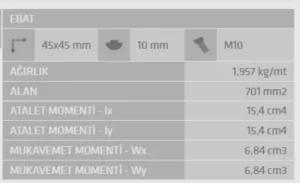
Channel 10 Profiles: Generally used in larger and heavy-duty profiles such as 45×45 mm, 45×90 mm, and 90×90 mm. These profiles are designed for demanding and heavy industrial applications requiring high load-bearing capacity, such as heavy machine frames, large conveyor systems, test stands, vibrating platforms, and industrial furnaces. Channel 10 T-nuts and fasteners offer the highest tightening torques and the strongest connections. This ensures the system can withstand extreme loads, dynamic stresses, and high vibration levels. The moment of inertia values for Channel 10 profiles are significantly higher than other channel types, providing exceptional bending and torsional strength. They typically have thicker wall thicknesses and larger cross-sectional areas, making them heavier and more expensive, but indispensable in applications where strength is critical.
These channel sizes not only affect the T-slot width but also the overall geometry of the profile, wall thicknesses, and consequently engineering values such as weight per meter and moment of inertia (Ix, Iy). Choosing the correct channel size requires considering the project’s mechanical requirements, cost budget, and potential for future expansion or modification. Each channel type is optimized for a specific range of applications, and understanding these differences is a fundamental step for success in industrial automation projects.
| Parameter | Value/Description |
|---|---|
| Channel Type | T-Slot Width (mm) |
| Channel 6 (Light Duty) | 6 mm – Typically for 20×20, 20×40 profiles. Light loads, compact designs. |
| Channel 8 (Standard Duty) | 8 mm – Typically for 30×30, 40×40, 40×80 profiles. Medium loads, wide application range. |
| Channel 10 (Heavy Duty) | 10 mm – Typically for 45×45, 45×90, 90×90 profiles. Heavy loads, high strength requirements. |
| Fasteners | T-nuts, corner connectors, and accessories specific to each channel type. |
| Application Areas | C6: Electronic enclosures, light test stands. C8: Machine frames, conveyors, workbenches. C10: Heavy industrial machinery, robotic platforms. |
| Strength and Load Capacity | Channel 6 < Channel 8 < Channel 10 (Increasing order). Directly proportional to moment of inertia values. |
| Modularity and Flexibility | All channel types offer high modularity, but accessory variety is highest for Channel 8. |

Sigma Profile T-Slot Channel Sizes (Channel 6, Channel 8, Channel 10): Field Considerations
- Load Capacity and Mechanical Strength Analysis: Always conduct a detailed analysis of the static and dynamic loads, vibration levels, and potential impact forces your project must bear. Channel 6 profiles are generally sufficient for light loads, while Channel 8 is designed for medium-duty, and Channel 10 for heavy-duty applications. Selecting a profile with insufficient strength can lead to system deformation, failures, and safety risks. Therefore, the profile’s cross-sectional area, moment of inertia (Ix, Iy), and material strength values are critical to verify that they meet the expected stresses.
- Fastener Compatibility and Quality: It is mandatory to use T-nuts, corner connectors, end caps, and other accessories that are compatible with your chosen channel size. Forcing fasteners designed for different channel sizes can create weak points in connections, damage the profile channels, and lead to loosening over time. Furthermore, the material and quality of the fasteners are important; stainless steel or high-strength alloys ensure durable and reliable connections, especially in humid or chemical environments. Ensure that fasteners are tightened to the correct torque values.
- Environmental Conditions and Material Selection: Although sigma profiles are typically made from aluminum alloys, surface treatment (anodizing, powder coating) and alloy type determine resistance to environmental effects. For applications exposed to corrosive environments (chemical vapor, moisture, salty air), high temperatures, or UV radiation, profiles and fasteners with appropriate surface treatment must be selected. Anodizing increases aluminum’s corrosion resistance while also improving the aesthetic appearance of the profiles. Additionally, in sectors where hygiene is critical, such as the food or pharmaceutical industry, specially certified or stainless steel accessories should be preferred.
- Modularity and Future Expansion Potential: One of the greatest advantages of sigma profiles is their modular structure. When designing your project, consider potential future changes, additions, or system expansions. Larger channel sizes (e.g., Channel 8 or Channel 10) generally offer more accessory and connection options, facilitating future modifications. If integration with an existing system is required, selecting new profiles compatible with the channel sizes of existing profiles will prevent incompatibility issues.
- Design and Assembly Ease: During profile selection and design, also evaluate ease of assembly and labor costs. Complex designs or hard-to-reach areas may require more flexible fasteners or special assembly techniques. Cutting tolerances, profile straightness, and T-slot precision save time and effort during assembly. When choosing a supplier, check the quality and conformity of profiles and accessories to standards.
- Vibration Management and Damping: Especially in high-speed or dynamic systems, vibrations can lead to loosening at connection points and structural fatigue. While Channel 8 and Channel 10 profiles allow for more robust connections, increasing vibration resistance, additional vibration damping elements or special connection techniques may be necessary. Using spring washers or anti-vibration nuts at connection points can help minimize loosening.
Sigma Profile T-Slot Channel Sizes (Channel 6, Channel 8, Channel 10): Common Problems and Solutions
Below are some common problems that may be encountered when working with sigma profiles in industrial automation projects, along with practical solutions:
- Problem 1: Loosening or Slipping at Connection Points.Scenario: Especially in systems exposed to dynamic loads or high vibration levels, fasteners may loosen or profiles may slip relative to each other over time. This reduces system precision, jeopardizes structural integrity, and can create safety risks.
Solution: First, ensure that the fasteners (T-nut, bolt, corner bracket) are appropriate for the selected channel size and are of high quality. Make sure the T-nuts fit snugly into the profile channel and provide sufficient contact surface. To prevent loosening, use spring washers, lock nuts, or special anti-vibration bolts. Adjust tightening torques according to the manufacturer’s recommendations and check them at regular intervals. For heavy loads or high vibrations, consider more robust pinned connections or welded reinforcements (if welding aluminum profiles is feasible) instead of bolts and nuts.
- Problem 2: Insufficient Load Capacity or Deformation.Scenario: When load analysis is not sufficiently performed at the beginning of a project, or when heavier loads than expected are applied, bending, twisting, or permanent deformation may occur in the profiles. This typically happens when Channel 6 or Channel 8 profiles are used in heavy-duty applications that require Channel 10.
Solution: Conduct a detailed structural analysis (such as finite element analysis) during the design phase to confirm whether the profile can safely bear the expected maximum loads. If deformations are observed in the existing system, reinforce it with profiles that have a higher moment of inertia (i.e., larger cross-section and/or thicker walls) or completely switch to stronger profiles like Channel 10. In critical load-bearing areas, distribute stress by shortening the profile’s support spans or by using additional support elements.
- Problem 3: Assembly Difficulty or Damage Due to Incompatible Fasteners.Scenario: When profiles and fasteners of different channel sizes are mixed, difficulties may arise during assembly. For example, attempting to force a Channel 8 nut into a Channel 6 profile can cause channel deformation or the nut to get stuck.
Solution: It is essential to check the channel sizes (Channel 6, Channel 8, Channel 10) of all profiles and fasteners before assembly and ensure correct matching. Clearly specify this distinction in stock management and material procurement. If necessary, use different color coding or labeling systems for profiles and accessories of different channel sizes. Never attempt to force an incompatible part into place; this can cause permanent damage to both the profile and the fastener.
- Problem 4: Corrosion or Environmental Effects.Scenario: Over time, corrosion, oxidation, or surface degradation may occur in profiles, especially when used in humid, chemical-laden, or outdoor conditions.
Solution: Use aluminum profiles with a surface treatment suitable for environmental conditions (e.g., anodized coating). For extremely corrosive environments, prefer stainless steel fasteners. Regularly inspect and clean the surface of the profiles. If necessary, extend the life of the profiles by applying protective coatings or paints. Especially in sensitive areas like the food or pharmaceutical industry, use profiles and accessories with easily cleanable and dirt-resistant surfaces.
Sigma Profile T-Slot Channel Sizes (Channel 6, Channel 8, Channel 10): Conclusion and Expert Advice
The importance of sigma profile T-slot channel sizes (Channel 6, Channel 8, Channel 10) in industrial automation projects goes beyond a mere technical detail; it is a critical choice that directly impacts the system’s overall performance, safety, cost-effectiveness, and longevity. As detailed in this guide, each channel size is optimized for a specific range of applications and loading scenarios. Channel 6 profiles offer economical solutions for light and compact configurations, while Channel 8 profiles form the backbone of industrial automation, providing an excellent balance across a wide range of applications. Channel 10 profiles, on the other hand, are indispensable for the most demanding, heavy-duty, and high-strength applications.
Based on our field experience, we emphasize the necessity of conducting a detailed engineering analysis before starting a project, meticulously evaluating expected loads, environmental conditions, and future expansion potential. Incorrect profile selection, while seemingly offering a cost advantage initially, can lead to long-term maintenance costs, system failures, and even production losses. Therefore, the correct channel size selection should cover not only current needs but also all scenarios that the system may encounter throughout its lifecycle. Supplier selection is also of great importance in this process; a partner offering quality materials, precise manufacturing tolerances, and a wide range of accessories will directly affect the success of your project. Remember that the right sigma profile system forms the robust and reliable foundation of your automation infrastructure, ultimately increasing your production efficiency and competitiveness. Equipped with this detailed technical information, we hope you make more informed and successful decisions in your industrial automation projects.
FAQ
What do Sigma profile channel sizes (Channel 6, Channel 8, Channel 10) mean?
Sigma profile channel sizes (Channel 6, Channel 8, Channel 10) refer to the width of the T-slot channel on the aluminum profile, measured in millimeters. This measurement is crucial because it determines the compatibility of fasteners, the load-bearing capacity of the structure, and the overall mechanical strength of the system.
What are the main differences in application between Channel 6, Channel 8, and Channel 10 profiles?
Channel 6 profiles are typically used for light-duty applications, compact designs, and smaller structures like electronic enclosures or light machine frames. Channel 8 profiles are the most versatile, suitable for medium-duty applications such as machine frames, conveyor systems, and workbenches. Channel 10 profiles are designed for heavy-duty applications, high load capacities, and robust structures like heavy industrial machinery and robotic platforms.
Why is it important to choose the correct Sigma profile channel size for an industrial project?
Choosing the right channel size is critical for several reasons: it ensures the structural integrity and safety of your system, dictates the types of compatible fasteners and accessories, affects the overall cost and weight of the construction, and determines the system's ability to withstand static and dynamic loads. An incorrect choice can lead to premature failure, increased maintenance, and safety hazards.
What factors should be considered when selecting a Sigma profile channel size?
When selecting a sigma profile, consider the expected static and dynamic loads, environmental conditions (e.g., humidity, chemicals), required modularity and potential for future expansion, and the availability of compatible fasteners. A detailed engineering analysis of these factors will guide you to the optimal channel size and profile type.
What are common problems encountered with Sigma profiles and their solutions?
Common issues include loosening of connections due to vibration, insufficient load capacity leading to deformation, difficulty in assembly due to incompatible fasteners, and corrosion in harsh environments. Solutions involve using appropriate fasteners with correct torque, reinforcing structures with higher-capacity profiles, ensuring fastener compatibility, and selecting profiles with suitable surface treatments for environmental resistance.