No products in the cart.
Common Mistakes When Choosing a CNC Step Motor Set

Contents
- Critical Errors in CNC Step Motor Set Selection: Causes and Consequences
- Understanding Step Motor Technology and Its Importance in CNC Systems
- The Cost of Incorrect Selection: Beyond Financial Losses to Operational Downtime
- Overlooking Performance Criteria: Fundamental Misunderstandings
- Inadequate Calculation of Torque Requirements
- Ignoring the Motor Driver’s Role and Capabilities
- Mismatching Motor Inertia with System Dynamics
- Power Supply Inadequacy
- Ensuring Longevity and Reliability: Practical Considerations
- Proper Ventilation and Thermal Management
- Cable Selection and Management
- Environmental Factors
- Conclusion: Strategic Selection for Optimal CNC Performance
Mermak CNC Technical Guide
Practical notes for CNC router, automation and industrial motion systems.
Critical Errors in CNC Step Motor Set Selection: Causes and Consequences
CNC machines, the workhorses of industrial automation, perform complex tasks requiring precision, speed, and repeatability. Step motors, a fundamental component for motion control in these systems, can significantly impact overall performance if not selected correctly. Choosing a step motor set is not just about the motor itself; it involves a holistic consideration of the motor, its driver, power supply, and mechanical transmission elements. This article delves into common mistakes made when selecting step motor sets for CNC applications, exploring the technical reasons behind these errors and their potential outcomes.
Incorrect step motor set selection can lead to short-term issues like production losses, subpar product quality, and increased energy consumption. In the long run, it can shorten machine lifespan, cause frequent breakdowns, and escalate maintenance costs. Therefore, meticulously matching each component’s technical specifications with the application’s requirements is paramount. A thorough understanding of this selection process is essential for industrial automation professionals aiming to optimize costs and enhance operational efficiency. The right choice is not merely an expense but a strategic investment that provides a competitive edge.
Understanding Step Motor Technology and Its Importance in CNC Systems
Step motors are electric motors that convert electrical pulses into mechanical rotational motion, commonly used in open-loop control systems. Each pulse causes the motor to rotate by a specific angle, enabling precise positioning. In CNC machines, the movement of the tool or workpiece along the X, Y, and Z axes is often driven by step motors. Their primary advantage is offering high precision with simple control algorithms, allowing position tracking without the need for feedback systems.
Step motors are an ideal choice for cost-effective solutions, especially for small and medium-sized machines. However, this simplicity can sometimes lead to misconceptions during the selection process. Parameters such as the motor’s torque-speed curve, inertia matching, driver capabilities, and power supply capacity are critical factors directly influencing the system’s overall performance. Understanding these parameters and aligning them with the application’s dynamic requirements is fundamental for error-free and efficient CNC operation.
The Cost of Incorrect Selection: Beyond Financial Losses to Operational Downtime
Selecting the wrong step motor set might initially seem like a simple purchasing error, but its implications are far more profound. An under-spec’d motor can lead to stalling during machining, lost steps, and consequently, unwanted marks or dimensional inaccuracies on the workpiece. This increases scrap material and extends production times, resulting in significant financial losses. Machine operators may also face constant troubleshooting, leading to decreased morale and productivity.
Conversely, choosing an oversized or excessively powerful motor incurs unnecessary investment costs and can increase energy consumption. The inertia of larger motors can also slow down the control system’s response time and reduce acceleration/deceleration performance, a critical disadvantage in high-speed, dynamic applications. An improperly matched driver or power supply can prevent the motor from reaching its full potential or cause overheating, triggering failures. Therefore, the correct selection is a strategic decision impacting the entire system’s efficiency and reliability.
Overlooking Performance Criteria: Fundamental Misunderstandings
Several critical criteria determine the performance of step motor sets and are often overlooked during the selection process. A lack of understanding or inadequate evaluation of these criteria can prevent a CNC machine from achieving its expected performance, leading to various operational issues. Key parameters like torque, speed, resolution, and resonance directly influence a step motor’s success in a given application. Each of these must be analyzed comprehensively alongside the mechanical transmission system and the workload.
A common mistake is relying solely on the motor’s nominal torque value. The torque-speed curve, illustrating how torque changes with speed, is far more important. A motor that cannot provide sufficient torque at high speeds will be inadequate for applications requiring rapid movements. Similarly, misinterpreting resolution and microstepping settings can result in undesirable surface finishes or positioning inaccuracies. All these factors have a direct impact on the system’s overall efficiency and machining quality.
Inadequate Calculation of Torque Requirements
One of the most frequent errors in selecting step motors for CNC machines is the insufficient or incorrect calculation of the required torque. Torque represents the motor’s ability to move a load or resist a force. Factors such as load inertia, friction, cutting forces (in machining applications), and mechanical transmission efficiencies must be accurately assessed. Neglecting these elements can lead to insufficient torque, causing the motor to lose steps, especially under load or during rapid accelerations.
It is crucial to consider the motor’s holding torque (static torque when stationary) and running torque (dynamic torque while rotating). The application’s peak torque demand, which occurs during acceleration or cutting, must be met by the motor’s capabilities at the operating speed. Using a torque-speed curve provided by the manufacturer is essential for this analysis. A common oversight is failing to account for torque losses in the drive train, such as those from ball screws, belts, or gearboxes. These losses can significantly reduce the torque delivered to the load, necessitating a motor with a higher rated torque.
Ignoring the Motor Driver’s Role and Capabilities
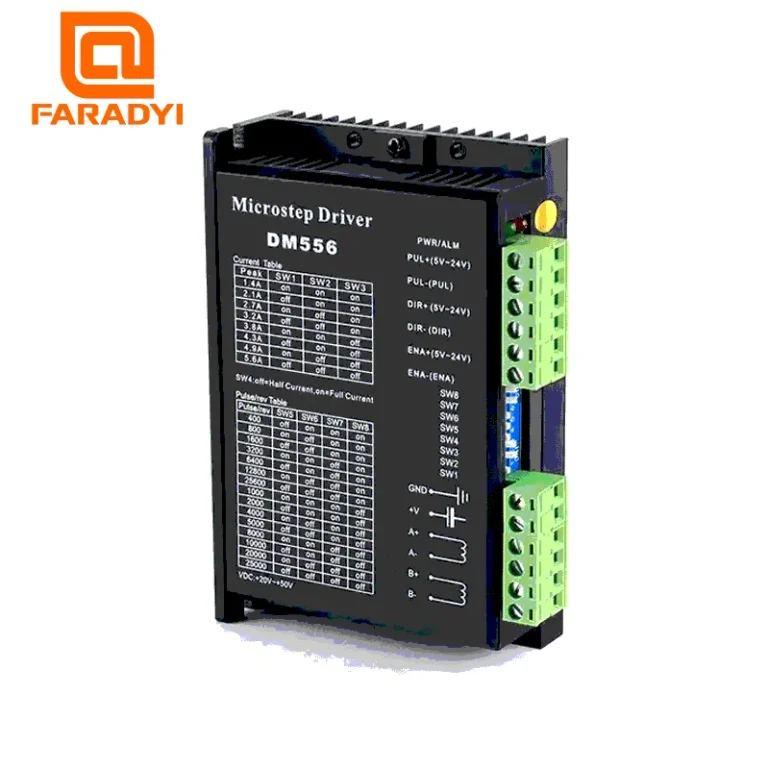
The motor driver is the interface between the CNC controller and the step motor, responsible for delivering the correct current and voltage pulses to the motor windings. Selecting an incompatible or under-spec’d driver is a critical mistake. For instance, a driver that cannot supply the required current for the chosen motor will limit its performance, particularly at higher speeds or when higher torque is needed. Conversely, a driver with excessive current capability might lead to motor overheating if not properly configured.
Microstepping capabilities are also vital. Higher microstepping resolutions (e.g., 1/256th step) result in smoother motion, reduced resonance, and improved positioning accuracy, which is crucial for fine machining operations. If the driver does not support the desired microstepping level, the potential benefits of a high-resolution motor are lost. Furthermore, features like current decay settings (fast decay, slow decay, mixed decay) significantly impact motor performance and heat generation. Incorrect settings can lead to inefficient operation or increased motor temperature.
Mismatching Motor Inertia with System Dynamics
Inertia is a measure of an object’s resistance to changes in its rotational speed. When selecting a step motor, its rotor inertia must be carefully matched with the inertia of the mechanical system it drives (e.g., ball screw, pulley, workpiece). A motor with significantly higher inertia than the load can lead to instability, poor acceleration/deceleration performance, and increased step loss. The motor struggles to overcome the inertia of its own rotor in addition to the load.
A general rule of thumb is to keep the motor’s rotor inertia to no more than 10-20% of the reflected load inertia. This ratio ensures that the motor can effectively control the load’s motion. For applications requiring very high accelerations or precise dynamic control, using a motor with lower inertia becomes even more critical. Sometimes, a gearbox or a different type of motor (like a servo motor) might be necessary if achieving the correct inertia match with standard step motors proves difficult.
Power Supply Inadequacy
The power supply unit (PSU) is the backbone of the motor control system, providing the necessary electrical energy. An undersized or unstable power supply is a common cause of step motor system failures. If the PSU cannot deliver the required voltage and current, especially during peak demand when the motor is accelerating or under load, the system’s performance will suffer. This can manifest as erratic motor behavior, reduced torque, or complete system shutdown.
The power supply’s voltage rating should be compatible with the motor driver’s input voltage requirements. Its current rating must be sufficient to handle the combined current draw of all connected motor drivers, with a safety margin. Fluctuations in voltage or excessive ripple can lead to inconsistent motor performance and potential damage to the driver electronics. Investing in a high-quality, appropriately rated power supply is crucial for reliable CNC operation.
Ensuring Longevity and Reliability: Practical Considerations
Beyond the core technical specifications, several practical aspects contribute to the long-term reliability and lifespan of a step motor set in a CNC environment. Addressing these points during the selection and installation phase can prevent future issues.
Proper Ventilation and Thermal Management
Step motors, especially when operating under load or at high speeds, generate heat. Inadequate ventilation can lead to overheating, which degrades insulation, reduces motor efficiency, and can cause permanent damage. Ensure that the motors are installed in an environment with sufficient airflow. If the motors are enclosed, consider active cooling solutions like fans or heatsinks. The motor driver also generates heat and requires proper ventilation, often necessitating mounting on a heatsink or in a well-ventilated enclosure.
Cable Selection and Management
The quality and routing of motor cables are critical. Using cables with inadequate wire gauge for the required current can lead to voltage drop, reducing motor performance. Shielded cables are recommended to prevent electromagnetic interference (EMI) from affecting control signals. Proper cable management, including avoiding sharp bends and securing cables to prevent abrasion, is essential for preventing short circuits and ensuring signal integrity.
Environmental Factors
Consider the operating environment. High levels of dust, moisture, or extreme temperatures can negatively impact both the motor and the driver. If the CNC machine operates in a harsh industrial setting, consider motors and drivers with appropriate IP (Ingress Protection) ratings or protective enclosures to safeguard them from environmental contaminants.
Conclusion: Strategic Selection for Optimal CNC Performance
Choosing the right step motor set for a CNC machine is a critical engineering decision that directly impacts performance, reliability, and cost-effectiveness. By understanding the common pitfalls—such as underestimating torque requirements, overlooking driver capabilities, mismatching inertia, and inadequate power supply—engineers and technicians can make more informed choices. Careful consideration of performance curves, environmental factors, and proper installation practices will ensure that the selected step motor system contributes positively to the CNC machine’s overall operational efficiency and longevity.
For industrial buyers seeking robust and reliable motion control solutions, Mermak CNC offers a comprehensive range of high-quality step motors, drivers, and related components. Explore our offerings to find the perfect match for your CNC router machine or industrial CNC router application.
Ready to optimize your CNC system? Request a quote on WhatsApp today!