No products in the cart.
LM Series Linear Bearings: Types and Load Capacities for Industrial Automation
Contents
- Linear Bearings (LM Series) Types and Load Capacities: Introduction and Technical Analysis At the core of industrial automation, motion systems are critical for the efficiency and precision of manufacturing processes. One of the fundamental building blocks of these systems is undoubtedly linear bearings. Specifically, LM Series (Linear Motion Series) linear bearings have established a solid position in the industry thanks to their compact structure, high precision, low friction, and wide range of applications. This guide provides an in-depth examination of the types, operating principles, and most importantly, the load capacities and critical field details of LM Series linear bearings for industrial automation engineers, technicians, and decision-makers. Our goal is to provide the necessary technical information to maximize system performance, reduce failure rates, and optimize operational costs through correct bearing selection. Linear bearings, found in many areas from CNC machines to robotic systems, packaging machines to medical devices, directly affect a system’s lifespan, repeatability, and overall precision. Therefore, understanding the different types of the LM Series, their unique advantages and disadvantages, and what dynamic and static load capacities mean and how they are calculated, is indispensable for a successful automation project. This detailed analysis aims to provide a comprehensive resource to readers by blending not only theoretical knowledge but also practical field experiences. Correct bearing selection is a strategic decision that impacts not only initial investment costs but also long-term maintenance, energy consumption, and production downtime costs. LM Series Linear Bearings: Operating Principle and Technical Data
- Basic Types of LM Series Linear Bearings
- Load Capacities and Life Calculations
- Life Calculation
- Field Considerations for LM Series Linear Bearings
- Common Problems and Solutions for LM Series Linear Bearings
- Conclusion and Expert Advice on LM Series Linear Bearings
- FAQ
Linear Bearings (LM Series) Types and Load Capacities: Introduction and Technical Analysis
At the core of industrial automation, motion systems are critical for the efficiency and precision of manufacturing processes. One of the fundamental building blocks of these systems is undoubtedly linear bearings. Specifically, LM Series (Linear Motion Series) linear bearings have established a solid position in the industry thanks to their compact structure, high precision, low friction, and wide range of applications. This guide provides an in-depth examination of the types, operating principles, and most importantly, the load capacities and critical field details of LM Series linear bearings for industrial automation engineers, technicians, and decision-makers. Our goal is to provide the necessary technical information to maximize system performance, reduce failure rates, and optimize operational costs through correct bearing selection. Linear bearings, found in many areas from CNC machines to robotic systems, packaging machines to medical devices, directly affect a system’s lifespan, repeatability, and overall precision. Therefore, understanding the different types of the LM Series, their unique advantages and disadvantages, and what dynamic and static load capacities mean and how they are calculated, is indispensable for a successful automation project. This detailed analysis aims to provide a comprehensive resource to readers by blending not only theoretical knowledge but also practical field experiences. Correct bearing selection is a strategic decision that impacts not only initial investment costs but also long-term maintenance, energy consumption, and production downtime costs.
LM Series Linear Bearings: Operating Principle and Technical Data
Linear bearings are mechanical components designed to provide low-friction linear motion along an axis, as opposed to rotational motion. LM Series linear bearings typically consist of an outer housing that slides or rolls on a shaft, and ball or roller elements contained within this housing. The operating principle is based on the continuous recirculation of the internal balls or rollers in the gap between the bearing housing and the shaft. This recirculating motion converts sliding friction between directly contacting surfaces into rolling friction, thereby increasing the fluidity of motion and significantly reducing frictional resistance. This allows for faster and more precise movements with less power. Linear bearings offer significant advantages in terms of energy efficiency and positioning accuracy compared to traditional plain bearings, having much lower friction coefficients.

Basic Types of LM Series Linear Bearings
The LM Series generally includes types that operate on cylindrical shafts and vary according to different mounting and load requirements:
- LM / LME Series (Standard Compact Type): This is the most commonly used type. It has a cylindrical outer body and usually features sealing elements on both sides. Its compact structure makes it preferred in limited spaces. Ideal for high-precision motion and medium-level loads. Available in metric (LM) and inch (LME) dimensions.
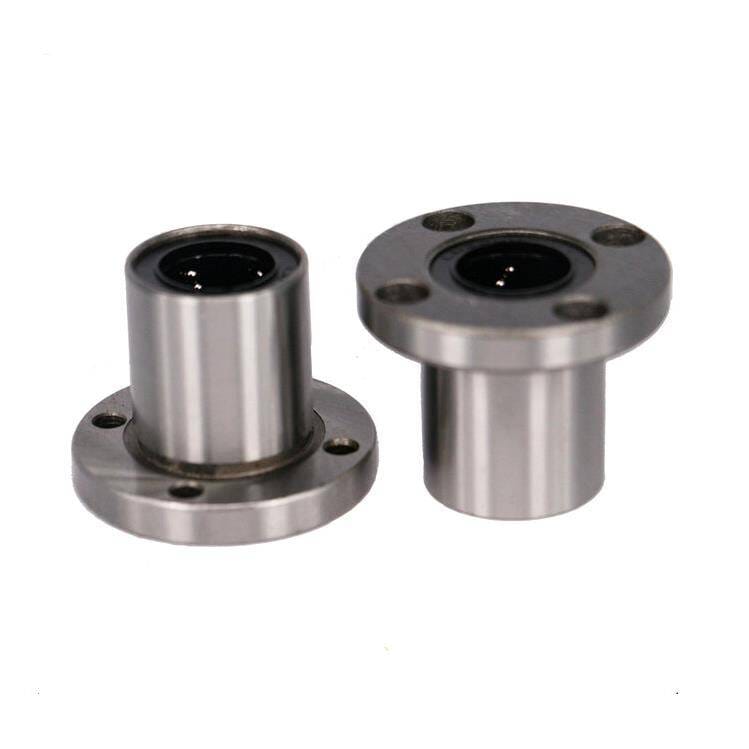
- LMF / LMK Series (Flanged Type): Comes with a square or round flange integrated into the bearing housing. This flange allows the bearing to be easily mounted by bolting directly to a surface. This design offers more robust mounting and better load distribution. It is particularly preferred in applications requiring rigidity. LMK is square flanged, LMF is round flanged.
- LMH Series (Oval Flanged Type): An oval flanged variant used especially in situations with space constraints or when specific mounting hole spacings are required.
- LM-OP Series (Open Type): Used when one side of the shaft needs to be supported, and this support must pass under the bearing housing. Open-type bearings leave a gap in the bearing housing in the areas where the shaft is supported, which increases the shaft’s bending resistance, allowing operation over longer spans.
- LM-AJ Series (Adjustable Type): A type where the clearance between the bearing and the shaft can be adjusted. This allows for applying preload to increase system rigidity or compensate for mounting tolerances. Valuable in applications requiring high precision and minimal clearance.
- LM-P Series (Pillow Block Type): Bearings housed within an aluminum or steel pillow block. This type facilitates direct mounting of bearings to the machine chassis and reduces assembly time. It also helps protect the bearings from external factors.
Load Capacities and Life Calculations
One of the most critical factors in linear bearing selection is load capacity. This capacity is divided into two main categories:
- Dynamic Load Capacity (C): The maximum load value under which the bearing can safely operate under dynamic loads for a specified life (typically 100 km or 50 million revolutions) at a certain speed and condition. This value is determined by bearing manufacturers through tests and is provided in catalogs in millimeters or inches. Dynamic load capacity directly affects the operating life of the bearing. The ratio between the applied equivalent dynamic load (P) and the dynamic load capacity (C) determines the expected life of the bearing.
- Static Load Capacity (C0): The maximum load the bearing can withstand without permanent deformation when not in motion. This value indicates the onset of permanent deformation between the bearing elements and the raceways. Static load capacity is particularly important in applications with sudden shock loads or prolonged static loads. It is usually evaluated with a safety factor (s0) (C0 > s0 * P0, where P0 is the static equivalent load).
Life Calculation
The expected life (L) of linear bearings is calculated using the dynamic load capacity (C) and the applied equivalent dynamic load (P). The formula commonly used for ball bearings according to ISO standards is as follows:
L = (C / P)^3 * 50 km (or 100 km, depending on the manufacturer)
Here:
- L: Expected life (in km)
- C: Dynamic load capacity (N)
- P: Applied equivalent dynamic load (N)
- The exponent “3” is a standard value for ball bearings.
These calculations do not include other factors affecting bearing life (temperature, lubrication, contamination, vibration, mounting accuracy, etc.). These factors can usually be included in the formula with a life adjustment factor (fa), but C and P values are essential for basic selection. For correct bearing selection, the direction of applied loads (radial, axial, moment), speed, acceleration, and operating cycle must be analyzed in detail. In systems using multiple bearings, load distribution and the relative position of the bearings also affect life calculations.
| Parameter | Value/Description |
|---|---|
| Bearing Type | LM Series (Ball, Compact) |
| Shaft Diameter Range | 3 mm – 80 mm (Common Industrial Sizes) |
| Dynamic Load Capacity (C) | 200 N – 20,000 N (Varies by Shaft and Size) |
| Static Load Capacity (C0) | 300 N – 30,000 N (Varies by Shaft and Size) |
| Maximum Operating Temperature | -20°C to +80°C (With Standard Sealing Elements) |
| Maximum Speed | 3 m/s – 5 m/s (Depends on Load and Lubrication Conditions) |
| Accuracy Class | P0 (Normal), P1 (High), P2 (Precision) |
| Material | Hardened Bearing Steel (100Cr6 or equivalent), Synthetic Cage |
Field Considerations for LM Series Linear Bearings
- Shaft Selection and Machining: The performance of linear bearings is directly related to the quality of the shaft they operate on. The shaft’s hardness (typically HRC 60-62), surface roughness (Ra 0.2µm or lower), accuracy (diameter tolerance, roundness, straightness), and parallelism are critically important. Inadequate shaft quality shortens bearing life, increases friction, and reduces precision. Hard chrome-plated shafts can be preferred for corrosion resistance and wear durability.
- Mounting Accuracy: The precision exercised during the mounting of bearings and their shafts determines the overall system performance. The parallelism of the shafts, the concentricity of the housings, and the flatness of the mounting surfaces are vital. Misalignment leads to excessive stress on the bearings, binding of the balls, and premature failures. Applying correct tightening torques using torque wrenches during assembly prevents damage to bearings and fasteners.
- Lubrication: Although LM Series bearings are designed for low friction, proper and regular lubrication significantly increases their life and performance. The correct grease or oil type should be selected according to the application and environmental conditions. Low-viscosity oils may be preferred for high-speed applications, while higher-viscosity greases may be chosen for high-load applications. Lubrication intervals should be determined according to operating conditions and manufacturer recommendations. Lack of lubrication leads to overheating, wear, and premature failure, while excessive lubrication can damage sealing elements and attract contaminants.
- Sealing: The operating environment of bearings is often filled with contaminants such as dust, moisture, metal chips, or chemicals. LM Series bearings typically come with integrated sealing elements (seals). It must be ensured that these seals are intact and performing their function. In extremely dirty environments, external sealing measures such as bellows or additional protective covers should be used to protect the bearings. Contamination is one of the biggest factors that damage the internal structure of bearings and shorten their life.
- Environmental Factors: Environmental factors such as operating temperature, humidity, vibration, and chemical exposure directly affect bearing performance. Excessive temperatures can degrade lubricant properties or cause expansion in bearing material. High humidity and chemical vapors can lead to corrosion. In such conditions, stainless steel bearings or special coatings should be preferred, and appropriate sealing and protection should be provided.
- Load Direction and Preload: LM series bearings generally show high resistance to radial loads. However, axial and moment loads must also be considered. Especially moment loads can lead to unbalanced stresses on the bearing, shortening its life. If necessary, wider-spaced bearings or additional supports should be used to absorb moment loads. Preload increases system rigidity and reduces vibration by eliminating bearing clearance. In applications requiring high precision and rigidity, controlled preload can be applied with adjustable type bearings or special mounting methods. However, care must be taken as excessive preload will shorten bearing life.
Common Problems and Solutions for LM Series Linear Bearings
Problems encountered with linear bearings in industrial automation systems typically arise from incorrect selection, faulty assembly, inadequate maintenance, or environmental factors. Early diagnosis and correct solutions for these problems ensure continuous system operation and long life.
- Excessive Noise and Vibration:
- Causes: One of the most common causes is misalignment of the shaft or bearings. Parallelism or concentricity errors during assembly cause irregular rolling of the balls and vibration. Insufficient or degraded lubrication can increase friction within the bearing, leading to noise. Dirt or foreign particles accumulated inside the bearing can cause damage to the ball raceways. Worn or damaged balls/raceways are also a direct source of noise and vibration.
- Solutions: First, the alignment of the shaft and bearings should be checked with precise measuring instruments and corrected if necessary. The lubrication status should be reviewed, the bearing cleaned and re-lubricated, or the lubricant type changed. If noise and vibration persist, the internal structure of the bearings should be checked for damage, and the bearings replaced if necessary. Especially in high-speed applications, the dynamic balance of the bearings should be checked.
- Short Life and Premature Failure:
- Causes: Shorter-than-expected bearing life is usually due to overloading. The most critical error is when the selected bearing’s dynamic load capacity is lower than the applied equivalent dynamic load. Insufficient lubrication or using an unsuitable lubricant accelerates wear on bearing surfaces. Contaminants entering the bearing (dust, moisture, metal chips) lead to pitting and wear on the surfaces. Excessive operating temperatures can cause lubricant degradation and material fatigue in the bearing. Inadequate shaft surface quality or hardness can also lead to premature bearing wear.
- Solutions: Bearing selection should be re-evaluated, and a higher capacity bearing should be chosen after accurately analyzing the system’s actual loads and operating cycle. The lubrication schedule and lubricant type should be optimized. Sealing elements should be checked, and if necessary, more effective sealing solutions (bellows, additional seals) should be implemented. Operating temperature should be kept under control, and cooling systems integrated if necessary. Shaft quality should be checked, and shafts with appropriate hardness and surface roughness should be used.
- Binding or High Friction:
- Causes: Bending or deflection of the shaft prevents the balls from moving smoothly within the bearing. Stresses created during assembly or a tight fit of the bearing in its housing can also lead to binding. Contamination inside the bearing can cause the balls to get stuck in the raceways. Insufficient or dried-out lubrication increases friction. Applying too much preload can also increase friction and cause the bearing to bind.
- Solutions: The straightness and flatness of the shaft should be checked, and bent shafts replaced. Assembly stresses should be eliminated, and bearings mounted with correct torques and without stress. The bearing should be cleaned and re-lubricated. If necessary, preload settings should be checked and optimized.
- High Clearance or Looseness:
- Causes: Wear of bearing elements (balls, raceways) causes clearance to increase over time. Incorrect preload or loss of preload over time also leads to looseness. The bearing not seating properly in its housing during assembly or loosening of fasteners can also be a cause.
- Solutions: Bearings should be checked, and if there are signs of wear, they should be replaced. Preload should be readjusted in adjustable type bearings. All fasteners should be checked and tightened to the correct torques. For a more rigid system, bearings with a higher accuracy class or higher preload can be considered.
- Corrosion:
- Causes: Exposure to moisture, water, or aggressive chemicals causes rust and corrosion on bearing surfaces. Inadequate sealing allows such substances to enter the bearing. Acidic or basic cleaning agents can also lead to corrosion.
- Solutions: The operating environment should be evaluated, and if necessary, sealing systems or bellows that provide better protection for bearings should be used. LM Series bearings made of stainless steel (e.g., 440C stainless steel) or special anti-corrosion coatings can be preferred. Regular lubrication can form a protective layer on metal surfaces, delaying corrosion.
Conclusion and Expert Advice on LM Series Linear Bearings
The correct selection, assembly, and maintenance of linear bearings, especially the LM Series, are vital for a system’s long-term performance, reliability, and cost-effectiveness in industrial automation systems. As discussed in this detailed guide, the different types of the LM Series (standard, flanged, open, adjustable, etc.) each offer features optimized for specific application requirements. Understanding and accurately calculating dynamic and static load capacities is a fundamental step to estimate bearing life and prevent premature failures. Our field experience shows that many problems arise from initial incorrect selections or negligence in assembly and maintenance processes. Selecting a bearing based on catalog values is only the first step; real-world operating conditions (load profile, speed, acceleration, temperature, contamination, vibration) can significantly affect these theoretical values. Therefore, performing a detailed engineering analysis during the project design phase will always provide the most accurate and economical solution.
As expert advice, we strongly recommend considering the following principles when designing linear motion systems or optimizing existing ones:
- Comprehensive Needs Analysis: Determine all system loads (radial, axial, moment), speeds, accelerations, operating cycles, desired life, and environmental conditions (temperature, humidity, contamination) in detail. Without this data, it is impossible to make the correct bearing selection.
- Adherence to Manufacturer Data: Each manufacturer may have its own test methods and standards. Carefully review the technical data sheets and catalogs of the bearings, and use their own formulas and correction factors for life calculations.
- Invest in Quality: Linear shafts and bearings are fundamental precision and life elements of a system. Low-quality products, while seemingly offering a cost advantage in the short term, can prove much more expensive in the long run due to frequent failures, production losses, and high maintenance costs. Prefer products from reliable and recognized brands.
- Correct Assembly and Alignment: Strictly follow assembly instructions. The parallelism of shafts, concentricity of housings, and flatness of surfaces are critically important. Use precise methods such as laser alignment if necessary. Misalignment can reduce bearing life by up to 80%.
- Periodic and Proper Lubrication: Lubrication is the insurance of bearing life. Apply the manufacturer’s recommended type and amount of lubricant at specified intervals. Dirty or degraded lubricant is one of the most common causes of bearing damage.
- Effective Sealing: Use appropriate sealing solutions (integrated seals, bellows, external covers) to protect bearings against contaminants in the operating environment. Contamination causes pitting and wear on the ball raceways, shortening life.
- Evaluate Field Feedback: Take seriously abnormalities such as noise, vibration, and temperature increases from operating systems. Early diagnosis can prevent major failures and unplanned downtime.
- Training and Expert Support: Ensure your personnel have sufficient knowledge and experience regarding linear bearings. If necessary, obtain technical support and training from bearing manufacturers or independent experts.
In conclusion, LM Series linear bearings are an indispensable part of industrial automation and can significantly increase the precision, speed, and durability of systems when selected correctly. However, to fully utilize this potential, it is essential to adhere strictly to engineering principles, conduct detailed analyses, and implement proactive maintenance strategies. Remember, the weakest link in a system can often be one of its smallest but most critical components. Linear bearings are among these critical components.
FAQ
What are LM Series linear bearings and how do they work?
LM Series linear bearings are mechanical components designed to provide low-friction linear motion along an axis. They typically consist of an outer housing and internal ball or roller elements that recirculate to convert sliding friction into rolling friction, enabling smooth and precise movement. They are essential for industrial automation, CNC machines, robotics, and other precision applications.
What are the different types of LM Series linear bearings?
The main types include standard compact (LM/LME), flanged (LMF/LMK), oval flanged (LMH), open (LM-OP), adjustable (LM-AJ), and pillow block (LM-P) types. Each type is designed for specific mounting requirements, load conditions, and space constraints in industrial applications.
What is the difference between dynamic and static load capacity for linear bearings?
Dynamic load capacity (C) is the maximum load a bearing can handle during movement for a specified life (e.g., 100 km), while static load capacity (C0) is the maximum load it can withstand without permanent deformation when stationary. Both are crucial for selecting the right bearing to ensure longevity and prevent premature failure under operational loads.
What critical factors affect the performance and lifespan of LM Series linear bearings?
Key factors include the quality of the shaft (hardness, surface roughness, straightness), mounting accuracy (parallelism, concentricity), proper and regular lubrication, effective sealing against contaminants, and environmental factors like temperature and humidity. Misalignment, insufficient lubrication, and contamination are common causes of premature failure.
What are common problems with LM Series linear bearings and how can they be resolved?
Common issues include excessive noise/vibration (due to misalignment, poor lubrication, or internal damage), short life (overloading, contamination, high temperatures), binding/high friction (bent shafts, tight fit, contamination), high clearance/looseness (wear, incorrect preload), and corrosion (moisture/chemical exposure). Solutions involve re-alignment, optimized lubrication, improved sealing, correct load assessment, and material selection.