No products in the cart.
Lathe Chuck Types: 3-Jaw vs. 4-Jaw Chuck Differences and Technical Analysis
Contents
- Lathe Chuck Types: 3-Jaw vs. 4-Jaw Chuck Differences – Introduction and Technical Analysis At the heart of industrial automation and modern manufacturing processes, lathe machines are indispensable components of the fabrication sector due to their precise machining capabilities. One of the most critical components of these machines are lathe chucks, which ensure the workpiece is held securely and centrally, allowing machining operations to be performed accurately. Lathe chucks play a vital role in positioning the workpiece relative to the axis of rotation and holding it steady during machining. The correct chuck selection directly impacts not only the quality and precision of the workpiece but also production efficiency, operational safety, and overall operational costs. This technical article is for experts, engineers, and operators in the industrial automation sector, providing an in-depth examination of the fundamental differences, working principles, advantages, disadvantages, and application areas of the two most commonly used lathe chuck types: 3-jaw (three-jaw) and 4-jaw (four-jaw) chucks. This guide aims to provide the necessary technical information for making the right chuck selection, offering practical solutions to challenges encountered in manufacturing processes. Understanding these chucks, used across a wide range from modern CNC lathe machines to conventional machines, is of great importance for the integration and optimization of automation systems. Lathe Chuck Types: 3-Jaw vs. 4-Jaw Chuck Differences – Working Principle and Technical Data
- 3-Jaw Self-Centering Lathe Chucks (Three-Jaw Automatic Chuck)
- 4-Jaw Independent Lathe Chucks (Four-Jaw Independent Chuck)
- Jaw Types (Hard and Soft Jaws)
- Lathe Chuck Types: 3-Jaw vs. 4-Jaw Chuck Differences – Considerations in the Field
- Lathe Chuck Types: 3-Jaw vs. 4-Jaw Chuck Differences – Common Problems and Solutions
- Lathe Chuck Types: 3-Jaw vs. 4-Jaw Chuck Differences – Conclusion and Expert Advice
- FAQ
Lathe Chuck Types: 3-Jaw vs. 4-Jaw Chuck Differences – Introduction and Technical Analysis
At the heart of industrial automation and modern manufacturing processes, lathe machines are indispensable components of the fabrication sector due to their precise machining capabilities. One of the most critical components of these machines are lathe chucks, which ensure the workpiece is held securely and centrally, allowing machining operations to be performed accurately. Lathe chucks play a vital role in positioning the workpiece relative to the axis of rotation and holding it steady during machining. The correct chuck selection directly impacts not only the quality and precision of the workpiece but also production efficiency, operational safety, and overall operational costs. This technical article is for experts, engineers, and operators in the industrial automation sector, providing an in-depth examination of the fundamental differences, working principles, advantages, disadvantages, and application areas of the two most commonly used lathe chuck types: 3-jaw (three-jaw) and 4-jaw (four-jaw) chucks. This guide aims to provide the necessary technical information for making the right chuck selection, offering practical solutions to challenges encountered in manufacturing processes. Understanding these chucks, used across a wide range from modern CNC lathe machines to conventional machines, is of great importance for the integration and optimization of automation systems.
Lathe Chuck Types: 3-Jaw vs. 4-Jaw Chuck Differences – Working Principle and Technical Data
Lathe chucks are mechanical devices that secure a workpiece on its rotational axis during machining. They typically consist of a body, movable jaws, and a mechanism that actuates these jaws. This mechanism firmly grips the workpiece, ensuring its resistance against machining forces. The design and working principle of chucks vary based on factors such as the workpiece geometry, required precision, and production speed. Now, let’s delve into a detailed technical analysis of 3-jaw and 4-jaw chucks.

3-Jaw Self-Centering Lathe Chucks (Three-Jaw Automatic Chuck)
Working Principle: As the name suggests, 3-jaw chucks have three jaws. These jaws are typically interconnected via a scroll gear or cam mechanism. This connection allows all three jaws to move simultaneously inward or outward with a single adjustment using a chuck key. This synchronized movement automatically centers the workpiece. Due to this feature, they are referred to as “self-centering” or “automatic centering.” Even if the workpiece is eccentrically mounted, the chuck attempts to align it to its geometric center.
Technical Advantages:
- Fast Clamping: The time required to clamp and unclamp a workpiece is significantly reduced due to a single adjustment point. This considerably increases efficiency, especially in mass production environments.
- High Repeatability: When machining multiple workpieces of the same diameter, it is easy to clamp each piece with approximately the same centering accuracy. This is a major advantage in automation systems and CNC machines.
- Simple Operation: Does not require the operator to possess special centering skills, which reduces training costs and lowers the error rate.
- Ideal Geometries: An excellent solution for workpieces with symmetrical and standard geometries, particularly round, hexagonal, or dodecagonal shapes.
Technical Disadvantages:
- Limited Centering Accuracy: The self-centering mechanism may exhibit small run-out errors over time due to wear on the chuck and jaws. This run-out can be unacceptable, especially in high-precision applications.
- Unsuitable for Irregular Parts: Struggles to hold irregularly shaped workpieces such as square, rectangular, asymmetrical, or cast parts accurately and securely; often impossible.
- Clamping Force Distribution: Three-point clamping can cause deformation in workpieces, especially those with thin walls or delicate materials. Since the clamping force is distributed equally among three points, it potentially offers a lower total clamping force compared to four-jaw chucks.
Application Areas: Workshops engaged in mass production, CNC lathe machines for clamping standard round bars, tubes, or pre-machined parts, hydraulically and pneumatically controlled automatic chucks, general-purpose lathe machines.

4-Jaw Independent Lathe Chucks (Four-Jaw Independent Chuck)
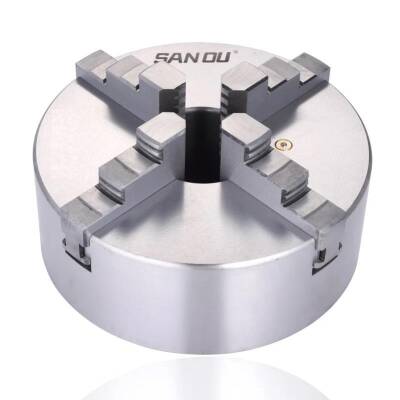
Working Principle: 4-jaw chucks have four jaws, and each of these jaws is moved by an independent screw mechanism. This means that each jaw can be adjusted independently of the others. This independent movement capability allows the operator to manually center the workpiece with very high precision relative to the chuck axis, or even intentionally clamp it eccentrically.
Technical Advantages:
- High-Precision Centering: The operator can minimize workpiece run-out using a dial indicator. This is indispensable for applications requiring precision at the thousandths of a millimeter level.
- Clamping Irregularly Shaped Parts: Can securely and accurately clamp square, rectangular, oval, asymmetrical cast parts, or other workpieces with irregular geometries.
- Eccentric Machining Capability: Allows for eccentric turning operations by intentionally clamping the workpiece off-center. This is a critical feature in the production of parts such as crankshafts, cams, or special fasteners.
- Higher Clamping Force and Stability: Four-point clamping provides a more balanced distribution of clamping force on the workpiece and offers higher stability, especially for heavy cutting operations or vibration-prone parts.
- Reduced Deformation in Thin-Walled Parts: Since the clamping force is spread over four points, it allows for gentler and more secure holding of thin-walled or deformation-prone parts.
Technical Disadvantages:
- Long Clamping Time: Because each jaw must be adjusted separately, the time required to clamp and center a workpiece is significantly longer compared to 3-jaw chucks. This makes it unsuitable for mass production.
- Operator Skill Requirement: Requires an experienced and skilled operator for accurate centering and secure clamping. The potential for error is higher.
- Repeatability is Operator-Dependent: Differences in centering accuracy can occur between different operators or the same operator’s clamping at different times.
Application Areas: Single-piece production, prototyping, mold making, precision machine tools, machining of cast parts, turning of square or rectangular materials, applications requiring eccentric machining, universal lathe machines.
Jaw Types (Hard and Soft Jaws)
The jaws used for both chuck types generally fall into two main categories: hard jaws and soft jaws.
- Hard Jaws: Typically made from heat-treated steel and possess high wear resistance. They are long-lasting and ideal for general machining applications. However, they tend to leave marks on the workpiece.
- Soft Jaws: Generally made from softer materials like mild steel or aluminum. They can be specially machined (turned) to precisely fit the workpiece. This process prevents workpiece deformation and provides very high centering accuracy. Soft jaws are used particularly for secondary operations, precise finishing operations, or machining thin-walled parts. However, they may need to be re-machined for each different workpiece diameter or shape, which entails additional time and cost.
| Parameter | 3-Jaw Self-Centering Chuck | 4-Jaw Independent Chuck |
|---|---|---|
| Centering Principle | Automatic (self-centering) | Manual (independently adjustable) |
| Clamping Time | Very Fast | Longer (requires operator skill) |
| Centering Accuracy | Good, but may have run-out due to wear | Very High (adjustable to micron level) |
| Suitable Part Geometries | Round, hexagonal, symmetrical parts | Round, square, rectangular, asymmetrical, irregularly shaped parts |
| Application Areas | Mass production, general turning, CNC machines | Single-piece production, prototyping, precision machining, eccentric machining, cast parts |
| Operator Skill | Less Requirement | High Degree of Requirement |
| Risk of Deformation | May be higher for thin-walled parts | Less (as force is distributed over four points) |
| Cost (General) | Generally more economical | Generally more expensive |
Lathe Chuck Types: 3-Jaw vs. 4-Jaw Chuck Differences – Considerations in the Field
- Workpiece Geometry and Material: The shape (round, square, asymmetrical) and material (hard steel, aluminum, thin-walled pipe) of the workpiece to be machined are fundamental determinants in chuck selection. A 3-jaw chuck provides efficiency for symmetrical and standard forms, while a 4-jaw chuck is indispensable for irregular and precision parts. The use of soft jaws for thin-walled parts is critical to prevent deformation.
- Machining Precision and Run-out Tolerance: The tolerances required by the application directly influence chuck selection. In cases requiring micron-level precision, the manual adjustment capability of a 4-jaw chuck or 3-jaw chucks with specially machined soft jaws should be preferred. In automation systems, continuous monitoring of chuck run-out and keeping it within specified limits is essential for production quality.
- Production Volume and Speed Requirement: For mass production and high-volume jobs, 3-jaw self-centering chucks, offering fast clamping and unclamping, are ideal. Since 4-jaw chucks have a longer clamping time, they are more suitable for single-piece production, prototyping, or very specialized operations. When automatic loading/unloading systems are integrated, the speed of 3-jaw chucks enhances automation efficiency.
- Clamping Force and Safety: Ensuring sufficient clamping force to withstand cutting forces generated during machining is vital for both workpiece quality and operator safety. The correct chuck selection and clamping technique must be applied to prevent the workpiece from flying out of the chuck during excessive speeds or heavy cuts. Hydraulically or pneumatically controlled chucks allow for precise adjustment of clamping force and are frequently used in automation systems.
- Chuck and Jaw Maintenance and Cleaning: Regular cleaning, lubrication, and wear checks of chucks and jaws extend their performance and lifespan. Accumulations of chips, dust, and dirt can prevent jaws from moving smoothly, reducing centering accuracy and damaging the chuck mechanism. Especially in automatic chucks, the cleanliness and lubrication of the scroll gear are critically important.
- Operator Training and Experience: The correct and efficient use of 4-jaw independent chucks, in particular, depends on the operator’s experience and technical knowledge. Sufficient training and practical experience are required to accurately center and securely clamp the workpiece. In automation systems, such skills are integrated into software and robotic systems to reduce operator dependency.
Lathe Chuck Types: 3-Jaw vs. 4-Jaw Chuck Differences – Common Problems and Solutions
Lathe chucks can cause various problems due to intensive use or incorrect applications. Diagnosing and solving these problems are essential for production continuity and quality.
-
Run-out Problems:
Problem: When the workpiece is clamped, it deviates from the axis of rotation, leading to concentricity errors on the machined surface.
Causes:
- In 3-jaw chucks: Wear on jaws or scroll gear, chip accumulation, error in chuck mounting.
- In 4-jaw chucks: Incorrect or insufficient centering, operator error.
- In both chuck types: Dirty or damaged clamping surface of the workpiece, loosening of chuck mounting, damage to jaws.
Solutions:
- Thoroughly clean the chuck and jaws, remove chips and dirt accumulation.
- Check for wear on jaws or chuck mechanism; replace worn parts.
- If using a 4-jaw chuck, precisely center the workpiece with a dial indicator.
- Ensure the chuck is correctly and tightly mounted to the machine spindle.
- If using soft jaws, re-machine them to fit the workpiece diameter, creating a precise seating surface.
-
Insufficient Clamping Force and Workpiece Slippage:
Problem: The workpiece slips or flies out of the chuck during machining, creating dangerous situations and damaging the workpiece.
Causes:
- Insufficient clamping force (not tightened enough in manual chucks, low-pressure setting in hydraulic/pneumatic chucks).
- Jaws unsuitable for the workpiece (e.g., toothed jaws may be needed instead of smooth jaws for rough surfaces).
- Workpiece is too heavy or spindle speed is too high.
- Worn jaws or chuck mechanism.
- Oily or slippery workpiece surface.
Solutions:
- Increase clamping force (tighten more in manual chucks, increase pressure in hydraulic/pneumatic chucks).
- Use appropriate, toothed, or specially formed jaws for the workpiece.
- Clean the workpiece surface, remove oil.
- If necessary, reduce spindle speed or use a larger/more powerful chuck.
- Replace worn jaws or chuck mechanism parts.
-
Jaws Sticking or Not Moving:
Problem: Chuck jaws do not open and close smoothly, get stuck, or cannot move.
Causes:
- Chip, dirt, or rust accumulation.
- Insufficient or incorrect lubrication.
- Deformation/damage to jaws or chuck body.
- Wear on the scroll gear or other mechanical parts.
Solutions:
- Disassemble the chuck, clean all parts (especially jaw guides and scroll gear).
- Apply lubrication of the type and amount recommended by the manufacturer.
- Replace deformed or damaged jaws or chuck parts.
- Ensure jaws are inserted into the correct slots and follow numbering.
-
Workpiece Deformation:
Problem: Workpieces, especially those made from thin-walled or soft materials, are crushed or deformed during clamping.
Causes:
- Excessive clamping force.
- Sharp corners of hard jaws.
- Insufficient support (due to workpiece length or shape).
Solutions:
- Reduce clamping force, especially carefully adjust pressure in hydraulic/pneumatic chucks.
- Use soft jaws suitable for the workpiece and machine them to the workpiece form if necessary.
- Use a supporting mandrel inside the workpiece or a special clamping fixture on the outside.
- In four-jaw chucks, distribute the clamping force more evenly to reduce deformation.
Lathe Chuck Types: 3-Jaw vs. 4-Jaw Chuck Differences – Conclusion and Expert Advice
Lathe chucks are one of the cornerstones of industrial automation and precision manufacturing, and selecting the right chuck is a critical factor for operational success. As seen in this detailed technical analysis, 3-jaw self-centering chucks and 4-jaw independent chucks offer optimized solutions for different production needs and workpiece geometries. 3-jaw chucks stand out with their speed, ease of use, and high efficiency in mass production; while 4-jaw chucks are indispensable for single-piece production, prototyping, and special applications due to their unique centering precision, ability to clamp irregular parts, and eccentric machining capability. From an industrial automation perspective, 3-jaw chucks are generally easier to integrate with robotic loading/unloading systems and automated production lines, whereas the manual adjustment requirement of 4-jaw chucks can create additional challenges in automation processes, though these can be overcome with high-precision robotic vision systems and adaptive control algorithms.
As an expert, my advice is never to rely on a single criterion when selecting a chuck. All factors, such as the complexity of the workpiece geometry, material properties, desired machining precision, production volume, existing machine infrastructure, and operator experience level, must be evaluated together. Furthermore, regular maintenance, cleaning, and timely replacement of worn parts of chucks are vital for maintaining machining quality and minimizing potential failures and safety risks. Practical approaches such as the use of soft jaws and machining special forms for workpieces can offer effective solutions to challenging clamping problems. With evolving automation technologies, innovations like smart chucks and quick-change systems are expanding the application areas of both chuck types and making production processes more flexible and efficient. In conclusion, the selection of the correct lathe chuck is not merely a hardware decision but also a reflection of production strategy and engineering approach. We hope this guide will be instrumental in helping experts and practitioners in the industry make informed decisions. Request a quote on WhatsApp for your specific industrial CNC router machine needs.
FAQ
What are the main differences between a 3-jaw and a 4-jaw lathe chuck?
A 3-jaw chuck is a self-centering lathe chuck where all three jaws move simultaneously to clamp the workpiece. It is ideal for quickly clamping symmetrical workpieces like round or hexagonal bars. A 4-jaw chuck, on the other hand, has four independent jaws that can be adjusted individually. This allows for precise centering of irregular shapes, eccentric clamping, and higher clamping force distribution, but requires more setup time and operator skill.
When should I use a 3-jaw chuck versus a 4-jaw chuck in industrial applications?
For mass production of symmetrical parts (e.g., round shafts, pipes), a 3-jaw self-centering chuck is generally more efficient due to its fast clamping and ease of use. For single-piece production, prototyping, or machining irregular shapes (e.g., square blocks, castings, eccentric components) that require high precision or eccentric clamping, a 4-jaw independent chuck is the superior choice.
What are common issues with lathe chucks and how can they be resolved?
Common problems include run-out (workpiece not perfectly centered), insufficient clamping force leading to slippage, jaws sticking, and workpiece deformation. Solutions involve thorough cleaning and lubrication, checking for wear and replacing worn parts, precise manual centering with a dial indicator for 4-jaw chucks, adjusting clamping force, and using appropriate jaw types (hard vs. soft) for the workpiece material and geometry.
What is the difference between hard jaws and soft jaws for lathe chucks?
Hard jaws are made from heat-treated steel, offering high wear resistance and durability for general machining, but can mark the workpiece. Soft jaws are made from softer materials and can be machined to precisely fit the workpiece's unique shape, preventing deformation and providing superior accuracy for delicate or secondary operations. Soft jaws need re-machining for different workpiece diameters.
What factors should be considered when selecting a lathe chuck for a CNC machine?
Key factors include workpiece geometry (symmetrical vs. irregular), material properties (hard vs. soft, thin-walled), required machining precision (standard vs. micron-level), production volume (mass production vs. single-piece), and operator skill level. For automated systems, ease of integration with robotic loading/unloading is also a consideration.