No products in the cart.
What Happens If a Step Motor is Operated with the Wrong Driver?

Contents
- Fundamentals of the Step Motor and Driver Relationship
- Step Motor Structure and Key Parameters
- Step Motor Driver Functions and Types
- Mechanisms and Error Scenarios of Incorrect Driver Usage
- Common Symptoms of Mismatched Step Motor Drivers
- Electrical Mismatches: Current, Voltage, and Inductance
- Ensuring Correct Step Motor and Driver Compatibility
- Step 1: Analyze the Step Motor’s Specifications
- Step 2: Determine Application Requirements
- Step 3: Select the Appropriate Driver
- Conclusion
Operating a step motor with an incompatible driver can lead to significant performance issues and permanent damage. This article explores the fundamental relationship between step motors and their drivers, detailing the risks associated with incorrect pairings. Understand the critical parameters for selecting the right driver to ensure optimal performance and longevity for your industrial automation systems.
Mermak CNC Technical Guide
Practical notes for CNC router, automation and industrial motion systems.
Step motors are fundamental components in industrial automation, crucial for precise positioning and motion control in numerous applications. However, their performance and lifespan are directly tied to being correctly matched with their drivers. Using an incorrect driver or an incompatible configuration can result in a wide range of problems, from subtle performance degradations to irreversible damage. This technical article provides a detailed examination of scenarios arising from operating step motors with the wrong drivers, potential failures, symptoms, and the criteria for correct selection, offering a comprehensive guide for industrial automation professionals.
Fundamentals of the Step Motor and Driver Relationship
Step motors convert electrical pulses into mechanical rotational movement, with each pulse causing the motor to rotate a specific angle (step angle). This enables precise control over the motor’s position, making them indispensable for applications like CNC machines, 3D printers, robotic systems, and automated production lines. Step motors typically have two or more phases; their windings are energized sequentially to create a rotating magnetic field that drives the rotor in discrete steps.
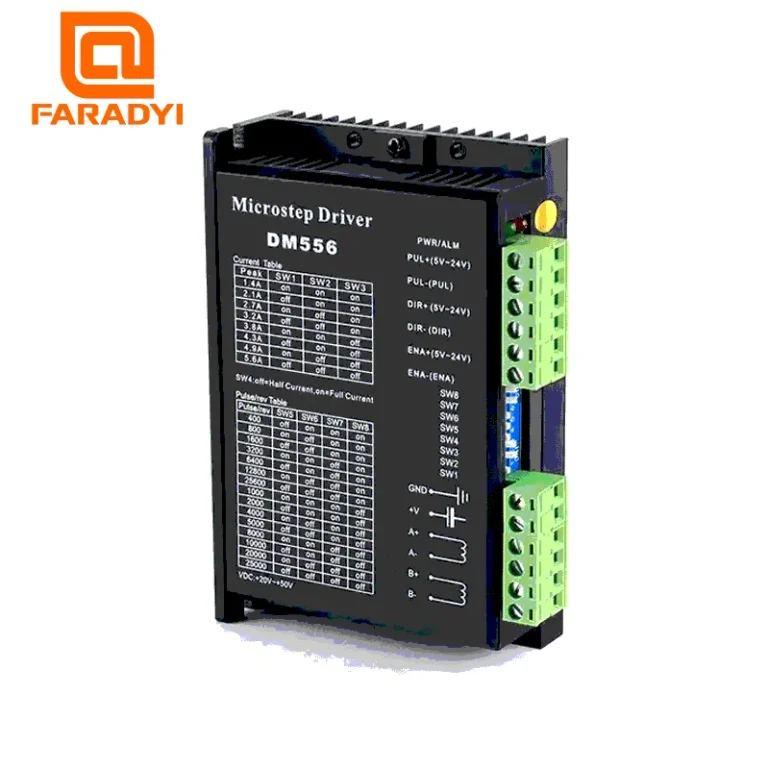
The step motor driver is an electronic device that receives low-power pulse signals from a controller (like a PLC or microcontroller) and converts them into the high-current, high-voltage pulses required by the step motor’s windings. The driver dictates when and how much current is sent to each phase, ensuring the motor rotates at the desired speed and direction with accurate steps. Therefore, the compatibility between the driver and the motor is vital for the system’s overall performance, precision, and reliability. An incorrect driver choice can prevent the motor from reaching its full potential or lead to its damage.
Step Motor Structure and Key Parameters
A step motor consists of a stationary stator with multiple windings (phases) and a rotating rotor. Key electrical parameters include the number of phases (typically 2 or 3), step angle (e.g., 1.8 degrees, meaning 200 steps per revolution), nominal phase current (Amps), nominal phase voltage (Volts), winding resistance (Ohms), and inductance (millihenrys). These parameters directly influence the motor’s torque production, speed performance, and thermal characteristics. Inductance, in particular, is crucial for determining the motor’s current response and torque at high speeds.
Mechanical parameters include inertia and static holding torque. Inertia affects the motor’s acceleration and deceleration capabilities, while holding torque is its ability to maintain position against external loads when energized. When selecting a driver, all these electrical and mechanical parameters must be considered to ensure the driver can maximize the motor’s potential while maintaining safe operating conditions. Failure to do so can shorten the motor’s lifespan or cause performance losses.
Step Motor Driver Functions and Types
Step motor drivers offer various operating modes and features to control motor movement. The most common modes are full-step, half-step, and micro-stepping. Full-step mode provides maximum torque but offers the lowest positioning accuracy and roughest motion. Half-step mode doubles the number of steps, resulting in smoother motion. Micro-stepping divides the nominal step angle into much smaller increments (e.g., 1/16, 1/32, 1/256 steps), enabling highly precise positioning, smoother movement, and reduced vibration. The choice of mode depends on the application’s specific precision and smoothness requirements.
Driver types are typically classified by their current control methods. Constant voltage drivers apply a fixed voltage to the motor windings, offering weak current control and performance degradation at high speeds. Modern systems predominantly use constant current (chopper) drivers. These drivers continuously monitor and regulate the current flowing through the motor windings, adjusting the voltage via Pulse Width Modulation (PWM) to maintain the nominal current. This ensures adequate torque even at high speeds and optimizes heat dissipation. Microcontroller-based drivers offer advanced features like sophisticated current control algorithms, resonance damping, and error diagnostics.
Mechanisms and Error Scenarios of Incorrect Driver Usage
Incompatibility between a step motor and its driver can negatively impact the performance and lifespan of either component through various mechanisms. These incompatibilities often arise from mismatches in electrical parameters (current, voltage, inductance), control signal discrepancies, or the driver failing to meet the application’s performance demands. Each error scenario presents distinct symptoms and consequences, jeopardizing the overall system reliability. This section details the primary incompatibility mechanisms and the resulting error scenarios.
Incorrect driver usage, even if the system initially appears to function, can lead to gradual degradation or sudden failures over time. For instance, a driver that cannot supply sufficient current will result in lost steps, reduced torque, and poor performance, especially under load or at higher speeds. Conversely, a driver that provides excessive current can overheat the motor windings, leading to insulation breakdown and permanent motor damage. Voltage mismatches can also cause issues; a driver with a significantly higher voltage rating than the motor’s nominal voltage, if not properly current-limited, can force excessive current through the windings, causing overheating. The inductance of the motor windings is another critical factor. Motors with higher inductance require drivers capable of maintaining adequate current at higher switching frequencies (higher speeds). Using a driver with insufficient voltage or current-driving capability for a high-inductance motor will severely limit its speed and torque.
Common Symptoms of Mismatched Step Motor Drivers
Recognizing the symptoms of an incorrect driver-motor pairing is crucial for diagnosing and resolving issues promptly. These symptoms can range from subtle performance anomalies to catastrophic failures:
- Overheating: The motor or driver becomes excessively hot to the touch. This often indicates excessive current or inefficient operation.
- Lost Steps/Positioning Errors: The motor fails to complete the commanded steps, leading to inaccurate positioning. This is common when the driver cannot provide sufficient torque, especially during acceleration or under load.
- Reduced Torque: The motor struggles to move loads or stalls easily, indicating insufficient current or voltage from the driver.
- Vibration and Noise: Unusual vibrations or noise during operation can signal resonance issues exacerbated by improper micro-stepping settings or an inadequate driver’s ability to smooth current delivery.
- Intermittent Operation/Stalling: The motor stops unexpectedly during operation, potentially due to thermal shutdown of the driver or motor, or due to the driver being unable to maintain torque under changing load conditions.
- Driver Faults/Shutdowns: The driver may enter a fault state or shut down completely, often indicated by an LED status light, if it detects overcurrent, overvoltage, or other critical errors.
In industrial CNC router machines, these symptoms can translate to poor cut quality, dimensional inaccuracies in machined parts, or complete system downtime. For example, a CNC machine using a step motor with insufficient torque due to a mismatched driver might fail to complete a cutting path, resulting in scrap parts and production delays. Similarly, positioning errors can render a robotic arm ineffective for its intended task.
Electrical Mismatches: Current, Voltage, and Inductance
The most common cause of step motor problems is an electrical mismatch between the motor and the driver. The driver’s output current rating must be appropriately matched to the motor’s nominal phase current. If the driver’s current rating is too high and not properly configured (e.g., via DIP switches or software settings), it can force excessive current into the motor windings, leading to overheating and insulation damage. Conversely, if the driver’s current rating is too low, the motor will not achieve its rated torque, resulting in lost steps and poor performance.
Voltage is also critical. While step motors are often rated for a specific voltage, the driver’s voltage supply capability plays a significant role, especially with chopper drivers. Higher voltage drivers can allow for faster current rise times in the windings, enabling better torque at higher speeds. However, the driver must be able to control this voltage effectively to prevent over-currenting the motor. Motor inductance is another key factor. Motors with higher inductance require drivers that can switch at high frequencies and maintain adequate current. A driver with insufficient voltage or a slow switching capability will struggle to drive a high-inductance motor at speed, severely limiting its performance.
For instance, using a low-power driver designed for small NEMA 17 motors with a high-torque NEMA 34 motor will inevitably lead to insufficient torque, lost steps, and potential stalling, especially when the CNC machine is tasked with heavy cutting operations. Conversely, using an overpowered driver without proper current limiting on a small motor can quickly burn out its windings.
Ensuring Correct Step Motor and Driver Compatibility
Selecting the correct driver for a step motor is paramount for reliable and efficient operation. This involves a systematic approach that considers the motor’s specifications, the application’s requirements, and the driver’s capabilities. Consulting datasheets and understanding the interplay between different parameters is essential.
Step 1: Analyze the Step Motor’s Specifications
Begin by thoroughly reviewing the step motor’s datasheet. Key parameters to note include:
- Nominal Phase Current: This is the maximum continuous current the motor windings can handle without overheating. The driver’s output current should be set to match this value, or slightly lower for safety margins.
- Phase Resistance and Inductance: These values affect the motor’s speed-torque characteristics. Higher inductance motors generally require drivers with higher voltage ratings or advanced current control to achieve good high-speed performance.
- Step Angle: Determines the resolution per step.
- Holding Torque: The maximum torque the motor can produce when stationary.
- Frame Size (e.g., NEMA 17, NEMA 34): Indicates the physical dimensions and generally correlates with power output.
Step 2: Determine Application Requirements
Consider the demands of the application:
- Required Speed and Torque: What are the maximum speeds and torques needed? This will influence the choice of motor size and driver power. For applications requiring high speed, a motor with lower inductance and a driver with higher voltage might be necessary.
- Positioning Accuracy: Does the application require high precision? Micro-stepping capabilities of the driver are crucial here.
- Duty Cycle and Environment: Will the motor run continuously? What are the ambient temperature conditions? This affects thermal management considerations for both the motor and driver.
- Noise and Vibration Sensitivity: Some applications require very smooth and quiet operation, favoring drivers with advanced micro-stepping and smoothing algorithms.
Step 3: Select the Appropriate Driver
Based on the motor specifications and application requirements, choose a driver that meets or exceeds these needs:
- Current Rating: The driver’s continuous output current rating should match the motor’s nominal phase current. Ensure the driver allows for adjustable current settings.
- Voltage Rating: For higher speed applications, a driver with a higher input voltage capability is often beneficial, as it allows for faster current rise times in the motor windings.
- Micro-stepping Capability: Select a driver that offers the desired level of micro-stepping for the required precision and smoothness.
- Control Interface: Ensure compatibility with your controller (e.g., step/direction, CW/CCW, or more advanced communication protocols).
- Protection Features: Look for drivers with built-in protection against overcurrent, overvoltage, and short circuits for added reliability.
For example, when specifying components for an industrial CNC router, a NEMA 34 motor with a holding torque of 8.5 Nm might require a driver like the JSS860H, capable of delivering up to 7.2A and supporting micro-stepping up to 1/256. This ensures sufficient power and precision for demanding machining tasks. Conversely, a smaller NEMA 17 motor used in a 3D printer might be paired with a driver like the TB6600, which is suitable for lower current requirements (typically up to 4A) and offers basic micro-stepping.

Proper matching ensures that the step motor drivers can effectively control the motor, delivering the necessary power without causing damage. This is critical for the longevity and performance of automated machinery, from small-scale prototyping machines to large industrial CNC routers.
Conclusion
The synergy between a step motor and its driver is fundamental to the success of any motion control system. Operating a step motor with an incorrect or incompatible driver is a common pitfall that can lead to a cascade of issues, including reduced performance, increased wear, and potentially catastrophic component failure. By understanding the core principles of step motor operation, the functions of drivers, and the critical parameters for compatibility—such as current, voltage, and inductance—engineers and technicians can make informed decisions. Careful selection based on motor specifications and application demands ensures optimal performance, reliability, and extended operational life for industrial automation equipment. Always consult datasheets and consider the specific requirements of your CNC router machine or other automated systems to achieve the best results.
For expert advice on selecting the right step motor and driver combination for your industrial needs, contact our specialists.