



































































Should CNC Machines Be Fixed to the Floor? The Essential Guide
📑 Table of contents (Click to open)
Practical notes for CNC router, automation and industrial motion systems.
The Critical Importance of Securing CNC Machines to the Floor
In industrial automation, CNC (Computer Numerical Control) machines are the backbone of precision manufacturing, capable of shaping materials like metal, plastic, and wood with exceptional accuracy. These sophisticated systems operate through high-speed spindle rotation, precise tool engagement, and rapid axis movements. The dynamic forces generated during these operations—including vibrations, cutting forces, and inertial loads—can significantly impact machine stability. This leads to a crucial question: Should CNC machines be fixed to the floor? The overwhelming consensus among manufacturers and industry experts is a resounding yes. Proper floor anchoring is not merely about preventing movement; it’s fundamental to enhancing machining precision, extending machine lifespan, reducing wear on components, and, most importantly, ensuring operator safety. By minimizing micro-movements and resonance, floor mounting contributes to higher quality output and lower long-term maintenance costs.
Operational Principles and Technical Data
The core principle of CNC machining involves a tool following a programmed path to remove material. High spindle speeds (often 10,000-30,000 RPM or more), the forces exerted by the cutting tool on the workpiece, and the rapid acceleration/deceleration of machine axes (X, Y, Z, and rotational) generate substantial kinetic energy and dynamic loads. If a CNC machine is not adequately secured, these forces can induce vibrations, leading to machine ‘walking’ or resonance. Resonance, where vibration amplitude increases at specific frequencies, poses a significant risk of damage to the machine and the workpiece.
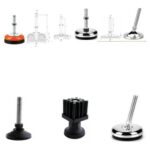
Floor anchoring effectively transfers these static and dynamic loads to the foundation, mitigating their impact. This is typically achieved using leveling feet with integrated anchor points and specialized anchor bolts. Leveling feet ensure the machine is perfectly horizontal, while anchor bolts provide a secure, permanent connection. For machines that generate significant vibrations or require extreme precision, anti-vibration pads or mounts can be installed between the machine and the floor. These pads help dampen vibrations transmitted to and from the machine, though they do not eliminate the need for anchoring; they are usually used in conjunction with anchor bolts.
Large, heavy CNC machines, such as gantry mills or large lathes, may necessitate installation on a dedicated concrete foundation designed to handle both static weight and dynamic operational forces. The foundation’s depth, concrete strength, and reinforcement are determined by engineering calculations based on the machine’s weight, cutting forces, and site conditions. Proper anchoring and leveling are directly correlated with the surface finish, dimensional tolerances, and geometric accuracy of machined parts. Even micron-level deviations from an unsecured machine can result in scrapped components.
| Parameter | Value/Description |
|---|---|
| Anchoring Purpose | Enhance machining precision, dampen vibration, extend machine life, ensure operator safety. |
| Typical Vibration Frequencies | 50 Hz – 5000 Hz, varies with spindle speed and cutting dynamics. |
| Anchor Bolt Types | Chemical anchors (epoxy/polyester resin), mechanical anchors (expansion/wedge type), specialized anchor bolts. |
| Minimum Concrete Thickness | Typically 150 mm – 300 mm (varies by machine weight and type); heavy machines may require specialized foundations. |
| Torque Values | Follow manufacturer-specified values (e.g., 80-120 Nm for M16) based on bolt diameter and type. |
| Leveling Accuracy | 0.02 mm/meter – 0.05 mm/meter (depends on precision requirements). Optical or laser leveling devices are used. |
| Floor Flatness Tolerance | Recommended maximum deviation of 2-3 mm per square meter. |
| Vibration Damping Ratio | 60% – 95% damping achievable with specific isolation pads. |
On-Site Considerations for Installation
- Foundation Preparation and Quality: The installation surface must possess adequate load-bearing capacity, be level, and capable of dampening vibrations. High-strength (e.g., C25 or higher) and well-cured concrete floors are preferred. Ensure the floor is free from cracks, slopes, or voids. Allow new concrete to cure fully (typically 28 days) before installation. Use specialized leveling compounds or epoxy coatings to achieve the required flatness.
- Precise Leveling: For optimal CNC performance, the machine must be perfectly horizontal and plumb. Utilize the adjustable leveling feet on the machine’s base, employing a high-precision spirit level or a laser leveling device. Even minor deviations can misalign axes, negatively impacting machining accuracy, tool life, and surface finish. Follow the manufacturer’s instructions meticulously during the leveling process.
- Correct Anchor Bolt Selection and Installation: Choose anchor bolts appropriate for the machine’s weight, floor type, and expected dynamic loads. Chemical anchors offer high pull-out strength, while mechanical anchors provide faster installation. Ensure bolts are installed to the correct depth and tightened to the manufacturer’s specified torque values. Under-tightening can lead to movement, while over-tightening can damage the bolt or the floor.
- Vibration Isolation Applications: In environments with external vibration sources or for machines producing high-frequency vibrations, consider placing anti-vibration pads or rubber mounts under the machine feet. These help isolate the machine from floor vibrations and prevent vibration transmission to the surroundings. Remember, these pads supplement, but do not replace, the need for secure anchoring with bolts.
- Periodic Checks and Maintenance: Regularly inspect the tightness of anchor bolts and the machine’s level after installation and during operation. Vibrations can cause bolts to loosen over time. Re-torque any loose bolts and re-level the machine if necessary. These routine checks are vital for maintaining the machine’s long-term accuracy and operational integrity.

Common Issues and Solutions
During the installation or operation of CNC machines, several issues can arise if proper floor anchoring is neglected. One common problem is machine walking, where the machine visibly shifts its position during operation. This is typically caused by insufficient anchoring or uneven leveling, leading to inaccuracies and potential damage. The solution involves re-securing the machine with appropriate anchor bolts and ensuring precise leveling.
Another frequent issue is excessive vibration, which can degrade part quality, accelerate tool wear, and cause operator fatigue. This can stem from an unsecured machine resonating with its operational frequencies or from vibrations transmitted from the floor. Solutions include reinforcing the anchoring, using anti-vibration pads, and ensuring the foundation itself is stable. Inadequate leveling can lead to dimensional inaccuracies and poor surface finish, as the machine’s axes are not operating on a true plane. Correcting this requires meticulous re-leveling using precision instruments.
Premature wear on machine components, such as linear guide rails and spindle bearings, can also be a consequence of vibration and movement. Ensuring the machine is rigidly anchored minimizes these stresses. Finally, operator safety is paramount. An unsecured, vibrating machine poses a risk of unexpected movement or component failure. Proper anchoring is a fundamental safety measure.
For any industrial CNC router machine, whether it’s a heavy-duty industrial CNC router or a more specialized model, the principle remains the same: secure installation is non-negotiable for optimal performance and safety. Investing in proper floor preparation and anchoring ensures the longevity and precision of your CNC equipment.
Need expert advice on installing your CNC machinery? Request a quote on WhatsApp today and ensure your operations run smoothly and precisely.
Related product categories: Genel · Turuncu Makine Ayağı · Federli Makine Ayağı