








































































Chassis Static Analysis and Vibration Damping for Precision Cutting

📑 Table of contents (Click to open)
Introduction and Technical Analysis
At the heart of industrial automation, precision cutting applications are an indispensable part of modern manufacturing processes. Across a wide spectrum, from laser cutting and waterjet cutting to CNC machining centers and robotic welding systems, achieving results with sub-micron accuracy is a fundamental requirement for staying competitive in today’s market. In ensuring this high precision, the static rigidity of the chassis (frame) structure on which the machine is positioned and its capability for dynamic vibration damping play a critical role. The design and manufacturing of the chassis not only support the machine components but also directly impact operational stability, longevity, and most importantly, the final product quality. This technical article and field guide aim to provide engineers, technicians, and decision-makers in the industrial automation sector with a comprehensive perspective on chassis static analysis and effective vibration damping strategies for precision cutting machines.
Static analysis is an engineering method that evaluates how a chassis structure deforms under external loads (e.g., weight of machine components, cutting forces, motor torques), where stress concentrations occur, and its overall rigidity. These analyses, particularly those performed using Finite Element Analysis (FEA/FEM) techniques, allow for the identification of potential weaknesses, optimization of material usage, and prevention of excessive displacements or stresses during the design phase. A chassis lacking sufficient static rigidity can flex even at the micron level during cutting, leading to deviations in the tool path, degradation of surface quality, and geometric errors. This situation can result in unacceptable product rejection rates, especially in critical sectors such as aerospace, medical, and defense industries.
On the other hand, vibration damping aims to minimize the transmission of dynamic loads (motor vibrations, harmonics generated by the cutting process, table movements) that arise during machine operation to the chassis and, consequently, to the workpiece. Vibrations shorten tool life, increase surface roughness, cause premature wear in machine components, and most importantly, reduce cutting precision. An effective vibration damping strategy can involve various approaches, from passive damping elements (viscoelastic materials, spring-damper systems) to active control systems (sensor and actuator-based feedback systems). Integrating both static rigidity and dynamic damping properties into the chassis design is vital for maximizing the performance and reliability of industrial automation systems. This guide details the practical applications and optimization methods of these two fundamental engineering disciplines in field applications.
Operating Principle and Technical Data
The primary goal in chassis design and vibration damping strategies for precision cutting machines is to ensure high repeatability and accuracy throughout the machine’s operational life. This is achieved by the chassis exhibiting minimal deformation under static loads and effectively damping vibrations by avoiding resonances under dynamic loads.
Chassis Design and Material Selection: As the chassis is the main load-bearing element of the machine, material selection and structural geometry are of great importance. Typically, materials such as welded steel structures, cast iron, or polymer concrete (mineral casting) are preferred. Steel structures offer a high rigidity-to-weight ratio and can be manufactured in complex geometries, while cast iron and polymer concrete absorb vibrations more effectively due to their natural damping properties. Polymer concrete, in particular, is increasingly preferred in ultra-precision applications due to its high damping capacity, thermal stability, and corrosion resistance. In design, bending and torsional rigidity are increased by using closed sections (box profiles), ribs, and reinforcements. In welded structures, stress relieving is critical to prevent deformations that may occur over time by eliminating internal stresses.
Static Analysis Details: The static behavior of the chassis is thoroughly examined using Finite Element Analysis (FEA) software. In this analysis, all static and quasi-static loads, such as the weight of machine components (motors, optics, cutting head, table), the weight of the workpiece, forces generated during the cutting process (cutting pressure, friction), and motor torques, are applied. Boundary conditions represent the connection points of the chassis to the ground or foundation. The resulting displacement maps, stress distributions (Von Mises stress), and torsion angles are examined. Acceptable displacement limits in precision cutting areas are typically at the micron level (e.g., a maximum of 5-10 microns over 1000 mm). In areas with stress concentrations, material thickness is increased, or geometry is optimized. The goal is to ensure that the chassis remains within the specified rigidity tolerances under all operating conditions.
Vibration Damping Mechanisms: Vibration control is generally achieved through a combination of passive and active methods.
- Passive Vibration Damping:
- Material Intrinsic Damping: The use of materials with high intrinsic damping coefficients, such as cast iron or polymer concrete, dissipates vibration energy by converting it into heat.
- Viscoelastic Dampers: Pads, isolators, or damping layers made of rubber, neoprene, or special polymers are placed between the machine and the floor or integrated between chassis elements to reduce vibration transmission. These materials provide both damping and flexibility, reducing resonance amplitudes.
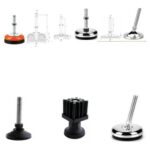
- Spring and Damper Systems: Springs used in machine feet isolate low-frequency vibrations, while hydraulic or pneumatic dampers absorb sudden shocks and resonances. Air springs can provide adaptive damping against load changes.
- Tuned Mass Dampers (TMD): An additional mass-spring-damper system tuned to a specific resonance frequency of the chassis helps absorb and damp vibration energy at that frequency. This is particularly effective in systems with a single dominant resonance frequency.
- Rigid Connections and Anchoring: Firmly anchoring the machine to a solid floor or a special concrete foundation increases the overall rigidity of the chassis and reduces the effect of external vibrations. Proper anchor bolts and leveling pads must be used.
- Active Vibration Damping:
- Sensor-Actuator Systems: Sensors such as accelerometers or laser displacement sensors measure vibrations in real-time. A control unit processes this data and actively cancels vibrations by generating forces in counter-phase through piezoelectric actuators, electro-hydraulic systems, or magnetostrictive actuators. These systems are used especially in applications requiring very high precision and where dynamic loads constantly change.
- Feedback Control: Based on the principle of continuously monitoring the vibration signal and dynamically adjusting the actuator output by the control algorithm. This can provide effective damping over a wide frequency range.
Performance Criteria: The vibration performance of a chassis is evaluated by parameters such as resonance frequencies (natural frequencies of the machine), damping ratios (how quickly vibration amplitude decreases over time), and vibration amplitudes (maximum permissible vibration amplitude during operation). The design goal is to ensure that the machine’s operating frequencies are far from the chassis’s natural resonance frequencies and that the amplitudes of any resulting vibrations remain below acceptable levels. Typically, the permissible vibration amplitude during cutting operations can be at the level of 1-5 microns RMS (root mean square).
| Parameter | Value/Description |
|---|---|
| Chassis Material Type | High-quality welded steel (S355JR or similar) or Polymer Concrete (Mineral Casting) |
| Young’s Modulus (E) | ~210 GPa for Steel, ~30-50 GPa for Polymer Concrete (Must be checked against manufacturer datasheet) |
| Poisson’s Ratio (ν) | ~0.3 for Steel, ~0.25 for Polymer Concrete (Must be checked against manufacturer datasheet) |
| Density (ρ) | ~7850 kg/m³ for Steel, ~2300-2400 kg/m³ for Polymer Concrete |
| Maximum Static Displacement Tolerance | Typically < 5-10 microns per 1000 mm length |
| First Resonance Frequency Target | Should be > 25% above the machine’s operating frequency range (e.g., > 150 Hz) |
| Vibration Damping Ratio | 0.5-2% for Steel, 3-5% for Polymer Concrete (Must be checked against manufacturer datasheet) |
| Surface Finish Quality Target | Ra value < 0.8 μm for critical surfaces |
Field Considerations
- Foundation Preparation and Machine Leveling: The floor where the machine will be installed must be solid, flat, and free from vibrations. A special concrete foundation may be required. Machine feet should be designed to provide precise leveling and rigid anchoring, and during installation, laser alignment devices should be used to level with sub-millimeter accuracy. Incorrect leveling can lead to internal stresses and deformations in the chassis.
- Periodic Maintenance and Bolt Torque Checks: All connection bolts on the chassis, especially those in areas exposed to vibrations, should be periodically checked and tightened to specified torque values. Loose connections can increase vibration amplitude and reduce chassis rigidity. The wear and tear of vibration damping elements (rubber pads, springs) should be regularly inspected and replaced when their service life expires.
- Operating Environment Conditions: The temperature, humidity, and dust levels of the machine’s operating environment must be controlled. Large temperature variations can cause thermal expansion and contraction of the chassis, leading to precision losses. External ground vibrations (nearby forklift traffic, other machines) should be monitored, and additional ground isolation provided if necessary.
- Operator Training and Process Parameters: Machine operators must be trained in correct workpiece loading and clamping techniques. Improper clamping can cause additional vibrations during cutting. Furthermore, process parameters such as cutting speeds, feed rates, and spindle speeds should be optimized to suit machine dynamics. Speeds close to resonance frequencies should be avoided.
- Real-Time Vibration Monitoring and Analysis: Vibration levels during machine operation should be continuously monitored using accelerometers or vibration sensors placed in critical areas. Abnormal increases in vibration can be an early indicator of a potential malfunction or maintenance need. The collected data can be used for predictive maintenance strategies.
- Spare Parts Management and Isolator Life: Vibration damping elements (e.g., rubber isolators) have a specific lifespan and lose their damping properties over time due to hardening or fatigue. A stock of these parts should be maintained, and periodic replacements should be made according to the manufacturer’s recommendations.

Common Problems and Solutions
Problems encountered with chassis static rigidity and vibration damping in precision cutting machines are often interconnected and can be summarized by the following scenarios:
- Excessive Vibration and Resonance:
- Problem: The machine exhibiting abnormally high vibration levels at certain operating speeds or frequencies, usually indicating it has entered a resonance state. This leads to degradation of surface quality, reduced tool life, and excessive noise.
- Solution:
- Frequency Analysis: Determine the machine’s natural frequencies and dominant vibration frequencies during operation using a vibration analyzer.
- Adjustment of Operating Parameters: Adjust machine operating speeds (spindle RPM, feed rate) to move away from resonance frequencies.
- Passive Damping Improvement: Integrate additional damping materials (viscoelastic pads), tuned mass dampers (TMD) into the chassis, or replace existing isolators in machine feet with those having higher damping capacity.
- Structural Reinforcement: Increase chassis rigidity by adding reinforcing ribs or increasing material thickness in critical areas, which shifts natural frequencies upwards.
- Loss of Precision and Dimensional Errors:
- Problem: Inconsistencies in the dimensions or geometries of cut parts, degradation of edge perpendicularity, or a general decrease in machining precision. This can result from insufficient chassis static rigidity or thermal deformations.
- Solution:
- Repeat Static Analysis: Re-analyze the current chassis design with FEA to check displacements under load and identify weak areas.
- Chassis Reinforcement: Strengthen identified weak areas with additional reinforcements or more rigid connection elements.
- Thermal Management: Control ambient temperature and use effective cooling systems or thermal insulation for heat sources within the machine (motors, spindle).
- Periodic Calibration: Machine axes and the cutting head should be regularly checked with precision calibration devices, and necessary adjustments made.
- High Noise Level:
- Problem: The machine producing excessive noise during operation, posing issues for both operator health and environmental regulations. This typically results from the conversion of vibrations into acoustic energy.
- Solution:
- Acoustic Insulation: Add sound insulation panels or enclosures around the machine.
- Vibration Damping: Identify vibration sources causing noise and apply relevant vibration damping methods (isolators, damping materials).
- Mechanical Friction Control: Check friction sources in moving parts (bearings, linear guides), improve lubrication, or replace worn parts.
- Reduced Tool Life and Surface Quality Defects:
- Problem: Cutting tools (laser optics, waterjet nozzles, CNC cutters) wearing out faster than normal, and defects such as roughness, burrs, or waviness appearing on the machined surface. These situations are often a direct result of excessive vibration and lack of rigidity.
- Solution:
- Vibration Analysis and Optimization: Analyze the dynamic interaction between the machine and the tool, determine appropriate cutting parameters and tool geometries.
- Chassis and Component Rigidity: Increase the rigidity of the chassis and critical components like tool holders to reduce vibration amplitudes.
- Tool Holder and Connection Quality: Ensure tool holders are high-precision and have vibration-damping properties. Check tool connections.
- Cooling and Lubrication: Use effective cooling and lubrication systems in the cutting zone to improve tool wear and surface quality.
Expert Advice
Chassis static analysis and vibration damping for precision cutting machines are two indispensable fundamental engineering disciplines in industrial automation. Addressing these two areas with an integrated approach not only extends the machine’s lifespan but also directly impacts production quality, efficiency, and operating costs. From an expert perspective, the success of a chassis begins with detailed Finite Element Analyses performed during the design phase. These analyses identify potential weaknesses before a physical prototype is even produced, preventing costly revisions. Material selection, especially the use of composites with high damping capacity such as cast iron and polymer concrete, offers significant advantages in terms of dynamic performance. However, even the best-designed chassis cannot deliver expected performance without proper installation and periodic maintenance. Precise anchoring of the machine to a solid and level foundation, tightening all fasteners to specified torque values, and regular inspection of vibration damping elements are essential for continuous operational stability. A large portion of field problems stem from fundamental installation errors or maintenance deficiencies. Therefore, continuous training for operators and maintenance teams in these areas will enhance their ability to detect and resolve problems at an early stage. The integration of vibration monitoring sensors and the analysis of collected data hold the potential to develop predictive maintenance strategies, minimizing unexpected downtime. In the future, adaptive vibration control systems, supported by artificial intelligence and machine learning algorithms, will set new standards in precision and efficiency by optimizing the chassis’s dynamic behavior in real-time. Every engineer and technician in the industrial automation sector must master these fundamental principles and actively apply them to enhance the sector’s competitiveness.
FAQ
What is chassis static analysis and why is it important for precision cutting machines?
Chassis static analysis evaluates how a machine's frame deforms under loads like component weight, cutting forces, and motor torques. It uses methods like Finite Element Analysis (FEA) to identify weak points, optimize material use, and prevent excessive displacement or stress, which are crucial for maintaining micron-level precision in industrial CNC router machines.
How does vibration damping contribute to the performance of industrial CNC router machines?
Vibration damping minimizes the transmission of dynamic loads (e.g., motor vibrations, cutting harmonics) to the chassis and workpiece. It's critical because vibrations reduce tool life, increase surface roughness, cause premature wear, and significantly decrease cutting precision. Effective damping ensures consistent high-quality output and extends machine longevity.
What materials are typically used for precision cutting machine chassis and why?
Common materials include welded steel structures, cast iron, and polymer concrete (mineral casting). Steel offers high rigidity, while cast iron and polymer concrete provide superior natural damping properties. Polymer concrete is increasingly favored for ultra-precision applications due to its high damping capacity, thermal stability, and corrosion resistance.
What are the main types of vibration damping mechanisms used in industrial CNC machines?
Both passive and active methods are employed. Passive methods include using materials with high intrinsic damping (e.g., polymer concrete), viscoelastic dampers (rubber pads), spring-damper systems, tuned mass dampers, and rigid anchoring. Active methods involve sensor-actuator systems with feedback control to actively cancel vibrations in real-time, especially for very high precision needs.
What practical steps should be taken in the field to ensure optimal chassis performance and vibration control?
Key field considerations include ensuring a solid, level, and vibration-free foundation, precise machine leveling, periodic maintenance with bolt torque checks, controlling environmental conditions (temperature, humidity, dust), proper operator training on workpiece loading, and real-time vibration monitoring. These practices help sustain operational stability and precision.