No products in the cart.
Air-Cooled vs. Water-Cooled Spindle Motor: Which to Choose for Industrial CNC Routers?
Contents
- Air-Cooled vs. Water-Cooled Spindle Motor: Which to Choose? Introduction and Technical Analysis
- Air-Cooled vs. Water-Cooled Spindle Motor: Operating Principle and Technical Data
- Air-Cooled Spindle Motors
- Water-Cooled Spindle Motors
- Air-Cooled vs. Water-Cooled Spindle Motor: Field Considerations
- Air-Cooled vs. Water-Cooled Spindle Motor: Common Problems and Solutions
- Common Problems and Solutions in Air-Cooled Spindle Motors:
- Common Problems and Solutions in Water-Cooled Spindle Motors:
- Air-Cooled vs. Water-Cooled Spindle Motor: Conclusion and Expert Advice
- FAQ
Air-Cooled vs. Water-Cooled Spindle Motor: Which to Choose? Introduction and Technical Analysis
At the heart of industrial automation, spindle motors are critical components for CNC machines, robotic systems, and other precision machining equipment. These motors directly impact machining accuracy, efficiency, and product quality. However, one of the fundamental dilemmas when selecting a spindle motor is the choice of cooling system: air-cooled or water-cooled? This decision affects not only the initial investment cost but also operational performance, maintenance requirements, lifespan, and even the overall working environment. An incorrect cooling system choice can lead to severe issues such as overheating, performance degradation, premature failures, and high maintenance costs. This comprehensive field guide and technical article aims to provide industrial automation professionals with a detailed understanding of the differences, advantages, disadvantages, and suitability of air-cooled and water-cooled spindle motors for various scenarios. By delving into the operating principles, technical details, and practical applications in field conditions for both cooling methods, we will help readers make informed and optimized decisions. This will enable businesses to both increase their efficiency and reduce long-term costs.
Air-Cooled vs. Water-Cooled Spindle Motor: Operating Principle and Technical Data
The operating principle of spindle motors is fundamentally based on an electric motor transmitting rotational motion to a cutting tool. However, when operating at high speeds and under heavy loads, they generate a significant amount of heat due to friction and electrical losses. Effective dissipation of this heat is vital for maintaining the motor’s performance, lifespan, and machining accuracy. This is where cooling systems come into play.
Air-Cooled Spindle Motors
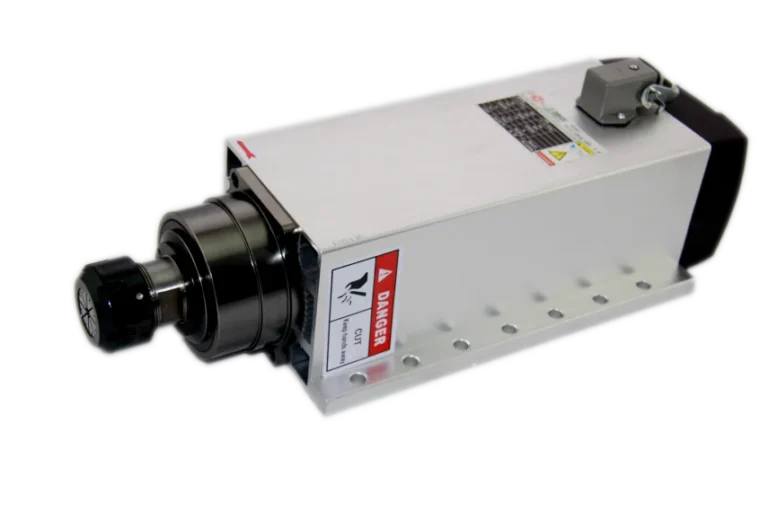
Operating Principle: Air-cooled spindle motors, as the name suggests, use ambient air to dissipate heat. A fan is typically integrated at the rear of the motor. This fan draws and pushes air over the fins around the motor body, removing heat from the motor’s surface. Some models may also have internal air channels running through the motor. This method achieves heat transfer through convection.
Technical Data and Application Areas:
- Simplicity: Their biggest advantage is the simplicity of the system. They do not require an external cooling unit (chiller), pump, or hose installation. This makes installation and commissioning quite easy.
- Cost: Generally, the initial purchase cost is lower compared to water-cooled systems. Since they do not require additional equipment, the total system cost can also be more affordable.
- Maintenance: Maintenance requirements are generally lower; periodic cleaning of the fan and fins from dust is usually sufficient.
- Application Areas: Ideal for woodworking, plastic processing, light metal machining (such as aluminum), engraving applications, and general CNC router machines requiring lower power. They are quite effective for power ratings typically up to 3 kW.
- Disadvantages:
- Noise: They are generally noisier due to the continuous operation of the fan. This can be an issue, especially in sensitive working environments or with prolonged operator exposure.
- Temperature Control: Dependent on ambient temperature. When the ambient temperature is high or the motor operates under high load for extended periods, cooling efficiency may decrease, and the motor can overheat. They do not provide precise temperature control.
- Dust Sensitivity: Dust and debris in the environment can clog the fan blades and cooling channels, negatively affecting cooling performance. This requires regular cleaning.
- Heat Dissipation: The heat generated by the motor is directly dissipated into the working environment, which can increase ambient temperature in enclosed or small workshops.
- Power Limitation: They may struggle to provide adequate cooling in high-power (e.g., above 5 kW) and long-duration, heavy-load applications.
Water-Cooled Spindle Motors
Operating Principle: Water-cooled spindle motors remove heat using a cooling fluid (typically water or a special cooling solution) circulating in a closed loop through channels inside the motor body. This fluid absorbs heat as it passes through special channels around the motor and is then transferred to an external chiller unit or radiator. The chiller unit maintains the temperature of the cooling fluid at a specific level, dissipating the heat externally and returning the cooled fluid to the motor. This system provides extremely efficient heat transfer.
Technical Data and Application Areas:
- Temperature Control: The most significant advantage is the precise control of the cooling fluid’s temperature by the chiller unit. This ensures the motor remains at its optimal operating temperature, which extends bearing life and minimizes thermal expansion errors in high-precision machining.
- Noise: They are much quieter during operation because an external fan does not continuously run on the motor. The chiller unit can be positioned separately.
- Power Density and Performance: Ideal for high-power (3 kW and above), high-speed, and heavy-load applications. Thanks to more efficient heat dissipation, motors can operate at high performance for longer durations.
- Clean Environments: They are unaffected by ambient dust, offering reliable performance even in dusty or dirty environments.
- Application Areas: Preferred in metal machining (hard metals like steel, titanium), mold making, aerospace industry, glass processing, high-precision engraving, and applications requiring long-duration, continuous operation.
- Disadvantages:
- Cost: The initial purchase cost is higher because, in addition to the spindle motor, a chiller unit, pump, hoses, and connectors are required.
- Installation Complexity: Installation is more complex, involving additional steps such as plumbing for water, chiller unit placement, and electrical connections.
- Maintenance: The cooling fluid may need periodic checking, replacement, and the use of corrosion inhibitors. There is a risk of leaks at hose and connection points.
- Space Requirement: Requires additional space for the chiller unit.
- Leakage Risk: Water or cooling fluid leakage has the potential to damage other electronic components.
| Parameter | Air-Cooled Spindle | Water-Cooled Spindle |
|---|---|---|
| Cooling Principle | Ambient air (fan and fins) | Closed-loop cooling fluid (chiller/radiator) |
| Temperature Control | Dependent on ambient temperature, less precise | Precise and stable control with chiller |
| Noise Level | Generally higher (fan noise) | Lower (chiller can be positioned separately) |
| Initial Cost | Lower | Higher (chiller, pump, hoses) |
| Maintenance Ease | Easier (dust cleaning) | More complex (fluid change, leak check) |
| Power Range | Typically low to medium power (0.8 kW – 5 kW) | Medium to high power (1.5 kW – 24 kW and above) |
| Precision | Can be affected by thermal expansion | High precision (due to stable temperature) |
| Typical Applications | Wood, plastic, light metals, engraving | Hard metals, mold making, glass, long-duration heavy machining |
| System Complexity | Simple, compact | More complex, requires additional space |
Air-Cooled vs. Water-Cooled Spindle Motor: Field Considerations
- Operating Environment Conditions: This is one of the most critical factors in selection. If the workshop environment is dusty, chip-laden, or dirty, the cooling fins and fan of an air-cooled spindle motor can quickly become clogged, reducing cooling performance and leading to overheating. In such environments, a water-cooled system is much more advantageous as it protects the motor’s internal mechanism from external factors. Ambient temperature is also important; at high ambient temperatures, the cooling capacity of air-cooled systems drops significantly, while water-cooled systems can maintain a more stable operating temperature thanks to the chiller.
- Machining Material and Continuity: The type of material to be machined and the intensity of the machining directly affect how much heat the spindle will generate. Hard metals (such as steel, titanium), high RPMs, and long-duration, continuous operation (e.g., 8-10 hour shifts) generate more heat. In these scenarios, water-cooled spindle motors, offering precise temperature control and high heat dissipation capacity, are indispensable. For short-duration or intermittent machining of softer materials like wood or plastic, air-cooled systems are usually sufficient.
- Precision and Surface Quality Requirements: Especially in high-precision applications such as mold making, optical parts, or aerospace components, thermal expansion of the motor can directly affect machining tolerances. Water-cooled systems minimize thermal expansion by keeping the spindle’s operating temperature within a narrow range, thus providing higher machining precision and surface quality. Temperature fluctuations can be more pronounced in air-cooled systems, which can lead to deviations in very precise work.
- Noise Tolerance and Operator Comfort: Air-cooled spindles are generally noisier due to the continuous operation of the fan. In enclosed workshops or situations where operators work at the machine for long periods, this noise can degrade the quality of the working environment and cause fatigue. In environments with high noise sensitivity or where compliance with international noise standards is required, quieter water-cooled systems should be preferred. The chiller unit can be placed in a separate area away from the machine to further reduce noise levels.
- Installation Ease and Maintenance Costs: Air-cooled systems are simpler to install as they do not require additional equipment. However, in dusty environments, the fan and fins need regular cleaning. Water-cooled systems require more complex installation due to the chiller unit, pump, hose plumbing, and electrical connections. Additionally, there are extra maintenance items such as periodic replacement of cooling fluid, filter checks, and leak detection. These maintenance costs and labor are significant factors affecting the total cost of ownership (TCO). However, with proper maintenance, water-cooled systems can offer fewer breakdowns and lower repair costs in the long run by extending bearing life.
- Space and Infrastructure Requirements: Water-cooled systems require space for a chiller unit in addition to the spindle. This chiller can be located next to the machine or in a separate technical room. In situations where existing workshop space is limited, this additional space requirement can be a disadvantage. Furthermore, adequate electrical infrastructure and sometimes a water connection may be needed for the chiller. Air-cooled systems, on the other hand, offer a more compact solution and generally do not require additional infrastructure.
Air-Cooled vs. Water-Cooled Spindle Motor: Common Problems and Solutions
While both spindle cooling systems have their unique advantages, they also have potential problems that can arise due to incorrect installation, inadequate maintenance, or improper use. Recognizing these problems and implementing the correct solutions is vital to prevent production interruptions and extend equipment life.
Common Problems and Solutions in Air-Cooled Spindle Motors:
- Overheating and Performance Degradation:
Problem: Overheating of the spindle motor can lead to speed reduction, increased vibration, and deterioration in machining quality. This situation usually results from the cooling fins or fan on the motor being clogged with substances like dust, chips, or oil mist. High ambient temperature also reduces cooling efficiency.
Solution:
- Regular Cleaning: Periodically clean the spindle motor’s cooling fins and fan with compressed air or a soft brush. This cleaning routine is crucial, especially for machines processing wood or composite materials.
- Environment Control: Try to keep the working environment’s temperature as low as possible. Improve workshop ventilation systems if necessary.
- Adequate Airflow: Ensure there is sufficient clearance around the spindle and no equipment or obstructions impeding airflow.
- Load Control: Avoid continuously operating the motor at maximum load, especially if environmental conditions are challenging.
- Increased Noise and Vibration:
Problem: Unbalanced fan operation, worn bearings, or foreign objects caught in the fan blades can increase noise and vibration. This can also damage the spindle bearings.
Solution:
- Fan Inspection: Check the physical condition of the fan. Replace damaged or unbalanced fans.
- Bearing Inspection: Check for signs of wear in the spindle’s own bearings as well as the fan motor’s bearings. Replace bearings if necessary.
- Mounting Inspection: Ensure the spindle is correctly and securely mounted to the machine. Loose connections can cause vibration.
Common Problems and Solutions in Water-Cooled Spindle Motors:
- Loss of Cooling Efficiency and Overheating:
Problem: Insufficient cooling of the spindle due to inadequate chiller cooling, contaminated cooling fluid, pump failure, or air bubbles in the system.
Solution:
- Chiller Maintenance: Regularly clean the condenser and evaporator coils of the chiller unit. Have refrigerant gas levels checked. Ensure the chiller is appropriate for the ambient temperature and the spindle’s power requirements.
- Cooling Fluid Check: Regularly check the level, quality, and cleanliness of the cooling fluid. Immediately replace dirty, algae-filled, or corroded fluids. Use distilled water and manufacturer-recommended corrosion inhibitors/antifreeze additives.
- Pump Check: Ensure the cooling fluid pump is operating correctly and providing sufficient flow. Replace the pump if it fails.
- Air Purging: Perform air purging according to manufacturer instructions to remove air bubbles from the cooling system. Air bubbles can obstruct flow and reduce cooling efficiency.
- Leaks and Corrosion:
Problem: Leaks occurring at hose connections, pump seals, or in the chiller unit. Corrosion within the system due to incorrect cooling fluid usage or insufficient corrosion inhibitor.
Solution:
- Regular Inspection: Regularly check all hose connections, clamps, and seals for signs of leaks. Tighten or replace loose or worn parts.
- Correct Fluid Usage: Always use the manufacturer’s recommended cooling fluid and additives. Prefer distilled water over tap water and remember to add corrosion inhibitor and antifreeze (especially in cold climates).
- Material Compatibility: Ensure all parts in the system (hoses, connections, pump internal parts) are compatible with the cooling fluid used.
- Clogs:
Problem: Clogging of the motor’s fine cooling channels or chiller filters by particles, corrosion products, or algae formation within the cooling fluid.
Solution:
- Filtration: Regularly check and clean or replace the chiller unit’s filters.
- Fluid Replacement: Completely replace the cooling fluid at the intervals recommended by the manufacturer.
- System Cleaning: In cases of severe clogging, it may be necessary to clean the entire cooling system with special cleaning solutions.
In both cooling systems, strict adherence to the periodic maintenance procedures specified in the manufacturer’s user manual is the best approach to prevent potential problems and ensure long-lasting, efficient operation of your spindle motor. When problems arise, early diagnosis and rapid intervention prevent larger breakdowns and costly production downtimes.
Air-Cooled vs. Water-Cooled Spindle Motor: Conclusion and Expert Advice
The choice between air-cooled and water-cooled spindle motors is a highly application-specific decision, with no single correct answer, given the complexity and diversity of industrial automation applications. Both technologies have their unique advantages and disadvantages, and making the optimal choice requires a detailed evaluation of your business’s specific needs, budget constraints, and operational expectations.
If your application is simple, requires low power, operates intermittently, and is in an environment not highly sensitive to dust (e.g., hobby CNC machines, wood or plastic engraving and cutting, light aluminum machining), air-cooled spindle motors generally offer a more economical, easier-to-install, and less complex maintenance solution. The low initial cost and simplicity of the system can be an attractive option, especially for small and medium-sized businesses. However, even in this case, keeping the amount of dust in the environment to a minimum and regularly cleaning the fan/fins will directly affect the motor’s lifespan and performance.
On the other hand, if your application demands high precision, long-duration operation under heavy load, machining of hard materials (steel, titanium, mold steel), high RPMs, and low noise levels, water-cooled spindle motors offer an undeniably superior option. Precise temperature control provided by the chiller unit minimizes machining errors caused by thermal expansion, extends tool life, and delivers much more stable operating performance. Although the initial investment cost is higher, this cost difference is usually amortized in the long run through fewer breakdowns, longer bearing life, and high-quality production output. Especially in dusty or dirty industrial environments, the immunity of water-cooled systems to external factors makes them a more reliable choice.
As expert advice, it is recommended to follow these steps when making this critical decision:
- Define Your Machining Requirements: What materials will you be machining? What RPM and torque ranges do you need? What level of precision and surface quality do you expect? How long will the machining cycles be?
- Evaluate Your Operating Environment: How dusty, humid, or hot is your workshop environment? What is your noise tolerance? Do you have sufficient space for a chiller unit?
- Consider Your Budget and Total Cost of Ownership (TCO): Account not only for the initial cost but also for energy consumption, maintenance (consumables, labor), potential breakdown costs, and the cost of production downtime.
- Seek Expert Opinion: Contact spindle motor manufacturers or industrial automation integrators. Do not hesitate to get specific advice and solutions tailored to your applications. Field experience will be an invaluable guide in making the right decision.
Remember, choosing the correct spindle cooling system not only increases the efficiency and lifespan of your machine but also elevates your production quality and directly contributes to your business’s competitiveness. In light of this detailed analysis and guide, by selecting the most suitable spindle motor cooling solution for your needs, you can achieve maximum efficiency from your automation investments.
FAQ
What are the main differences between air-cooled and water-cooled spindle motors?
Air-cooled spindle motors are generally simpler, more affordable, and easier to install, making them suitable for light-duty applications like woodworking, plastic processing, and engraving. Water-cooled spindle motors offer superior temperature control, quieter operation, and are ideal for high-precision, heavy-duty applications involving hard metals, mold making, and continuous operation where thermal stability is critical.
What maintenance is required for each type of spindle cooling system?
For air-cooled spindles, regular cleaning of the fan and cooling fins is essential to prevent dust and debris buildup, which can lead to overheating. For water-cooled systems, maintenance involves checking and replacing the cooling fluid periodically, ensuring the chiller unit is clean and functioning, and inspecting for any leaks in the hoses and connections. Using distilled water with recommended additives is crucial for water-cooled systems.
What are the common problems associated with air-cooled and water-cooled spindle motors?
Air-cooled spindles are prone to overheating in high ambient temperatures or under prolonged heavy loads, and their cooling efficiency can be compromised by dust. Water-cooled spindles, while offering better performance, have higher initial costs, more complex installation, and the potential for leaks or corrosion if not properly maintained.
How do I choose the right spindle cooling system for my industrial CNC router?
Consider your machining materials (soft vs. hard metals), required precision, operating hours (intermittent vs. continuous), workshop environment (dusty vs. clean), and budget (initial cost vs. total cost of ownership). High-precision, heavy-duty, and continuous operations in demanding environments typically benefit more from water-cooled systems.
How does spindle cooling affect machining precision and surface quality?
Water-cooled spindles provide more stable operating temperatures, which minimizes thermal expansion of the motor. This leads to higher machining accuracy and better surface finishes, especially crucial for applications like mold making, aerospace components, and optical parts where tight tolerances are required.