No products in the cart.
80×80 and 90×90 Sigma Profile Features for Heavy Industry
Contents
- Introduction and Technical Analysis of 80×80 and 90×90 Sigma Profiles for Heavy Industry
- Working Principle and Technical Data of 80×80 and 90×90 Sigma Profiles for Heavy Industry
- Field Considerations for 80×80 and 90×90 Sigma Profile Features in Heavy Industry
- Common Issues and Solutions for 80×80 and 90×90 Sigma Profile Features in Heavy Industry
- Conclusion and Expert Advice on 80×80 and 90×90 Sigma Profile Features for Heavy Industry
- FAQ
Introduction and Technical Analysis of 80×80 and 90×90 Sigma Profiles for Heavy Industry
Sigma profiles are indispensable building blocks in industrial automation and heavy industry applications, distinguishing themselves with their modular design, lightweight nature, and high strength. Specifically, large cross-section aluminum extrusions like the 80×80 sigma profile and 90×90 sigma profile are preferred in demanding industrial environments that require high load-bearing capacity and rigidity. These profiles offer a range of significant advantages over traditional steel constructions, including ease of assembly, flexibility, corrosion resistance, and aesthetics. Heavy industry typically involves challenging conditions such as large machinery, high-speed moving systems, vibrating equipment, and the transport of heavy loads. Structural elements selected for such environments are expected to withstand dynamic and static loads, offer long service life, and simultaneously enhance the overall efficiency of the system. This technical article will comprehensively discuss the critical role, technical specifications, application areas, and field considerations for 80×80 and 90×90 sigma profiles in industrial automation and heavy industry. Our aim is to provide a comprehensive reference for engineers, designers, and field implementers, supporting optimal profile selection and system design.
Working Principle and Technical Data of 80×80 and 90×90 Sigma Profiles for Heavy Industry
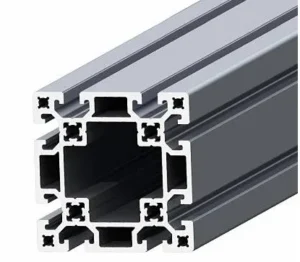
Sigma profiles are structural elements typically produced from high-strength aluminum alloys (e.g., EN AW-6063 T6 or EN AW-6060 T66) using the extrusion method, featuring standard-sized T-slots on all four sides. These T-slots allow for quick and flexible connection with other profiles or machine components using specialized fasteners (T-nuts, corner brackets, anchor plates, etc.). This modular design offers great flexibility in design and allows for future modifications or expansions. Large cross-section profiles like 80×80 and 90×90 are specifically designed for applications requiring high torsional and bending resistance.
The 80×80 sigma profile is a square cross-section profile with an 80 mm side length. It is generally preferred for medium to heavy-load applications. Thanks to its robust structure, it is used in many areas such as machine frames, conveyor systems, robotic cells, test stands, and workstations. Its cross-sectional area and, consequently, its moment of inertia make the profile highly resistant to bending and torsional moments. These profiles can typically have 8 mm or 10 mm T-slot widths, providing compatibility with a wide range of fastening elements.
The 90×90 sigma profile has a larger cross-section than the 80×80 profile, with a 90 mm side length. This larger size naturally translates to a higher moment of inertia (Ix, Iy) and section modulus (Wx, Wy). Consequently, 90×90 profiles can withstand higher static and dynamic loads, exhibit less deflection, and dampen vibrations more effectively than 80×80 profiles. Especially in situations requiring extreme strength and rigidity, such as frames for very heavy machinery, long-span conveyor lines, high-speed and vibrating robotic applications, or multi-story, heavy-load storage systems, 90×90 profiles play a critical role. These profiles typically have a 10 mm T-slot width and are compatible with fastening elements designed for the heaviest loads.
Both profile types offer the advantage of a lightweight structure. Aluminum being approximately one-third lighter than steel provides significant benefits in terms of transportation, assembly, and energy efficiency. Furthermore, aluminum’s corrosion resistance reduces maintenance costs and extends system life, especially in humid or chemically exposed industrial environments. Their surfaces can be anodized to provide additional protection against scratches and abrasion.
In terms of technical data, a profile’s performance is determined by parameters such as cross-sectional area (A), unit weight (m), moments of inertia (Ix, Iy), section moduli (Wx, Wy), and polar moment of inertia (Ip). These values allow engineers to calculate how much deflection a profile will experience under a specific load or what stresses it will be subjected to. For 80×80 and 90×90 profiles, these values are detailed in manufacturer catalogs for standard aluminum alloys and profile designs and can also be used in structural analysis software.
| Parameter | 80×80 Sigma Profile (EN AW-6063 T6) | 90×90 Sigma Profile (EN AW-6063 T6) |
|---|---|---|
| Profile Size (mm) | 80×80 | 90×90 |
| T-Slot Width (mm) | 8 or 10 | 10 |
| Cross-Sectional Area (A) (cm²) | ~15.0 – 16.5 | ~19.0 – 21.0 |
| Unit Weight (kg/m) | ~4.0 – 4.5 | ~5.1 – 5.7 |
| Moment of Inertia (Ix, Iy) (cm⁴) | ~100 – 115 | ~170 – 190 |
| Section Modulus (Wx, Wy) (cm³) | ~25 – 28 | ~38 – 42 |
| Material Alloy | EN AW-6063 T6 | EN AW-6063 T6 |
| Surface Treatment | Natural Anodized | Natural Anodized |
Field Considerations for 80×80 and 90×90 Sigma Profile Features in Heavy Industry
- Correct Profile and Fastener Selection: The selection of 80×80 or 90×90 profiles is critical, considering the project’s required load capacity, rigidity, and environmental conditions. For high dynamic loads, vibrating environments, or large spans, the 90×90 profile should generally be preferred. Fasteners must also be chosen to match the profile’s strength; especially for heavy loads, reinforced corner brackets, anchor plates, and T-nuts should be used. Incorrect fastener selection can become the weak point of the system and lead to unexpected failures.
- Vibration Damping and Rigidity: Machinery in heavy industry often generates significant vibration. While sigma profiles inherently possess good vibration damping properties, larger cross-sections like 90×90 generally perform better. During the design phase, vibration sources should be identified, and the profile configuration, additional supports, or vibration isolators should be used to ensure the system’s natural frequency is kept away from operational frequencies. Proper assembly of profiles and adequate tightening of all connection points are vital for minimizing vibration and increasing overall rigidity.
- Assembly and Alignment Precision: To fully leverage the advantages of modular systems, assembly must be carried out with high precision. Profile cuts must be clean, connection points accurately aligned, and all bolts tightened to specified torque values. Even millimeter deviations can negatively affect system performance and lifespan, especially for long-distance conveyor lines or precise robotic cells. Using laser alignment tools or precision measuring devices can enhance assembly quality. Furthermore, grounding requirements should not be overlooked, especially in areas with electrical equipment.
- Environmental Conditions and Maintenance: Although aluminum profiles are corrosion-resistant, extreme conditions such as aggressive chemical environments or high-temperature fluctuations can affect the profile’s lifespan and performance. In such cases, special surface treatments (e.g., thicker anodizing layer or paint) should be considered. Regular inspection of connection points, tightening loose bolts, and addressing potential damage ensures the system operates safely and efficiently. Especially in outdoor or high-humidity environments, stainless steel fasteners would be more appropriate.
Common Issues and Solutions for 80×80 and 90×90 Sigma Profile Features in Heavy Industry
When using 80×80 and 90×90 sigma profiles in heavy industry applications, some common issues may arise. Early detection and correct solutions for these problems are critical to maintaining system efficiency and safety.
1. Issue: Loosening of Connection Points and Structural Weakness. Especially in systems exposed to high vibration or dynamic loads, connection bolts can loosen over time. This can lead to deflections, noise, and even safety risks in the structure. Solution: Ensure all bolts are tightened to the manufacturer’s specified torque values during initial assembly. Spring washers, lock nuts, or chemical threadlockers (Loctite) can be used to prevent loosening. Periodic maintenance routines should include checking and re-tightening all connection points as necessary. Also, ensure the load-bearing capacity of the fasteners is appropriate for the load the profile will carry.
2. Issue: Profile Deflection or Deformation Under Excessive Load. Insufficient load calculations during the design phase or exposure to higher-than-expected loads during operation can cause excessive deflection or permanent deformation in profiles. This can disrupt the alignment of sensitive moving parts or reduce machine performance. Solution: During the design phase, detailed engineering analyses (finite element analysis – FEA) should be performed for static and dynamic loads. If necessary, switch to 90×90 profiles with higher moments of inertia or increase rigidity by adding extra supports, cross-bracing, or reinforcement elements to existing profiles. Profile spans should be shortened as much as possible, and support points increased. Ensure load distribution is even.
3. Issue: Corrosion or Surface Damage. Although aluminum is corrosion-resistant, corrosion can occur, especially in environments with high concentrations of acidic or basic chemicals, or where surface scratches are present. Mechanical impacts or abrasion can also degrade the profile’s aesthetics and protective surface. Solution: For profiles to be used in aggressive environments, special anodized coatings or additional surface protection methods like epoxy paint should be applied. Care should be taken to protect profile surfaces from impacts and scratches during assembly and use. Damaged areas should be cleaned and repaired with an appropriate protective coating. Stainless steel fasteners will be effective in reducing the risk of corrosion.
4. Issue: Electrical Grounding Problems. Aluminum profiles can sometimes be used for grounding due to their electrical conductivity, but their anodized surfaces can be insulating. This can lead to electrical safety issues, especially in automation systems with sensitive electronic equipment. Solution: For electrical grounding, special grounding elements where the anodized layer is removed or connection parts that provide direct metal-to-metal contact should be used. The design and implementation should be checked by a qualified electrical engineer to ensure the entire system is properly grounded and equipotential bonding is performed. Grounding continuity should be tested regularly.
Conclusion and Expert Advice on 80×80 and 90×90 Sigma Profile Features for Heavy Industry
In the heavy industry and industrial automation sectors, large cross-section aluminum extrusions like the 80×80 sigma profile and 90×90 sigma profile offer indispensable solutions due to their modularity, high strength-to-weight ratio, corrosion resistance, and ease of assembly. These profiles are ideal for creating reliable and efficient structures across a wide range of applications, from complex machine frames to high-speed conveyor systems, robotic work cells, and safety barriers. The correct selection of the profile is critical for project success; 80×80 profiles provide sufficient rigidity for medium-scale heavy loads, while 90×90 profiles offer superior performance for extreme loads, large spans, and high-vibration environments.
As an expert, my advice is to conduct a detailed engineering analysis, considering the unique requirements of each project. Load calculations, deflection analyses, vibration analysis, and environmental factors should directly influence profile selection and system design. Equally critical is the selection of appropriate fastening elements and accessories, as even the strongest profile can lose its performance with a weak connection point. Precision during the assembly phase guarantees the long-term and trouble-free operation of the entire system. Periodic maintenance and inspection routines will detect potential loosening or damage early, preventing major failures. In the future, these profiles are expected to become even lighter, offer higher alloy strengths, and increase Industry 4.0 compatibility with smart sensor integrations. By following this evolution, the efficiency and adaptability of automation systems in heavy industry can be continuously optimized. It should be remembered that good design and correct application not only reduce costs but also maximize operational safety and efficiency.
FAQ
What are sigma profiles and why are they used in heavy industry?
Sigma profiles are structural aluminum extrusions with T-slots, known for their modularity, light weight, and high strength. They are used to build machine frames, conveyor systems, and other industrial structures due to their ease of assembly and adaptability.
What is the main difference between 80×80 and 90×90 sigma profiles in terms of application?
The 80×80 sigma profile is suitable for medium to heavy-load applications, offering robust support for machine chassis and robotic cells. The 90×90 sigma profile, with its larger cross-section, provides superior strength and rigidity for extreme loads, large spans, and high-vibration environments, making it ideal for very heavy machinery frames and high-speed conveyor lines.
What critical factors should be considered when using sigma profiles in heavy industry?
Key considerations include selecting the correct profile and fasteners based on load capacity and environmental conditions, ensuring proper vibration damping and rigidity, maintaining high precision during assembly and alignment, and accounting for environmental factors like corrosion and temperature fluctuations. Regular maintenance is also crucial.
What are common problems encountered with sigma profiles in heavy industry and how can they be resolved?
Common issues include loosening of connection points, excessive deflection under heavy loads, corrosion or surface damage, and electrical grounding problems. Solutions involve using appropriate fasteners with threadlockers, conducting detailed engineering analyses for load distribution, applying special surface treatments, and ensuring proper electrical grounding with specialized components.
Are aluminum sigma profiles resistant to corrosion in harsh industrial environments?
Yes, aluminum sigma profiles are generally corrosion-resistant, especially when anodized. However, in aggressive chemical environments or areas with high humidity, additional protective coatings or stainless steel fasteners may be required to extend their lifespan and performance.