No products in the cart.
Comparing Rack and Pinion, Ball Screw, and Timing Belt Systems with Stepper Motors
Contents
Selecting the right linear motion system for your stepper motor is crucial for industrial automation. This article compares rack and pinion, ball screw, and timing belt drives, evaluating their precision, speed, load capacity, cost, and maintenance needs. Understand the technical advantages and disadvantages of each to make an informed decision for your CNC router machine.
Mermak CNC Technical Guide
Practical notes for CNC router, automation and industrial motion systems.
Understanding Linear Motion Systems for Stepper Motors
Stepper motors are fundamental in industrial automation for their precise rotational control. However, to achieve linear movement in applications like CNC router machines, this rotational output must be converted. The choice of conversion mechanism significantly impacts performance, accuracy, and cost. We will compare three primary systems: rack and pinion, ball screw, and timing belt, when driven by a stepper motor.
Rack and Pinion System
How it Works: A stepper motor drives a pinion gear, which engages with a linear gear rack. As the pinion rotates, it moves the rack linearly. Reducers are often used between the motor and pinion to increase torque and reduce backlash.
Advantages:
- Long Travel Distances: Easily scalable for very long linear movements.
- High Speed Potential: Capable of achieving high linear speeds with appropriate gearing.
- High Load Capacity: Robust design suitable for heavy loads, especially with larger module racks.
- Cost-Effective: Often more economical for long-stroke applications.
Disadvantages:
- Backlash: Inherent gear play can reduce positioning accuracy. Zero-backlash systems or dual-pinion designs can mitigate this.
- Noise and Vibration: Mechanical contact can generate noise during operation.
- Maintenance: Requires regular lubrication and can experience gear wear over time.
Stepper Motor Integration: Stepper motors provide the necessary torque, but precision applications may require additional mechanical backlash compensation to overcome inherent system play.
Ball Screw System
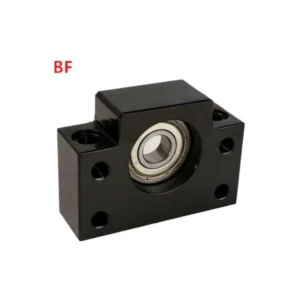
How it Works: A stepper motor rotates a ball screw shaft. A nut, containing recirculating ball bearings, travels along the screw, converting rotation into precise linear motion. This system offers very low friction.
Advantages:
- High Precision and Repeatability: Minimal friction and tight manufacturing tolerances result in excellent accuracy.
- High Rigidity: Capable of handling significant axial loads with minimal deflection.
- High Efficiency: Low friction means less power is lost, allowing for efficient operation.
- Low Backlash: Preloaded nuts can virtually eliminate play for superior accuracy.
Disadvantages:
- Cost: Generally more expensive, especially for longer travel lengths.
- Critical Speed Limitations: Long screws can be prone to whipping (vibration) at high speeds, limiting operational range.
- Sensitivity to Contamination: Ball bearings require protection from dust and debris, often needing bellows or seals.
- Back-Driving Risk: Low friction can allow loads to move the screw when the motor is stopped, potentially requiring brakes.
Stepper Motor Integration: The precise stepping of the motor combined with the accuracy of the ball screw is ideal for high-precision CNC applications. For example, a NEMA 34 stepper motor paired with a high-quality ball screw can achieve micron-level accuracy.
Timing Belt System
How it Works: A stepper motor drives a pulley, which engages with a toothed belt. The belt’s teeth mesh with corresponding grooves on a carriage or plate, translating the pulley’s rotation into linear motion.
Advantages:
- High Speed Capability: Can achieve very high linear speeds due to low inertia and minimal friction.
- Low Noise: Operates much quieter than gear-driven systems.
- Low Maintenance: No lubrication required, and belts are generally durable.
- Cost-Effective for Long Runs: Can be more economical than ball screws for long distances.
Disadvantages:
- Lower Precision: Belt stretch and tooth engagement can lead to lower accuracy and repeatability compared to ball screws.
- Limited Load Capacity: Generally not suitable for very heavy loads without specialized, wide belts and robust tensioning systems.
- Belt Wear and Tensioning: Belts can wear over time and require periodic tension adjustments.
- Potential for Slippage: If not properly tensioned or overloaded, the belt can slip on the pulley.
Stepper Motor Integration: Stepper motors are well-suited for timing belt drives, especially where speed and smooth motion are prioritized over extreme precision. For instance, in automated material handling or lighter-duty CNC routing tasks.
Choosing the Right System
The optimal choice depends on your specific application requirements:
- For high precision, heavy loads, and moderate speeds: Ball screws are often the preferred choice, especially when paired with high-torque stepper motors like NEMA 34 models.
- For long travel, high speeds, and moderate precision: Rack and pinion systems offer a cost-effective solution.
- For high speeds, quiet operation, and moderate loads: Timing belts provide a good balance of performance and cost.
Consider the interplay between your stepper motor’s torque and speed characteristics, the required linear speed, the payload, and the necessary positional accuracy. Mermak CNC offers a wide range of components, including stepper motors, drives, and mechanical parts like ball screws, to help you build robust and efficient automated systems.
Ready to optimize your CNC machine’s linear motion? Request a quote on WhatsApp to discuss your project needs with our experts.