
No products in the cart.
%16 Discount


Ball Screw SCR 1605
Original price was: 38.40$.32.40$Current price is: 32.40$.
High-precision mechanical component for converting rotary motion to linear motion in industrial automation.
In stock
🔥 Special for Today Only %16 Discount Opportunity!📦 Category: 16 mm Lead Screws and Nuts🏷️ Shaft Diameter: 16 mm🏷️ Pitch: 5 mm Pitch🏷️ Dimensions: 16
Mermak assuranceFrom factory to end user · importer / main dealer · strong stock
ImporterMain dealer / distributorStrong stockGood priceCorporate invoice
In stock / available to order · 14-day return for standard unused products; conditions may vary for custom size/cut products.
Ball Screw SCR 1605
INDUSTRIAL AUTOMATION PARTS | SUPERIOR PERFORMANCE SERIES
Detailed Product Review
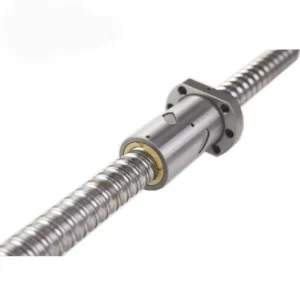
Ball Screw SCR 1605 is a critical mechanical drive component designed to convert rotary motion energy into high-precision linear translational motion in industrial automation systems. The “SCR” designation in this series indicates a product category that meets standard resolution and performance expectations, while the code “1605” metrically specifies that the nominal diameter of the screw is 16 millimeters, and the ball nut provides 5 millimeters of linear travel (lead) per full revolution. The primary function of the product is to transform the rotational motion from a drive motor into a precisely controllable linear displacement via a ball nut. This conversion is achieved with minimal friction thanks to the ball circulation mechanism between the screw and the nut, ensuring high efficiency and low energy loss. The thread profile of the ball screw is specially designed to allow the balls to roll smoothly along the screw surface, which enhances the system’s overall rigidity and positioning accuracy.
The SCR 1605 ball screw is manufactured from hardened high-carbon steel; this material choice guarantees the component’s high axial and radial load-carrying capacity and superior resistance to wear, even in demanding industrial environments. The rolling method applied during the manufacturing process imparts a surface hardness of up to 55 HRC to the thread profiles, further minimizing friction and ensuring the screw maintains its geometric precision and accuracy even during high-speed operations. This ball screw typically operates as an integrated system with a compatible flanged ball nut, such as the SFUR series, linear guides, and servo, stepper, or geared motors. The double-lip seals on the ball nut prevent dust, chips, moisture, and other particles from the operating environment from entering the ball circulation system, thus preventing contamination of the internal mechanism. This protective feature significantly extends the system’s operational life, reduces maintenance intervals, and ensures reliable performance continuity in the long term. The C7 accuracy class confirms its suitability for applications requiring high positioning accuracy by industrial standards.
Advantages of Ball Screw SCR 1605
High Positioning Accuracy and Repeatability: With its precise 5 mm lead value, the Ball Screw SCR 1605 offers positioning capabilities down to sub-millimeter levels. This feature provides maximum consistency and error margin optimization in production processes, especially in industrial applications requiring high accuracy such as CNC machines, precision measuring instruments, and optical alignment systems. The C7 accuracy class guarantees that the nominal linear movement stays within a specific tolerance range, allowing the same positioning accuracy to be maintained even in repetitive operations. This offers a critical advantage in machining complex geometries and in manufacturing where surface quality is critical.
Superior Load Capacity and Rigidity: The integrated 4-row ball circulation design within the ball nut allows the ball screw to exhibit exceptional resistance to high forces in both radial and axial directions. This multi-row ball configuration increases the contact surface area, optimizing load distribution, thereby ensuring stable and reliable performance even when carrying heavy loads or in pressing or lifting applications requiring high axial thrust. High rigidity contributes to maintaining positioning accuracy by minimizing screw deflection under dynamic loads and enhances vibration damping capacity.
Maximum Durability and Long Operational Life: The Ball Screw SCR 1605 features surface-hardened threads produced by a special rolling method, achieving a surface hardness of up to 55 HRC. This high hardness increases the threads’ resistance to wear, fatigue, and surface deformation, thus ensuring the screw maintains its performance characteristics even during prolonged and intensive use. Furthermore, the integrated double-lip dust seals on the ball nut protect the screw from dust, chips, metal particles, and other contaminants in the operating environment, preventing internal mechanism contamination. This protective barrier prevents the balls and thread surfaces from being exposed to abrasive effects, minimizing maintenance needs and significantly extending the system’s operational life, thereby reducing the total cost of ownership.
Technical Specifications and Capacity
FeatureValue/Description
Screw Diameter16 mm
Lead (Pitch)5 mm (Linear travel per full revolution)
Manufacturing MethodRolling Method (Rolled) – Ensures high surface quality and durability
Surface Hardness55 HRC (For wear resistance on the thread surface)
Compatible Nut TypeFlanged Ball Nut (e.g., SFUR 1605 series)
Accuracy ClassC7 (High accuracy by industrial standards)
Technical Frequently Asked Questions (FAQ)
What does the C7 accuracy class of the Ball Screw SCR 1605 mean for industrial applications, and which performance parameters does this classification affect?
The C7 accuracy class refers to the dynamic and static positioning accuracy of the ball screw as defined by the ISO 3408-3 standard. This classification guarantees that the nominal linear movement of the screw will remain within a specific tolerance range. The C7 class offers a suitable balance for applications requiring high precision, such as CNC machines, automation systems, and general industrial machinery, but not necessarily the ultra-high precision of laboratory equipment. For a C7 class ball screw, the positioning accuracy over a typical working length of 300 mm is around ±50 micrometers. This accuracy class directly impacts machining quality, repeatability, tool life, and final product tolerances. While lower accuracy classes (e.g., C5 or C3) offer higher precision, the C7 class represents a combination of cost-effectiveness and sufficient accuracy.
How does the rolled manufacturing method contribute to the mechanical properties and performance of the Ball Screw SCR 1605 compared to the ground method?
The rolled manufacturing method for ball screws is based on the principle of cold forming the thread profiles using specialized dies under high pressure. This process compresses and aligns the material’s grain structure, creating a hardening and stress buildup on the thread surfaces. Consequently, ball screws produced by the rolling method achieve a surface hardness of up to 55 HRC, significantly increasing wear resistance and exhibiting higher strength against thread fatigue. Compared to the ground method, while rolling typically results in a rougher surface finish, it can provide higher dynamic load capacity and longer fatigue life due to the strengthening of the material’s internal structure. Furthermore, the rolling method is more economical in terms of production costs, making a high-performance product with C7 accuracy class more accessible. While ground ball screws are generally preferred for higher accuracy classes like C5 or C3, rolled ball screws offer sufficient precision and superior mechanical durability for a wide range of industrial automation applications.
What are the key technical parameters to consider when selecting a compatible drive motor (servo or stepper) and coupling for the Ball Screw SCR 1605?
When selecting a compatible drive motor and coupling for the Ball Screw SCR 1605, several critical technical parameters that directly affect the system’s dynamic performance and lifespan must be considered. Firstly, the motor’s torque capacity should be determined by considering the maximum axial load the ball screw will bear, the system’s acceleration/deceleration requirements, and friction losses. The motor’s nominal speed must be compatible with the ball screw’s critical speed (resonance frequency) and the desired linear speed; the required RPM for a specific linear speed with the SCR 1605’s 5 mm lead must be calculated. The motor’s inertia should be balanced with the inertia of the ball screw and the connected load, or matched with an appropriate gearbox. The coupling selection must be able to compensate for axial, radial, and angular misalignments between the motor and the ball screw, while also reliably transmitting the system’s torque. Zero-backlash couplings with high rigidity are preferred to maintain positioning accuracy and minimize vibration. Additionally, the coupling’s torsional stiffness directly affects the system’s dynamic response and control performance. Selecting all these components to optimize the system’s overall rigidity and resonance frequencies is essential for a stable and precise motion system.
How do the double-lip dust seals on the Ball Screw SCR 1605’s ball nut technically affect the system’s operational life and maintenance requirements?
The double-lip dust seals integrated into the ball nut of the Ball Screw SCR 1605 act as a passive protective barrier that isolates the system’s critical internal mechanism from external environmental contaminants. These seals are located at both ends of the nut, closing the gap between the screw surface and the nut body, and preventing dust, chips, metal particles, moisture, and other abrasive substances from entering the ball circulation channels and thread profiles. Technically, this protective mechanism minimizes wear and tear on the balls and thread surfaces caused by contamination. The ingress of contaminants into the ball raceways can increase friction, leading to energy loss, noise, heat, and ultimately premature failure. Double-lip seals eliminate this risk of contamination, ensuring the ball screw maintains its nominal load-carrying capacity and positioning accuracy for an extended period. This leads to extended maintenance intervals, increased lubricant life, and reduced unplanned downtime, significantly extending the system’s overall operational life and lowering maintenance costs.
| Shaft Diameter | 16 mm |
|---|---|
| Pitch | 5 mm Pitch |
| Dimensions | 16 |
You must be logged in to post a review.
Taksit Tablosu
Related Products
 %64 DiscountBall Screw SCR 4005Original price was: 77.56$.27.84$Current price is: 27.84$.View
 Ball Screw SCR 201024.19$View
 %43 Discount1610 Ball Screw Nut | SFU NutOriginal price was: 39.60$.22.60$Current price is: 22.60$.View

Reviews
There are no reviews yet.