




































































Can Stepper Motors Be Used with Gearboxes? A Field Guide and Technical Article
In industrial automation systems, motion control plays a critical role in manufacturing efficiency and precision. In this context, stepper motors are widely preferred actuators for positioning applications. However, the torque capacities or precision requirements of standalone stepper motors can be insufficient for some applications. This is precisely where gearboxes (gear reducers) come into play, becoming an indispensable component that transforms the performance of stepper motors and expands their application areas. This field guide and technical article have been prepared to help experts and engineers in the industrial automation sector deeply understand the benefits, technical details, application principles, and critical points to consider in the field when using stepper motors with gearboxes. Our goal is to provide a comprehensive overview of when and how this combination can be used most efficiently.
Introduction and Technical Analysis
Motion control systems, at the heart of industrial automation, form the backbone of today’s manufacturing facilities. Stepper motors used in these systems are preferred in many applications due to their ease of open-loop control, precise positioning capability, and cost-effectiveness. However, due to the inherent characteristics of stepper motors, some limitations may be encountered in applications requiring high torque or high resolution even at very low speeds. For example, a stepper motor’s torque drops significantly as its speed increases, which can create problems when moving heavy loads or in situations requiring high acceleration. This is where gearboxes (gear reducers) offer a powerful solution to overcome these natural limitations of stepper motors.
Gearboxes are mechanical devices that transmit rotational motion from an input shaft to an output shaft, increasing torque and reducing speed by a specific gear ratio (reduction ratio). The combination of a stepper motor and a gearbox can fundamentally change the overall performance of the system. The main benefits of this combination include increased torque, higher positioning accuracy (resolution), inertia matching, and increased load carrying capacity. A gearbox multiplies the torque produced by the motor by the gear ratio, enabling the same motor to move heavier loads or achieve higher acceleration. At the same time, each step angle of the motor is reduced by the gearbox ratio, allowing for much more precise and smoother movements at the output shaft. For example, a stepper motor with a 1.8-degree step angle, when used with a 10:1 ratio gearbox, achieves a 0.18-degree step angle at the output shaft, which means very high resolution even without microstepping.
This technical analysis reveals that the combination of stepper motors with gearboxes is not just a performance enhancer but also an indispensable engineering solution for specific industrial automation requirements. Correct gearbox selection and integration directly affect the system’s lifespan, efficiency, and reliability. Therefore, the design and implementation of geared stepper motor systems require in-depth knowledge and careful attention.
Operating Principle and Technical Data
Stepper motors are brushless DC motors that rotate at specific angles (step angles) via electrical pulses applied to their inputs. Each pulse energizes the motor’s stator coils in a specific sequence, causing the rotor to align with the magnetic field and advance one step. This feature allows stepper motors to perform precise positioning even in open-loop control systems. However, the torque curve of stepper motors tends to decrease as speed increases. This leads to the problem of not being able to provide sufficient torque at high speeds.
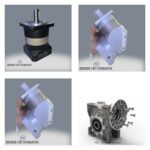
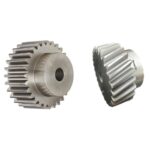
Gearboxes are used to compensate for this torque drop and improve the overall system performance. The fundamental operating principle of a gearbox is to provide a mechanical advantage, thereby increasing torque and proportionally decreasing speed. This is similar to the principle of a lever; moving a large load with a small force. The different sized gears within the gearbox convert the high-speed, low-torque motion from the motor shaft into a low-speed, high-torque output motion. The ratio of this conversion is called the gear ratio (i) and is typically expressed as the ratio of output speed to input speed or the ratio of input torque to output torque (usually in the form 1:i, where i > 1). Common types of gearboxes include spur, helical, bevel, worm, and planetary gearboxes. In industrial automation applications, the most frequently used gearbox type with stepper motors is planetary gearboxes, due to their high torque capacity, compact structure, and low backlash characteristics.
The engineering data and application areas of a stepper motor and gearbox combination are quite extensive:
- Torque Increase: The gearbox multiplies the motor’s nominal torque by the gear ratio. This is vital for applications involving heavy load transportation, driving high-friction systems, or requiring high acceleration. For example, geared stepper motors are preferred in applications such as conveyor belts, robotic arms, or press machines.
- Positioning Accuracy (Resolution): The gearbox divides the motor’s step angle by the gear ratio. This allows for much smaller and more precise movements at the output shaft. For instance, high resolution is critical in applications like optical alignment systems, microscope stages, or precise measuring devices. When combined with microstepping, incredibly smooth and accurate movements can be achieved.
- Inertia Matching: The compatibility between the motor’s inertia and the load’s inertia is crucial for the system’s dynamic performance. The ratio of load inertia to motor inertia should generally be between 1:1 and 10:1. Gearboxes reflect the load’s inertia to the motor side, reducing it by the square of the gear ratio. This enables the motor to control the load more efficiently, respond faster, and reduce oscillations. Incorrect inertia matching can lead to step losses, overheating, and system instability.
- Load Carrying Capacity: Thanks to increased torque, the system can handle larger static and dynamic loads. This extends the motor’s lifespan and reduces the risk of overload.
- Vibration and Noise Reduction: Some gearbox types, especially helical and planetary gearboxes, can help reduce vibration and noise due to smoother gear meshing.
Application areas are quite broad:
- CNC Machines: For precise axis movements in milling, turning, and laser cutting machines.
- Robotic Applications: In small robotic arms, pick-and-place robots, and drive systems for mobile robots.
- Packaging Machines: For synchronized and precise movements in filling, capping, labeling, and palletizing systems.
- Medical Devices: For high-accuracy movements required in laboratory automation, imaging devices, and dosing systems.
- Printing Machines: In areas such as paper feeding and print head positioning.
- Textile Machines: For precise tension control and positioning in yarn winding and weaving machines.
- Optical and Camera Systems: For precise adjustment in focusing, zoom, and pan/tilt units.
When selecting a geared stepper motor, application requirements (torque, speed, resolution, inertia, backlash tolerance, environmental conditions) and gearbox technical specifications (gear ratio, efficiency, backlash, size, mounting type) must be considered. A correctly selected system will offer long-lasting, efficient, and reliable operation.
| Parameter | Value/Description |
|---|---|
| Gear Ratio (Reduction Ratio) | Selectable in a wide range from 1:3 to 1:1000. Determined by application torque and speed requirements. |
| Backlash | 3-15 arcmin (standard), <1 arcmin (for precise applications). Directly affects positioning accuracy. |
| Maximum Output Torque | Can vary from 1 Nm to 1000 Nm. Depends on gearbox size and gear ratio. |
| Efficiency | 85% – 97% (for planetary gearboxes). May be lower in worm gearboxes (50-90%). |
| Noise Level | Must be checked according to manufacturer datasheet value. |
| Operating Temperature Range | Typical values are -20°C to +80°C. Must be checked according to manufacturer datasheet value. |
| Protection Class (IP Rating) | Varies from IP40 to IP68. Selected according to the working environment’s exposure to dust and liquids. |

Field Considerations for Geared Stepper Motor Systems
- Correct Gearbox Ratio Selection and Inertia Matching: The selection of the gearbox ratio is critical not only for meeting desired torque and speed requirements but also for ensuring proper matching between the motor’s inertia and the load’s inertia. It is important to remember that load inertia is reflected to the motor side by the square of the gearbox ratio. Incorrect inertia matching can lead to motor overheating, step losses, vibration, and overall system instability. Generally, it is recommended to keep the ratio of reflected load inertia to motor inertia between 1:1 and 10:1. This allows the motor to accelerate and decelerate the load more efficiently.
- Backlash and Positioning Accuracy: The clearance between gears in gearboxes directly affects positioning accuracy. Especially in high-precision applications (e.g., CNC machines, optical positioning systems), low-backlash gearboxes (typically 1-5 arcmin) should be preferred. Backlash creates some free play in the system during direction changes, leading to positioning errors. A gearbox with an appropriate backlash level should be selected based on the application’s tolerances and budget.
- Mounting and Alignment Precision: The interface between the stepper motor and the gearbox, and the mounting of the gearbox to the load, requires high precision. Misalignment can lead to excessive loading on motor and gearbox bearings, vibration, noise, and premature wear. During mounting, it is important to select the correct couplings and adhere to specified tightening torques with a torque wrench. Additionally, care must be taken to ensure that radial and axial loads on the output shaft remain within manufacturer limits.
- Environmental Conditions and Protection Class (IP Rating): Geared stepper motor systems may operate in environments with dust, moisture, water splashes, or chemical substances. For such conditions, it is essential that the gearbox and motor have an appropriate IP (Ingress Protection) rating. For example, in food processing or washdown areas, products with an IP65 or higher protection class should be preferred. Furthermore, the operating temperature range must be considered, and additional cooling or heating measures should be taken if necessary.
- Lubrication and Maintenance: Gearboxes require proper lubrication to extend the life of internal gears and bearings. Although most modern gearboxes are designed to be maintenance-free (lifetime lubrication), some heavy-duty or high-speed applications may require periodic oil changes or checks. The manufacturer’s maintenance manual must be strictly followed, and the specified type and amount of lubricant must be used. Oil leaks or abnormal noises are indications of problems that should be investigated immediately.

Common Problems and Solutions
Some common problems encountered in geared stepper motor systems and their solutions are detailed below:
- Step Loss or Positioning Error:
- Problem: The motor fails to reach the expected position or move the load.
- Possible Causes: Insufficient torque (load exceeds motor capacity), incorrect inertia matching, excessive acceleration/deceleration rates, resonance, insufficient driver current setting, wiring problems, mechanical binding, or excessive friction.
- Solution:
- Recalculate the torque capacity and inertia matching of the motor and gearbox combination; if necessary, choose a larger motor or a gearbox with a different gear ratio.
- Check the driver’s current settings and ensure they match the motor’s nominal current.
- Reduce acceleration and deceleration ramps.
- Identify system resonance frequencies and adjust the speed profile to avoid these frequencies or use vibration dampers.
- Check for and eliminate mechanical binding or excessive friction in the system.
- Check wiring connections and shielding, keeping them away from noise sources.
- Overheating:
- Problem: The motor or gearbox exceeds its normal operating temperature.
- Possible Causes: Continuous operation under excessive load, driver current set too high, inadequate cooling, incorrect inertia matching, friction or lubrication issues in the gearbox.
- Solution:
- Reduce the load or use a system with higher torque capacity.
- Adjust the driver current to match the motor’s nominal value.
- Implement appropriate cooling measures (heat sinks, fans) for the motor and gearbox.
- Check the lubrication level and quality of the gearbox; replace if necessary.
- Review inertia matching, as incorrect matching can also cause overheating.
- Abnormal Noise and Vibration:
- Problem: Clicking, whining, or excessive vibration during operation.
- Possible Causes: Incorrect mounting or alignment, loose connections, worn gears or bearings in the gearbox, resonance, bent motor shaft, coupling damage.
- Solution:
- Check and realign the motor and gearbox mounting if necessary.
- Ensure all mounting bolts are tight.
- Inspect the gearbox internals; replace worn gears or bearings.
- Optimize the speed profile to avoid system resonance frequencies.
- Check the integrity and suitability of the coupling.
- Increased Backlash in Gearbox:
- Problem: Increased free play in the system during direction changes, reduced positioning accuracy.
- Possible Causes: Wear in gearbox gears, prolonged operation under heavy load, shock loads, low-quality gearbox.
- Solution:
- Inspect the gearbox’s internal mechanism; replace worn gears or bearings.
- Consider selecting a more durable or lower-backlash (precision) gearbox for the application.
- Protect the system from excessive loads and sudden shock loads.
- Oil Leakage from Gearbox:
- Problem: Oil dripping from the gearbox housing.
- Possible Causes: Seal damage, excessive internal pressure, incorrect lubrication level, mounting error.
- Solution:
- Check the seals and replace if damaged.
- Check if the gearbox’s vent hole is clogged.
- Check the oil level; avoid overfilling.
- Check the flatness of mounting surfaces and bolt tightness.
Expert Advice
The use of stepper motors with gearboxes in industrial automation applications is often an indispensable engineering solution to meet specific performance requirements and increase overall system efficiency. This comprehensive review clearly highlights the fundamental benefits offered by the geared stepper motor combination, such as increased torque, enhanced precision, inertia matching, and increased load carrying capacity. Especially in applications requiring high torque at low speeds, micrometer-level positioning accuracy, and control of heavy loads, a stepper motor system without a gearbox will often be insufficient. This combination undertakes critical tasks across a wide range of applications, from robotic arms to CNC machining centers, and from packaging machines to medical devices.
As expert advice, we emphasize that when designing a geared stepper motor system or optimizing an existing one, the entire system should be considered as a whole, rather than focusing solely on the individual characteristics of the motor or gearbox. For successful integration, a thorough understanding of the application’s dynamic requirements (speed, torque, acceleration, deceleration), environmental conditions (temperature, humidity, dust), mechanical tolerances (backlash, positioning accuracy), and budget constraints is necessary. Inertia matching is vital for the system’s dynamic performance and energy efficiency; correctly calculating this parameter and optimizing it with the gearbox ratio will prevent step losses and overheating. Furthermore, while low-backlash gearboxes may have a higher cost, it should be remembered that this investment will more than pay off in terms of accuracy and repeatability in the long run for applications requiring precise positioning. Attention to mounting and alignment precision will directly affect the system’s lifespan and reliability. Periodic maintenance and proper lubrication are indispensable for the gearbox’s smooth operation. Finally, adopting a systematic troubleshooting approach for encountered problems will greatly benefit engineers in identifying root causes and producing lasting solutions. A correctly designed and implemented geared stepper motor system will offer you high performance, reliability, and long life in your industrial automation projects. Request a quote on WhatsApp today to discuss your specific needs!
FAQ
What are the primary benefits of combining a stepper motor with a gearbox?
Using a stepper motor with a gearbox significantly increases the output torque, allowing the system to move heavier loads or achieve higher acceleration. It also improves positioning accuracy by reducing the effective step angle, leading to smoother and more precise movements.
How do I choose the right gearbox for my stepper motor application?
Key factors include the required torque and speed, positioning accuracy (backlash tolerance), inertia matching between the motor and load, environmental conditions (IP rating, temperature), and the physical size and mounting type. Planetary gearboxes are often preferred for their high torque capacity and low backlash.
What are the common problems encountered with geared stepper motor systems and how can they be resolved?
Common issues include step loss (due to insufficient torque or incorrect inertia matching), overheating (from excessive load or high driver current), and abnormal noise/vibration (often caused by misalignment or worn components). Regular maintenance, correct parameter settings, and proper installation are crucial for preventing these problems.
Why is inertia matching important when using a gearbox with a stepper motor?
Inertia matching is critical for dynamic performance and energy efficiency. A gearbox reduces the reflected load inertia to the motor, allowing the motor to control the load more effectively, respond faster, and reduce oscillations. Incorrect matching can lead to instability and step losses.
Are there specific industrial applications where geared stepper motors are particularly advantageous?
Yes, many industrial applications benefit from this combination, including CNC router machines, robotic arms, packaging machinery, medical devices, and precision optical systems, where high torque, fine resolution, and reliable motion control are essential.