





















































































What is a Planetary Gearbox? Why is it Used in Servo Motors?

📑 Table of contents (Click to open)
- Introduction to Planetary Gearboxes and Their Role in Servo Motor Systems
- What is a Planetary Gearbox? Working Principle and Technical Data for Servo Motor Applications
- Practical Considerations for Planetary Gearbox Implementation in Servo Systems
- Common Issues and Solutions for Planetary Gearboxes in Industrial Settings
- Conclusion and Expert Advice on Planetary Gearboxes in Servo Motor Systems
- FAQ
Introduction to Planetary Gearboxes and Their Role in Servo Motor Systems
At the heart of industrial automation, motion control systems are critical for the efficiency and precision of modern manufacturing processes. Among the fundamental components of these systems, servo motors stand out for their high dynamic performance, precise positioning, and speed control capabilities. However, in many applications, the direct output torque or speed of a servo motor may not meet the requirements of the workload. This is precisely where planetary gearboxes come into play, serving as an indispensable bridge that optimizes servo motor performance and meets application demands. This comprehensive field guide and technical article will delve into what planetary gearboxes are, their operating principles, why they are so compatible with servo motors, and their critical role in the industrial automation sector. Our goal is to provide engineers, technicians, and decision-makers in the industry with an in-depth understanding and practical information on correct gearbox selection, installation, and maintenance.
What is a Planetary Gearbox? Working Principle and Technical Data for Servo Motor Applications
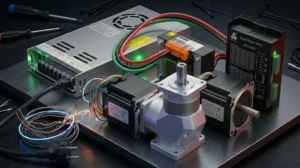
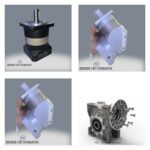
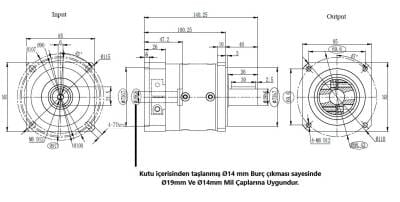
A planetary gearbox, named after the movement of planets around the sun, is a type of gear train known for its high torque density and compact structure. It primarily consists of three main components: a central sun gear, multiple planet gears that revolve around the sun gear and are fixed on a carrier, and an outer internally-toothed ring gear (or annulus) that encloses these planet gears. The input shaft is typically connected to the sun gear, transmitting the motor’s rotational motion to it. As the sun gear rotates, the surrounding planet gears begin to rotate both on their own axes and around the sun gear within the ring gear. The carrier, which holds the planet gears, is connected to the output shaft and rotates with this movement, transferring the reduced torque and speed to the system.
This unique mechanism of planetary gearboxes offers numerous advantages over traditional parallel-axis gearboxes. Its most significant advantage is the distribution of the load among multiple gears (planet gears). This results in higher torque capacity, better load distribution, and consequently, a longer service life. Furthermore, due to the concentric arrangement of the gears, these gearboxes can achieve high reduction ratios in a much more compact structure. This compactness is a significant advantage, especially in machine designs with limited space.
Servo motors are preferred in applications requiring high precision, dynamic response, and a wide speed range. However, servo motors themselves typically produce low torque at high speeds. Most industrial applications, conversely, require high torque at low speeds. This is where planetary gearboxes address this limitation of servo motors, making them usable in a much wider range of applications. The primary reasons for using planetary gearboxes with servo motors are:
- Torque Increase and Speed Reduction: Planetary gearboxes reduce the motor’s high speed, increasing the torque proportionally. This provides the mechanical advantage needed to move heavy loads or apply high forces.
- Low Backlash: Since positioning accuracy is critical in servo systems, play in the gearbox (backlash) can lead to unwanted vibrations and positioning errors. Planetary gearboxes, through special manufacturing techniques and precise gear geometries, can achieve extremely low backlash values (typically 1-5 arcmin). This ensures that the servo motor responds instantly and accurately to control signals.
- High Rigidity: The torsional rigidity of the gearbox directly affects the system’s dynamic performance. High-rigidity planetary gearboxes exhibit minimal deformation even under shock loads or rapid direction changes. This increases the system’s stability and repeatability.
- Low Inertia: In servo systems, the inertia of the motor and its connected load directly affects acceleration and deceleration times and energy consumption. Planetary gearboxes offer low inertia moments thanks to optimized gear designs and low-friction bearings. This allows the servo motor to respond faster, consume less energy, and generate less heat.
- High Efficiency: Modern planetary gearboxes offer efficiencies above 95% through optimized gear profiles and low-friction bearings that minimize energy losses. This reduces operating costs and increases the overall energy efficiency of the system.
- Compact Design: The planetary gear arrangement allows for high torque capacity and reduction ratio in a much smaller volume. This provides machine designers with greater flexibility and space savings.
- Balance and Low Noise: Distributing the load among multiple planet gears reduces stress at gear contact points and ensures more balanced operation. This translates to less vibration and lower noise levels.
| Parameter | Value/Description |
|---|---|
| Transmission Ratio (i) | Wide range from 1:3 to 1:1000, single or multi-stage |
| Nominal Output Torque | From 5 Nm to 2000 Nm (varies by model) |
| Maximum Output Torque (Shock Load) | 2-3 times nominal torque (emergency stop, collision, etc.) |
| Backlash | < 1 arcmin (precision), 3-5 arcmin (standard) |
| Efficiency | 97-98% for single stage, 94-96% for two stages |
| Torsional Rigidity | 10-200 Nm/arcmin (critical for high dynamic applications) |
| Moment of Inertia | From 0.01 kgcm² to 100 kgcm² (motor inertia matching is important) |
| Operating Temperature Range | -20°C to +90°C (varies by environment and lubricant type) |
| Protection Class (IP) | From IP54 to IP65 (protection against dust and liquids) |
Practical Considerations for Planetary Gearbox Implementation in Servo Systems
- Correct Sizing and Selection: Gearbox selection should not be based solely on torque and speed ratio. Factors such as application dynamic requirements (acceleration/deceleration times), inertia matching, backlash tolerance, duty cycle, environmental conditions, and expected lifespan must be considered. Specifically, inertia matching is vital for servo system performance; the gearbox inertia should be within a certain ratio of the motor’s inertia (typically 1:1 to 1:10, ideally 1:3-1:5). Otherwise, motor control can become difficult, overheating may occur, and the system may operate unstably.
- Precise Installation and Alignment: Planetary gearboxes are manufactured with high precision components and must be installed with the same precision. Any axial or angular misalignment in the connection between the motor and gearbox (flange and shaft) can lead to premature bearing wear, vibration, noise, and efficiency loss. During installation, specified tightening torques with a torque wrench must be followed, and surfaces must be clean and flat. Ensure that keyways or clamping bushes are correctly installed for shaft connections.
- Lubrication and Maintenance Schedule: Most modern planetary gearboxes come sealed-for-life and do not require periodic oil changes. However, some high-performance or heavy-duty industrial applications may require oil level checks and periodic oil changes. Manufacturer’s instructions must be strictly followed, and the correct type and amount of lubricant must be used. Excessive temperatures or dirty environments can shorten lubricant life. Regular visual inspections help detect early warning signs such as leaks or abnormal noise.
- Thermal Management and Environmental Conditions: The operating temperature of the gearbox directly affects its efficiency and lifespan. Overloading or insufficient ventilation can cause the gearbox to overheat. It is important to adhere to the operating temperature ranges specified by the manufacturer. Additionally, ensure that the environment where the gearbox will be installed has an appropriate IP protection class against environmental factors such as dust, moisture, and corrosive chemicals. A higher IP class should be chosen for gearboxes operating in dirty or humid environments.
- Vibration and Noise Control: New generation planetary gearboxes generally have low noise levels. However, a sudden increase in noise or vibration can be a sign of a malfunction (e.g., bearing wear, gear damage, installation error). In such cases, the system should be checked immediately, and potential problems addressed. Vibration sensors and periodic analyses can help detect potential faults at an early stage.
Common Issues and Solutions for Planetary Gearboxes in Industrial Settings
While planetary gearboxes are robust and reliable components, various issues can arise due to incorrect selection, installation, or maintenance. The most common problems and their potential solutions are listed below:
- Excessive Noise and Vibration:
- Possible Causes: Misalignment, loose mounting bolts, worn bearings, damaged gears, incorrect or insufficient lubrication, overloading.
- Solutions: Check and correct mounting alignment. Ensure all bolts are tightened to the correct torque with a torque wrench. Check lubricant level and quality; replace if necessary. Disassemble the gearbox to inspect for worn bearings or damaged gears; replace components as needed. Compare application torque requirements with gearbox capacity; replace with a larger model if necessary.
- Overheating:
- Possible Causes: Continuous overloading, insufficient lubrication, incorrect lubricant type, high ambient temperature, inadequate ventilation, high friction (e.g., misalignment).
- Solutions: Review the application’s load profile, ensuring the gearbox is not continuously operating above its nominal torque. Check lubricant level and type, adhering to manufacturer recommendations. Take measures to reduce ambient temperature or increase airflow around the gearbox. Check mounting alignment.
- Increased Backlash or Loss of Positioning Accuracy:
- Possible Causes: Gear wear, increased bearing play, loosened clamping bush (in shaft connection), loosened coupling between motor and gearbox.
- Solutions: Periodically check backlash. If gear or bearing wear is detected, replace components or overhaul the gearbox. Check shaft connections and couplings to ensure they are tight.
- Shaft Breakage or Deformation:
- Possible Causes: Sudden and excessive shock loads, fatigue, incorrect shaft material or design, incorrect coupling selection.
- Solutions: Analyze the application’s dynamic loads, ensuring the gearbox and shaft do not exceed their maximum torque capacity. Use shock-absorbing couplings if necessary. Review the suitability of the shaft’s material and design.
- Oil Leakage:
- Possible Causes: Worn or damaged seals, incorrect installation, excessive internal pressure (if breather is clogged).
- Solutions: Identify the source of the leak. Replace worn or damaged seals. Check and clean the breather plug if it is clogged.
Conclusion and Expert Advice on Planetary Gearboxes in Servo Motor Systems
In the rapidly evolving world of industrial automation, the synergy created by servo motors and planetary gearboxes forms the foundation of high-performance and precise motion control systems. Planetary gearboxes not only enhance the inherent capabilities of servo motors by meeting high torque demands at low speeds but also significantly improve the overall efficiency, precision, and dynamic response of the system through features like low backlash, high rigidity, low inertia, and compact design. As an automation expert, based on my field experience, I can confidently say that the correct selection and implementation of a planetary gearbox play a critical role in the success of a project. To extend the system’s lifespan, minimize downtime, and achieve maximum efficiency, it is essential to be meticulous during the sizing phase, maintain precision during installation, and not neglect periodic maintenance. It should be remembered that even the most high-tech component can compromise its performance due to incorrect application or neglect. Therefore, to fully utilize the potential of planetary gearboxes, adhering to manufacturer recommendations, paying attention to system integration, and establishing regular control mechanisms are key to long-term success and return on investment. The right planetary gearbox selection will not only meet today’s needs but also lay a solid foundation for your future automation goals. Request a quote on WhatsApp today for Mermak CNC planetary gearboxes.
FAQ
What is a planetary gearbox and how does it work?
A planetary gearbox is a compact gear system where multiple 'planet' gears revolve around a central 'sun' gear, all contained within an outer 'ring' gear. This design allows for high torque density, efficient power transmission, and significant speed reduction in a small footprint.
Why are planetary gearboxes used with servo motors?
Planetary gearboxes are crucial for servo motors because they increase output torque, reduce speed, and provide extremely low backlash, high rigidity, and low inertia. These characteristics enable servo motors to achieve precise positioning, handle heavier loads, and operate with greater dynamic response and efficiency in industrial applications.
What are the critical factors for selecting the right planetary gearbox for a servo motor application?
Key factors include the required torque and speed reduction ratio, backlash tolerance, system inertia matching, torsional rigidity, efficiency, and environmental conditions. It is vital to match the gearbox's inertia to the servo motor's inertia (ideally 1:3 to 1:5 ratio) for optimal performance and stability.
What are the common problems encountered with planetary gearboxes and how can they be resolved?
Common issues include excessive noise and vibration (often due to misalignment or worn components), overheating (from overloading or insufficient lubrication), increased backlash, and shaft damage. Solutions involve precise installation, regular lubrication checks, load analysis, and timely replacement of worn parts.
What are the best practices for installing a planetary gearbox with a servo motor?
Proper installation involves precise alignment between the motor and gearbox, correct tightening of mounting bolts to specified torques, and ensuring clean, flat mating surfaces. Misalignment can lead to premature wear, noise, and reduced efficiency.