




































































































What Happens if a Stepper Motor Driver Receives Insufficient Current?
📑 Table of contents (Click to open)
Introduction and Technical Analysis
Stepper motors are indispensable components in industrial automation systems, favored for numerous applications requiring precise positioning, speed, and torque control. One of the most critical factors directly influencing the performance of these motors is the current supplied by the motor driver. Correct adjustment of the driver current directly determines the motor’s nominal torque, dynamic performance, and overall system stability. However, a common issue encountered in the field is when a stepper motor driver receives less current than its nominal value. While this might initially be done with good intentions, such as energy saving or preventing motor overheating, it can actually lead to a series of technical problems that severely degrade system performance, reduce operational efficiency, and even shorten equipment lifespan. This detailed field guide and technical article comprehensively addresses the causes, technical consequences, field symptoms, and troubleshooting methods for insufficient current supply to stepper motor drivers, targeting industrial automation professionals. Our aim is to help engineers and technicians grasp the importance of this critical parameter, enabling them to make their systems more reliable and efficient.
Operating Principle and Technical Data
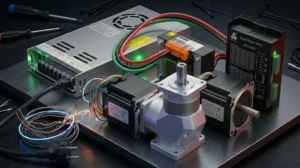
Stepper motors operate on the principle of sequentially changing magnetic fields by applying pulse sequences to their coils. Each pulse rotates the motor’s rotor by a specific angle (step angle), ensuring precise positioning. The torque produced by the motor is directly proportional to the intensity of the current flowing through its coils. Higher current generates stronger magnetic fields, resulting in higher torque and, consequently, better performance under load. Stepper motor drivers aim to achieve the motor’s nominal torque and maintain sufficient torque even at high speeds by providing a constant current to the motor coils (typically using a “constant current chopper drive” principle). The driver attempts to maintain the targeted current level in the coils by compensating for the motor’s inductive reactance and back electromotive force (EMF). This optimizes the motor’s dynamic performance and minimizes the risk of step loss.
Supplying less current to a stepper motor driver than the manufacturer’s specified nominal value causes the magnetic field generated in the motor coils to weaken. This weakening of the magnetic field directly reduces the maximum torque the motor can produce. This situation negatively affects both the holding torque and the dynamic torque (pull-out torque). Holding torque refers to the motor’s ability to maintain its rotor position when energized, while dynamic torque indicates the maximum torque the motor can apply at a specific speed while in motion. Both torque values decrease due to insufficient current. The risk of the motor losing steps significantly increases, especially during acceleration and deceleration ramps or when operating under load at high speeds. Furthermore, low current can cause the motor to exhibit more pronounced vibrations at its resonance frequencies and disrupt overall system stability. Operating the motor below its nominal torque means the system performs below its design capacity, which is unacceptable in industrial automation applications. The correct current level is vital for the motor’s efficient operation, long lifespan, and for the system to achieve the expected precision and repeatability values.
| Parameter | Value/Description |
|---|---|
| Nominal Phase Current (I_nom) | 2.8 A (Must be checked against manufacturer’s datasheet.) |
| Motor Coil Resistance (R_ph) | 0.9 Ohm (Typical value, varies by motor model.) |
| Motor Coil Inductance (L_ph) | 3.5 mH (Typical value, varies by motor model.) |
| Holding Torque | 1.8 Nm (At nominal current, decreases as current is reduced.) |
| Step Loss Threshold | Risk increases below 70-80% of nominal current. |
| Driver Output Current Tolerance | ±5% (Depends on driver model and adjustment precision.) |
| Maximum Operating Temperature | 80°C (Coil temperature is indirectly affected when current is reduced.) |
Field Considerations
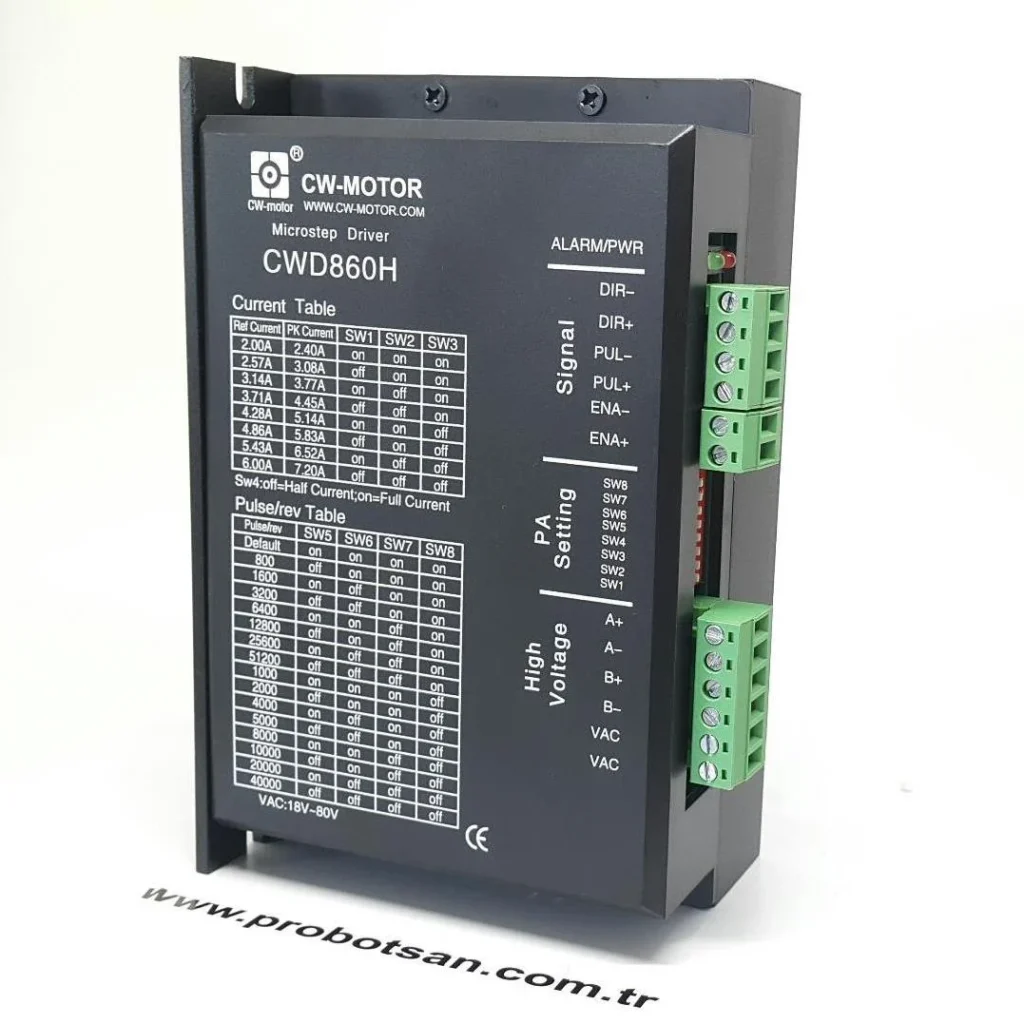
- Motor and Driver Matching: Every stepper motor has a specific nominal current value. It is essential that the driver has the capacity to supply this current and is adjusted correctly. A driver set lower than the motor’s nominal current will prevent the motor from ever reaching its full potential. Always set the driver current based on the nominal current value in the motor’s technical datasheet. Drivers typically have adjustment options for RMS or peak current values; understand this difference to make the correct setting.
- Load Analysis and Torque Requirement: Accurately calculating the maximum torque required by the application (static, dynamic, acceleration torques) is critically important. Motor selection and driver current adjustment must be made to meet these torque requirements. If the driver current is too low to generate the torque needed for the motor to handle the load, step loss becomes inevitable. All factors such as load moment, friction, inertia, and external forces must be considered.
- Cable Gauge and Length: The gauge and length of the cables running from the driver to the motor affect voltage drop. Long or thin cables can cause the effective current reaching the motor to decrease, meaning that even if the driver is set to supply the correct current, insufficient current reaches the motor. Appropriate gauge, shielded, and low-resistance cables should be used for high-current lines. Ensure that cable connections are robust and have low contact resistance.
- Resonance and Vibration Control: Low current can make motor vibrations more pronounced at its natural resonance frequencies. This can lead to noise, mechanical wear, and even step loss in the system. While microstepping settings are an effective method to reduce resonance, their effectiveness can be lost with insufficient current. When adjusting the current, the motor’s vibration behavior at different speeds should be observed, and anti-resonance algorithms or mechanical dampeners should be used if necessary.
- Driver and Motor Cooling: There is a common misconception that the motor will heat up less when supplied with insufficient current. However, if the motor is constantly forced to its limits to handle the load or loses steps, it can operate inefficiently and heat up more than expected. Additionally, the driver may consume more energy to provide the correct current and can also overheat. Adequate cooling (fan, heatsink) must be provided for both the driver and the motor. Ambient temperature also affects these factors.
- Speed-Torque Curve Analysis: Every stepper motor has a speed-torque curve. This curve shows the maximum torque the motor can produce at different speeds. When the driver current is reduced, this curve shifts significantly downwards. The maximum operating speed and torque requirement at that speed for your application must not exceed the torque the motor can provide with a low current setting. A good understanding of this curve is a fundamental reference for correct motor and driver selection and current adjustment.

Common Problems and Solutions
Supplying insufficient current to a stepper motor driver manifests itself with various fault symptoms in the field. Correctly diagnosing and rectifying these problems is critical to improving system reliability.
Step Loss: This is the most prominent and frequently encountered consequence of insufficient current. The motor fails to reach the expected position according to the number of pulses applied. It occurs especially during acceleration/deceleration or under heavy load.
Symptoms: Positioning errors, movement hesitation, initial jitter, failure to reach the target position.
Solution: First, increase the driver current to the motor’s nominal value. Check the mechanical load and reduce it if necessary. Make acceleration and deceleration ramps smoother. Check if the motor is operating at excessive speeds. If necessary, consider using a higher torque motor or a more powerful driver. If an encoder feedback system is used, step loss can be detected instantly, and corrective actions can be taken.
Low Torque and Weakness: The motor cannot move the load it is supposed to, or it struggles during movement. This is particularly noticeable in systems carrying heavy loads or with high friction.
Symptoms: Motor unable to move the load, struggling even at low speeds, slow response time.
Solution: Set the driver current to the motor’s nominal current. Ensure that the motor’s nominal torque meets the maximum torque requirement of the application. If necessary, replace the motor with a higher torque model or increase torque using a gearbox. Check and optimize friction and inertia in the mechanical system.
High Vibration and Noise: The motor operates with abnormal vibration and noise, especially at certain speeds or when idling. This can shorten the lifespan of mechanical components and degrade the quality of the working environment.
Symptoms: Pronounced vibration in the motor body, mechanical noises (humming, knocking), system shaking.
Solution: Set the driver current to the nominal value. Increase the microstepping setting to enhance step resolution. Activate or optimize the driver’s resonance damping (anti-resonance) features. Mount the motor and driver securely to reduce mechanical resonances. Consider using mechanical damping elements.
Motor Stalling or Sticking: The motor suddenly stops or gets stuck at a certain point while trying to move, oscillating back and forth but unable to advance.
Symptoms: Motor not moving, getting stuck, constant “jittering.”
Solution: Check the current setting and set it to the nominal value. Check cable connections between the motor and driver, and the power supply. Check for mechanical jamming or excessive load. Verify the accuracy and frequency of pulse signals to the driver with an oscilloscope.
Positioning Error and Repeatability Issues: The motor fails to reach the same target position every time or shows deviations in repetitive movements.
Symptoms: Dimensional or positional differences in manufactured products, deviation in repetitive operations.
Solution: Confirm if step loss is occurring and apply the solutions above. Check the microstepping setting and ensure it provides sufficient resolution. Implement position verification using a feedback system (encoder) and compensate for deviations. Eliminate other mechanical errors in the system such as backlash and elasticity.
Low Speed Performance: The motor cannot produce sufficient torque at high speeds and experiences performance degradation.
Symptoms: Failure to achieve desired cycle time, step loss when speed is increased.
Solution: Check the driver supply voltage; higher voltage helps the motor perform better at high speeds. Set the current to the nominal value. Consider the relationship between motor inductance and driver voltage capacity. If necessary, use a motor with lower inductance or a driver with a higher supply voltage.
Expert Advice
Supplying less current to a stepper motor driver than its nominal value is a critical error in industrial automation systems, leading to a wide range of negative consequences, from performance degradation to equipment failure. Although this situation is often done with good intentions but a misguided approach, aiming to prevent motor overheating or save energy, the resulting problems lead to much greater costs and operational disruptions in the long run. Insufficient current weakens the motor’s magnetic field, directly reducing its torque capacity, which causes issues such as step loss, positioning errors, high vibration, and overall system instability. Our field experience shows that one of the most common underlying causes of such problems is incompatibility between the motor and driver or incorrect adjustment of the driver current.
As expert advice, always set driver parameters based on the nominal current value specified by the motor manufacturer. Be sure to check whether this setting refers to RMS or peak current and enter the correct value according to your driver’s adjustment method (DIP switches, software). Carefully analyze the maximum load torque and speed profile required by your application. If necessary, select a motor and driver with a margin to meet the system’s torque requirements. Ensure that cable cross-sections are adequate and connections are robust, as long and thin cables can also reduce effective current. Optimize microstepping settings to minimize resonance frequencies and utilize your driver’s advanced features (anti-resonance, torque boosting). Remember that correct current adjustment not only ensures efficient and reliable motor operation but also extends the overall system lifespan and reduces maintenance costs. When encountering problems, first checking the current setting, then examining the mechanical load and other system parameters, is key to a systematic problem-solving approach. When in doubt, always refer to manufacturer datasheets and seek support from an experienced automation engineer. A stepper motor system designed and adjusted with correct engineering principles will continue to operate reliably and with high performance at the heart of industrial automation.
FAQ
What are the primary consequences of providing insufficient current to a stepper motor driver?
Supplying insufficient current to a stepper motor driver significantly reduces the motor's torque output, leading to problems like step loss, inaccurate positioning, increased vibration, and potential stalling. This can compromise the overall performance and reliability of your industrial automation system.
How can I identify if my stepper motor driver is receiving insufficient current?
Common symptoms include the motor failing to reach its target position (step loss), struggling to move its load, excessive vibration and noise, sudden stalling, and inconsistent positioning. These issues often become more pronounced under heavy loads or at higher speeds.
What is the correct way to set the current for a stepper motor driver?
Always refer to the motor's datasheet for its nominal current rating. Adjust the driver's current setting to match this value. Ensure you understand whether the driver's setting refers to RMS or peak current. Also, verify that your power supply can deliver the required current and voltage, and that cables are appropriately sized.
Are there other factors besides current adjustment that affect stepper motor performance?
Beyond adjusting the current, ensure proper motor-driver matching, analyze your application's load and torque requirements, use appropriate cable gauges and lengths, optimize microstepping settings to reduce resonance, and ensure adequate cooling for both the motor and driver. Consulting the motor's speed-torque curve is also crucial.
Does insufficient current help prevent a stepper motor from overheating?
While it might seem counterintuitive, insufficient current can cause the motor to work harder and less efficiently to overcome the load, potentially leading to overheating. The driver itself might also overheat trying to compensate. Always ensure adequate cooling for both components.