




































































What Problems Do Grounding Faults Cause in Stepper Motors?
📑 Table of contents (Click to open)
- The Importance of Grounding in Stepper Motors: An Industrial Perspective
- What is Grounding and Why is it Critical?
- Safety and Performance Relationship
- Noise Immunity and EMI/RFI Protection
- How to Identify Symptoms of Grounding Faults
- Motor Behavior Abnormalities
- Driver and Controller Errors
- System Instability and Data Integrity Issues
- Root Cause Analysis: Factors Leading to Grounding Faults
- Incorrect or Inadequate Grounding Practices
- FAQ
Practical notes for CNC router, automation and industrial motion systems.
The Importance of Grounding in Stepper Motors: An Industrial Perspective
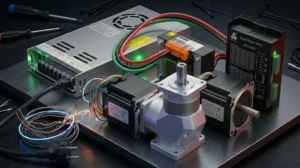
Stepper motors are indispensable components in industrial automation systems, playing a critical role in applications requiring precise positioning and speed control. For these motors and their drivers to operate at optimal performance, safely, and stably, proper grounding is essential for overall system efficiency. However, grounding, often overlooked or not fully understood, is a fundamental safety and performance factor in the smooth operation of stepper motor systems. Incorrect or inadequate grounding practices can lead to far more than a simple “ground leakage” issue, causing severe disruptions throughout the system.
This article will detail the types of problems grounding faults can cause in stepper motor systems, how to diagnose these faults, their root causes, and how to prevent such issues in an industrial automation environment. We aim to provide practical, field-backed insights with technical depth. Our goal is to educate a wide range of professionals, from operators to maintenance technicians, engineers, and system integrators, about the vital role of grounding and correct application methods in stepper motor applications.
What is Grounding and Why is it Critical?
Grounding is a connection made in electrical systems to balance potential differences, safely discharge overvoltages, and provide a reference point to prevent electric current from flowing through unexpected paths. Especially in industrial environments, electrical currents flowing between high-power motors, drivers, and control units can create noise sources such as electromagnetic interference (EMI) and radio frequency interference (RFI). Proper grounding absorbs or directs this noise, ensuring the stable operation of sensitive electronic equipment.
In stepper motor systems, grounding is critical not only for human safety but also for the system’s performance, stability, and longevity. Stepper motor drivers power motor phases using high-frequency switched currents. These switching operations create electromagnetic fields within and around the system. Without adequate and correct grounding, these fields can propagate uncontrollably, affecting other equipment and even disrupting signal integrity within the system itself.

Safety and Performance Relationship
One of the primary purposes of grounding is to ensure personnel safety by eliminating the risk of electric shock. In the event of an electrical fault, such as a phase cable contacting a metal enclosure, the grounding line safely directs the fault current to the ground, causing protective devices (fuses, residual current devices, etc.) to open the circuit. This protects against potentially fatal situations. Since stepper motors and drivers often have metal enclosures, proper grounding of these enclosures is a legal requirement and a fundamental necessity for occupational safety.
Beyond safety, grounding directly impacts system performance. Incorrect grounding can lead to motor vibration, position losses, driver overheating, or fault conditions. Especially in high-speed and high-torque applications, every step of the motor must be accurate and repeatable. Electrical noise caused by poor grounding can disrupt motor control signals, jeopardizing this precision, which leads to production errors and efficiency losses. Therefore, grounding is not just a safety measure but also an integral part of the system’s operational integrity.

Noise Immunity and EMI/RFI Protection
Industrial automation environments contain numerous noise sources such as motors, contactors, switched-mode power supplies, and radio frequency equipment. Stepper motor drivers themselves are significant sources of electromagnetic noise. This noise can infiltrate cables carrying control signals, leading to misinterpretation of commands or signal losses. A correct grounding system absorbs or directs these electromagnetic interferences (EMI) and radio frequency interferences (RFI), preventing them from affecting sensitive control circuits.
Using shielded cables and properly grounding these shields is one of the primary ways to increase noise immunity. The shield acts as a barrier, preventing external noise from entering or internal noise from escaping. However, for the shield to be effective, both ends, or at least one end, must be properly connected to a low-impedance grounding point. Inadequate grounding can render the shield ineffective or, worse, cause it to act like an antenna, collecting noise. This situation becomes even more critical over long cable distances or in multi-driver systems.
How to Identify Symptoms of Grounding Faults
Grounding faults in stepper motor systems often manifest through various symptoms that may not initially be directly associated with grounding. These symptoms range from general system instability to abnormalities in the motor’s physical behavior. In the troubleshooting process, correctly interpreting these symptoms is crucial for identifying the root cause of the problem. An experienced technician will prioritize checking grounding when encountering such symptoms.
Symptoms often appear intermittently or worsen under specific operating conditions (e.g., high speed, heavy load, or when other equipment is activated). This can complicate the fault detection process. The general electrical infrastructure of the system, the operation of other machinery, and even environmental factors (humidity, temperature) can exacerbate the effects of grounding issues. Therefore, comprehensive observation and a systematic approach are essential for diagnosing grounding-related problems.

Motor Behavior Abnormalities
Grounding faults can lead to various physical abnormalities that prevent the stepper motor from performing as expected. One of the most common symptoms is excessive motor vibration. If these vibrations are not due to a mechanical issue, they typically result from electrical noise or distorted current supplied from the driver to the motor. Vibrations can lead to faster motor wear, loosening of mechanical connections, and a reduction in overall system lifespan.
Another significant symptom is position losses or stepping errors. Stepper motors are known for their precise stepping capabilities. However, electrical noise can cause the driver to switch motor phases at the wrong time or with incorrect current levels. This can result in the motor failing to reach its target position, taking random steps, or stopping at a different position in each cycle. Especially in closed-loop (encoder-equipped) systems, noise affecting feedback signals from the encoder can cause the driver to make incorrect corrections, further increasing these position losses.

Driver and Controller Errors
Stepper motor drivers and controllers are among the electronic components most affected by grounding faults. Weak or inadequate grounding can expose the internal circuits of drivers and controllers to voltage fluctuations and noise. This typically manifests as the driver suddenly resetting, displaying a specific error code (e.g., overcurrent, undervoltage, or communication error), or completely ceasing operation. Driver overheating is another common symptom, as noise can unnecessarily strain internal power electronics.
On the controller side, issues such as the PLC or CNC control unit struggling to communicate with the stepper motor driver, delayed command transmission, or commands not being detected at all can arise. This becomes more pronounced in systems using high-speed serial communication protocols (EtherCAT, Profinet, Modbus RTU, etc.). Unexpected controller freezing, program interruptions, or meaningless data entries in error logs can also be signs of electrical noise caused by grounding issues. Such errors severely impact the overall stability and reliability of the system.

System Instability and Data Integrity Issues
Grounding faults can affect not only the motor and driver but the entire automation system, leading to general instability. This instability can cause the system to stop randomly, generate unexpected faults, or produce non-repeatable errors. For example, while processing a specific product on a production line, no problems may occur, but similar errors might appear when processing another product. Such “intermittent” problems make root cause analysis extremely difficult and often point to fundamental infrastructure issues like grounding.
Data integrity issues are also a significant consequence of inadequate grounding. Stepper motor systems typically operate with data from encoders, limit switches, sensors, and other feedback devices. Electrical noise can corrupt analog or digital signals from these sensors or encoders. This leads to the controller receiving incorrect information and consequently making wrong decisions. For example, a limit switch being falsely triggered due to noise can cause the motor to stop suddenly or move in an unintended direction. Such data corruption creates unacceptable risks, especially in applications involving precise measurements or critical safety functions.
Root Cause Analysis: Factors Leading to Grounding Faults
The root causes of grounding faults encountered in stepper motor systems are diverse and typically related to the facility’s electrical infrastructure, installation practices, and the quality of components used. Correctly identifying these factors is crucial not only for resolving the current problem but also for preventing similar faults in the future. Root cause analysis is like detective work; it requires evaluating each clue to arrive at the most probable scenario.
Often, a grounding fault results from a combination of multiple factors rather than a single cause. For instance, the severity of problems can multiply when a weak grounding line, a low-quality cable shield, and a noisy industrial environment converge. Therefore, when troubleshooting, it is essential to consider the entire system and environmental interactions rather than focusing on a single potential cause. Let’s examine the most common root causes in detail.
Incorrect or Inadequate Grounding Practices
The grounding system, extending from a facility’s electrical panel to the final load point, must be correctly designed and implemented. One of the most common errors is using grounding cables with insufficient cross-sectional area. The cross-section of the grounding cable must be capable of safely discharging the potential fault current. A smaller cross-section cable can overheat or break during a fault, completely eliminating grounding protection. Additionally, high grounding impedance is also a problem; a low-impedance path ensures fault current flows quickly to the ground.
Another common mistake is creating “ground loops.” This occurs when a device is grounded at multiple points or when grounding lines are improperly connected. Ground loops cause potential differences between different grounding points, leading to noise currents. These currents can be destructive, especially for sensitive control signals. Correct grounding architectures, such as single-point grounding or star grounding, are critical to prevent such loops. Furthermore, loose or corroded grounding bars and connection points also hinder effective grounding.
FAQ
What are the common problems caused by grounding faults in stepper motors?
Grounding faults in stepper motors can lead to various issues, including excessive motor vibration, position losses or stepping errors, driver overheating, unexpected controller resets, communication errors, and overall system instability. These problems can result in production errors, reduced efficiency, and premature wear of components.
How can I identify if my stepper motor system has a grounding fault?
Symptoms of grounding faults often include erratic motor behavior (vibration, missed steps), frequent driver errors (overcurrent, undervoltage, communication failures), controller malfunctions (freezing, delayed commands), and general system instability. These issues might appear intermittently or worsen under specific operating conditions.
What are the main causes of grounding faults in industrial stepper motor systems?
Common root causes include using grounding cables with insufficient cross-sectional area, high grounding impedance, and the creation of ground loops due to multiple grounding points or improper connections. Loose or corroded grounding connections also contribute significantly to these problems.
What are the best practices for preventing grounding faults in stepper motor installations?
To prevent grounding faults, ensure all grounding cables have adequate cross-sectional area, maintain low grounding impedance, and implement single-point or star grounding architectures to avoid ground loops. Regularly inspect and tighten all grounding connections to prevent corrosion and ensure secure contact. Using shielded cables with properly grounded shields is also crucial for noise immunity.
Why is proper grounding so critical for both safety and performance in stepper motor systems?
Proper grounding is vital for both safety and performance. It protects personnel from electric shock by safely discharging fault currents. For performance, it minimizes electrical noise (EMI/RFI), which can disrupt control signals, leading to precise motor operation, stable system performance, and extended equipment lifespan.