What Happens If a Motor Cable is Disconnected from a Stepper Motor Driver While Energized?
📑 Table of contents (Click to open)
Disconnecting a stepper motor cable from an energized driver can cause severe overvoltage spikes, leading to permanent damage to the driver’s power components (MOSFETs/IGBTs) and potentially the motor itself. This operational error compromises system integrity and poses safety risks.
Practical notes for CNC router, automation and industrial motion systems.
Understanding the Risks of Disconnecting a Stepper Motor Cable While Energized
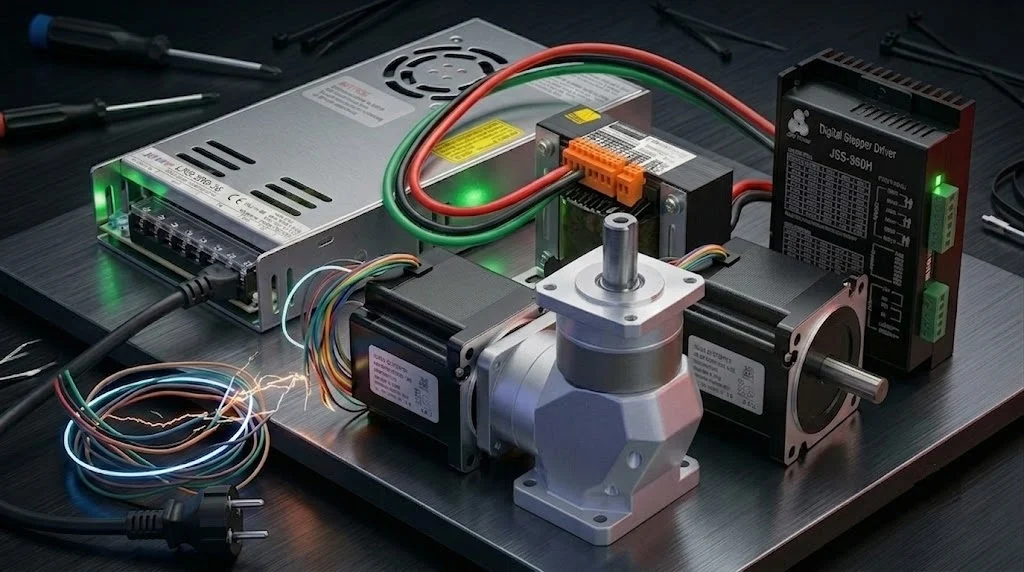
In industrial automation, stepper motors are vital for precise motion control, driven by specialized stepper motor drivers. These drivers supply controlled current pulses to the motor windings, enabling step-by-step rotation. The process relies on high-frequency switching (PWM) and H-bridge topologies. Since motor windings are inherently inductive loads, abruptly interrupting current flow in an energized inductive circuit causes stored energy to seek a discharge path, resulting in significant voltage spikes (back EMF). Therefore, disconnecting a motor cable from an energized stepper motor driver is a critical operational mistake that can lead to catastrophic damage to both the driver and the motor.
Technical Principles and Consequences
Stepper motor drivers typically employ H-bridges constructed from MOSFET or IGBT transistors to energize the motor phases. During operation, magnetic energy is stored within the motor windings. Protective circuits, such as flyback diodes, are designed to safely dissipate this energy when the current is switched or reversed. However, physically yanking the motor cable while the system is powered bypasses these protective measures, creating an uncontrolled and severe energy discharge scenario.
When the motor cable is suddenly disconnected, the inductive energy in the windings attempts to collapse instantaneously. According to fundamental electrical laws (Ohm’s Law and Faraday’s Law of Induction), a rapid change in current (di/dt) in an inductor (L) induces a high voltage (V = -L * di/dt). This uncontrolled voltage surge propagates back to the driver’s output terminals, directly impacting the MOSFETs or IGBTs. These components have a maximum voltage rating (Vds_max or Vce_max). The resulting overvoltage spikes, which can range from hundreds to thousands of volts, can exceed this rating, causing the transistors to fail permanently (short or open circuit) and rendering the driver inoperable.
Beyond driver failure, this action can also damage the motor’s windings. The extreme voltage can break down the insulation, leading to arcing (flashover) between windings or between windings and the motor casing. This can result in motor winding short circuits or complete burnout. Furthermore, the electrical arc generated during such an event poses a significant safety hazard, potentially causing severe burns, eye damage, or even explosions, endangering personnel and nearby equipment. Strict adherence to safety protocols is paramount in industrial environments to prevent such incidents.
| Parameter | Value/Description |
|---|---|
| Motor Winding Type | Inductive Load (L) |
| Inductive Voltage Formula | V = -L * (di/dt) |
| Typical Driver Switching Element | MOSFET / IGBT |
| Driver Protection Mechanism | Flyback Diodes |
| Consequence of Sudden Disconnection | Uncontrolled Overvoltage Spikes |
| Potential Driver Damage | MOSFET/IGBT Failure (Short/Open Circuit) |
| Potential Motor Damage | Winding Insulation Breakdown, Arcing, Burnout |
| Safety Risk | Electrical Arc, Burns, Shock Hazard |
Essential Precautions for Industrial Environments
- Always De-energize and Lockout (LOTO): Before performing any electrical connection or disconnection, ensure all systems are completely de-energized. Implementing Lockout/Tagout (LOTO) procedures is crucial for mitigating risks in industrial automation. Always verify power is off using appropriate testing equipment like a voltmeter. This protects both the equipment and personnel.
- Ensure Quality Cabling and Connections: Use correctly sized motor cables, high-quality connectors, and ensure all connections are secure. Loose or poorly made connections can lead to intermittent issues and potential damage.
For reliable operation of your CNC machinery, always prioritize safety and proper maintenance procedures. If you are experiencing issues with your stepper motor systems or require expert advice, request a quote on WhatsApp.