No products in the cart.
Spindle Motor Ceramic Bearings vs. Steel Bearings: A Technical Comparison
Contents
- Spindle Motor Ceramic Bearings vs. Steel Bearings: Introduction and Technical Analysis Industrial automation, particularly the modern manufacturing industry, relies directly on the performance of high-speed and high-precision machining centers (CNC machines, robotic systems, etc.). At the heart of these systems are spindle motors, which are among the most critical components determining the speed, accuracy, and surface quality of machining processes. The performance of spindle motors largely depends on the type, quality, and operating conditions of their integrated bearings. Bearings ensure the smooth and stable rotation of the spindle at high speeds, minimizing vibration and supporting loads. In today’s industrial automation sector, there are two main bearing types commonly preferred for spindle motor applications: steel bearings and ceramic bearings (typically hybrid ceramic bearings). These two bearing technologies exhibit significant differences in terms of the advantages and disadvantages they offer, and making the right choice directly impacts a system’s overall efficiency, lifespan, and maintenance costs. This detailed field guide and technical article will comprehensively compare both bearing types from an engineering perspective, examine their technical parameters, highlight critical points in field applications, and guide industry professionals in making informed decisions. Spindle Motor Ceramic Bearings vs. Steel Bearings: Operating Principle and Technical Data
- Spindle Motor Ceramic Bearings vs. Steel Bearings: Field Considerations
- Spindle Motor Ceramic Bearings vs. Steel Bearings: Common Problems and Solutions
- Spindle Motor Ceramic Bearings vs. Steel Bearings: Conclusion and Expert Advice
- Request a Quote on WhatsApp
- FAQ
Spindle Motor Ceramic Bearings vs. Steel Bearings: Introduction and Technical Analysis
Industrial automation, particularly the modern manufacturing industry, relies directly on the performance of high-speed and high-precision machining centers (CNC machines, robotic systems, etc.). At the heart of these systems are spindle motors, which are among the most critical components determining the speed, accuracy, and surface quality of machining processes. The performance of spindle motors largely depends on the type, quality, and operating conditions of their integrated bearings. Bearings ensure the smooth and stable rotation of the spindle at high speeds, minimizing vibration and supporting loads. In today’s industrial automation sector, there are two main bearing types commonly preferred for spindle motor applications: steel bearings and ceramic bearings (typically hybrid ceramic bearings). These two bearing technologies exhibit significant differences in terms of the advantages and disadvantages they offer, and making the right choice directly impacts a system’s overall efficiency, lifespan, and maintenance costs. This detailed field guide and technical article will comprehensively compare both bearing types from an engineering perspective, examine their technical parameters, highlight critical points in field applications, and guide industry professionals in making informed decisions.
Spindle Motor Ceramic Bearings vs. Steel Bearings: Operating Principle and Technical Data
The operating principle of spindle motors is based on converting electrical energy into mechanical rotational motion to spin the cutting tool or workpiece at high speeds. The role of bearings is to ensure this rotational motion is stable, precise, and vibration-free. Bearings support the radial and axial loads of the spindle, minimizing rotational friction and ensuring efficient motor operation. The two main bearing types, steel and ceramic bearings, show significant distinctions in performance characteristics due to differences in material science.
Steel Bearings: Traditional Power and Cost-Effectiveness
Commonly used in traditional spindle motors, steel bearings are typically manufactured from high-carbon chromium steel (e.g., AISI 52100 or European standard GCr15). Both the inner and outer rings, as well as the rolling elements (balls or rollers), are made from these steel alloys. These bearings are known for their high load-carrying capacities and resistance to impact. Steel, as a material, is quite robust and machinable, which reduces manufacturing costs. However, steel bearings have some limitations:
- Friction and Heat Generation: Steel has a relatively high coefficient of friction when rubbing against other steel surfaces. This friction leads to significant heat generation, especially at high speeds. Excessive heat shortens bearing life, degrades lubricant properties, and causes thermal expansion of the spindle shaft, negatively affecting machining precision.
- Speed Limitations: Due to high friction and heat generation, steel bearings have lower maximum operating speeds compared to ceramic bearings. At high speeds, thermal expansion and excessive heating prevent stable bearing operation.
- Weight: Steel is a denser material than ceramic materials. This increases the inertia of rotating elements and can limit acceleration/deceleration performance in high-speed applications.
- Lubrication Requirement: Steel bearings require a continuous and effective lubrication system to reduce friction and wear. The quality and quantity of lubrication are critical for bearing life and performance.
- Corrosion Sensitivity: Steel can corrode in humid or chemically aggressive environments, directly affecting bearing performance and lifespan.
- Electrical Conductivity: Steel is electrically conductive. This can cause stray currents passing through the shaft in electric motors or welding applications to damage bearings (electrical arc erosion).
Ceramic Bearings: High Performance and Advanced Technology
In spindle motors, the term “ceramic bearing” typically refers to hybrid ceramic bearings. Hybrid ceramic bearings have steel inner and outer rings, while the rolling elements (balls) are made from high-performance ceramic materials, particularly Silicon Nitride (Si3N4) or, less commonly, Zirconia (ZrO2). Full ceramic bearings (where both rings and balls are ceramic) are used in more specialized applications, generally requiring lower loads, extreme corrosion resistance, or high temperatures, but they are not common in spindle motors. The advantages of hybrid ceramic bearings include:
- Lower Friction and Heat Generation: The coefficient of friction of ceramic balls on steel rings is significantly lower than that of steel balls. This means less heat generation, extending bearing life, delaying lubricant degradation, and minimizing thermal expansion of the spindle shaft, thereby increasing machining precision.
- High Speed Capacity: Thanks to lower friction and less heat generation, ceramic bearings can achieve much higher rotational speeds compared to steel bearings. This feature is indispensable for high-speed machining (HSM) applications.
- Lighter Weight and Lower Inertia: Ceramic materials are much lighter than steel (their density is approximately 40% lower). This reduces the inertia of the rolling elements, allowing the spindle motor to accelerate and decelerate faster, thus shortening cycle times.
- Longer Lubrication Life and Less Maintenance: Lower heat generation and less friction extend lubricant life and require less lubrication. This reduces maintenance costs and downtime.
- High Rigidity and Vibration Damping: Ceramic materials are more rigid and harder than steel. This reduces bearing deformation and provides better spindle support for higher precision machining. Additionally, the natural vibration damping properties of ceramic balls reduce vibrations generated during machining, improving surface quality.
- Electrical Insulation: Silicon Nitride (Si3N4) is an electrical insulator. This property prevents stray currents that may occur in spindle motors from damaging the bearings, which is a critical advantage especially in systems using variable frequency drives (VFDs).
- Corrosion Resistance: Ceramic balls are much more resistant to chemicals and moisture than steel balls, providing a longer lifespan in aggressive environments.
Disadvantages: The most significant disadvantage of ceramic bearings is their higher cost compared to steel bearings. Material costs and manufacturing difficulties increase the price of ceramic balls. Furthermore, full ceramic bearings can be more sensitive to impact, although hybrid ceramic bearings are closer to steel in this regard due to their steel rings.
| Parameter | Steel Bearing (AISI 52100) | Hybrid Ceramic Bearing (Si3N4 Ball) |
|---|---|---|
| Material (Balls) | High Carbon Chromium Steel (AISI 52100) | Silicon Nitride (Si3N4) |
| Maximum Speed Capacity | Medium (up to 1.0 x 10⁶ dmN) | Very High (2.5 x 10⁶ dmN and above) |
| Coefficient of Friction | High | Low (30-50% less) |
| Heat Generation | High | Low (Less thermal expansion) |
| Density (Ball) | ≈ 7.8 g/cm³ | ≈ 3.2 g/cm³ (Approximately 60% lighter) |
| Rigidity (Modulus of Elasticity) | ≈ 200 GPa | ≈ 300-320 GPa (Higher rigidity) |
| Electrical Conductivity | Conductive | Insulating (Stray current protection) |
| Corrosion Resistance | Low/Medium (Prone to rust) | High (Resistant to chemicals and moisture) |
| Average Lifespan | Standard | Longer (2-3 times more) |
| Cost | Low/Medium | High (2-5 times more expensive) |
| Lubrication Requirement | Critical and Continuous | Less and at Longer Intervals |
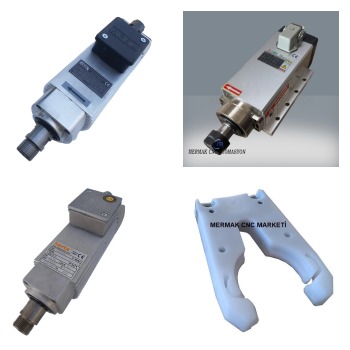
Spindle Motor Ceramic Bearings vs. Steel Bearings: Field Considerations
- Application Area and Speed Requirements: The maximum rotational speed required by the application where the spindle motor will be used is a fundamental determinant in bearing selection. If the application continuously requires high speeds (e.g., above 15,000 RPM) and high surface quality and precision are paramount, hybrid ceramic bearings are undoubtedly the only option. Steel bearings offer a cost-effective solution for lower and medium-speed applications (generally below 10,000-12,000 RPM). Using steel bearings in high-speed applications will lead to overheating, premature failure, and a decrease in machining precision.
- Load Capacity and Rigidity: The magnitude of radial and axial loads to be applied during machining is important. Steel bearings are known for their high static and dynamic load capacities and may be suitable for heavy material removal operations. However, the high rigidity of ceramic balls provides less deformation and thus better spindle support. Especially in situations where vibration control is critical, such as precision machining and machining thin-walled parts, the high rigidity and damping advantage offered by ceramic bearings are decisive.
- Thermal Management and Lubrication: The thermal behavior of the spindle motor directly affects machining precision. Ceramic bearings generate less heat due to low friction, which means a more stable operating temperature and less thermal expansion. This helps maintain the dimensional stability of the spindle shaft, especially in long-term and precise machining operations. For steel bearings, an effective cooling and lubrication system (oil-air, oil mist, or grease) is vital. The correct selection and regular maintenance of the lubrication system directly affect the life and performance of steel bearings. Ceramic bearings may require less frequent lubrication, which reduces maintenance costs.
- Cost-Performance Analysis and Total Cost of Ownership (TCO): The initial purchase cost of ceramic bearings is significantly higher than that of steel bearings. However, when making a decision, not only the initial cost but also the Total Cost of Ownership (TCO) should be considered. Ceramic bearings can be more economical in the long run by providing a longer lifespan, lower energy consumption (due to low friction), less maintenance, higher production speed, and better product quality. Especially for companies engaged in high-volume and precision production, the increase in efficiency brought by ceramic bearings can amortize the initial cost.
- Environmental Conditions: The conditions of the environment where the spindle motor will operate also play a role in bearing selection. If the environment contains moisture, chemical vapors, or abrasive substances, hybrid bearings with corrosion-resistant ceramic balls may be more suitable. Additionally, in applications where electrical stray currents can cause problems (e.g., welding operations or high-frequency motor drives), electrically insulating ceramic balls prevent bearing damage, increasing system safety.
- Vibration and Noise Levels: Minimizing vibration and noise levels is critical in high-precision machining applications. Ceramic balls’ lower friction and higher rigidity offer lower vibration and noise levels compared to steel bearings. This improves machining surface quality and enhances operator comfort.
- Installation and Maintenance Precision: Both bearing types require correct installation and preloading, but the assembly of high-speed spindle motor bearings requires specialized knowledge and equipment. Since ceramic bearings are manufactured with higher precision than steel bearings, more care must be taken during assembly, and the manufacturer’s instructions must be strictly followed. Incorrect assembly can severely shorten bearing life. Maintenance routines also vary by bearing type; although ceramic bearings require less lubrication, regular inspection and cleaning are still important.

Spindle Motor Ceramic Bearings vs. Steel Bearings: Common Problems and Solutions
Problems encountered in spindle motor bearings typically arise from incorrect selection, inadequate maintenance, faulty installation, or unsuitable operating conditions. These issues can lead to decreased spindle performance, degraded machining quality, and ultimately, production downtime.
Common Problems and Solutions for Steel Bearings:
- Problem: Overheating and Thermal Expansion. Steel bearings overheat, especially at high speeds or with insufficient lubrication. This leads to lubricant degradation, shortened bearing life, and thermal expansion of the spindle, causing a loss of machining precision.
Solution: Adhere to the spindle motor’s operating speed limits. Use an effective cooling system (water or air cooling). Regularly check the lubrication system (grease, oil-air, oil mist) and use the lubricant type and quantity recommended by the manufacturer. Ensure lubrication channels are not clogged. - Problem: Insufficient Lubrication or Contamination. Lubricant degradation over time, contamination, or insufficient quantity increases friction, leading to wear and premature bearing failure.
Solution: Strictly follow the lubrication schedule. Change or replenish the lubricant at regular intervals. Check and clean the filters of the lubrication system. Regularly inspect and, if necessary, replace sealing elements to prevent dust and contaminants from the operating environment from reaching the bearings. - Problem: Premature Fatigue and Wear. Excessive load, incorrect assembly (preload errors), or vibrations can cause premature fatigue and surface wear in steel bearings.
Solution: Do not exceed the nominal load capacity of the spindle motor. During assembly, strictly follow the manufacturer’s specified preload values and assembly techniques. Regularly check the spindle’s balance and rebalance if necessary. Use vibration sensors to detect abnormalities early. - Problem: Corrosion. In humid or aggressive chemical environments, steel bearings can corrode, leading to performance loss and failure.
Solution: Opt for bearings with protective coatings suitable for the environmental conditions or increase the environmental sealing of the spindle motor. Use anti-corrosion lubricants.
Common Problems and Solutions for Hybrid Ceramic Bearings:
- Problem: High Initial Cost. The initial cost of ceramic bearings is higher than that of steel bearings.
Solution: Conduct a long-term Total Cost of Ownership (TCO) analysis, not just the initial cost. Evaluate the return on investment by considering advantages such as longer lifespan, less maintenance, higher production speed, and better product quality. Accurately analyze application requirements to determine if ceramic bearings are truly necessary. - Problem: Impact Sensitivity (for Full Ceramic Bearings). Full ceramic bearings are more brittle against impact than steel bearings. However, hybrid ceramic bearings significantly reduce this sensitivity due to their steel rings.
Solution: Hybrid ceramic bearings should generally be preferred for spindle motor applications. Exercise special care against impacts during assembly and transportation. Implement design measures to minimize mechanical shocks. - Problem: Incorrect Installation and Preload. High-precision ceramic bearings can experience performance loss or premature failure due to incorrect assembly or faulty preload.
Solution: Ensure bearing assembly is performed only by authorized and trained personnel. Strictly follow the manufacturer’s assembly instructions and recommended preload values. Use specialized assembly tools and precision measuring devices. - Problem: Vibration and Noise (Rare Cases). Rarely, vibration or noise issues can also occur in ceramic bearings at excessively high speeds or with incorrect preload.
Solution: Check and optimize the dynamic balance of the spindle. Ensure bearings are correctly seated and preloaded. Review the overall rigidity of the spindle motor’s bearing arrangement design.
General Problems and Solutions (for Both Types):
- Problem: Spindle Vibration and Imbalance. Imbalance in the spindle shaft places excessive load on the bearings and leads to problems such as vibration, noise, and premature wear.
Solution: Regularly check the dynamic balance of the spindle shaft and rebalance with professional equipment if necessary. Ensure cutting tools are also balanced. - Problem: Sensor Failures or Faulty Readings. Malfunctioning temperature, vibration, or speed sensors on the spindle motor prevent early detection of bearing problems.
Solution: Periodically check the calibration and functionality of sensors. Replace faulty sensors immediately. - Problem: Incorrect Bearing Selection. Choosing a bearing type unsuitable for application requirements results in performance degradation and premature failure.
Solution: When selecting bearings, always consult in detail with the technical support units of spindle motor manufacturers or bearing suppliers. Conduct a comprehensive engineering analysis that considers all factors such as speed, load, temperature, environmental conditions, and cost.
Spindle Motor Ceramic Bearings vs. Steel Bearings: Conclusion and Expert Advice
Bearing selection for spindle motors is far from a simple decision in the complex and demanding world of industrial automation; instead, it is a critical engineering process requiring comprehensive engineering analysis, cost-benefit evaluation, and field experience. Steel bearings, having proven their reliability for years, offering high load capacity and relatively cost-effective solutions, remain a valid option for medium-speed and load applications. However, as the demands for speed, precision, and efficiency in modern manufacturing increase, the inherent limitations of steel bearings (high friction, heat generation, speed limits) become more pronounced. At this point, hybrid ceramic bearings, especially those equipped with Silicon Nitride (Si3N4) balls, offer a revolutionary advancement in spindle motor technology. With superior properties such as low friction, less heat generation, high-speed capacity, lightness, electrical insulation, and corrosion resistance, ceramic bearings have become indispensable in applications where high-speed machining (HSM), ultra-precision machining, and long operational life are critical.
As an expert, my advice is never to make bearing selection based on a single parameter, especially not solely on the initial purchase cost. Instead, adopt a holistic approach by considering your application’s specific requirements, expected operational life, ease of maintenance, energy efficiency, environmental conditions, and most importantly, a Total Cost of Ownership (TCO) analysis. If your application requires operation at high speeds (e.g., above 15,000 RPM), micron-level precision, superior surface quality, and long uninterrupted operating times, despite the higher initial cost of ceramic bearings, the return on this investment will be inevitable due to the performance advantages, increased efficiency, and reduced maintenance costs they provide in the long run. Especially in sectors such as aerospace, medical, mold making, and automotive, considering the direct impact of spindle motor performance on production quality and competitiveness, ceramic bearings are no longer a luxury but a necessity. On the other hand, for lower-speed and less critical precision applications, steel bearings will continue to offer a cost-effective solution.
In conclusion, when choosing the right bearing type for your spindle motor, always contact the technical support units of manufacturing companies. Share the details of your application, operating profiles, and expectations to determine the most suitable and optimized bearing solution. Remember that correctly selected and properly installed bearings are the heart of your spindle motor, directly affecting the health and efficiency of your entire production line.
Request a Quote on WhatsApp
For detailed information on spindle motors and bearing solutions tailored to your industrial needs, please do not hesitate to request a quote on WhatsApp. Our expert team at Mermak CNC is ready to assist you with professional advice and competitive pricing for your CNC router machine requirements.
FAQ
What are the main advantages of ceramic bearings over steel bearings for spindle motors?
Hybrid ceramic bearings, which use ceramic balls with steel rings, offer significantly lower friction, higher speed capacity, reduced heat generation, and electrical insulation compared to traditional steel bearings. This leads to longer lifespan, less maintenance, and higher precision in demanding industrial applications.
Are ceramic bearings more cost-effective than steel bearings in the long run?
While the initial cost of ceramic bearings is higher, their Total Cost of Ownership (TCO) can be lower over the long term. This is due to their extended lifespan, reduced maintenance requirements, lower energy consumption from less friction, and improved production efficiency and product quality.
How do I choose between ceramic and steel bearings for my specific spindle motor application?
For applications requiring high speeds (above 15,000 RPM), micron-level precision, superior surface quality, and extended uptime, hybrid ceramic bearings are highly recommended. For lower-speed applications (below 10,000-12,000 RPM) with less critical precision needs, steel bearings can be a cost-effective choice.
What critical factors should be considered when selecting spindle motor bearings?
Key factors include the maximum required speed, load capacity (radial and axial), thermal management capabilities, environmental conditions (moisture, chemicals), and the importance of vibration control and electrical insulation. A comprehensive engineering analysis and consultation with technical experts are crucial.
What are the common problems associated with both steel and ceramic spindle motor bearings?
Common issues with steel bearings include overheating, thermal expansion, lubrication inadequacy, and corrosion. For ceramic bearings, the primary concern is the higher initial cost and, for full ceramic types, impact sensitivity. Proper installation, maintenance, and correct bearing selection are vital for both.