





































































Servo Motor Brands Comparison: Which Brand to Choose for Industrial Applications?
📑 Table of contents (Click to open)
- Servo Motor Brands Comparison: Which Brand to Choose? Introduction and Technical Analysis
- Servo Motor Brands Comparison: Which Brand to Choose? Operating Principle and Technical Data
- Servo Motor Brands Comparison: Which Brand to Choose? Field Considerations
- Servo Motor Brands Comparison: Which Brand to Choose? Common Problems and Solutions
- Servo Motor Brands Comparison: Which Brand to Choose? Conclusion and Expert Advice
- FAQ
Servo Motor Brands Comparison: Which Brand to Choose? Introduction and Technical Analysis
Considered the heart of industrial automation, servo motors are indispensable for applications requiring precision, speed, and high dynamic performance in manufacturing processes. They play critical roles across a wide spectrum, from the millimeter-accurate movements of a robotic arm to the precision of a CNC machine’s cutting operation, synchronization in packaging machines, and thread tension control in the textile industry. However, with numerous powerful and established servo motor manufacturers in the market, the process of selecting the right brand and model becomes a complex engineering decision. This field guide and technical article aims to provide industrial automation professionals, engineers, and decision-makers with the fundamental criteria, technical details, and practical approaches to consider when performing a servo motor brand comparison. We will emphasize that the correct choice is not limited to initial cost but also encompasses factors such as long-term operational efficiency, ease of maintenance, and system integration. Our goal is to guide you in finding the most suitable and cost-effective solution for your application.
Servo Motor Brands Comparison: Which Brand to Choose? Operating Principle and Technical Data
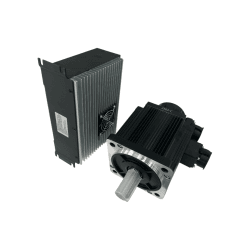
Servo motors are typically an integral part of closed-loop control systems, consisting of a DC or AC motor, a feedback device (encoder or resolver), and a servo drive (amplifier). The feedback device continuously measures the motor’s current position, speed, and sometimes torque, transmitting this information to the servo drive. The servo drive then compares this feedback information with the desired commands from the controller. Based on the difference (error signal), it precisely adjusts the motor’s torque and speed to achieve the desired position or speed. This closed-loop control mechanism enables the superior characteristics of servo systems, such as high precision, fast response time, and resistance to load changes.
Technically, the main parameters to consider when selecting a servo motor are:
- Torque: The rotational force the motor can produce. The starting, continuous, and peak torque values required by the application are critically important. Applications moving high inertia or heavy loads require higher torque.
- Speed (RPM): The maximum and continuous operating speed of the motor. The application’s cycle time and efficiency targets determine this parameter.
- Inertia: The motor’s resistance to rotational motion. The compatibility of motor and load inertia directly affects the system’s dynamic performance and stability. Generally, a motor-to-load inertia ratio between 1:1 and 1:10 is considered ideal, although this ratio may vary depending on the application.
- Resolution: The number of pulses an encoder or resolver can provide in one revolution. Higher resolution means more precise positioning and smoother motion. It is vital for applications requiring micro-positioning.
- Feedback Type: Different types are available, such as optical encoders (incremental or absolute), magnetic encoders, and resolvers. Absolute encoders retain position information even after power loss, while incremental encoders require a return to a reference point upon each startup. Resolvers are more robust in harsh environmental conditions.
- Operating Voltage: Typically ranges from 230V AC to 400V AC. Country standards and existing infrastructure influence this choice.
- IP Protection Class: Indicates the motor’s resistance to dust and water. A high IP class (IP65, IP67) is essential, especially in humid, dusty, or washdown environments (e.g., food industry).
- Communication Protocols: Protocols that enable communication between servo drives and controllers. Industrial Ethernet-based protocols like EtherCAT, Profinet, Sercos, Modbus TCP/IP, and CANopen are preferred for high-speed and synchronized communication.
- Size and Mounting Type: The mechanical constraints of the application determine the physical dimensions and flange type of the motor.
- Brake: Magnetic brake motors can be preferred for vertical axes or to prevent free fall of the load.
These technical data form the concrete parameters you can use for comparison when evaluating the product portfolios of different brands. For example, Yaskawa’s Sigma series or Mitsubishi’s MELSERVO series stand out for high-speed, high-precision robotic applications, while Siemens SINAMICS or Bosch Rexroth IndraDrive series might be more suitable for heavy industry and integrated automation solutions.
| Parameter | Value/Description |
|---|---|
| Torque Range | 0.1 Nm – 1000 Nm (Variable by application) |
| Speed Range | 100 RPM – 8000 RPM (Typical) |
| Positioning Accuracy | ±1 pulse (Up to 0.001 degrees depending on encoder resolution) |
| Feedback Type | Incremental Encoder, Absolute Encoder (Single/Multi-turn), Resolver |
| Protection Class | IP54 – IP67 (Protection Against Dust and Water) |
| Communication Protocols | EtherCAT, Profinet, Sercos, Modbus TCP/IP, CANopen |
| Operating Voltage | 200-240 VAC, 380-480 VAC (Single/Three Phase) |
Servo Motor Brands Comparison: Which Brand to Choose? Field Considerations
- Detailed Analysis of Application Requirements: First and foremost, you must clearly define the actual needs of your application. This includes not only basic parameters like torque and speed but also details such as acceleration/deceleration times, cycle times, positioning repeatability, load inertia, environmental conditions (temperature, humidity, vibration, explosive atmospheres), and safety functions (STO, SS1, etc.). For example, a packaging machine with high cycle rates requires a fast-responding system resistant to high inertia ratios, while a precision machining center prioritizes absolute positioning accuracy and smooth motion. Brands have different strengths in specific application areas; for instance, Yaskawa and Mitsubishi typically excel in high-speed and dynamic robotic applications, while Siemens and Rockwell Automation (Allen-Bradley) offer comprehensive solutions for broader integrated automation platforms and heavy industry applications.
- Integration and Compatibility: The selection of a servo motor and drive is closely related to how easily it can be integrated with your existing automation infrastructure. The brand and model of the PLC or controller you are using will directly affect the communication protocols (EtherCAT, Profinet, Sercos, Modbus TCP/IP, etc.) and software integration of the servo system you choose. For example, SINAMICS drives provide natural compatibility for a system operating within the Siemens TIA Portal ecosystem, while Allen-Bradley Kinetix series drives offer ease of integration for a facility using Rockwell Automation’s Studio 5000 platform. While combining products from different brands is theoretically possible, this often means additional engineering effort, potential compatibility issues, and more complex commissioning processes.
- Total Cost of Ownership (TCO): While initial investment cost is an important factor in brand selection, it should not be the sole determinant. Total Cost of Ownership (TCO) encompasses not only the purchase price but also energy consumption, spare part availability and cost, ease of maintenance, frequency of failures, access to technical support, and other costs that may arise throughout the system’s lifespan. A seemingly cheaper system can be much more costly in the long run due to high energy consumption, frequent failures, or expensive spare parts. For example, some brands offer regenerative drives that provide higher energy efficiency, while others may offer simpler, less efficient solutions. Brands like Bosch Rexroth and Kollmorgen can provide TCO advantages with their long-lasting and durable products.
- Technical Support, Service Network, and Documentation: Especially in critical production lines, access to fast and competent technical support in case of a malfunction is vital. You should research whether your chosen brand has a local service network, expert technical personnel, and comprehensive documentation (user manuals, error codes, programming examples). For companies with global operations, brands offering a worldwide support network (Siemens, Rockwell, Yaskawa, Mitsubishi) may be preferred. Additionally, the training opportunities offered by the brand will enable your personnel to work more efficiently with the system. Brands like Delta and Schneider Electric may have strong support networks across a wide geography.
- Durability and Environmental Conditions: The conditions of the environment in which the motor will operate directly influence the selection. For motors that will operate under harsh conditions such as high temperature, humidity, dust, dirt, chemical exposure, or vibration, models with a higher IP protection class (IP65, IP67), special coatings, or stainless steel housings should be preferred. For example, washdown motors (IP69K) are mandatory in the food and beverage industry. Furthermore, some brands offer more robust products specifically designed for demanding industrial conditions.
- Energy Efficiency and Sustainability: Considering today’s energy costs and environmental responsibilities, highly energy-efficient servo motors and drives should be preferred. IE (International Efficiency) classes provide an indicator in this regard. Regenerative drives save energy by returning energy generated during deceleration or braking to the grid or storing it in capacitors. This can make a significant difference, especially in applications with frequent start-stops or controlling high-inertia loads.
- Spare Parts and Lifecycle Management: The long-term spare parts support and lifecycle policy of the chosen brand’s products are important. Many brands offer a certain period of spare parts and service guarantee for their older generation products. When designing long-life systems, considering the end-of-life dates of the motor and drive and their replacement models helps you plan for future potential revisions and upgrade costs.
Servo Motor Brands Comparison: Which Brand to Choose? Common Problems and Solutions
Servo systems, being high-performance components, can occasionally encounter various issues. Correct diagnosis and resolution of these problems are vital to minimize production downtime.
- Overheating: Overheating of the servo motor or drive is one of the most common problems.
- Causes: Operating the motor under a load higher than its nominal torque, inadequate cooling (fan failure, dirty air filter), incorrect adjustment of drive parameters (high current limits), mechanical friction or jamming.
- Solutions: Re-evaluate the application’s torque and speed profiles, check the nominal values of the motor and drive. Clean or improve the cooling system (fans, heat sinks). Optimize drive parameters (current limits, PID gains). Check for excessive friction in mechanical components (bearings, belts, gears).
- Positioning Errors or Vibration: The motor failing to reach the desired position, deviating from the target position, or continuously vibrating.
- Causes: Encoder or feedback failure/cable damage, mechanical backlash or loose connections, incorrect adjustment of drive PID gains (excessively high or low gains), resonance frequencies.
- Solutions: Check encoder cables and connections, test encoder signal integrity. Eliminate mechanical backlash, tighten all fastening elements. Use the drive’s auto-tuning feature or manually optimize PID gains. Use notch filter settings in the drive to filter out resonance frequencies.
- Drive Faults (Error Code Display): The servo drive stopping operation and displaying an error code.
- Causes: Overcurrent, overvoltage, undervoltage, overheating, encoder error, communication error, internal hardware failure.
- Solutions: Check the error code displayed by the drive in the user manual and apply the relevant troubleshooting steps. Ensure the power supply is stable. Check encoder and motor cables. If necessary, revert the drive to factory settings and re-parameterize, or consult authorized service.
- Communication Issues: Interruption or erroneous data exchange between the controller and the servo drive.
- Causes: Communication cable damage, incorrect wiring, IP address or node address conflict, incorrect communication protocol settings, electrical noise.
- Solutions: Check the integrity and correct connection of communication cables. Verify IP addresses and node addresses. Ensure protocol settings (baud rate, data bits, etc.) are compatible on both devices. Use shielded cables and check grounding to reduce noise.
- Mechanical Failures: Mechanical problems related to the motor itself.
- Causes: Bearing wear, shaft misalignment, brake failure, damage to the mounting flange.
- Solutions: Listen to the motor’s sound; abnormal noises may indicate bearing failure. Check if the shaft rotates freely. Test if the brake is functioning correctly. If necessary, disassemble the motor for detailed inspection or send it to authorized service.
Servo Motor Brands Comparison: Which Brand to Choose? Conclusion and Expert Advice
Choosing the right servo motor brand in industrial automation is not just a product preference but a strategic decision that affects your project’s success, operational efficiency, and long-term sustainability. As seen in this detailed field guide, there is no single “best” servo motor brand; there is always the brand and model “most suitable for your application.”
From an expert perspective, I strongly recommend following these steps in the selection process:
- Create an Application Profile: Develop a comprehensive application profile including all technical details such as torque, speed, inertia, precision, environmental conditions, cycle times, and safety requirements. This profile will be your primary filter for eliminating or highlighting potential brands.
- Integration and Ecosystem: Considering your existing automation infrastructure (PLC, HMI, controller), prioritize brands that offer the best integration and require the least engineering effort. Integrated platforms like Siemens’ TIA Portal, Rockwell’s Studio 5000, or Mitsubishi’s iQ Works typically work seamlessly with their own brand’s servo systems.
- Perform a TCO Analysis: Conduct a Total Cost of Ownership (TCO) analysis that includes not only the motor and drive cost but also factors such as energy consumption, spare parts availability, service costs, software licenses, and commissioning time. Long-term costs can be much more significant than the initial price.
- Evaluate Technical Support and Service Network: Especially in the Turkish market, research the strength of the brand’s local distributor and service network, the competence of its technical personnel, and its spare parts stock. Fast and effective technical support minimizes production loss during unexpected breakdowns.
- Examine Sectoral References: Review references and case studies on which brands have been successfully used in similar applications. The experiences of other professionals in the industry can provide valuable insights. For example, Yaskawa and Fanuc have strong references in robotics, while Bosch Rexroth may excel with its hydraulic and linear motion systems.
- Consider Pilot Projects: For large and critical projects, consider conducting small-scale pilot projects with a few selected brands to test the performance and integration of the systems under real-world conditions.
In conclusion, servo motor brand selection is a technical evaluation, an economic analysis, and a strategic partnership decision. Each brand has its unique strengths and niche markets. By conducting comprehensive research, detailed analysis, and collaborating with reliable suppliers, you can find the most suitable, reliable, and efficient servo motor solution for your business needs. This will be a solid investment that meets not only today’s but also future automation requirements.
FAQ
What is a servo motor and why is it important in industrial automation?
Servo motors are critical components in industrial automation that provide precise control over position, speed, and torque. They are used in applications requiring high accuracy and dynamic performance, such as CNC machines, robotics, packaging equipment, and material handling systems.
What technical specifications should I consider when comparing servo motor brands?
Key technical parameters include torque range, speed range, positioning accuracy, feedback device type (encoder/resolver), IP protection class, operating voltage, and communication protocols. These parameters must align with your application's specific requirements.
How does Total Cost of Ownership (TCO) influence servo motor brand selection?
Beyond initial purchase price, consider the Total Cost of Ownership (TCO), which includes energy consumption, spare parts availability and cost, maintenance ease, technical support, and the brand's lifecycle management policy. A cheaper initial investment might lead to higher long-term costs.
What are common problems with servo motors and how can they be resolved?
Common issues include overheating (due to overload or poor cooling), positioning errors or vibration (often related to encoder issues or incorrect PID tuning), drive fault codes, communication problems, and mechanical failures (like bearing wear). Proper diagnosis and parameter optimization are crucial for resolution.
How important is integration and compatibility with existing automation infrastructure?
Prioritize brands that offer seamless integration with your existing PLC or controller ecosystem. Brands like Siemens, Rockwell Automation, and Mitsubishi often provide integrated platforms that simplify setup and reduce engineering effort when paired with their own servo systems.