No products in the cart.
Size and Precision Analysis in Linear Rail and Carriage Selection: An Industrial Field Guide

Contents
Linear Rail and Carriage Selection: Size and Precision Analysis: Field Guide
Introduction and Technical Analysis
At the heart of industrial automation, directly impacting the efficiency and precision of manufacturing processes, are linear rail and carriage systems. These systems are responsible for providing accurate, repeatable, and reliable linear motion in a wide range of applications, including robotic arms, CNC machines, assembly lines, medical devices, and packaging machinery. The overall performance, durability, and cost-effectiveness of an automation system depend on the meticulous selection of linear rails and carriages. An incorrect choice can not only lead to premature failures or increased maintenance costs but also jeopardize production accuracy, reduce product quality, and cause operational inefficiency.
This detailed field guide and technical article comprehensively cover the fundamental principles, technical details, and field applications of size and precision analysis in linear rail and carriage selection for engineers, designers, and maintenance specialists in the industrial automation sector. Critical parameters to consider during the selection process, such as load capacity, precision class, preload, speed, acceleration, environmental conditions, and service life, will be examined in depth. Furthermore, the importance of mounting accuracy, common problems, and practical solutions for these issues will form a significant part of the article. Our goal is to provide readers with the necessary knowledge and tools to make informed decisions in the complex world of linear motion systems, thereby ensuring success in automation projects. This guide aims to be a guiding resource for industry professionals, combining both theoretical knowledge and practical application experience.
Operating Principle and Technical Data
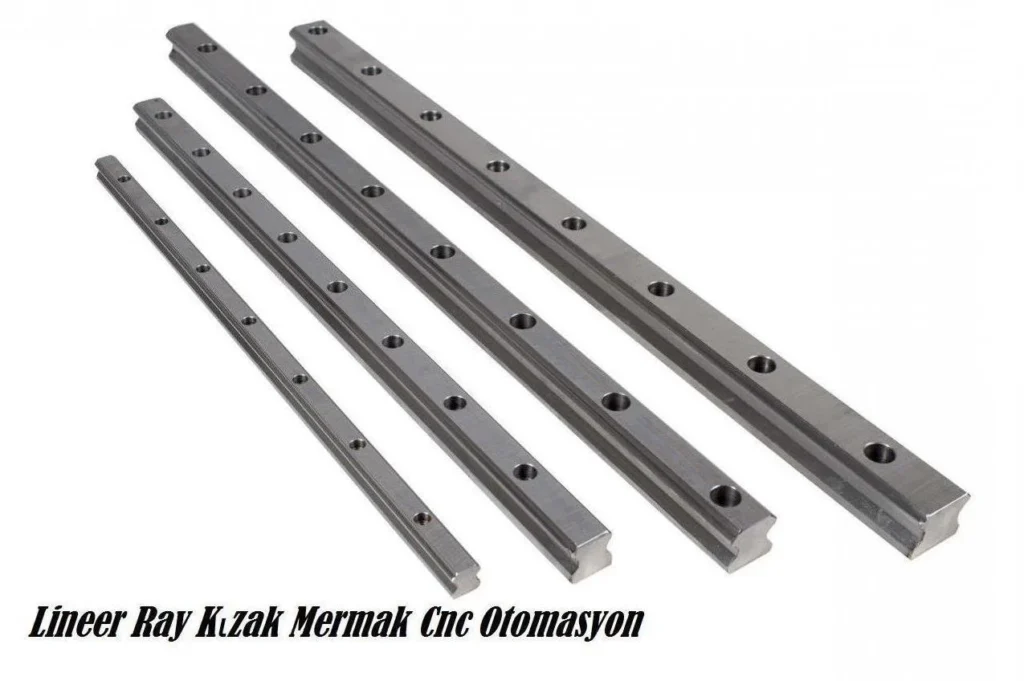
Linear rail and carriage systems consist of linear carriages (blocks or carriers) that move along one or more linear guides (rails). The basic operating principle involves the carriages moving with minimal friction via rolling elements (typically balls or rollers) along the rails. These rolling elements guide the carriage along the precisely machined channels (raceways) of the rail. This structure provides a much lower coefficient of friction, higher load-carrying capacity, and superior positioning accuracy compared to sliding bearing systems. Systems are designed in various types according to application requirements:
- Ball Linear Rails: The most commonly used type. Small balls roll at the contact point between the rail and carriage, allowing for high speeds and good precision. Generally preferred for applications requiring medium to high precision and speed. Loads are typically distributed based on ball diameter and number.
- Roller Linear Rails: Use larger rollers or cylinders compared to ball systems. This increases the contact area, providing much higher load capacity and rigidity. Ideal for applications requiring heavy loads, high moment loads, and very high rigidity (e.g., heavy machine tools). Speed limits may be slightly lower than ball systems.
- Needle Roller Linear Rails: Use very thin cylindrical rollers. Offers high load capacity and low cross-sectional height, but generally has more limited travel distances.
Technical parameters to consider in linear rail and carriage selection are vital for system performance and lifespan:
- Load Capacity: This is the maximum load a linear system can safely carry. It is divided into two main categories:
- Dynamic Load Capacity (C): The load a system can carry without failure while operating under dynamic load for a specified service life (typically 50-100 km). Calculated for systems continuously under load.
- Static Load Capacity (C0): The maximum load a system can carry without causing permanent deformation in the rolling elements when the system is stationary or moving very slowly. Shock loads and vibrations affect this value. Moment loads (pitch, yaw, roll) should also be evaluated separately.
- Precision Class: A classification indicating the manufacturing precision of linear rails and carriages. While varying by manufacturer, it is usually expressed with letters such as P, H, N, C (P: Precision, H: High, N: Normal, C: Common). Higher precision classes offer tighter tolerances, better flatness, parallelism, and repeatability. This is critical for positioning accuracy and repeatability.
- Repeatability: A measure of how closely a system can return to the same target position repeatedly. Usually expressed in microns and very important for applications requiring precise positioning.
- Accuracy: A measure of how much a system deviates from its true position. Expresses absolute positioning accuracy.
- Preload: The internal load applied to eliminate backlash between linear carriages and rails. Preload increases system rigidity, reduces vibration, and improves precision. However, excessive preload can increase friction and heat generation, shortening service life. Typically indicated by levels such as Z0 (light), ZA (medium), ZB (heavy).
- Friction Resistance: The force required to move the system. Low friction allows for the use of smaller motors and less energy consumption. Lubrication and preload level directly affect friction.
- Maximum Speed and Acceleration: The highest linear speed and acceleration values the system can safely achieve. These values are limited by the dynamic limits of the rolling elements and the rigidity of the system.
- Stroke Length: The maximum distance a linear carriage can travel on the rail. The rail length should be chosen to match the required travel distance of the application.
- Material and Environmental Conditions: Standard carbon steel, stainless steel, or specially coated rails provide durability for different environmental conditions (humidity, corrosion, dust, high/low temperature). Sealing elements (wiper, seal) provide protection against contamination.
- Service Life: The estimated distance (L10 life) a system can operate without failure under specific load and operating conditions, determined according to ISO standards. Load, speed, stroke, and preload affect this calculation.
| Parameter | Value/Description |
|---|---|
| Load Capacity (Dynamic, C) | 5,000 N – 500,000 N (Varies by size and type) |
| Load Capacity (Static, C0) | 8,000 N – 1,000,000 N (Varies by size and type) |
| Precision Class | C (Normal), H (High), P (Precision), SP (Super Precision), UP (Ultra Precision) |
| Repeatability | ±1 µm – ±5 µm (Varies by precision class and size) |
| Maximum Speed | 5 m/s – 10 m/s (In ball systems, depending on preload) |
| Maximum Acceleration | 30 m/s² – 150 m/s² (Must be checked against manufacturer datasheet values.) |
| Preload Level | Z0 (Light), ZA (Medium), ZB (Heavy). Selected according to application requirements. |
| Operating Temperature Range | -20°C to +80°C (Standard). Can be extended for special applications. |
| Corrosion Resistance | Stainless steel or specially coated options available. |
| Service Life Calculation Method | According to ISO 14728-1 and ISO 14728-2 standards (L10 life). |
Field Considerations
- Mounting Accuracy and Surface Flatness: The performance of linear rails and carriages is directly related to the flatness, parallelism, and concentricity of the mounting surfaces. Even the smallest deviations in mounting surfaces can lead to excessive stresses, increased friction, loss of precision, and premature wear in the system. It is essential to check surfaces before mounting with a precision spirit level, laser alignment devices, or micron-precision dial indicators. The parallelism and flatness of the rails to each other are critically important, especially in systems using multiple rails. Incorrect mounting can lead to system failure even below its nominal load capacity.
- Lubrication and Maintenance Program: Regular and correct lubrication is indispensable for the optimal performance and long life of rolling elements. The type of lubricant (grease, oil), viscosity, and application frequency should be determined according to manufacturer’s recommendations and operating conditions (load, speed, temperature, contamination). Insufficient lubrication increases friction and heat, leading to wear, while excessive lubrication can damage sealing elements and attract contaminants. Automatic lubrication systems can reduce maintenance burden and extend life by providing consistent lubrication, especially in hard-to-reach or continuously operating systems.
- Environmental Factor Management: Dust, dirt, chips, moisture, corrosive chemicals, and extreme temperature changes in the operating environment are enemies of linear motion systems. Measures such as bellows, sealing elements (wipers/seals), and protective coatings can prevent contamination from entering the system. In environments with high humidity or chemical vapors, stainless steel or specially coated corrosion-resistant rails should be preferred. Extreme temperature changes can cause thermal expansion or contraction in materials, leading to precision losses; in such cases, thermal compensation or appropriate material selection should be considered.
- Detailed Analysis of Load Profile: Before selection, a comprehensive analysis of all loads acting on the system (static, dynamic, shock, vibration, moment loads – pitch, yaw, roll) and how they change throughout the application should be performed. Not only vertical load, but also lateral and torsional loads must be taken into account. Application factors (impact, vibration, acceleration/deceleration) and safety factors should be applied to the calculated load capacity. Incorrect load analysis leads to over-sizing (unnecessary cost) or under-sizing (premature failure) of the system.
- System Rigidity and Vibration Control: In applications requiring high precision, the overall rigidity of the linear system is critically important. The rigidity of the mounting surface, fasteners, and surrounding structures, as well as the rigidity of the selected rail and carriage, affects the total system rigidity. Insufficient rigidity can cause vibration and positioning errors. Correct adjustment of the preload level can increase system rigidity and dampen vibration. Vibration analysis and appropriate damping solutions are beneficial, especially in high-speed or dynamic applications.

Common Problems and Solutions
Problems encountered in linear rail and carriage systems typically arise from incorrect selection, faulty installation, insufficient maintenance, or environmental effects. Here are some common problems and proposed solutions:
- Premature Wear or Damage:
- Problem: Visible wear, indentations, rust, abnormal noise, or difficulty in movement on rail or carriage surfaces.
- Causes: Insufficient or incorrect lubrication, excessive load, contamination (dust, chips), incorrect mounting (misalignment), corrosion.
- Solutions: Check the lubrication schedule and the type of lubricant used; change if necessary. Ensure that loads applied to the system do not exceed the calculated dynamic and static capacities. Prevent contamination entry by checking sealing elements and protective measures (bellows, covers). Verify mounting accuracy by checking the parallelism and flatness of the rails. If corrosion is present, consider switching to stainless steel or specially coated systems.
- Loss of Precision or Repeatability Issues:
- Problem: Positioning errors, inability to return to the target position, vibrating movement, inability to achieve desired surface quality.
- Causes: Loose fasteners, worn rolling elements or raceways, insufficient preload, thermal expansion/contraction, insufficient system rigidity.
- Solutions: Ensure all mounting bolts are tightened to the correct torque. Inspect rail and carriage surfaces for wear or damage; replace if necessary. Ensure the preload level is maintained according to manufacturer recommendations; adjust preload or select a system with higher preload if needed. Monitor temperature changes in the operating environment and implement thermal compensation strategies (material selection, cooling). Consider structural improvements to increase system rigidity.
- Excessive Noise and Vibration:
- Problem: Loud noise, abnormal vibrations, clicking or squeaking sounds during operation.
- Causes: Insufficient or incorrect lubrication, contamination, worn or damaged components, incorrect preload, resonance, mounting errors.
- Solutions: Check lubrication status and lubricate if necessary. Clean the system to remove contaminants. Thoroughly inspect rails and carriages for wear or damage. Check and adjust the preload level. Analyze the system’s natural frequencies to identify and avoid speeds or frequencies causing resonance. Recheck the flatness and parallelism of mounting surfaces.
- Sticking or Irregular Movement:
- Problem: Sticking, sudden stops, uneven speed profile during movement.
- Causes: Contamination, damage to rolling elements (crushing, breakage), bending or deformation in the rail, mounting error (misalignment), excessive preload.
- Solutions: Completely clean and lubricate the system. Thoroughly inspect rolling elements (balls, rollers) and raceways; replace damaged parts. Measure the straightness of the rail and the parallelism of mounting surfaces; realign or replace the rail if necessary. Ensure preload is appropriate to manufacturer recommendations; reduce if excessive.
Expert Advice
The selection of linear rails and carriages in industrial automation systems is far more than just choosing a product from a catalog; it is a critical process requiring engineering discipline, field experience, and detailed analysis. Beyond the size and precision parameters discussed in this article, factors such as load capacity, preload, speed, acceleration, environmental conditions, and service life directly impact the system’s long-term performance, reliability, and cost-effectiveness. For successful linear motion system integration, it is essential to meticulously match all these technical data with application requirements.
From an expert perspective, the fundamental principle that should never be compromised during the selection process is a holistic approach. Instead of focusing on a single parameter, a multi-dimensional evaluation should be performed, considering the dynamics of the entire system, environmental effects, and expected lifespan. For example, selecting a rail with the highest precision class will not deliver the expected performance if the mounting surfaces are not sufficiently flat or if environmental contamination cannot be controlled. Similarly, choosing a system with excessive load capacity will lead to unnecessary cost increases, while an under-capacity system will invite premature failures.
Field experience has repeatedly demonstrated the importance of carefully examining manufacturer datasheets and technical guides. Manufacturer-provided load calculation tools, life estimation software, and mounting instructions are invaluable resources for making correct selections and preventing potential problems. Furthermore, simulating real-world conditions during prototyping and testing phases is vital for confirming the accuracy of theoretical calculations and uncovering unexpected issues. Diligence during the mounting phase, correct lubrication, and implementation of regular maintenance programs are critical factors that directly affect the life and performance of the selected system. It should be remembered that the life and precision of a linear motion system are the result of a series of correct decisions and continuous care, starting from the initial selection. We hope this guide serves as a valuable resource for you to make the right choices in your industrial automation projects and maximize the efficiency of your systems.
FAQ
What are linear rail and carriage systems and why are they important in industrial automation?
Linear rail and carriage systems are critical components in industrial automation that provide precise, repeatable, and reliable linear motion. They consist of a linear guide (rail) and a linear carriage (block) that moves along it, typically using rolling elements like balls or rollers to minimize friction. These systems are essential for the performance, durability, and cost-effectiveness of applications such as CNC machines, robotic arms, and assembly lines.
What technical parameters are crucial when selecting linear rails and carriages?
Key technical parameters include dynamic and static load capacity, precision class, preload, maximum speed and acceleration, stroke length, material, environmental conditions, and service life. Load capacity defines the maximum weight the system can handle, precision class indicates manufacturing accuracy, and preload affects rigidity and vibration. All these factors must be carefully analyzed to match the specific application requirements.
What are the common problems encountered with linear rail and carriage systems, and how can they be resolved?
Common issues include premature wear, loss of precision, excessive noise, and irregular movement. These are often caused by insufficient lubrication, incorrect mounting, excessive load, contamination, or thermal effects. Solutions involve implementing proper lubrication schedules, ensuring precise mounting, verifying load calculations, protecting against environmental contaminants, and checking for appropriate preload settings.
Why is mounting accuracy so critical for the performance of linear rail and carriage systems?
Mounting accuracy is paramount because even minor deviations in surface flatness or parallelism can lead to increased stress, friction, reduced precision, and premature wear. Precise alignment ensures the system operates within its design parameters, preventing early failure and maintaining optimal performance and accuracy over its lifespan.
What expert advice should be followed for successful linear rail and carriage selection and integration?
A holistic approach is recommended, considering all system dynamics, environmental impacts, and expected lifespan, rather than focusing on a single parameter. Utilize manufacturer datasheets, load calculation tools, and life estimation software. Prototyping and testing under real-world conditions are also vital to confirm theoretical calculations and identify unforeseen issues before full deployment.