No products in the cart.
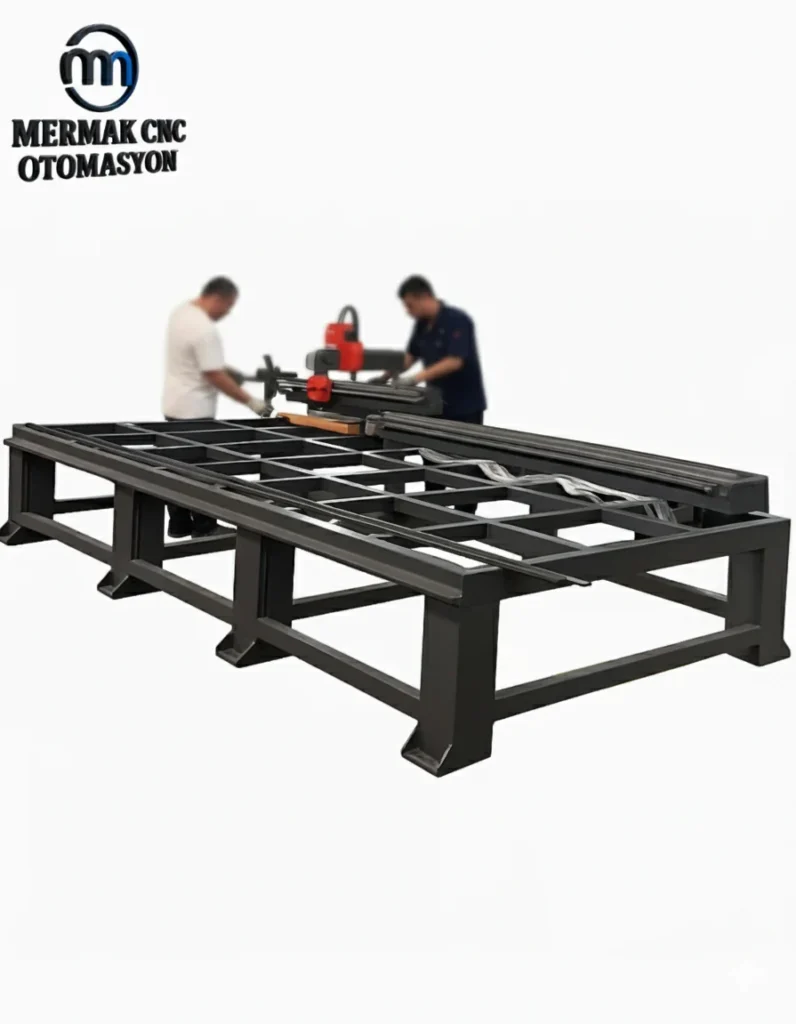
How Should a CNC Plasma Cutting Machine Frame Be?
Contents
- How Should a CNC Plasma Cutting Machine Frame Be? Introduction and Technical Analysis
- How Should a CNC Plasma Cutting Machine Frame Be? Working Principle and Technical Data
- How Should a CNC Plasma Cutting Machine Frame Be? On-Site Considerations
- How Should a CNC Plasma Cutting Machine Frame Be? Common Problems and Solutions
- How Should a CNC Plasma Cutting Machine Frame Be? Conclusion and Expert Advice
- FAQ
How Should a CNC Plasma Cutting Machine Frame Be? Introduction and Technical Analysis
In the industrial automation and metal processing sectors, CNC plasma cutting machines are indispensable tools for precise and rapid cutting of sheet metal and other metallic materials. One of the most critical factors determining the performance, cutting quality, speed, and lifespan of these machines is the frame (skeleton) structure that forms the machine’s foundation. The frame not only supports all other machine components but also directly influences the system’s overall precision and repeatability by managing dynamic loads, vibrations, and thermal stresses generated during the cutting process. This detailed field guide and technical article will thoroughly examine the ideal design criteria, material selections, engineering approaches, and critical on-site considerations for CNC plasma cutting machine frames. Our goal is to explain to industry professionals, engineers, and investors why frame design is so crucial for a high-performance and long-lasting plasma cutting machine and to help them make informed choices. The frame directly determines the machine’s rigidity, thermal stability, and vibration damping capacity; these features are vital for the quality of the final cut product and the operational efficiency of the machine.
How Should a CNC Plasma Cutting Machine Frame Be? Working Principle and Technical Data
In CNC plasma cutting machines, the frame is the main supporting structure that carries the moving gantry system, cutting table, linear guide rails, gearboxes, motors, and all other mechanical and electrical components. During the cutting process, as the plasma torch moves at high speeds and accelerations, it applies intense heat and force to the material. These dynamic processes continuously create stresses and vibrations on the frame. A well-designed frame must minimize these stresses, effectively damp vibrations, and control deformations caused by thermal expansion.
Rigidity and Stability: The most fundamental characteristic of a frame is its high rigidity. Insufficient rigidity leads to deflections and vibrations during gantry movements, causing undulations in the cutting line, angular errors, and a general decrease in cutting quality. Therefore, steel profiles with high section modulus (e.g., box profiles or I-beams) should be preferred in frame design. In welded constructions, the quality of weld seams and stress-relieving processes ensure the structural integrity and longevity of the frame. The frame must be dimensioned to safely support the total weight of the machine and dynamic loads.
Vibration Damping: The plasma cutting process and the rapid movements of the gantry naturally generate vibrations. These vibrations can negatively affect cutting precision and lead to premature wear of machine components. In frame design, vibration management should be achieved through methods such as using vibration-damping materials (e.g., special filling materials or polymer concrete) or keeping the structure’s natural frequency away from its operating frequencies. A heavy and massive frame generally has better vibration damping properties.
Thermal Stability: During the plasma cutting process, ambient temperature and the heating of the cut material can cause thermal expansion in the frame. Especially in large machines, these expansions can lead to millimeter-level shifts, disrupting cutting accuracy. In frame material selection and design, materials with a low thermal expansion coefficient should be preferred, or design details that compensate for thermal expansion (e.g., connection points allowing free expansion) should be used. Homogeneous heating/cooling properties of the material and structure are also important.
Material Selection: The most common frame materials are steel (especially structural steels S235, S355) and, in some cases, aluminum alloys. Steel is preferred due to its high rigidity, strength, and relatively low cost. However, its weight and corrosion risk can be disadvantages. Aluminum alloys are lighter and have good corrosion resistance but are more expensive than steel and may require larger cross-sections to achieve the same rigidity. In modern designs, composite materials or filled steel profiles are also used.
Structural Design and Manufacturing Quality:
- Weld Quality: The quality of welds used in frame manufacturing is critically important. High-strength welds, stress-relieving processes, and crack control ensure the frame’s longevity and stability.
- Machining Precision: The machining precision of the surfaces for linear guide rails, gearboxes, and motor connections directly affects the overall accuracy of the machine. These surfaces should be machined to thousandths of a millimeter precision.
- Modular Structure: For large machines, the frame can be designed modularly to facilitate transport and installation. However, the rigidity and alignment of module joints are of great importance.
- Leveling and Anchoring: The frame must be securely connected to the floor via sturdy and adjustable leveling feet. These feet ensure the machine is perfectly leveled, allowing the entire system to operate stably.
| Parameter | Value/Description |
|---|---|
| Material Type | High-strength structural steel (S355JR or equivalent), thick-walled box profiles, or special welded constructions. |
| Structural Design | Closed box profiles, truss structure, or composite (steel-concrete) filled profiles. Gantry should be integrated as closely as possible to the frame. |
| Rigidity (Deflection) | Maximum deflection on gantry and frame under dynamic loads (max. acceleration and speed) should be below 0.05 mm/meter. |
| Thermal Stability | Axial expansion difference should not exceed 0.02 mm/meter during ambient temperature changes (±5°C). Thermal stress relieving process must be applied. |
| Vibration Damping | Natural frequencies should be far from operating frequencies, and integrated vibration damping elements (e.g., elastomeric pads or polymer infill) should be used. |
| Leveling/Anchoring | High-precision adjustable leveling feet at each support point, secure anchoring to the floor. Tolerance ±0.01 mm/meter. |
| Surface Finish | Linear guide rail mounting surfaces precisely ground or milled, Ra value < 1.6 μm. Epoxy paint or special coating for corrosion protection. |
How Should a CNC Plasma Cutting Machine Frame Be? On-Site Considerations
- Installation and Leveling Precision: The frame of a CNC plasma cutting machine must be perfectly leveled during installation. The floor must have sufficient strength to support the machine’s total weight and dynamic loads, and provide a smooth surface. Leveling should be done to millimeter or even micron levels using laser alignment devices or precision spirit levels. Incorrect leveling leads to stresses in the linear guide rails, premature wear, and degradation of cutting accuracy. The machine may require periodic re-leveling, especially if there are floor movements or vibration sources in the working environment. Ensure that the load distribution at each foot point is balanced.
- Material Selection and Machining Quality: The correct thickness and cross-section of the material selected for the frame (typically structural steels S355 or higher strength alloys) are critical to ensure the expected rigidity and strength. In welded constructions, the penetration, cleanliness, and stress-relieving processes of the weld seams are very important. Welded structures without stress relieving can be prone to deformations and cracks over time. Linear guide rail mounting surfaces must be machined with extreme precision (grinding or milling), and flatness tolerances must be strictly controlled. Surface roughness directly affects the smooth movement and long life of the linear guide rails.
- Vibration Management and Damping: The plasma cutting process and the high-speed movements of the gantry inevitably produce vibrations. In frame design, the goal should be to keep the machine’s natural frequencies away from its operating frequencies. Additionally, placing vibration damping pads or special mounting elements between the frame and the floor reduces the transmission of external vibrations to the machine and machine vibrations to the floor. Heavy frame structures typically damp vibrations better due to their mass. In some advanced frame designs, sand, special concrete, or polymer fillers are added to internal cavities to increase damping capacity.
- Thermal Expansion Control: Temperature changes in the working environment and heat generated during the cutting process cause thermal expansion in the frame material. Especially in long frames, this expansion can lead to significant dimensional changes. In the design, the material’s thermal expansion coefficient should be considered, and gaps or flexible connections should be left at critical points to compensate for expansion. For example, sliding connections that allow one side to expand freely while the other is fixed can be used. Regular ambient temperature control and preventing the machine from being exposed to direct sunlight are also important for thermal stability.
- Maintenance and Inspection: Although the frame is the most fundamental component of the machine, its regular maintenance and inspection should not be neglected. Periodically checking the linear guide rails, gearboxes, and motor connection points on the frame, verifying the tightness of bolts, and early detection of possible cracks or deformation signs are critically important. Corrosion, especially in humid or chemical vapor environments, can reduce frame strength. Therefore, the frame surfaces should be regularly renewed with protective paints or coatings, and damaged areas should be repaired.
- Environmental Factors: The environment where the frame is located must be protected against environmental factors such as dust, humidity, temperature, and chemical vapors. Especially metal dust and fumes from plasma cutting can cause corrosion and wear of the frame and moving parts. An effective dust extraction and filtration system extends the life of the frame. Preventing extreme fluctuations in ambient temperature is also important for thermal stability.
- Load Distribution and Dynamic Stresses: Frame design must account not only for static loads but also for dynamic stresses generated during gantry acceleration, deceleration, and direction changes. These dynamic loads can be concentrated particularly at linear guide rail connection points and gantry support elements. Structural analysis (FEA – Finite Element Analysis) should be used to identify these stress points, and the design should be optimized accordingly. Correct positioning of the center of gravity and balanced load distribution increase the overall stability of the machine.
How Should a CNC Plasma Cutting Machine Frame Be? Common Problems and Solutions
Problems related to the frame in CNC plasma cutting machines typically lead to a decrease in cutting quality, reduced machine lifespan, and operational inefficiency. Here are some common problems and suggested solutions:
- Degradation of Cutting Quality (Wavy Cuts, Angular Errors):Problem: Wavy edges, uneven lines, or undesirable angles on cut parts. This usually occurs due to insufficient frame rigidity, incorrect leveling, or play in the gantry’s moving parts.
Solution: First, precisely check and adjust the machine’s leveling if necessary. Check for play in the linear guide rails or gear/belt systems and tighten settings. Review the structural integrity of the frame (weld cracks, deformations). If the frame is structurally weak, consider adding reinforcements or replacing it with a more rigid frame. Check the condition of vibration damping pads.
- Wear and Degradation of Linear Guide Rails:Problem: Premature wear, rough movement, or noise in linear guide rails or bearings. Main causes include overloading, insufficient lubrication, dust accumulation, or misalignment.
Solution: Regularly clean and lubricate linear guide rails and bearings as recommended by the manufacturer. Ensure protective bellows or sealing elements are intact to prevent dust and contaminant ingress. Check the alignment and parallelism of the linear guide rails; misalignment causes uneven load distribution on the linear guide rails. If wear is advanced, linear guide rails and bearings may need replacement. Avoid operating the machine with loads exceeding its carrying capacity.
- Vibration-Induced Noise and Loss of Precision:Problem: Excessive vibration during machine operation, high noise levels, and a decrease in cutting precision. Caused by insufficient damping, loose connections, or resonance.
Solution: Check the tightness of all connection bolts. Ensure that vibration damping elements (rubber mounts, spring isolators) between the machine and the floor are correctly positioned and secure. Use more effective damping materials if necessary. Interventions such as adding mass to the structure or changing support points can be considered to alter the frame’s natural frequency. Checking motor and gearbox connections is also important.
- Thermal Deformations and Dimensional Instability:Problem: Inconsistencies in cut dimensions or shifts in machine axes due to long operating hours or ambient temperature changes.
Solution: Try to minimize temperature fluctuations in the machine’s environment. An air-conditioned environment improves thermal stability. Avoid exposing the machine to direct sunlight or heat sources. Ensure that elements compensating for thermal expansion (expansion gaps, flexible connections) in the frame design are functioning correctly. If necessary, allow a certain “warm-up” period before operating the machine to allow the frame to reach a stable temperature.
- Structural Cracks or Deformations:Problem: Formation of cracks in weld zones or high-stress points on the frame, general warping or twisting of the structure.
Solution: Such problems usually arise from inadequate design (stress concentrations), poor weld quality, or the absence of stress-relieving processes. Non-destructive testing methods such as visual inspection, magnetic particle testing, or liquid penetrant testing should be used to detect cracks. Small cracks can be professionally repaired (with welding and stress relieving). However, large cracks or severe deformations may require complete replacement of the frame. This significantly shortens machine life and is usually a costly solution. Periodic structural inspections enable early detection of such problems.
How Should a CNC Plasma Cutting Machine Frame Be? Conclusion and Expert Advice
The frame of a CNC plasma cutting machine is like the heart and skeleton of the machine; it has a direct and decisive impact on its performance, cutting quality, accuracy, and operational life. To remain competitive in the industrial automation sector and produce high-quality products, the care given to frame design and manufacturing should never be overlooked. It must be remembered that a machine frame is far more than just a “supporting” element; it is a critical system where complex engineering principles are applied, managing dynamic loads, damping vibrations, and ensuring thermal stability.
As expert advice; when purchasing a new CNC plasma cutting machine or evaluating your existing machine, always pay attention to technical details such as the frame’s material quality, structural rigidity, weld quality, stress-relieving processes, and the machining precision of linear guide rail mounting surfaces. A machine with a low-cost but structurally weak frame, while initially attractive, will ultimately cost much more in the long run due to cutting quality issues, frequent breakdowns, high maintenance costs, and production losses. Especially for large and high-speed machines, the engineering design and manufacturing quality of the frame are vital for return on investment (ROI) and operational efficiency.
During the purchasing process, inquire whether modern engineering tools such as Finite Element Analysis (FEA) were used in the frame design. Learn about the manufacturer’s frame manufacturing processes (e.g., post-weld stress-relieving ovens) and quality control standards. Ensure you receive professional leveling service during machine installation and adhere to periodic maintenance schedules. Remember that a robust and well-designed frame not only provides better cutting quality but also extends the life of your machine, reduces downtime, and increases your business’s overall efficiency. Therefore, the investment in the frame is as important as the machine itself and will add value to your business in the long term. In this rapidly developing era of industrial automation, making the right choices by adhering to fundamental engineering principles is key to sustainable success.

FAQ
Why is the frame of a CNC plasma cutting machine so important?
The frame of a CNC plasma cutting machine is the primary structural component that supports all other machine parts, including the gantry, cutting table, linear guide rails, and motors. Its design directly impacts the machine's rigidity, thermal stability, and vibration damping capacity, which are crucial for cutting precision, speed, and overall operational lifespan.
What are the essential characteristics of an ideal CNC plasma cutting machine frame?
Key characteristics include high rigidity to prevent deflections and vibrations, excellent thermal stability to minimize dimensional changes due to temperature fluctuations, and effective vibration damping to ensure cutting precision and reduce wear. The frame should also be designed for easy maintenance and protection against environmental factors.
What materials are typically used for CNC plasma cutting machine frames?
Common materials include high-strength structural steels (like S355JR) for their rigidity and cost-effectiveness, and sometimes aluminum alloys for lighter weight and corrosion resistance. Modern designs may also incorporate composite materials or steel profiles filled with polymer concrete for enhanced damping.
What should be considered during the installation and maintenance of a CNC plasma cutting machine frame?
Critical considerations include the quality of welds and stress-relieving processes, the precision of machined surfaces for linear guide rail mounting, and the use of adjustable leveling feet for perfect installation. Regular inspection for cracks, proper lubrication, and protection against dust and humidity are also vital for longevity.
What are the common problems associated with CNC plasma cutting machine frames and their solutions?
Common issues include wavy cuts or angular errors due to insufficient rigidity, premature wear of linear guide rails from misalignment or lack of lubrication, excessive vibration and noise, thermal deformations affecting dimensional accuracy, and structural cracks. Solutions often involve precise leveling, tightening connections, improving damping, controlling ambient temperature, and professional repair or replacement of damaged sections.