No products in the cart.
Steel Construction vs. Aluminum Profile for CNC Router Bodies
Contents
Introduction and Technical Analysis
In the industrial automation sector, particularly for machines requiring precision and repeatability such as computer numerical control (CNC routers), the structural choice of the machine body is a critical engineering decision. This choice directly impacts the machine’s performance, lifespan, cost, and operational efficiency. Typically, two main material and structural approaches stand out for CNC router bodies: steel construction and aluminum profile. Each option has its unique advantages and disadvantages, and making the right choice requires a deep understanding of the application’s specific requirements. This detailed field guide and technical article aims to provide industrial automation professionals with a comprehensive perspective to support their decision-making process, highlighting the fundamental differences, technical parameters, and field application experiences between these two structural materials.
As the primary function of a CNC router is to cut, shape, or process a workpiece according to a specific design with high precision, the rigidity and vibration-damping capabilities of the machine body are paramount. The body serves as the main structure supporting the moving axes (X, Y, Z), the spindle motor, and the processing table, ensuring stability during operation. Insufficient rigidity or poor vibration damping can lead to a decline in processing quality, reduced tool life, and an overall negative impact on the machine’s performance. Therefore, material selection should not be considered merely a cost factor but also a guarantee of performance and quality. Steel constructions are often preferred for applications demanding high strength and rigidity, while aluminum profiles offer advantages in modularity, light weight, and rapid assembly. Examining the technical details and field application implications of each option is essential for reaching the correct engineering decision.
Operating Principle and Technical Data
The CNC router body forms the main supporting framework of the machine, housing all moving components, the spindle motor, and the worktable. Its fundamental operating principle is to absorb and dampen dynamic and static loads generated during processing, maintaining the tool’s position relative to the workpiece with sub-micrometer precision. To achieve this stability, the material used must possess high rigidity (resistance to bending and torsion), good vibration damping capacity, and dimensional stability. Here are the technical details and application areas for steel construction and aluminum profiles within this framework:
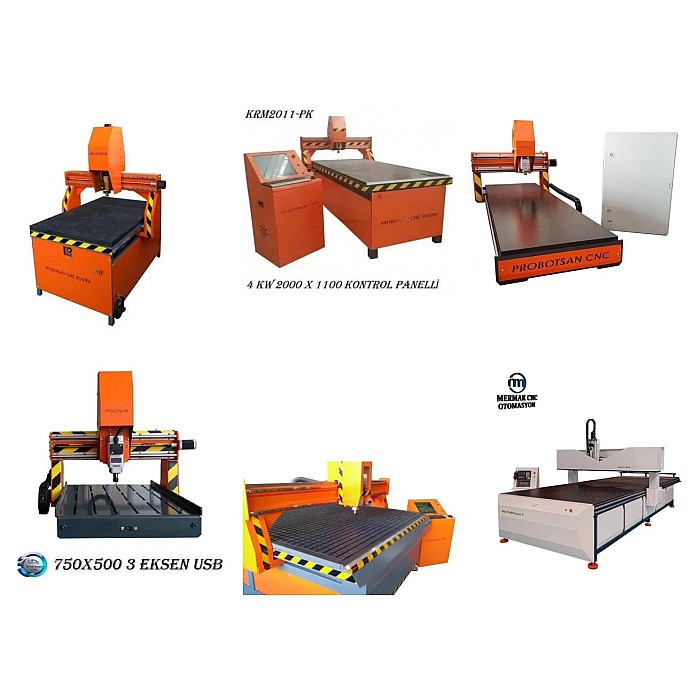
Steel Construction (Welded Steel Frame)
Steel construction typically refers to a welded and machined structure made from structural steels such as ST-37 (S235JR) or ST-52 (S355JR). These types of bodies are known for their high strength and rigidity. Steel’s modulus of elasticity (approximately 200-210 GPa) is about three times higher than aluminum’s, meaning it deforms less. This characteristic is crucial for large-format or heavy-duty CNC routers. Steel also has a natural ability to absorb and dissipate vibration energy more effectively, reducing the transfer of machining-induced vibrations to the machine and workpiece. This results in smoother surface finishes and longer tool life.
Advantages:
- Superior Rigidity and Strength: Provides excellent resistance to high processing forces and heavy workpieces.
- High Vibration Damping: The material’s internal structure effectively absorbs vibrations, enhancing processing quality.
- Long Lifespan and Durability: Offers high resistance to impact and wear in industrial environments.
- Cost-Effectiveness (Per Unit Strength): The material cost per unit of strength is generally lower than aluminum.
Disadvantages:
- High Weight: Steel’s density (approx. 7850 kg/m³) is about three times that of aluminum, significantly increasing the machine’s total weight. This can raise transportation and installation costs.
- Manufacturing Complexity and Process: Requires welding, heat treatment, and precision machining, which are time-consuming and require specialized expertise.
- Corrosion Risk: Requires surface treatments (painting, galvanizing, etc.) to protect against corrosion.
- Design Flexibility: Welded structures offer less flexibility for subsequent modifications or expansions.
Application Areas: Heavy-duty industrial CNC routers, metal processing machines, large-format wood or composite machining centers, high-precision mold machines.
Aluminum Profile Construction (Modular Aluminum Profile)
Aluminum profiles are modular structural elements, typically produced by extrusion from alloys like EN AW-6060 or EN AW-6063, featuring standard cross-sections such as T-slots or V-slots. These profiles are easily assembled using specialized connectors (corner brackets, T-nuts, bolts). Aluminum’s modulus of elasticity (approx. 70 GPa) is lower than steel’s, meaning it is less rigid for the same cross-sectional area. However, aluminum’s low density (approx. 2700 kg/m³) allows for the creation of lightweight structures.
Advantages:
- Lightweight: Significantly reduces the machine’s overall weight, facilitating transportation and installation.
- Modularity and Flexibility: Easily assembled, disassembled, and can be expanded or modified according to future needs. Ideal for prototyping and rapid manufacturing.
- Corrosion Resistance: Naturally resistant to corrosion, generally requiring no additional surface treatments (except anodizing).
- Aesthetic Appearance: Often available with anodized finishes, providing a clean and modern look.
- Fast Assembly: Assembly time is short as it does not require welding or specialized machining.
Disadvantages:
- Lower Rigidity and Vibration Damping: Compared to steel of the same cross-sectional area, it is less rigid and has lower vibration damping capacity. It has a higher potential for flexing over large spans or under heavy loads.
- Cost (Per Unit Strength): The material cost per unit of strength is generally higher than steel.
- Weakness at Connection Points: Bolted connections may not be as monolithic and rigid as a welded structure and carry a risk of loosening over time.
- Thermal Expansion: Has a higher coefficient of thermal expansion than steel, which can have a greater impact on dimensional stability with temperature changes.
Application Areas: Small and medium-sized CNC routers, 3D printers, laser cutters, automation stands, prototyping machines, light material processing (wood, plastic, thin aluminum).
| Feature | Steel Construction | Aluminum Profile |
|---|---|---|
| Modulus of Elasticity (GPa) | ~200-210 | ~70 |
| Density (kg/m³) | ~7850 | ~2700 |
| Rigidity | Very High | Moderate |
| Vibration Damping | Good | Fair |
| Weight | Heavy | Light |
| Assembly | Welding, Machining | Bolting, Modular |
| Corrosion Resistance | Requires Treatment | Good (Natural) |
Factors Influencing the Choice
The decision between a steel construction and an aluminum profile body for a CNC router depends heavily on several key factors:
- Application Type: What materials will be processed? What are the required cutting depths and speeds? For heavy-duty applications like cutting thick metals or large volumes of dense wood, the superior rigidity of steel is often necessary. For lighter materials like plastics, foams, or thin aluminum, and for applications prioritizing speed and flexibility, aluminum profiles can be sufficient.
- Precision Requirements: While both can achieve high precision with proper design and components (like high-quality linear guide rails and servo drives), the inherent rigidity of steel provides a more stable platform, especially under dynamic loads, which can be critical for achieving the tightest tolerances.
- Budget: Steel construction often has a lower initial material cost for the frame itself, but the manufacturing process can be more labor-intensive. Aluminum profiles might have a higher material cost per unit, but the ease of assembly can reduce overall manufacturing time and cost, especially for smaller series or custom builds.
- Machine Size and Footprint: For very large machines, the weight of a steel construction can become a significant logistical challenge. Aluminum’s lightness makes it more manageable for larger formats.
- Operational Environment: In environments prone to corrosion or where frequent cleaning is required, aluminum’s natural resistance can be an advantage.
- Future Adaptability: If the machine is expected to be upgraded or reconfigured frequently, the modularity of aluminum profiles offers a distinct advantage.
Hybrid Solutions and Advanced Considerations
It’s also worth noting that hybrid solutions are possible. For instance, a machine might feature a primary steel base for maximum stability and rigidity in critical areas, combined with aluminum components for less stressed parts or for ease of assembly and weight reduction. The choice of motion control systems, such as servo drives and ball screws or linear guide rails, also plays a crucial role. Regardless of the frame material, these components must be mounted on precisely machined surfaces to ensure optimal performance and accuracy.
Furthermore, the design of the frame itself is as important as the material. Well-designed steel frames can mitigate some of the weight issues through optimized structures, while advanced aluminum profile designs, often incorporating internal ribbing or larger cross-sections, can enhance rigidity. The vacuum table, spindle motor mounting, and overall machine layout must be integrated into the frame design to ensure optimal load distribution and minimal deflection.
Conclusion
The choice between steel construction and aluminum profile for an industrial CNC router body is not a one-size-fits-all decision. Steel construction offers unparalleled rigidity and vibration damping, making it the preferred choice for demanding, heavy-duty applications where maximum stability and tool life are paramount. Its robustness ensures longevity in harsh industrial environments. On the other hand, aluminum profiles provide excellent modularity, flexibility, and a lightweight solution, ideal for applications prioritizing rapid assembly, ease of modification, and reduced machine footprint. They are particularly well-suited for lighter-duty tasks and prototyping.
Ultimately, the optimal choice depends on a thorough evaluation of your specific operational needs, including the materials to be processed, required precision levels, budget constraints, and desired machine lifespan. Understanding the technical trade-offs between steel’s strength and aluminum’s versatility will guide you toward selecting the most suitable structural foundation for your CNC router, ensuring optimal performance and return on investment.
Ready to find the perfect CNC router for your industrial needs?
Contact us today to discuss your project requirements and get a personalized quote. We can help you select the machine with the ideal body construction for your specific application.