




































































Which Spindle Motor is Best for a Wood CNC Router? A Field Guide and Technical Article
📑 Table of contents (Click to open)
- Which Spindle Motor is Best for a Wood CNC Router? Introduction and Technical Analysis
- Which Spindle Motor is Best for a Wood CNC Router? Operating Principle and Technical Data
- Which Spindle Motor is Best for a Wood CNC Router? Field Considerations
- Which Spindle Motor is Best for a Wood CNC Router? Common Problems and Solutions
- Which Spindle Motor is Best for a Wood CNC Router? Conclusion and Expert Advice
- FAQ
Which Spindle Motor is Best for a Wood CNC Router? Introduction and Technical Analysis
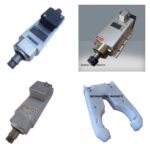
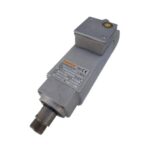
In the woodworking industry, precision and efficiency are fundamental to gaining a competitive edge. In this context, CNC router machines have become critical technology transforming production processes. The heart of a CNC router and the most important component directly affecting its performance is undoubtedly the spindle motor. The spindle motor is the drive unit responsible for processing the material by providing the rotational movement of the cutting tool. When processing fibrous and variable-density materials like wood, selecting the correct spindle motor directly impacts both processing quality and machine longevity. This detailed field guide and technical article will comprehensively cover the critical factors, technical details, and field experiences that industrial automation professionals and woodworking workshops should consider when choosing the most suitable spindle motor for wood CNC routers.
The market offers numerous spindle motors with varying power, speed, and cooling systems. However, the definition of the “best” spindle motor actually varies according to the specific requirements of the application. Woodworking involves a wide range of operations such as carving, cutting, drilling, and profiling, each requiring different revolutions per minute (RPM) and torque (Torque) specifications. For example, high RPMs and low torque may suffice for fine detail carving, while high torque and sufficient power are essential for cutting thick wood panels in a single pass. Therefore, when selecting a spindle motor, it is necessary to evaluate not only the motor’s nominal power but also many other parameters such as its operating speed range, cooling type, bearing quality, torque curve, and ease of integration. With an expert approach, we will analyze the impact of each of these components on wood CNC processing performance to find the most optimal solution in terms of investment cost, operating expenses, and production quality.
Which Spindle Motor is Best for a Wood CNC Router? Operating Principle and Technical Data
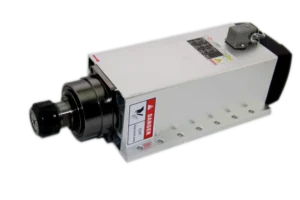
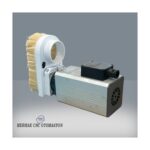
Spindle motors are typically three-phase AC asynchronous motors, specifically designed as high-frequency motors. These motors operate at much higher frequencies (e.g., up to 400 Hz or more) controlled by a Variable Frequency Drive (VFD), also known as an inverter, rather than at standard mains frequency (50/60 Hz). These high frequencies allow the motor to reach very high speeds (typically 18,000-24,000 RPM, up to 60,000 RPM in some special applications). The VFD dynamically changes the input frequency and voltage to adjust the motor’s speed and torque. This offers the operator the flexibility to achieve optimal cutting conditions based on the material being processed and the cutting tool used.
The main technical parameters to consider when selecting a spindle motor for woodworking are:
- Power (kW/HP): The power of the spindle motor directly affects the cutting depth, feed rate, and the hardness of the material that can be processed. For wood CNC routers, powers between 1.5 kW and 9 kW are generally preferred. While 1.5-2.2 kW may be sufficient for smaller workshops and hobby machines, 3.7 kW, 5.5 kW, or higher powers are required for industrial production and cutting thick panels. Power is closely related to the motor’s torque production capacity.
- RPM Range: For woodworking, high RPMs (18,000-24,000 RPM) are generally preferred to achieve clean cut surfaces and fine details. Lower RPMs (e.g., 6,000-12,000 RPM) may be suitable for different applications such as deep passes with larger diameter cutting tools or metal processing. A spindle with a wide RPM range is advantageous for adapting to various woodworking operations.
- Torque: Torque refers to the motor’s cutting force. Sufficient torque is vital, especially when cutting thick wood at high feed rates or processing hard woods. Spindles that can maintain their torque even at high RPMs should be preferred.
- Cooling Type: Spindle motors generate a significant amount of heat when operating at high speeds. Efficient dissipation of this heat is critical for the motor’s lifespan and performance. There are two main cooling types:
- Air-Cooled Spindle: Generally a simpler, lower-maintenance, and more cost-effective option. It provides cooling by circulating air through a fan mounted on the motor. However, especially in dusty woodworking environments, fan blades and cooling channels can become clogged with dust, reducing cooling efficiency. They also tend to operate louder than water-cooled spindles.
- Water-Cooled Spindle: Provides more efficient cooling and generally operates more quietly. It dissipates heat through a circulating cooling fluid (usually a mixture of water and antifreeze) inside the motor. These systems require an external water pump, radiator, and water reservoir. Installation and maintenance are slightly more complex than air-cooled, but they offer more stable performance, especially during long and intensive operations, and extend motor life. Due to the dusty nature of woodworking environments, water-cooled spindles are often preferred as they minimize the risk of dust affecting the cooling system.
- Bearing Type and Quality: The spindle motor’s bearings carry loads at high RPMs and determine the motor’s precision, vibration level, and lifespan. High-quality, precise ceramic ball bearings (P4 class or better) offer longer life, less vibration, and higher processing quality, especially in high-speed applications like woodworking.
- Collet Type: The collet type, which secures the cutting tools to the spindle, is typically from the ER series (ER11, ER16, ER20, ER25, ER32). ER20 and ER25 are the most commonly used for woodworking because they support a wide range of tool diameters (e.g., from 1mm to 16mm). The quality of the collet affects the tool’s runout and gripping force.
- Voltage and Frequency: Spindle motors are generally available as 220V or 380V (three-phase). Your machine’s electrical infrastructure and VFD compatibility determine this choice. The operating frequency is controlled by the VFD and determines the motor’s maximum RPM.
| Parameter | Value/Description |
|---|---|
| Power Range | 1.5 kW – 9.0 kW (Varies by woodworking application) |
| RPM Range | 6,000 – 24,000 RPM (High RPMs are ideal for wood) |
| Cooling Type | Water-Cooled (More efficient, quieter, unaffected by dust) or Air-Cooled (Simpler, less maintenance) |
| Bearing Type | P4 Class Ceramic Ball Bearings (High precision, long life) |
| Collet Type | ER20 or ER25 (Wide tool diameter support, 1mm-16mm) |
| Voltage | 220V or 380V (Three-phase, according to electrical infrastructure) |
| Frequency Range | 0 – 400 Hz (Controlled by VFD, determines maximum RPM) |
| Torque Characteristic | High torque continuity across a wide RPM range |
Which Spindle Motor is Best for a Wood CNC Router? Field Considerations
- Machine Rigidity and Spindle Compatibility: The power and size of the spindle motor must be compatible with the mechanical structure and rigidity of the CNC router. An overly heavy or powerful spindle mounted on a weak frame can lead to vibrations, loss of precision, and even structural damage. The movement capability and precision of the machine axes (X, Y, Z) must be capable of handling the weight and dynamic loads of the selected spindle.
- VFD (Variable Frequency Drive) Selection and Settings: To achieve full spindle motor performance, it must be paired with an appropriate VFD. The VFD’s power should be at least 20-30% higher than the spindle’s power, and its output frequency range must support the spindle’s maximum operating frequency. Correct adjustment of VFD parameters (maximum frequency, base frequency, acceleration/deceleration times, overcurrent protection, etc.) is critical for efficient and safe motor operation. Incorrect settings can cause the spindle to overheat, lose performance, or suffer permanent damage.
- Cooling System Maintenance and Inspection: Especially for water-cooled spindles, the quality of the cooling fluid (antifreeze mixture, anti-scaling agents), water pump performance, and radiator cleanliness should be regularly checked. The cooling fluid level should never drop, and it should be replaced if contaminated. For air-cooled spindles, fan blades and cooling channels should be regularly cleaned of woodworking dust accumulation. Inadequate cooling shortens bearing life and causes motor windings to overheat.
- Tool Holder and Collet Quality: Just as important as high-quality cutting tools, the quality of the collets and collet nuts that secure these tools to the spindle directly affects machining precision. Cheap or worn collets can cause runout in the tool, leading to vibration, poor surface quality, and reduced tool life. It is important to regularly inspect ER series collets and replace them when they show signs of wear. Ensure the collet and collet bore are clean with every tool change.
- Environmental Conditions and Dust Management: Woodworking environments can be inherently very dusty. This dust can penetrate the spindle motor, damaging bearings and electrical components. A good dust collection system is vital not only for operator health but also for the lifespan of the spindle motor and other machine components. The effectiveness of the dust extraction system around the spindle should be regularly inspected, and its filters cleaned.
- Cabling and Grounding: The cabling between the VFD and the spindle, carrying high-frequency signals, must be done with specially shielded cables and properly grounded to minimize electromagnetic interference (EMI). Incorrect or poor-quality cabling can negatively affect the performance of the VFD and spindle, and even cause interference in other electronic devices.
Which Spindle Motor is Best for a Wood CNC Router? Common Problems and Solutions
Various problems can arise with spindle motors during field use. Early diagnosis and correct solutions for these problems minimize production downtime and prevent costly repairs.
- Spindle Overheating:
- Failure Scenario: The spindle motor becomes too hot to touch, the VFD gives an over-temperature warning, or performance degradation occurs.
- Solution Methods:
- For Water-Cooled: Check if the water pump is working, if the water level is sufficient, if the water is contaminated, or if the radiator is clogged. Check the cooling fluid ratio (water/antifreeze). Eliminate air bubbles in the cooling system.
- For Air-Cooled: Is the fan working? Are the fan blades and motor cooling channels clogged with dust? Clean with compressed air.
- General Solutions: Check VFD parameters, especially if the motor’s nominal frequency and voltage are correctly set. Is there an overload? Is the ambient temperature too high?
- High Vibration or Abnormal Noise:
- Failure Scenario: The spindle operates louder than normal, vibration is felt, or ripples or poor finishes appear on the cutting surface.
- Solution Methods:
- Bearing Issues: Bearings may have reached the end of their life. Friction noises or squeaks at high RPMs may indicate bearing failure. Professional service may be required for bearing replacement.
- Collet or Tool Issue: The collet may be worn or dirty, the tool may not be properly installed, or it may be unbalanced. The tool itself may be damaged or unbalanced.
- Mounting Issue: The spindle may not be properly mounted to the machine, or the mounting bolts may have loosened.
- VFD Settings: The VFD’s motor parameters may be incorrectly set, leading to unstable operation.
- Power Loss or Low RPM Performance:
- Failure Scenario: The spindle stops during cutting or cannot maintain its RPM, the VFD gives an overcurrent or overload error.
- Solution Methods:
- VFD Settings: Check the VFD’s maximum current, base frequency, and acceleration time parameters. Is the spindle’s nominal current correctly set in the VFD?
- Cabling: Are there any breaks, short circuits, or poor connections in the cables between the spindle and VFD?
- Overload: The diameter of the tool used or the cutting depth may exceed the spindle’s power. Try reducing the feed rate or cutting depth.
- Motor Failure: Rarely, internal faults such as short circuits or open circuits in the motor windings can occur. This should be checked by an electrician.
- Spindle Not Working or Not Starting:
- Failure Scenario: The spindle does not rotate when commanded, or the VFD displays an error code.
- Solution Methods:
- VFD Errors: Check the error code on the VFD display and refer to the user manual. These can typically be overvoltage, undervoltage, overcurrent, phase loss, or internal fault codes.
- Power Supply: Is there a problem with the main power supply to the VFD? Are fuses or circuit breakers tripped?
- Cabling: Check the connections of the power cables between the spindle and VFD.
- Control Signals: Verify that the Start/Stop or speed control signals from the CNC control card are correctly reaching the VFD.
Which Spindle Motor is Best for a Wood CNC Router? Conclusion and Expert Advice
Choosing the “best” spindle motor for a wood CNC router is a complex decision with no single right answer, varying according to the specific requirements of the application. However, from an industrial automation perspective, it is possible to make an optimal choice by considering longevity, high precision, reliability, and low operating costs. Our field experience shows that a correct initial investment pays for itself in the long run by increasing production efficiency and reducing maintenance costs.
As expert advice, we recommend following these steps when selecting a spindle motor for your woodworking operations: First, clarify the types of wood you will process (softwood, hardwood, MDF, plywood), maximum cutting depths, expected processing speeds, and surface quality targets. This will give you an idea of the minimum required power (kW) and RPM range. Second, regarding the cooling type, considering dusty woodworking environments and long operating hours, water-cooled spindle motors should generally be preferred for their more stable performance and longer lifespan. Although installation is slightly more complex, the cooling efficiency and quiet operation advantages it provides will be worth the extra effort. Third, pay special attention to the spindle’s bearing quality (preferably P4 class ceramic bearings) and collet system (common and reliable types like ER20 or ER25). These components are critical factors directly affecting machining precision and tool life. Fourth, ensure you pair your spindle motor with a fully compatible Variable Frequency Drive (VFD) that has all the necessary protection features. Correct VFD adjustment extends your motor’s life and optimizes its performance. Finally, ensure that your chosen spindle is compatible with the mechanical rigidity and control system of your existing CNC router. If necessary, do not hesitate to seek detailed information and advice from the technical support units of manufacturers or suppliers. Remember, a well-chosen and regularly maintained spindle motor will be your wood CNC router’s most valuable asset, directly enhancing your production quality and efficiency.
FAQ
What power spindle motor is generally recommended for wood CNC routers?
The ideal power for a wood CNC router spindle motor typically ranges from 1.5 kW for smaller, hobbyist machines up to 9 kW for heavy-duty industrial applications. The specific power needed depends on the types of wood being processed, desired cutting depths, and required feed rates. Thicker and harder woods, or operations requiring high material removal rates, will necessitate higher power spindles (e.g., 3.7 kW, 5.5 kW, or more).
What is the optimal RPM range for a spindle motor used in wood CNC routing?
For woodworking, high RPMs (18,000-24,000 RPM) are generally preferred. This speed range helps achieve clean cut surfaces and fine details, which are crucial for quality wood processing. While lower RPMs might be suitable for specific applications like large diameter tools or metalworking, a wide RPM range on your spindle offers versatility for various woodworking tasks.
Should I choose an air-cooled or water-cooled spindle for my wood CNC router, especially in a dusty environment?
Water-cooled spindles are generally recommended for industrial wood CNC routers. They offer more efficient cooling, operate more quietly, and are less susceptible to dust accumulation affecting cooling efficiency compared to air-cooled spindles. While they require a more complex setup (pump, radiator, fluid), their stable performance and extended motor life in dusty woodworking environments make them a superior choice for professional use.
What type of bearings are best for a wood CNC router spindle motor?
High-quality P4 class ceramic ball bearings are crucial for spindle motors in wood CNC routers. These bearings provide superior precision, reduce vibration, and offer a longer lifespan, especially under the high RPMs typically used in woodworking. Investing in a spindle with high-grade bearings ensures better machining accuracy and tool life.
Which collet type is most suitable for a wood CNC router spindle?
The ER20 or ER25 collet types are most commonly used for wood CNC router spindles. These collets support a wide range of tool diameters (typically 1mm to 16mm), providing flexibility for various cutting tools. The quality of the collet and collet nut directly impacts machining precision and tool runout, so always use high-quality components.