
No products in the cart.
Belt Pulley System Installation for CNC Drive Mechanisms
Contents
- Introduction and Technical Analysis At the heart of industrial automation, especially CNC (Computer Numerical Control) machines, lie precise and reliable motion transmission mechanisms. Among these, belt pulley systems are widely preferred due to their advantages such as high efficiency, low cost, vibration damping capability, and flexibility. The correct integration of belt pulley systems in the installation of a CNC drive mechanism directly impacts the machine’s positioning accuracy, repeatability, torque transmission capacity, and overall operational lifespan. This guide delves into the technical details, installation processes, and optimization strategies of belt pulley systems in CNC applications for industrial automation professionals. In modern manufacturing facilities, the performance of CNC machines depends on correctly selected and mounted drive components. An incorrect selection or faulty installation can lead to a decrease in production quality, unplanned downtime, and high maintenance costs. Therefore, understanding the engineering principles, material science aspects, and field applications of belt pulley systems is of paramount importance. Especially synchronous belts, also known as timing belts, have become an ideal solution for CNC applications by offering precise positioning without slippage, thanks to their toothed structure. These systems transmit the rotational motion of the motor to the spindle or moving axes, while also serving as a reduction or increase function to provide the desired speed and torque ratios. This technical article aims to provide practical and theoretical information on the installation, maintenance, and troubleshooting processes of these complex systems. Operating Principle and Technical Data
- Field Considerations
- Common Problems and Solutions
- Expert Advice
- FAQ
Introduction and Technical Analysis
At the heart of industrial automation, especially CNC (Computer Numerical Control) machines, lie precise and reliable motion transmission mechanisms. Among these, belt pulley systems are widely preferred due to their advantages such as high efficiency, low cost, vibration damping capability, and flexibility. The correct integration of belt pulley systems in the installation of a CNC drive mechanism directly impacts the machine’s positioning accuracy, repeatability, torque transmission capacity, and overall operational lifespan. This guide delves into the technical details, installation processes, and optimization strategies of belt pulley systems in CNC applications for industrial automation professionals. In modern manufacturing facilities, the performance of CNC machines depends on correctly selected and mounted drive components. An incorrect selection or faulty installation can lead to a decrease in production quality, unplanned downtime, and high maintenance costs. Therefore, understanding the engineering principles, material science aspects, and field applications of belt pulley systems is of paramount importance. Especially synchronous belts, also known as timing belts, have become an ideal solution for CNC applications by offering precise positioning without slippage, thanks to their toothed structure. These systems transmit the rotational motion of the motor to the spindle or moving axes, while also serving as a reduction or increase function to provide the desired speed and torque ratios. This technical article aims to provide practical and theoretical information on the installation, maintenance, and troubleshooting processes of these complex systems.
Operating Principle and Technical Data
Belt pulley systems fundamentally consist of a drive pulley (typically attached to a motor shaft), a driven pulley (attached to the load shaft or axis), and a belt connecting these two pulleys. In CNC applications, synchronous belts (timing belts) are generally used. These belts establish a positive connection through compatible teeth located on the inner surface of the belt and around the circumference of the pulleys. This toothed structure prevents the belt from slipping on the pulley, thereby maintaining speed ratio and positioning accuracy. This feature is critically important, especially for CNC machines requiring precise motion control.
The operating principle of the system is based on the transmission of the motor’s rotational motion to the drive pulley, from there via the belt to the driven pulley, and finally to the CNC axis or spindle. The speed ratio is determined by the ratio between the number of teeth on the drive pulley and the number of teeth on the driven pulley. For example, if the drive pulley has 20 teeth and the driven pulley has 40 teeth, the speed ratio will be 1:2; meaning the driven pulley will rotate at half the speed of the drive pulley. This can be used to increase torque while decreasing speed, or vice versa.
From a technical data perspective, many parameters must be considered when selecting a belt pulley system:
- Belt Type and Profile: Different tooth profiles exist, such as HTD, AT, and GT series. HTD (High Torque Drive) is generally preferred for high torque applications, while AT (Arc Tooth) and GT (Gates Poly Chain GT) series offer higher precision and power density. The belt material (neoprene, polyurethane) and its tensile members (steel, fiberglass, aramid) are also important. Polyurethane belts can be more resistant to wear and have tighter tolerances.
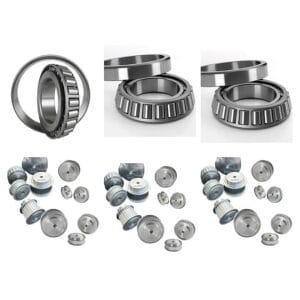
- Pulley Material: Pulleys are manufactured from materials such as aluminum, steel, or cast iron. Aluminum may be preferred for lightness and heat dissipation, while steel may be more suitable for high strength and wear resistance. The tooth profile of the pulleys must be perfectly compatible with the belt’s profile.
- Speed Ratio and Torque Capacity: The number of teeth on the pulleys is determined according to the speed and torque values required by the application. The maximum torque of the motor and the inertia moment of the axes must not exceed the maximum torque that the belt and pulleys can transmit.
- Positioning Accuracy and Backlash: Synchronous belts offer minimal backlash due to their toothed structure. However, belt tension, belt flexibility, and manufacturing tolerances of the pulleys can affect backlash. Especially in high-precision CNC applications, low-backlash or zero-backlash belt pulley systems should be preferred.
- Tension Force: Correct belt tension is critically important for the system’s performance and lifespan. Insufficient tension causes the belt to skip, while excessive tension can damage bearings and the belt, leading to energy loss. Manufacturer-specified tension values must be adhered to. Tension is usually adjusted by a tension meter or by measuring the natural frequency of the belt.
- Environmental Factors: Operating temperature, humidity, dust, chemicals, and lubricants can affect the belt’s lifespan and performance. Materials resistant to these factors should be selected.
- Noise and Vibration: Belt pulley systems operate more quietly and dampen vibration better compared to gearboxes. However, misalignment or incorrect tension can increase noise and vibration.
| Parameter | Value/Description |
|---|---|
| Belt Type | Synchronous (Timing) HTD 5M or GT2 3M/5M |
| Pulley Material | Aluminum Alloy (6061-T6) or Steel |
| Speed Ratio | Between 1:1 and 1:5 (According to application requirements) |
| Torque Capacity | 5 Nm – 50 Nm (Varies by belt width and profile type) |
| Positioning Accuracy | ± 0.05 mm (Depends on system components and tension) |
| Recommended Tension Force | Should be checked according to manufacturer datasheet values. (Typically 10-25 N/mm) |
| Operating Temperature Range | -20°C to +80°C (Varies by belt material) |
| Noise Level | Low (Quieter than gearboxes) |
Field Considerations
- Correct Component Selection: The correct belt type (HTD, GT2, AT, etc.), width, tooth profile, and material, along with compatible pulleys, must be selected considering the application’s required torque, speed, precision, and environmental conditions. Inertia moments of the motor and load should be calculated to make selections suitable for the system’s dynamic performance. Avoid incorrect selections that could lead to overloading or insufficient performance. The static and dynamic load capacities of the belt should be meticulously examined using manufacturer data.
- Critical Tension Adjustment: Belt tension is one of the most critical factors for the system’s lifespan and performance. Insufficient tension leads to belt skipping, slippage, and positioning errors, while excessive tension causes premature wear of the belt, pulleys, and motor/load bearings. Tension must be adjusted using manufacturer-recommended methods (e.g., with a belt tension meter or frequency measurement device). Adjusting tension by measuring the belt’s natural frequency is one of the most precise methods.
- Perfect Alignment: The parallel and axial alignment of the pulleys relative to each other is vital. Misalignment leads to wear on the belt edges, increased friction, noise, vibration, and energy loss. Axial and angular alignment of the pulleys should be checked using laser alignment devices or a precise ruler and visual inspection. Ensure that both the drive and driven pulleys are mounted perpendicular to the shafts.
- Assembly Sequence and Cleanliness: During installation, ensure that the pulleys are correctly secured to the shafts (usually with keys or clamping rings). Before installing the belt, all surfaces must be cleaned and free of oil and dirt. It is important to install the belt without damaging it or forcing it onto the pulleys; forcing the belt can damage its internal structure. Typically, the belt should be easily installed by loosening one pulley or bringing the tensioning mechanism to its slackest position.
- Environmental Protection and Maintenance: Belt pulley systems must be protected from dust, chips, moisture, oil, and chemicals. Special coated or material belts and protective enclosures should be used for aggressive environments. Regular visual inspections should be performed; check for cracks, wear, tooth deformation, or discoloration on the belt. Check pulleys for wear or damage. Adhere to the manufacturer’s specified periodic maintenance and replacement schedule.
- Vibration and Noise Control: After installation, check for abnormal noise or vibration during system operation. Such symptoms may indicate incorrect tension, misalignment, worn components, or faulty assembly. If necessary, a vibration analyzer should be used to identify the source of the problem.
- Bearing and Shaft Support: Radial loads created by belt tension are exerted on the bearings of the motor and load shafts. Ensure that these bearings and shafts are capable of withstanding these loads. Insufficient bearing support can lead to premature bearing failures and system instability.
Common Problems and Solutions
While belt pulley systems are highly reliable when installed correctly, problems can arise for various reasons. Rapid and accurate diagnosis of these issues is vital to minimize production loss and extend system life.
- Belt Skipping or Tooth Stripping:
Problem: The belt skips over the pulley teeth or the teeth strip while the system is operating. This usually occurs during high torque fluctuations or sudden load changes.
Solution: First, check the belt tension. Insufficient tension is the most common cause. Adjust to the manufacturer’s recommended tension value. If the tension is correct, check for wear on the belt or pulley teeth; worn components should be replaced. Evaluate if the belt is subjected to excessive load; a wider belt or a belt type with a stronger tooth profile may be required. Also, check for any jamming or excessive resistance in the system.
- Abnormal Noise and Vibration:
Problem: Friction noises, squeaking, knocking, or excessive vibration during operation.
Solution: First, check the alignment of the pulleys. Misalignment causes friction and noise on the belt edges. Correct axial and angular alignment using laser alignment tools. Check belt tension; both too loose and too tight belts can cause noise. Check for and clean any foreign matter (dust, chips) on the surfaces of the belt or pulleys. The belt type or size may be unsuitable; consider a quieter or better vibration-damping belt type (e.g., a more flexible polyurethane belt). Check for wear in the bearings on the motor or load side.
- Positioning Error or Increased Backlash:
Problem: CNC axes failing to reach the desired position precisely or a noticeable play when the direction of motion changes.
Solution: If belt tension is insufficient, this causes the belt to stretch and backlash to increase; optimize tension. Check for wear on the belt or pulley teeth; worn components should be replaced. The belt itself may have stretched over time; in this case, replace the belt with a new one. For applications requiring higher precision, low-backlash or zero-backlash specially designed belt pulley systems should be used. Also, ensure that the connections of the pulleys to the shafts (key, clamping ring) have not loosened.
- Short Belt Lifespan / Premature Wear:
Problem: The belt cracks, its teeth break, or it wears out in a shorter time than expected.
Solution: Excessive tension puts undue stress on the belt material and tensile members, shortening its lifespan; adjust tension to the correct level. Misalignment of the pulleys causes friction and abnormal wear on the belt edges; correct the alignment. Exposure to environmental conditions (high temperature, chemicals, oils) can degrade the belt material; use special belts resistant to such environments or add protective enclosures. Check if the belt is operating under a load exceeding its capacity; a stronger belt or a different drive system may be required. Check for sharp edges or burrs on the pulley surfaces; these can damage the belt.
- Overheating:
Problem: Abnormal heating of the belt or pulleys.
Solution: Excessive friction usually results from excessive tension or misalignment. Check and correct tension and alignment. Ensure the belt moves freely on the pulley; clean any foreign matter that could increase friction. The belt type, pulley material, or overall system design may not provide the heat dissipation required by the application; evaluate more thermally suitable components. Remember that ambient temperature can also affect the system’s heating behavior.
Expert Advice
Belt pulley systems are indispensable components in CNC drive mechanisms, offering numerous advantages such as precision, cost-effectiveness, and vibration damping. However, to fully leverage these benefits and maintain optimal machine performance, correct design, meticulous installation, and regular maintenance are vitally important. As an expert in industrial automation, I want to emphasize that every detail, from belt selection to tension adjustment, alignment to environmental protection, has a decisive impact on the overall reliability and lifespan of the system. Even the smallest overlooked detail can lead to long-term production losses, high maintenance costs, and undesirable breakdowns.
Therefore, strict adherence to engineering principles during the installation process, meticulous following of manufacturer specifications, and the use of appropriate measurement equipment (laser alignment devices, belt tension meters) are critically important. It should be remembered that a belt pulley system is not just composed of belts and pulleys; it is an integrated whole with bearings, shafts, the motor, and the control system. The harmony and quality of each part of this whole directly affect the final performance. Periodic inspections are essential to detect signs of wear early and resolve potential problems before they escalate. Visual inspection of the belt, tension checks, and cleanliness of the pulleys should be integral parts of routine maintenance. When an unexpected problem is encountered, the troubleshooting steps outlined in this guide will help minimize production downtime by providing quick and effective solutions. Finally, when designing a new system or optimizing an existing one, always seek technical support from experienced engineers and component manufacturers. Following innovations in the industry and adopting a continuous learning approach are key to remaining competitive in the field of industrial automation.
FAQ
What are the main advantages of using belt pulley systems in CNC drive mechanisms?
Belt pulley systems offer high efficiency, low cost, excellent vibration damping, and flexibility. Synchronous belts, in particular, provide precise positioning without slippage, which is crucial for CNC machines requiring high accuracy and repeatability.
What technical parameters should be considered when selecting components for a CNC belt pulley system?
Key factors include belt type (HTD, AT, GT series), material (neoprene, polyurethane, with steel/fiberglass/aramid tensile members), pulley material (aluminum, steel), speed ratio, torque capacity, positioning accuracy, and environmental factors like temperature and contaminants. Always refer to manufacturer specifications for optimal selection.
What are the most common problems encountered with belt pulley systems in CNC applications and how can they be identified?
Common issues include belt skipping (due to insufficient tension or worn teeth), abnormal noise/vibration (from misalignment or incorrect tension), positioning errors/backlash (due to loose belts or worn components), and premature wear (from excessive tension, misalignment, or harsh environments).
What are the critical steps for proper installation and maintenance of a CNC belt pulley system?
To prevent issues, ensure correct component selection, critical tension adjustment using appropriate tools, perfect axial and angular alignment of pulleys, proper assembly sequence with clean surfaces, and environmental protection. Regular visual inspections and adherence to maintenance schedules are also vital.
How can common problems like belt skipping, noise, and positioning errors be effectively troubleshooted?
For belt skipping, check and adjust tension, inspect for worn teeth, and ensure the belt capacity matches the load. For noise/vibration, correct pulley alignment and tension. For positioning errors, optimize tension, replace worn components, and consider low-backlash systems. For premature wear, verify tension, alignment, and environmental resistance.

