No products in the cart.
Understanding the Differences Between 20×20, 30×30, and 40×40 Sigma Profiles
Contents
Discover the critical distinctions between 20×20, 30×30, and 40×40 Sigma profiles. Learn how their sizes, cross-sectional areas, load capacities, and rigidity impact their suitability for various industrial automation and machine building applications. Make informed decisions for your next project.
Mermak CNC Technical Guide
Practical notes for CNC router, automation and industrial motion systems.
Key Differences in Sigma Profiles: 20×20, 30×30, and 40×40
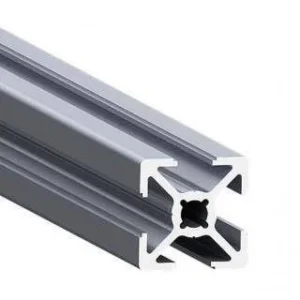
In the industrial automation and machine manufacturing sectors, Sigma profiles are indispensable for creating modular and flexible structures. These profiles, typically produced via aluminum extrusion, feature standardized dimensions and mounting channels on all four sides. These channels facilitate rapid and easy assembly using specialized T-nuts and connectors. The designations “20×20, 30×30, and 40×40” refer to the external dimensions in millimeters, which are critical parameters directly influencing the profile’s mechanical properties, load-bearing capacity, and application suitability. Each size is engineered to meet distinct engineering requirements, with 20×20 profiles ideal for light loads and compact structures, while 40×40 profiles are designed for much heavier loads and high rigidity applications. The inherent flexibility of these profiles empowers designers and engineers to construct structures that are easily adaptable, disassemblable, and reusable.
Operational Principles and Technical Data
Sigma profiles operate on the principle of forming a modular and adaptable structural framework. Their specially designed channels (slots) allow for the easy insertion and removal of T-nuts and various connectors (corner brackets, articulated joints, end caps, etc.), enabling quick and precise assembly of even complex structures. The aluminum construction provides lightness, corrosion resistance, and an aesthetic finish. However, the primary differentiating factors are their geometric and mechanical characteristics.
20×20 Sigma Profile: This is one of the smallest and lightest standard profiles. It has a relatively small cross-sectional area and a low moment of inertia (a measure of bending resistance). These profiles are typically used for light-duty constructions, mounting small sensors and cameras, protective enclosures, frames for lightweight automation equipment, and prototyping projects. They are ideal for applications where compactness and light weight are prioritized over high rigidity. For instance, the frame of a desktop 3D printer or a small test rig can be constructed using 20×20 profiles.
30×30 Sigma Profile: Designed for medium-scale applications, this profile offers a higher load-bearing capacity and rigidity compared to the 20×20 profile. Its cross-sectional area and moment of inertia are significantly increased. These profiles are commonly used in various industrial automation projects, such as workstations, light to medium-duty conveyor systems, machine frames, safety barriers, test stands, and modular shelving. They provide a balance of adequate strength, light weight, and cost-effectiveness. A medium-sized pallet transport system for an assembly line or an ergonomic operator workstation can be built with 30×30 profiles.
40×40 Sigma Profile: This profile is the choice for heavy-duty applications and structures requiring high rigidity. Compared to 20×20 and 30×30 profiles, it boasts a much larger cross-sectional area and significantly higher moments of inertia. This makes the profile extremely resistant to bending and torsion. 40×40 profiles are employed in critical applications like robotic cells, large machine chassis, heavy-load conveyors, industrial oven and cabinet frames, safety cages, and base structures for high-precision optical or laser systems. They are engineered to provide minimal deflection and maximum stability under high loads. For example, the supporting frame of a robotic arm or the precise base of a large CNC machine can be constructed using 40×40 profiles.
Each profile size has a specific channel width and a corresponding T-nut size. This can make direct connection between different profile sizes challenging, though it can be resolved with adapters and specialized connectors. Generally, larger profiles utilize larger and thus stronger connectors, enhancing the overall structural integrity.
| Parameter | 20×20 Sigma Profile | 30×30 Sigma Profile | 40×40 Sigma Profile |
|---|---|---|---|
| External Dimensions (mm) | 20 x 20 | 30 x 30 | 40 x 40 |
| Cross-Sectional Area (mm²) | ~200 – 250 | ~500 – 600 | ~800 – 900 |
| Weight (kg/m) | ~0.5 – 0.7 | ~1.3 – 1.6 | ~2.2 – 2.5 |
| Moment of Inertia Ix/Iy (cm⁴) | ~0.8 – 1.0 | ~4.5 – 5.5 | ~15 – 17 |
| Channel Width (mm) | 6 | 8 | 8 |
| Compatible T-Nut Size | M4, M5 | M6, M8 | M6, M8 |
| Typical Application Area | Light structures, sensor mounting | Workstations, medium conveyors | Robotic cells, heavy machine chassis |

Important Considerations in Practice
- Load Calculation and Rigidity Requirements: Accurately determining the maximum static and dynamic loads your project must bear is crucial. The load-bearing capacities of profiles vary significantly based on their dimensions and moments of inertia. For example, mounting a heavy robotic arm onto a structure built with 20×20 profiles can lead to excessive deflection and structural failure. Selecting the most suitable profile with an adequate safety factor, considering the worst-case load scenarios throughout the project’s lifespan, ensures long-term stability and safety. Especially when dealing with dynamic loads and vibrations, opting for 30×30 or 40×40 profiles with higher moments of inertia directly impacts system performance and longevity.
- Connector Selection and Assembly Method: Each profile size has a specific channel width and compatible T-nut size. Choosing the correct connectors is vital for the structural integrity and ease of assembly. For instance, 20×20 profiles typically use M4 or M5 T-nuts, while 30×30 and 40×40 profiles require M6 or M8 T-nuts. Various connectors, including corner brackets, internal connectors, and adjustable joints, are available, and their proper selection directly influences the structure’s load capacity and rigidity. Ensuring connectors are tightly fastened with the correct torque values prevents loosening and structural weaknesses over time. When combining different profile sizes, adapters or specialized connectors may be necessary.
- Environmental Conditions and Material Compatibility: Sigma profiles are generally made from anodized aluminum, offering good corrosion resistance. However, if used in environments with aggressive chemicals, high humidity, or extreme temperature fluctuations, ensure the material properties of the profiles and connectors are suitable. For instance, in hygiene-critical industries like food or pharmaceuticals, stainless steel connectors or specially coated profiles might be preferred. In high-vibration environments, additional safety measures like spring washers or lock nuts should be used to prevent connector loosening. While the profile’s cross-section is designed to minimize dust accumulation, closed-channel profiles or additional seals may be required for cleanroom applications.

Choosing the correct Sigma profile size is fundamental for the success of any industrial automation project. By carefully considering the load requirements, rigidity needs, environmental factors, and available connection methods, you can ensure the creation of robust, reliable, and efficient structures. For applications demanding precision and strength, such as those involving CNC router machines, industrial CNC routers, or systems with powerful spindle motors and servo drives, selecting the appropriate profile is paramount for optimal performance and longevity.
If you are designing a custom automation solution, a machine frame, or a structural component that requires high-quality aluminum profiles, Mermak CNC can provide the expertise and materials you need. Explore our range of Sigma profiles and related components to find the perfect fit for your industrial requirements.
Ready to build your next industrial solution? Request a quote on WhatsApp today!
Related product categories: Genel · Sigma Profil Toptan · Sigma Profil Kapakları