No products in the cart.
CNC Water Cooling System vs. Air Cooling System: A Technical Analysis for Industrial Buyers
Contents
- Introduction and Technical Analysis At the heart of industrial automation, CNC (Computer Numerical Control) machines play a critical role in manufacturing processes. The performance, precision, and lifespan of these machines are directly dependent on the selection and implementation of appropriate thermal management systems. Especially in high-speed and high-torque operations, the heat generated in the spindle motor and other moving parts can lead to material deformation, tool wear, and premature failure of machine components. Therefore, two main methods are used to effectively dissipate heat in CNC machines: water cooling systems and air cooling systems. This field guide and technical article aims to provide guidance for industrial automation professionals by thoroughly examining the operating principles, technical details, advantages, disadvantages, and critical points in field applications for both cooling systems. The goal is not only to provide theoretical knowledge but also to offer a comprehensive perspective by sharing practical solutions and experiences from the field. The correct cooling solution has the potential to increase operational efficiency, reduce maintenance costs, and enhance production quality. Operating Principle and Technical Data
- Water Cooling Systems
- Air Cooling Systems
- Field Considerations
- Common Problems and Solutions
- Expert Advice
- Request a Quote on WhatsApp
- FAQ
Introduction and Technical Analysis
At the heart of industrial automation, CNC (Computer Numerical Control) machines play a critical role in manufacturing processes. The performance, precision, and lifespan of these machines are directly dependent on the selection and implementation of appropriate thermal management systems. Especially in high-speed and high-torque operations, the heat generated in the spindle motor and other moving parts can lead to material deformation, tool wear, and premature failure of machine components. Therefore, two main methods are used to effectively dissipate heat in CNC machines: water cooling systems and air cooling systems. This field guide and technical article aims to provide guidance for industrial automation professionals by thoroughly examining the operating principles, technical details, advantages, disadvantages, and critical points in field applications for both cooling systems. The goal is not only to provide theoretical knowledge but also to offer a comprehensive perspective by sharing practical solutions and experiences from the field. The correct cooling solution has the potential to increase operational efficiency, reduce maintenance costs, and enhance production quality.
Operating Principle and Technical Data
Heat generated in CNC machines typically originates from the spindle, motors, and control electronics. Controlling this heat is vital for stable machine operation, maintaining part precision, and extending component life. Cooling systems aim to achieve optimal operating temperatures by removing this excess heat from the machine environment.
Water Cooling Systems
Water cooling systems typically operate via a chiller unit, a pump, a closed-loop piping system, and a water jacket or heat exchanger around the spindle or other components to be cooled. The chiller unit precisely controls the temperature of the cooling fluid (typically a mixture of distilled water with rust inhibitor/antifreeze). The pump circulates the cold fluid to the spindle or the component to be cooled. The fluid absorbs heat and returns hot to the chiller. Inside the chiller, the fluid is recooled through a refrigeration cycle consisting of a compressor, condenser, expansion valve, and evaporator. This closed-loop system provides stable cooling capacity independent of external ambient temperature. Thanks to its high heat transfer coefficient and specific heat capacity, water is a much more efficient heat carrier than air. These systems are preferred especially in high-speed and high-power spindles, laser cutting machines, and other applications that generate intense heat. Precise temperature control is one of the biggest advantages of water cooling systems; this minimizes thermal expansion, especially in long-duration and high-precision operations, thereby improving part quality. Furthermore, water cooling systems tend to operate more quietly than air cooling systems and allow for more compact spindle designs.
Air Cooling Systems
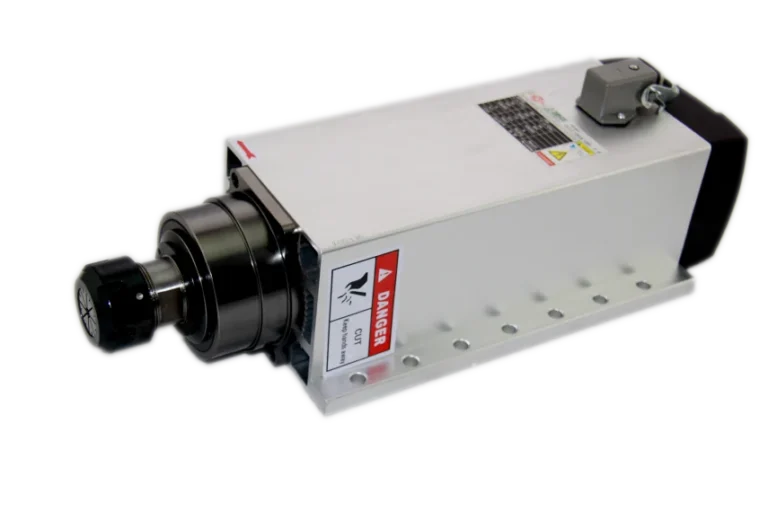
Air cooling systems typically dissipate heat directly into the ambient air using a fan and a heat sink. Integrated fins on the spindle body or an external fan provide airflow over the spindle, removing heat through convection. More advanced air cooling systems may include vortex tubes using compressed air or specially designed radiator and fan combinations. These systems are structurally simpler and have a lower initial cost. Maintenance requirements are generally less than for water cooling systems; there is no risk of fluid leakage or corrosion. Air cooling is widely used, especially in low and medium-power spindles, applications with lower thermal loads, and situations where cost is a critical factor. However, the performance of air cooling systems largely depends on the ambient temperature and the dust content of the air. As ambient temperature rises or airflow is restricted, cooling efficiency drops significantly. Additionally, air-cooled spindles can have higher noise levels and typically require a larger surface area (and thus a larger design) for effective heat dissipation, which can be considered a disadvantage.
| Parameter | Value/Description |
|---|---|
| Heat Dissipation Capacity | Water Cooling: Very high, with precise control. Ideal for high power applications. Air Cooling: Medium-Low, dependent on ambient conditions. Sufficient for low-medium power applications. |
| Temperature Stability | Water Cooling: Excellent (up to ±0.1°C). Minimizes thermal expansion. Air Cooling: Medium (±5-10°C). Sensitive to ambient temperature and load changes. |
| Noise Level | Water Cooling: Generally lower. Chiller fan and pump are main sources. Air Cooling: Generally higher. Spindle fan or external fan noise is noticeable. |
| Maintenance Frequency | Water Cooling: More frequent (filter changes, fluid checks, antifreeze/rust inhibitor top-ups). Air Cooling: Less frequent (fan cleaning, air filter checks). |
| Initial Installation Cost | Water Cooling: Higher (chiller, pump, piping, sensors). Air Cooling: Lower (fan, heat sink). |
| Operating Cost | Water Cooling: Electricity consumption (chiller), fluid replacement, filters. Air Cooling: Electricity consumption (fan). |
| Installation Complexity | Water Cooling: More complex (piping, chiller placement). Air Cooling: Simpler (integrated directly into spindle or external fan). |
| Typical Application Areas | Water Cooling: High-speed/power machining, laser cutting, metalworking, glass processing, long-duration precision tasks. Air Cooling: Woodworking, plastic processing, light metalworking, prototyping, low/medium duty cycles. |
| Dependence on Environmental Factors | Water Cooling: Low (chiller operates independently of external environment). Air Cooling: High (ambient temperature, dust, humidity). |
Field Considerations
- Cooling Fluid Quality and Maintenance for Water Cooling Systems: The quality of the fluid used in water cooling systems is critically important. Using only distilled water is not sufficient to prevent corrosion. The system must contain appropriate proportions of rust inhibitor (anti-corrosive) and algaecide (algicide) additives. These additives both prevent corrosion in the pipelines and internal channels of the spindle, extending system life, and prevent microbiological growth, thereby avoiding blockages and efficiency drops. The cooling fluid level should be checked regularly, and if any change in color or clarity is noticed, it should be replaced immediately. Filters should also be cleaned or replaced periodically; otherwise, blockages can lead to excessive load on the pump and a decrease in cooling efficiency.
- Environmental Conditions and Airflow for Air Cooling Systems: The performance of air cooling systems is directly dependent on the ambient temperature and air quality of the operating environment. Excessively hot environments can severely reduce cooling capacity, leading to spindle overheating. Similarly, dusty or dirty environments can cause dust accumulation between the spindle fins or in the fan grilles, obstructing airflow. This reduces cooling efficiency and causes the fan motor to overwork. Therefore, it is important for areas with air-cooled systems to be clean and well-ventilated. Regular inspection, cleaning, and replacement of fans, if necessary, are essential to maintain optimal airflow and cooling performance. Additionally, sufficient space around the machine is a critical factor for free air circulation.
- Vibration and Noise Control: In both cooling systems, vibration and noise can affect the working environment and machining quality. In water cooling systems, the placement of the chiller unit and pump is important for vibration and noise isolation. If necessary, anti-vibration pads or silent pump models can be preferred. In air cooling systems, high-speed fans can be a significant source of noise. This can negatively impact operator comfort, especially in environments with long operating hours. Fans should be checked for balance and bearing wear. Furthermore, since vibrations caused by fans can affect machining precision, periodic inspection and maintenance of fans directly connected to the spindle are important.
Common Problems and Solutions
Water Cooling Systems:
- Leaks: Loose hose connections, cracked hoses, or leaking pump seals are the most common causes of leaks.
- Solution: Regularly check and tighten all connections. Inspect hoses for signs of wear and cracks, and replace them if necessary. Have pump seals checked and replaced by an authorized service technician.
- Low Cooling Efficiency (Spindle Overheating): Insufficient cooling fluid level, clogged filters, dirty chiller condenser, or a faulty pump can lead to this situation.
- Solution: Check and top up the cooling fluid level. Clean or replace filters. Clean the chiller condenser with compressed air. Check pump pressure; low pressure may indicate pump failure.
- Chiller Malfunction: Compressor failure, refrigerant gas leakage, or control board issues can cause the chiller to lose power or fail to cool.
- Solution: Check the power supply and fuses. Read chiller error codes and consult the manufacturer’s manual. For serious issues like compressor or gas leaks, call an authorized service technician.
- Algae Growth and Clogging: Algae or bacterial growth in the cooling fluid can clog pipelines and spindle channels.
- Solution: Regularly add algaecide and rust inhibitor to the cooling fluid. Periodically drain the cooling fluid completely, flush the system with clean water, and refill with new fluid containing appropriate additives.
Air Cooling Systems:
- Spindle Overheating: Fan failure, clogged fan grilles or spindle fins, insufficient ambient airflow, or high ambient temperature are the main causes.
- Solution: Check if the fan is operating. Clean fan grilles and spindle fins with compressed air. Remove any obstructions around the machine to ensure proper airflow. If ambient temperature is too high, consider additional ventilation or ambient cooling solutions.
- High Noise or Vibration: Unbalanced fan, worn fan bearings, or foreign object contact can lead to these problems.
- Solution: Check the fan, remove any foreign objects. If there are signs of wear on fan bearings, replace the fan. Check fan balance with vibration sensors.
- Dust Accumulation: Heavy dust accumulation on fan grilles or between fins on the spindle.
- Solution: Regularly clean with compressed air. If the environment is very dusty, consider air filtration systems around the machine or a more enclosed working area.
Expert Advice
The selection of the correct cooling system for CNC machines is not merely a cost item but a fundamental determinant of production quality, machine lifespan, and operational efficiency. Our field experience shows that both systems have their unique advantages and disadvantages, and there is no single “best” cooling system; there is only the “most suitable” system for your application. For applications requiring high precision, continuous operation, high spindle power, and stable temperature control, water cooling systems (especially closed-loop systems supported by chillers) are almost indispensable. These systems minimize thermal expansion, thereby maintaining part tolerances and extending tool life in the long run. However, the high initial investment cost, maintenance requirements (fluid quality, filters), and potential leak risks must be considered. On the other hand, for lower-power spindles, applications requiring less precision or intermittent operation, and situations where the budget is limited, air cooling systems stand out for their simplicity, low initial cost, and easy maintenance. However, factors such as dependence on ambient temperature, potential noise levels, and lower heat dissipation capacity must be carefully evaluated when making a choice. As experts in the industrial automation sector, our recommendation is to comprehensively analyze not only the spindle power but also the type of material to be processed, the expected machining precision, daily operating hours (duty cycle), ambient working conditions (temperature, dust), and long-term maintenance costs when selecting a cooling system. A system being cheaper than another does not necessarily mean it will be more economical in the long run. An incorrectly chosen cooling system can lead to production errors, machine failures, and unexpected downtime, resulting in much greater costs. Therefore, before investing, conducting a detailed engineering analysis and, if possible, benefiting from the technical support of manufacturers and consulting field experts with experience in similar applications will help you make the most accurate decision. Remember, good cooling means a healthy life for the heart of your CNC machine.
Request a Quote on WhatsApp
If you need further assistance in choosing the ideal cooling system for your industrial CNC router machine or have specific technical questions, our Mermak CNC experts are ready to help. We offer tailored solutions to optimize your production processes and ensure the longevity of your equipment. Request a quote on WhatsApp today to discuss your specific needs and find the perfect cooling solution for your industrial application.
FAQ
What are the fundamental differences between CNC water cooling and air cooling systems?
Water cooling systems utilize a closed-loop circuit with a chiller unit, pump, and a cooling fluid (typically distilled water with additives) to precisely control and dissipate heat from the spindle. Air cooling systems use a fan and heat sink to directly dissipate heat into the ambient air. Water cooling offers superior temperature stability and heat dissipation for high-power applications, while air cooling is simpler and more cost-effective for lower-power needs.
Which cooling system is better for high-precision or high-power CNC applications?
For high-precision, high-speed, and high-power applications, water cooling systems are generally preferred due to their excellent temperature stability (minimizing thermal expansion) and superior heat dissipation capacity. This leads to better part quality and extended tool life. Air cooling is suitable for less demanding applications, lower power spindles, and when budget or simplicity are primary concerns.
What are the typical maintenance requirements for each cooling system?
Water cooling systems require regular checks of fluid level and quality (adding rust inhibitors and algaecides), and periodic cleaning or replacement of filters. Air cooling systems primarily need regular cleaning of fans and heat sinks to prevent dust accumulation and ensure optimal airflow. Both systems benefit from periodic inspection for unusual noise or vibration.
What are the common problems associated with water and air cooling systems, and how can they be resolved?
Common issues with water cooling include leaks (loose connections, cracked hoses), low cooling efficiency (clogged filters, dirty condenser), chiller malfunctions, and algae growth. For air cooling, common problems are spindle overheating (fan failure, clogged fins), high noise/vibration (unbalanced fan), and excessive dust accumulation.
How do I choose the right cooling system for my specific CNC router machine and application?
The choice depends on several factors: spindle power, required machining precision, daily operating hours, ambient environmental conditions (temperature, dust), and long-term maintenance costs. High-demand applications benefit from water cooling, while simpler tasks may be served by air cooling. Consulting with a Mermak CNC expert can help you analyze your specific needs and make an informed decision.