







































































Ball Screw vs. Rack and Pinion: Which Drive System Offers More Precision?

📑 Table of contents (Click to open)
Introduction and Technical Analysis
At the heart of industrial automation lies the ability for precise motion control and positioning. In numerous applications, from production lines and robotic systems to CNC machines and automated assembly stations, moving loads along a specific path with high accuracy is critically important. Two primary drive systems stand out for achieving this linear motion: ball screw systems (typically ball screws) and rack and pinion systems. Both systems have their unique advantages and limitations, and making the correct choice directly impacts the application’s performance, cost, and lifespan. This guide aims to assist engineers and field experts in thoroughly analyzing these two popular linear drive solutions to determine which system is more suitable for a particular application. Critical parameters such as precision, speed, load capacity, travel distance, and environmental factors will be examined in detail, thereby forming a solid foundation for the most optimal drive system selection.
Operating Principles and Technical Data
Ball screw and rack and pinion systems, which form the basis of linear motion systems, operate on different mechanical principles to meet the diverse needs of industrial automation. This section will detail the operating principles, key technical specifications, and common application areas for each system.
Ball Screw Systems
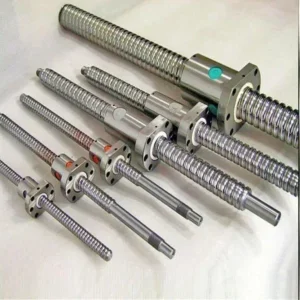
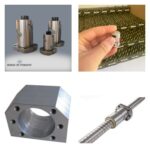
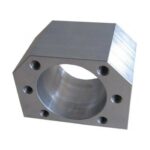
Ball screw systems typically consist of a helical thread (screw) machined onto a shaft and a nut designed to match this thread. In the most common type, ball screws, the elements providing contact between the nut and the shaft are steel balls that minimize friction and ensure high efficiency. When the shaft is rotated, the balls roll along the screw threads, causing the nut to move linearly. This rolling motion offers a much lower friction coefficient compared to sliding friction, which translates to less energy loss, lower heat generation, and a longer lifespan.
Advantages:
- High Precision and Repeatability: Ball screws offer micro-level positioning accuracy and excellent repeatability. This is a critical feature, especially for precise machining, measurement, and assembly applications.
- Low Friction and High Efficiency: Thanks to the rolling motion of the balls, mechanical efficiency of over 90% can be achieved. This allows for larger loads to be moved with smaller motors or less energy consumption with the same motor.
- High Load Capacity and Rigidity: Due to the contact area of the balls and the robust structure of the shaft, they can carry high static and dynamic loads. Backlash can be eliminated by preloading, increasing system rigidity.
- Long Lifespan: With proper sizing and regular maintenance, ball screws can offer millions of revolutions and long operating hours.
Disadvantages:
- Limited Speed and Length: Critical speed and oscillation issues can arise in long shafts. Long ball screws must be supported due to buckling and resonance risks, which increases design complexity.
- Sensitivity to Contamination: The balls and thread surfaces are sensitive to dust, chips, and other particles. Appropriate sealing and protection systems are required.
- Cost: High-precision ball screws generally have a higher initial cost compared to rack and pinion systems.
- Back-drivability: Due to their high efficiency, braking or balancing systems may be required in vertical applications to prevent the load from back-driving.
Application Areas: CNC machine tools (lathes, milling machines), robotic arms, semiconductor manufacturing machines, precision assembly lines, medical devices, optical equipment, measuring instruments.

Rack and Pinion Systems
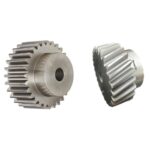
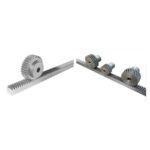
Rack and pinion systems are a simple yet powerful mechanism that converts rotary motion into linear motion. This system consists of a linear toothed bar, the rack, and a circular gear, the pinion, which meshes with the teeth of the bar. When the pinion is driven by a motor, it rolls along the rack, moving it forward or backward. Rack and pinions can be in spur gear or helical gear form. Helical gears offer more tooth contact area, providing lower noise, higher load capacity, and smoother motion, but are more complex and costly.
Advantages:
- Unlimited Travel Distance: Racks can be joined end-to-end to provide theoretically unlimited linear motion. This is ideal for applications requiring very long axial movement.
- High Speed and Acceleration: Rack and pinion gears are suitable for operation at high speeds and accelerations. High linear speeds can be achieved with large pinion diameters and high gear modules.
- High Load Capacity: Thanks to the robust structure of the gears and wide contact surfaces, they can carry heavy loads and generate high thrust forces.
- Simple Structure and Maintenance: They have a less complex structure compared to ball screws and are more durable in field conditions.
Disadvantages:
- Backlash and Precision: The unavoidable backlash between gears can reduce positioning accuracy. To increase precision, low-backlash reducers, dual-pinion systems (for preloading), or helical gears can be used, but this also increases cost.
- Higher Friction and Noise: Due to the sliding and rolling contact of the gears, higher friction and noise levels can be observed compared to ball screws, especially with spur gears.
- Wear: Contact between gears can lead to wear over time. Regular lubrication and high-quality materials reduce this effect.
- Sensitivity to Contamination: Open gear systems are sensitive to dust and particles and can shorten the life of the gears. Protective covers or automatic lubrication systems may be required.
Application Areas: Large gantry systems, laser cutting machines, plasma cutting machines, heavy-duty material handling systems, robotic transfer lines, automated storage and retrieval systems (AS/RS), door and barrier systems.
| Parameter | Ball Screw System | Rack and Pinion System (Helical) |
|---|---|---|
| Positioning Accuracy | ±0.005 mm – ±0.02 mm (C5-C7 class) | ±0.02 mm – ±0.1 mm (ISO 6-10 class) |
| Repeatability | ±0.001 mm – ±0.005 mm | ±0.005 mm – ±0.02 mm (with low-backlash reducer) |
| Maximum Travel Distance | ~6 meters (can be longer in special designs) | Theoretically unlimited (with modular addition) |
| Maximum Linear Speed | ~1.5 m/s (critical speed limitation) | ~10 m/s (higher in special applications) |
| Mechanical Efficiency | %90 – %98 | %85 – %95 (including reducer) |
| Load Capacity | High (in kN range, depending on shaft diameter) | Very High (depending on gear module and material quality, tons) |
| Noise Level | Low (with proper lubrication) | Medium – High (lower with helical gears) |
| Cost (Per System) | Medium – High (depending on precision and length) | Low – Medium (more economical for long distances) |
| Environmental Sensitivity | High (dust, moisture) | Medium (dust, chips in open systems) |

Field Considerations
- Assembly and Alignment Precision: Correct assembly and alignment are critically important for both systems. In ball screw systems, even the smallest deviations in the axial alignment of the shaft’s bearings and the nut can lead to excessive loading, premature wear, and even failure. Especially for long ball screws, appropriate intermediate supports must be used to prevent sagging, and a stress-free assembly between bearings must be ensured. In rack and pinion systems, the precision of the rack’s linear axis and the centering of the pinion are vital for controlling backlash between the gears and ensuring homogeneous tooth contact. Misalignment accelerates gear wear, increases noise, and shortens system life. Using precise assembly fixtures and laser alignment tools helps minimize these risks.
- Lubrication and Maintenance Routines: Both drive systems require regular and proper lubrication for optimal performance and long life. Ball screw systems are typically lubricated with grease or special oils, and since they are closed systems, lubrication intervals can be longer. However, using the correct type and amount of lubricant is essential to prevent wear on the balls and thread surfaces. Rack and pinion systems, often operating in open environments, may require more frequent lubrication. Automatic lubrication systems provide a significant advantage, especially in continuously operating or hard-to-reach systems. The viscosity of the lubricant should be selected considering temperature conditions and environmental factors. Additionally, systems should be periodically checked for dirt and wear, and sealing elements should be inspected.
- Adaptation to Environmental Conditions: The conditions of the operating environment are a decisive factor in drive system selection and maintenance. Ball screw systems are quite sensitive to dust, chips, moisture, and aggressive chemicals due to the precision of the balls and thread surfaces. If they are to operate in such environments, additional protective measures such as bellows, sealing gaskets, and special coatings must be applied. Otherwise, contamination can lead to ball jamming, accelerated wear, and system failures. Rack and pinion systems are generally considered more robust, but due to their open gear structure, they can still be exposed to dirt and particle accumulation. Especially in environments with metal chips, particles trapped between the gears can cause serious damage. Therefore, using protective covers or brush systems and regular cleaning are important. Extreme conditions such as high or low temperatures will also affect lubricant selection and material durability.
- Backlash Management: Backlash management is of great importance, especially in applications where precision is critical. In ball screw systems, backlash can be almost completely eliminated with preloading, providing high rigidity and precision. However, preloading can slightly increase system friction and heat generation. In rack and pinion systems, backlash is inherently present between the gears. To reduce this backlash, solutions such as helical gears, low-backlash reducers, or dual-pinion systems (where one pinion preloads to eliminate backlash) can be considered. While these solutions increase the complexity and cost of the system, they can significantly improve the precision of rack and pinion systems. The required level of precision for the application is the key factor in determining the most suitable method for backlash management.

Common Problems and Solutions
Various operational problems can be encountered when using ball screw and rack and pinion drives in industrial automation systems. Correct diagnosis and resolution of these problems extend the system’s efficient operation and lifespan.
- For Ball Screw Systems:
- Problem: Excessive Noise and Vibration. This usually occurs due to shaft bending, bearing wear, damage to the balls within the nut, or misalignment.
Solution: Shut down the system and perform a visual inspection. Check the straightness of the shaft and the condition of the bearings. Disassemble the nut and inspect the balls and raceways for damage. Replace damaged components if necessary. Check and correct assembly alignment with precise measuring tools. Lack of lubrication can also cause noise, so check the lubrication system and apply fresh lubricant. - Problem: Loss of Positioning Accuracy / Repeatability Issues. Increased backlash, deterioration of control system settings, or mechanical wear are the main causes.
Solution: First, check the feedback loop and parameters of the control system (servo motor, drive, encoder). Mechanically, check and adjust the backlash in the ball screw nut (if it’s an adjustable nut). If wear is advanced, the nut or the entire ball screw assembly may need replacement. Check for looseness or damage in the bearings. - Problem: Overheating. Occurs due to high friction, insufficient lubrication, excessive preloading, or overloading.
Solution: Check the lubrication system and ensure adequate lubrication. Incorrect lubricant selection can also lead to overheating; ensure the correct viscosity and type of lubricant are used. Check the amount of preloading (if any); excessive preloading increases friction. Evaluate whether the application exceeds the nominal load capacity. If the motor is suspected of being overloaded, monitor motor current and temperature.
- Problem: Excessive Noise and Vibration. This usually occurs due to shaft bending, bearing wear, damage to the balls within the nut, or misalignment.
- For Rack and Pinion Systems:
- Problem: Rapid Wear or Breakage of Gears. Can be caused by insufficient lubrication, incorrect gear alignment, overloading, foreign material accumulation, or incorrect gear module selection.
Solution: Check that the lubrication system is working properly and that the gears are sufficiently lubricated. Check and correct gear alignment with lasers or precise indicators. Check for and clean any foreign material (chips, dirt) between the gears. Evaluate whether the torque and force values required by the application exceed the nominal capacity of the gears. If necessary, use gears with a higher module or made from more durable materials. - Problem: High Noise and Vibration. Backlash in gears, misalignment, worn teeth, or insufficient lubrication are the main causes.
Solution: Precisely check and adjust the backlash between the gears (if an adjustable pinion reducer is used). Check and correct gear alignment. Replace worn or damaged gears. Address lubrication deficiencies and use the appropriate type of lubricant. Since helical gears operate more quietly than spur gears, switching to helical gear systems can be considered if possible. - Problem: Inconsistency in Positioning Accuracy. Usually occurs due to increased backlash, deviations in the straightness of the rack, or control system feedback errors.
Solution: Precisely adjust the backlash between the pinion and the rack. If backlash is too high and adjustment is not possible, solutions such as low-backlash reducers or dual-pinion systems should be evaluated. Check the flatness of the rack’s mounting surface and the accuracy of the rack itself. Ensure that encoders or feedback sensors are working correctly and are calibrated.
- Problem: Rapid Wear or Breakage of Gears. Can be caused by insufficient lubrication, incorrect gear alignment, overloading, foreign material accumulation, or incorrect gear module selection.
In both systems, it is important to follow a systematic approach to find the root cause of problems, perform manual inspection of components, analyze sensor data (temperature, current, position), and consult manufacturer manuals. Preventive maintenance is the most effective way to prevent many problems from arising.
Expert Advice
Ball screw and rack and pinion drive systems are fundamental components of industrial automation, each with its unique advantages and limitations. The answer to the question “Which drive system is more precise?” generally favors ball screw systems, as ball screws offer micro-level positioning accuracy and superior repeatability thanks to rolling friction and preloading capabilities. These features make them indispensable for applications where absolute precision is critical, such as CNC machining centers, precision assembly robots, and optical equipment. However, this superior precision often comes with disadvantages such as limited travel distances, critical speed limitations, and higher sensitivity to environmental contamination.
On the other hand, rack and pinion systems, especially when used with helical gears and low-backlash reducers, can achieve very high levels of precision today. However, their true strength lies in their unlimited travel distance, high speed and acceleration capability, and heavy load-carrying capacity. For applications covering large areas and prioritizing dynamic performance, such as large gantry systems, laser/plasma cutting machines, and material handling lines, rack and pinion gears offer a much more logical and economical solution. Our field experience shows that with proper engineering and quality components, rack and pinion gears can provide sufficient and even optimal precision for many applications.
As expert advice, when selecting a drive system, it is crucial to first analyze the application’s actual requirements in detail. The “most precise” system is not always the “best” system. All parameters such as required positioning accuracy, repeatability, travel distance, speed, acceleration, magnitude of the load to be carried, environmental conditions, and budget should be evaluated together. For example, while a ball screw is indispensable for an application requiring 5-micron precision, a rack and pinion system might be both more cost-effective and performant for an application where 50-micron precision is sufficient and a 10-meter travel distance is needed. Additionally, considering the total cost of ownership (TCO) of the system, factors such as initial cost, ease of maintenance, spare parts availability, and energy efficiency should also be included in the decision-making process. Focusing on correct engineering analysis and the specific needs of the application will ensure you select the most efficient and reliable drive system for your automation projects. Request a quote on WhatsApp today to discuss your specific needs!
FAQ
Which drive system is inherently more precise: ball screw or rack and pinion?
Ball screw systems generally offer higher positioning accuracy and repeatability, often reaching micro-level precision (e.g., ±0.005 mm). Rack and pinion systems, while capable of high precision with helical gears and low-backlash reducers, typically have slightly lower absolute accuracy (e.g., ±0.02 mm) due to inherent backlash.
When should I choose a rack and pinion system over a ball screw system?
For applications requiring very long travel distances (beyond 6-8 meters), high speeds (up to 10 m/s), and high acceleration with heavy loads, rack and pinion systems are generally preferred. Ball screws are limited by critical speed and buckling issues over long lengths, making them more suitable for shorter, high-precision movements.
How do environmental factors like dust and debris affect ball screw and rack and pinion systems?
Ball screw systems are more sensitive to dust, chips, and moisture due to their delicate ball and raceway surfaces, requiring robust sealing. Rack and pinion systems, especially open ones, can also be affected by debris, leading to accelerated wear. Both require appropriate protection and lubrication, but ball screws demand a cleaner operating environment for optimal performance.
What are the common methods for managing backlash in these drive systems?
Backlash in ball screws can be virtually eliminated through preloading, which increases rigidity and precision. In rack and pinion systems, backlash is managed using helical gears, low-backlash gearboxes, or dual-pinion configurations where one pinion is preloaded against the other to remove play. The choice depends on the required precision and budget.
What causes overheating in a ball screw system, and how can it be resolved?
Overheating in ball screw systems often indicates high friction due to insufficient lubrication, excessive preloading, or overloading. Solutions include checking and replenishing lubricant, verifying correct lubricant type/viscosity, adjusting preloading, and ensuring the load does not exceed the system's capacity. Monitoring motor current and temperature can help diagnose overloading.