No products in the cart.
How to Identify Original HIWIN Linear Guide Rails: A Guide to Distinguishing from Fakes
Contents
- How to Identify Original HIWIN Linear Guide Rails: An Introduction and Technical Analysis Among the motion control components considered the heart of industrial automation systems, **linear guides** and **linear rails** play a critical role. Designed with expectations of high precision, repeatability, load capacity, and long lifespan, these components find application in a wide range of fields, from CNC machines to robotic systems, semiconductor production lines to medical devices. In this domain, one of the globally recognized brands that stands out for its quality is **HIWIN**. HIWIN is a brand that sets the industry standard with its innovative designs, superior manufacturing quality, and engineering excellence. However, this high reputation, unfortunately, has led to an increasing number of **counterfeit products** and imitations in the market. While these fake products may initially offer a cost advantage, they can have devastating effects on system performance in the long run. Low precision, premature failure, safety risks, production losses, and damage to brand reputation are inevitable consequences of using counterfeit linear guides. Therefore, for industrial automation professionals, the ability to distinguish **original HIWIN linear guides** from fakes is vital for operational continuity, cost-effectiveness, and system safety. This detailed guide aims to equip industry professionals with the necessary technical knowledge, field observations, and expert advice to confirm the authenticity of HIWIN products. How to Identify Original HIWIN Linear Guide Rails: Operating Principle and Technical Data
- How to Identify Original HIWIN Linear Guide Rails: Field Observations to Consider
- FAQ
How to Identify Original HIWIN Linear Guide Rails: An Introduction and Technical Analysis
Among the motion control components considered the heart of industrial automation systems, **linear guides** and **linear rails** play a critical role. Designed with expectations of high precision, repeatability, load capacity, and long lifespan, these components find application in a wide range of fields, from CNC machines to robotic systems, semiconductor production lines to medical devices. In this domain, one of the globally recognized brands that stands out for its quality is **HIWIN**. HIWIN is a brand that sets the industry standard with its innovative designs, superior manufacturing quality, and engineering excellence. However, this high reputation, unfortunately, has led to an increasing number of **counterfeit products** and imitations in the market. While these fake products may initially offer a cost advantage, they can have devastating effects on system performance in the long run. Low precision, premature failure, safety risks, production losses, and damage to brand reputation are inevitable consequences of using counterfeit linear guides. Therefore, for industrial automation professionals, the ability to distinguish **original HIWIN linear guides** from fakes is vital for operational continuity, cost-effectiveness, and system safety. This detailed guide aims to equip industry professionals with the necessary technical knowledge, field observations, and expert advice to confirm the authenticity of HIWIN products.
How to Identify Original HIWIN Linear Guide Rails: Operating Principle and Technical Data
Linear guide rails typically operate on the principle of a carriage (block) moving along a rail, with **recirculating balls** or **rollers** inside the carriage. These balls or rollers provide low-friction contact between the rail and the carriage, allowing even heavy loads to be moved with high precision and minimal energy loss. HIWIN linear guides combine this fundamental principle with patented designs, the use of special alloy steel, precise machining techniques, and rigorous quality control processes to deliver unparalleled performance. Original HIWIN products are known for their high rigidity, smooth motion, long service life, high load-carrying capacity, and excellent positioning accuracy. These features directly impact the overall performance of the system, especially in applications requiring micron-level precision. For example, HIWIN linear guides used in a CNC machining center guarantee the accuracy of the tool path and surface quality, whereas a counterfeit product can lead to machining errors due to vibration, backlash, and wear. Counterfeit products often use low-quality steels, resulting in insufficient surface hardness and premature wear. Furthermore, manufacturing tolerances are typically very wide, leading to undesirable gaps between the carriage and the rail, and consequently, severe losses in motion accuracy. The quality, dimensional consistency, and surface roughness of the internal balls or rollers in counterfeit products also fall below standards, increasing friction, raising noise levels, and dramatically shortening service life. Special sealing elements and lubrication systems found in original HIWIN products prevent contaminants from entering and ensure long-term, maintenance-free operation; in counterfeit products, these details are often overlooked or imitated with low-quality materials. These technical differences reinforce HIWIN’s leading position in the industry, clearly demonstrating why counterfeit products only appear to be a short-term “gain” but lead to significant costs in the long run.
| Parameter | Value/Description |
|---|---|
| Material Quality | Special alloy high-carbon chromium bearing steel (SUJ2/100Cr6) and specific heat treatment. Fakes often use low-quality non-alloy steel. |
| Accuracy Grades | C (Normal), H (High), P (Precision), SP (Super Precision), UP (Ultra Precision). Fakes cannot achieve these grades. |
| Load Capacity | High values for Dynamic (C) and Static (C0) loads, compliant with ISO standards. Fakes do not meet stated values, early deformation. |
| Friction Coefficient | Extremely low, between 0.002 – 0.003, ensuring smooth motion. Fakes have higher friction, energy loss, overheating. |
| Operating Temperature Range | -20°C to +80°C (up to +150°C with special lubricants). Fakes are sensitive to temperature variations. |
| Surface Hardness | 58-62 HRC (Rockwell Hardness) for rail and block surfaces. Fakes have much lower values, leading to early wear. |
| Life Expectancy | Long life calculated by the formula L = (C/P)³ * 50 km. Fakes only achieve a small fraction of this expected life. |
How to Identify Original HIWIN Linear Guide Rails: Field Observations to Consider
- Packaging and Labeling Details: Original HIWIN products come in high-quality, durable, and professional-looking packaging. The **HIWIN logo** on the packaging is printed clearly, in correct colors, and with high resolution. On counterfeit products, the logo may often be faded, blurry, or in incorrect color tones. Each HIWIN product carries a label with a unique **serial number**, **model code**, and **QR code**. This QR code can be scanned via HIWIN’s official website or a dedicated application to verify the product’s authenticity. Counterfeit products either lack QR codes, have non-functional ones, or redirect to a fake website. Additionally, original packaging often includes security seals, holograms, or special anti-counterfeit labels. It is crucial to check the integrity and details of these labels. The quality of the packaging material (thick cardboard, sturdy foam inserts) and how the product is secured within the packaging are also indicators. HIWIN carefully packages its products to protect them from damage during transit.
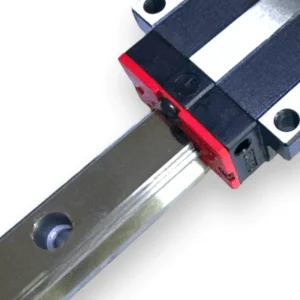
- Physical Appearance and Surface Finish Quality: The rails and blocks (carriages) of original HIWIN linear guides have a flawless surface finish. The machined surfaces of the rails exhibit a mirror-like shine and feel smooth to the touch. There are no burrs, scratches, undulations, or machining errors. The outer surfaces of the blocks also have an equally smooth and uniform coating. Counterfeit products often show rough machining marks, dull or irregular surfaces, color differences, or even signs of rust. The **HIWIN branding** on the blocks is laser-engraved, clear, and permanent; on fake products, this branding is often faint, embossed, or a low-quality print that can be easily wiped off. Furthermore, the edges and corners of the blocks have sharp lines and show no signs of rounding or deformation. Details such as end caps, lubrication ports, and sealing elements are made of high-quality plastic or rubber in original products, with excellent fit and finish; in counterfeit products, these components are often of poor quality, loose, or incorrectly sized.
- Movement and Performance (Tactile Test): One of the most practical ways to ascertain the authenticity of a linear guide is to move the block along the rail by hand. Original HIWIN blocks move with minimal force, in an **extremely smooth, quiet, and vibration-free** manner. No sticking, increased friction, or play (looseness) is felt throughout the movement. A certain resistance may be felt due to slight preload, but this resistance is consistent and does not hinder fluid motion. In counterfeit products, movement is often rough, jerky, noisy, and irregular. When moved along the rail, noticeable increased friction, play, or
FAQ
What are the primary indicators of an original HIWIN linear guide rail versus a fake?
Original HIWIN linear guide rails are identifiable by their high-quality packaging with clear, high-resolution logos, unique serial numbers, and functional QR codes that link to HIWIN's official verification. They also feature flawless surface finishes, precise laser-engraved branding, and smooth, quiet movement. Counterfeits often have poor packaging, blurry logos, non-functional QR codes, rough finishes, and noisy, inconsistent movement.
What are the common problems encountered when using fake HIWIN linear guide rails?
Using counterfeit HIWIN linear guides can lead to premature wear and failure, excessive noise and vibration, sticking or irregular motion, and reduced load capacity and rigidity. These issues result in unexpected downtime, production losses, increased maintenance costs, and compromised system accuracy and safety.
What is the best way to ensure I am purchasing genuine HIWIN linear guide rails?
To minimize the risk of purchasing counterfeit products, always buy HIWIN linear guide rails from authorized distributors. Verify product authenticity by checking packaging details, QR codes, physical appearance, and requesting quality control certificates and warranty documents. Avoid deals that seem too good to be true, as low prices often indicate a fake product.
How does the material quality of original HIWIN linear guides differ from fakes?
Original HIWIN linear guides are manufactured from special alloy high-carbon chromium bearing steel (SUJ2/100Cr6) with specific heat treatment, achieving surface hardness of 58-62 HRC. Counterfeits typically use lower quality, non-alloy steels with significantly reduced hardness, leading to rapid wear and deformation under load.
What are the performance differences in terms of accuracy and friction between genuine and fake HIWIN linear guides?
Original HIWIN products offer various accuracy grades (C, H, P, SP, UP) and exhibit an extremely low friction coefficient of 0.002-0.003, ensuring smooth and precise motion. Counterfeit products fail to meet these accuracy grades, have higher friction, and lack the precise manufacturing tolerances necessary for high-performance industrial applications.