No products in the cart.
What is an MPG Handwheel and How to Install it on a CNC Machine?
Contents
- What is an MPG Handwheel and How to Install it on a CNC Machine? Introduction and Technical Analysis CNC (Computer Numerical Control) machines, cornerstones of industrial automation and precision manufacturing, are indispensable in today’s production processes. While these machines can process complex geometries with high accuracy, there are always situations requiring operator intervention. This is where the MPG (Manual Pulse Generator) Handwheel, or commonly known as a “handwheel,” comes into play as a critical interface device, offering CNC operators the ability to manually control machine axes with extreme precision. This field guide and technical article will detail what an MPG handwheel is, its operating principles, installation in CNC systems, common problems, and solutions for experts and technicians in the industrial automation sector. The MPG handwheel provides operators with unique control flexibility, especially in situations such as workpiece zeroing, setting tool length and offset, fine adjustments in mold or prototype manufacturing, operations requiring precise positioning, and even diagnosing machine malfunctions. These devices, which send electrical signals to the CNC control unit to move each axis at micron levels (thousandths of a millimeter), are of great importance for production efficiency, machining quality, and operator safety. In modern manufacturing facilities, the correct selection, installation, and maintenance of the MPG handwheel are key to ensuring the machine park operates at maximum performance. In this article, we aim to delve into the technical depths of this critical component and provide practical information for field applications. MPG Handwheel: Working Principle and Technical Data
- Working Principle Details:
- Areas of Use and Advantages:
- MPG Handwheel: Field Considerations for Installation
- MPG Handwheel: Common Problems and Solutions
- MPG Handwheel: Conclusion and Expert Advice
- FAQ
What is an MPG Handwheel and How to Install it on a CNC Machine? Introduction and Technical Analysis
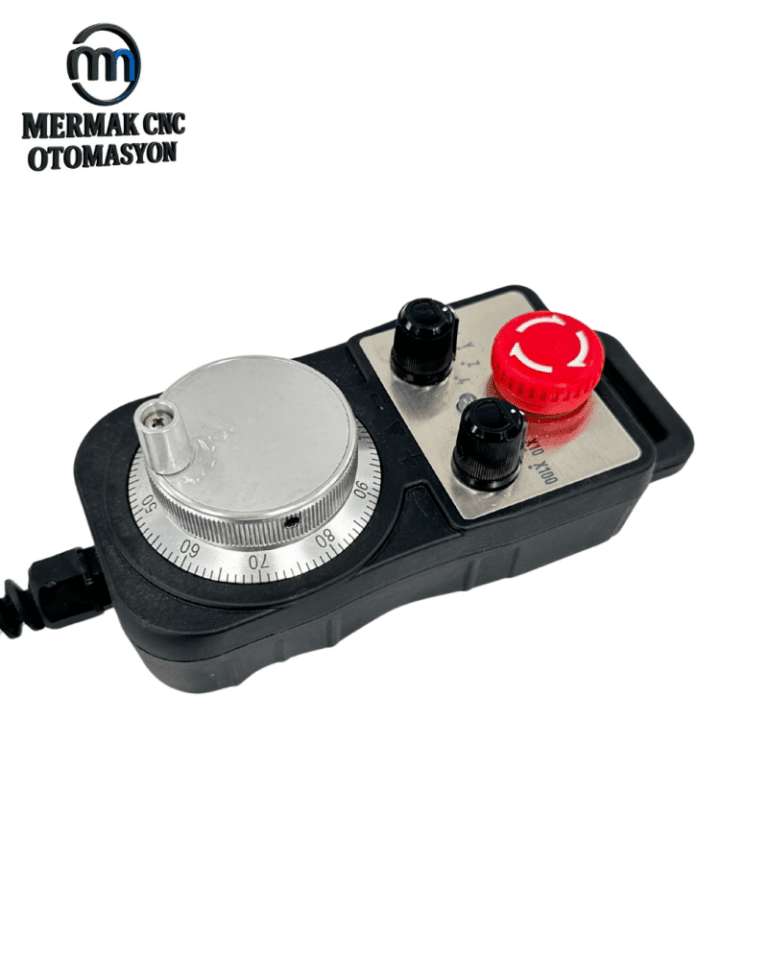
CNC (Computer Numerical Control) machines, cornerstones of industrial automation and precision manufacturing, are indispensable in today’s production processes. While these machines can process complex geometries with high accuracy, there are always situations requiring operator intervention. This is where the MPG (Manual Pulse Generator) Handwheel, or commonly known as a “handwheel,” comes into play as a critical interface device, offering CNC operators the ability to manually control machine axes with extreme precision. This field guide and technical article will detail what an MPG handwheel is, its operating principles, installation in CNC systems, common problems, and solutions for experts and technicians in the industrial automation sector.
The MPG handwheel provides operators with unique control flexibility, especially in situations such as workpiece zeroing, setting tool length and offset, fine adjustments in mold or prototype manufacturing, operations requiring precise positioning, and even diagnosing machine malfunctions. These devices, which send electrical signals to the CNC control unit to move each axis at micron levels (thousandths of a millimeter), are of great importance for production efficiency, machining quality, and operator safety. In modern manufacturing facilities, the correct selection, installation, and maintenance of the MPG handwheel are key to ensuring the machine park operates at maximum performance. In this article, we aim to delve into the technical depths of this critical component and provide practical information for field applications.
MPG Handwheel: Working Principle and Technical Data
An MPG handwheel primarily functions as an input device based on the principle of a rotary encoder. When the operator turns the handwheel, the internal encoder mechanism converts the rotational motion into a specific number of electrical pulses. These pulses are transmitted to the CNC control unit, which then interprets these pulses to move the relevant axis by a predetermined step size. For example, if a handwheel has a value of 100 PPR (Pulses Per Revolution), 100 pulses are generated when the operator turns the wheel one full revolution. Through settings in the CNC control unit, it is determined how much axis movement these 100 pulses correspond to. This is typically expressed with multipliers such as x1, x10, x100.
Working Principle Details:
At the heart of an MPG handwheel is an encoder based on optical or magnetic principles. Optical encoders consist of a light source, a detector, and a disk with precise holes or lines. As the disk rotates, light is interrupted or passed, creating electrical pulses in the detector. Magnetic encoders, on the other hand, generate pulses by sensing changes in the magnetic field. These pulses are usually generated in two phases (A and B phases), and the phase difference between these phases (typically 90 degrees) is used to determine the direction of rotation. Some encoders also have a Z phase (reference pulse), which is triggered once per revolution to provide a position reference.
MPG handwheels are typically equipped with an axis selector switch (X, Y, Z, A, B, etc.) and a step size selector switch (x1, x10, x100). The operator determines which axis to move and how much each pulse will move it via these switches. For example, in x1 mode, each pulse might move 0.001 mm (1 micron), while in x10 mode, it moves 0.01 mm, and in x100 mode, it moves 0.1 mm. These precision levels can be adjusted via parameters in different CNC control units such as Fanuc, Siemens Sinumerik, and Heidenhain iTNC.
Areas of Use and Advantages:
- Zeroing and Referencing: Used to precisely define reference points for the workpiece or tool.
- Tool Offset Adjustment: Provides micron-level control when manually adjusting tool length and diameter offsets.
- Molds and Prototypes: Especially in mold manufacturing or one-off prototypes, it allows the operator to make very fine movements with visual feedback.
- Machine Setup: Ideal for safely and controllably moving machine axes when a new workpiece is mounted or a fixture is changed.
- Debugging and Observation: Offers the ability to slowly move the machine to closely observe tool behavior or surface quality during machining.
MPG handwheels come in two main types: wired or wireless. While wired models can be more reliable and resistant to EMI (electromagnetic interference), wireless models offer operators greater freedom of movement and flexibility. Battery life and signal range are important factors for wireless models.
| Parameter | Value/Description |
|---|---|
| Output Type | Voltage Output (Line Driver), Open Collector |
| Pulse Count (PPR) | 25, 100 (Most common values) |
| Supply Voltage | +5V DC, +12V DC, +24V DC (Varies by CNC control unit) |
| Output Signal | A, /A, B, /B, Z, /Z Phases (Differential signals are more resistant to noise) |
| Axis Selection | X, Y, Z, A, B, C (Varies by machine configuration) |
| Step Selection | x1 (0.001mm), x10 (0.01mm), x100 (0.1mm) |
| Cable Length (for wired) | 3 meters, 5 meters, 10 meters (Varies by application, risk of signal loss with long cables) |
| Operating Temperature | 0°C – 50°C (Industrial standards, humidity and dust protection are important) |
MPG Handwheel: Field Considerations for Installation
-
Proper Model Selection and Compatibility:
When selecting an MPG handwheel, it is critical to choose a model that is fully compatible with your existing CNC control unit (Fanuc, Siemens, Heidenhain, Mitsubishi, Fagor, etc.). Each control unit has different electrical input requirements (supply voltage, signal type – Line Driver, Open Collector) and pin connection diagrams. Incorrect model selection can lead to the device not working or damaging the control unit. Furthermore, the choice between a wired or wireless model should be based on factors such as the size of the working environment, the operator’s need for freedom of movement, and the potential for electromagnetic interference (EMI). For wireless models, signal range and battery life should be considered, while for wired models, cable length and protection are important. The ergonomics and button layout of the handwheel should also be evaluated for operator ease of use.
-
Correct Electrical Connection and Cabling:
One of the most critical steps in MPG handwheel installation is correct electrical connection. The connection diagram (pinout diagram) provided by the manufacturer must be followed. Typically, there are +5V/GND power supply and differential signal lines such as A, /A, B, /B, Z, /Z. Differential signals are more resistant to electrical noise (EMI) in industrial environments. Using shielded cables during wiring and properly grounding this shield is vital for maintaining signal integrity and preventing interference. Cables should be kept separate from other power cables within cable trays, sharp bends should be avoided, and ensure there are no loose connections at connection points. Incorrect polarity (reverse connection) or short circuits can cause permanent damage to both the handwheel and the CNC control unit.
-
CNC Control Unit Parameter Settings:
After the physical connection is complete, the relevant parameters in the CNC control unit must be set correctly. These settings include activating the MPG handwheel, determining which axes will be selected with which switch, how many microns each step multiplier (x1, x10, x100) will correspond to, and informing the control unit of the encoder’s pulse count (PPR). For example, in Fanuc control units, these settings are usually made via system parameters (e.g., 1800 series parameters), while in Siemens Sinumerik, machine data (MD) or setting data (SD) parameters are used. Incorrect parameter settings can cause the handwheel not to work, axes to move in the wrong direction, or move at unintended step sizes. After making the settings, it is mandatory to test all functions of the handwheel (axis selection, step size, direction).
-
Physical Mounting and Ergonomics:
The location where the handwheel is physically mounted on the machine or control panel is very important for operator accessibility and ease of use. The wheel must be securely fastened, unaffected by vibration, and not move during operation. For wired models, it is important to route the cable in a way that it will not be affected by machine movements, pinched, or abraded. For wireless models, positioning the transmitter and receiver to face each other and avoiding metal obstacles improves signal quality. An ergonomic mounting position should be preferred to prevent operator fatigue during long periods of use and to ensure easy reach.
-
Maintenance and Environmental Conditions:
Industrial environments can be exposed to dust, chips, oil, and moisture. The MPG handwheel should have an adequate IP protection rating (e.g., IP65) against such conditions. The surface and button panel of the handwheel should be cleaned at regular intervals, and cable connections should be checked for looseness. For wireless models, battery level should be checked periodically and replaced if necessary. Care should be taken against mechanical wear or damage that may occur due to impact, and a faulty handwheel should be replaced immediately. Lack of maintenance can shorten the device’s lifespan and lead to unexpected malfunctions.
MPG Handwheel: Common Problems and Solutions
MPG handwheels, with proper installation and maintenance, can have a long lifespan, but they can encounter various problems due to the challenges of industrial environments and incorrect usage. Here are some common problems and their solutions:
-
Handwheel Not Working or Unresponsive:
This is one of the most common problems and usually stems from simple causes. First, check the handwheel’s power supply. Is the power cable correctly connected, cut, or damaged? Use a multimeter to measure voltage values and confirm proper power supply. Then, ensure that the signal cables (A, B, Z phases) are connected to the correct pins on the CNC control unit and that there are no loose connections. Double-check that the MPG-related parameters (activation, axis assignments) in the control unit are set correctly. If using a wireless handwheel, check the battery level, ensure the transmitter and receiver units are on and properly paired. Make sure you are within signal range and there are no metal obstacles in between.
-
Axes Moving in the Wrong Direction:
If the axes move in the opposite direction than expected when you turn the handwheel, it is usually due to the A and B phases being connected in reverse. Check the positions of the A+ and A- or B+ and B- terminals and correct them if necessary. Some CNC control units have parameters that allow you to reverse the direction of MPG inputs via software. Check these parameters and make the correct adjustment.
-
Axis Movement is Continuous or Vibrating:
If the axis moves even when the handwheel is not turned or if the movement is vibrating, it may be due to signal noise or a faulty MPG unit. Check if the shield of the signal cables is properly grounded. Ensure that the signal cables are away from power cables and are not affected by EMI sources. Visually inspect the cable for cuts or damage. If the problem persists, the encoder inside the MPG handwheel may be faulty, and the device may need to be replaced.
-
Incorrect or Inconsistent Step Sizes:
If the x1, x10, x100 selectors on the handwheel are not working correctly or the axes move a different distance than expected, it indicates that the relevant parameters in the CNC control unit are set incorrectly. Refer to the control unit’s manual to check the parameters related to MPG multipliers and pulse values, and enter the correct values. Ensure that the encoder’s PPR value (e.g., 100 PPR) matches the setting in the control unit. In some cases, the contacts of the step selector switch on the handwheel itself may be dirty or faulty, leading to inconsistency.
-
Signal Interruptions in Wireless Handwheel:
Signal interruptions in wireless MPGs typically occur due to weak battery, obstacles between the transmitter and receiver (especially large metal structures), interference from other wireless devices, or going out of range. Check the battery level and replace if necessary. Optimize the position of the receiver unit, providing a line of sight if possible. Check the frequencies of other wireless devices (Wi-Fi, Bluetooth) used in industrial environments and try using different channels to prevent conflicts. Some wireless MPGs offer the option to attach an external antenna to improve signal quality.
-
Button Panel or Switches Malfunctioning:
Over time, the axis selector switches, step size selectors, or other function buttons on the handwheel may wear out, become dirty, or mechanically malfunction. In this case, the relevant switch or button may not perform its function. Such malfunctions can usually be remedied by accessing the inside of the device to clean the contacts or replace the faulty component. However, this process requires care and technical knowledge, and it is recommended to have it done by an authorized service to avoid voiding the warranty.
MPG Handwheel: Conclusion and Expert Advice
The MPG Handwheel is an indispensable tool in modern CNC machining processes, directly impacting operator flexibility, precision, and thus production quality. This small but strategically important device combines the rigid control of automated systems with the operator’s intuitive and micron-level manual intervention capability, increasing production efficiency and safety, especially in critical initial settings, zeroing operations, and tasks requiring precise positioning. For every technician and engineer working in the industrial automation sector, a deep understanding of the MPG handwheel’s operating principles, different types, correct installation methods, and possible fault scenarios is key to ensuring the smooth and uninterrupted operation of the machine park.
Our field experience shows that the lifespan and performance of an MPG handwheel are not solely limited to the quality of the device itself. Correct model selection, meticulous electrical installation, accurate parameter settings in the CNC control unit, and the implementation of regular maintenance routines are critically important for the long-term reliability of this system. Especially during cabling, the use of shielded cables and the application of appropriate grounding techniques minimize the effects of electromagnetic noise in industrial environments, protecting signal integrity. When utilizing the advantage of freedom of movement offered by wireless models, signal range, battery life, and potential interactions with other wireless systems should always be considered. It should be remembered that even the most advanced CNC machine cannot fully realize its potential unless it can be guided correctly and precisely. The MPG handwheel is the bridge that gives the operator this guiding power, establishing that delicate balance between human and machine. Therefore, the care and knowledge applied to this critical component will directly contribute to the overall success of manufacturing facilities. As expert advice, in any MPG handwheel installation or troubleshooting process, strict adherence to manufacturer manuals and seeking support from authorized service or a qualified technician when in doubt is the most appropriate approach for both equipment health and operational reliability.
FAQ
What is an MPG handwheel and what is its primary function in CNC operations?
An MPG (Manual Pulse Generator) handwheel is an input device used in CNC machines that allows operators to manually control the movement of machine axes with high precision. It converts rotational movement into electrical pulses, which the CNC control unit interprets to move axes in small, precise increments.
How does an MPG handwheel work?
MPG handwheels typically operate on the principle of a rotary encoder. When turned, an internal encoder generates electrical pulses (e.g., 100 Pulses Per Revolution). These pulses are sent to the CNC control, which then moves the selected axis by a predefined step size, often controlled by x1, x10, or x100 multipliers.
What are the critical factors for selecting and installing an MPG handwheel?
Key considerations include compatibility with your CNC control unit (Fanuc, Siemens, Heidenhain), choosing between wired or wireless models, ensuring correct electrical connections with shielded cables, accurate parameter settings in the CNC control, ergonomic physical mounting, and regular maintenance to protect against dust, chips, and moisture.
What are the common problems encountered with MPG handwheels and how can they be resolved?
Common issues include the handwheel not responding (check power, cables, and parameters), axes moving in the wrong direction (check A/B phase connections or software parameters), continuous or vibrating axis movement (signal noise, grounding, or faulty encoder), and incorrect step sizes (check CNC parameters and encoder PPR). For wireless models, signal interruptions can occur due to low battery, obstacles, or interference.
What are the main advantages of using an MPG handwheel in industrial CNC applications?
MPG handwheels are essential for precise workpiece zeroing, accurate tool offset adjustments, fine positioning in mold and prototype manufacturing, safe machine setup, and detailed observation during machining. They enhance operator control, improve production efficiency, and ensure higher machining quality.