No products in the cart.
How to Select BK/BF and FK/FF Ball Screw End Supports for Industrial CNC Machines
Contents
- How to Select BK/BF and FK/FF Ball Screw End Supports: Introduction and Technical Analysis At the heart of industrial automation, ball screw systems play an indispensable role in many machines and systems requiring precise linear motion. One of the critical components directly impacting the performance, accuracy, and lifespan of these systems are the ball screw end supports. The widely used BK/BF and FK/FF series end supports are designed for different application needs, and making the correct selection is vital for the overall efficiency and reliability of the system. This detailed field guide and technical article provides engineers, designers, and maintenance specialists in the industrial automation sector with a comprehensive roadmap for making the most suitable selection by delving deep into these bearing types. Our aim is not only to list technical specifications but also to support decision-making processes with practical insights derived from field experience. The correct selection of ball screw end supports is an engineering decision that directly affects the system’s rigidity, accuracy, load capacity, and operational life. An incorrect selection can lead to unexpected failures, excessive vibrations, positioning errors, and costly downtime. Therefore, a deep understanding of the operating principles, technical differences, and application areas of these components forms the foundation of every automation project. How to Select BK/BF and FK/FF Ball Screw End Supports: Operating Principle and Technical Data
- How to Select BK/BF and FK/FF Ball Screw End Supports: Field Considerations
- How to Select BK/BF and FK/FF Ball Screw End Supports: Common Problems and Solutions
- How to Select BK/BF and FK/FF Ball Screw End Supports: Conclusion and Expert Advice
- FAQ
How to Select BK/BF and FK/FF Ball Screw End Supports: Introduction and Technical Analysis
At the heart of industrial automation, ball screw systems play an indispensable role in many machines and systems requiring precise linear motion. One of the critical components directly impacting the performance, accuracy, and lifespan of these systems are the ball screw end supports. The widely used BK/BF and FK/FF series end supports are designed for different application needs, and making the correct selection is vital for the overall efficiency and reliability of the system. This detailed field guide and technical article provides engineers, designers, and maintenance specialists in the industrial automation sector with a comprehensive roadmap for making the most suitable selection by delving deep into these bearing types. Our aim is not only to list technical specifications but also to support decision-making processes with practical insights derived from field experience. The correct selection of ball screw end supports is an engineering decision that directly affects the system’s rigidity, accuracy, load capacity, and operational life. An incorrect selection can lead to unexpected failures, excessive vibrations, positioning errors, and costly downtime. Therefore, a deep understanding of the operating principles, technical differences, and application areas of these components forms the foundation of every automation project.
How to Select BK/BF and FK/FF Ball Screw End Supports: Operating Principle and Technical Data
In ball screw systems, stable and smooth support of both ends of the screw is essential for the system to achieve its desired performance. This support task is undertaken by the end supports. Fundamentally, one end operates on the principle of fixed side, while the other end operates on the principle of supported/floating side. This structure ensures the ball screw’s resistance to both axial and radial loads, while also aiming to minimize the negative effects of factors such as thermal expansion.
BK (Ball Screw Fixed Support) and FK (Flange Type Fixed Support) Series (Fixed End Supports):
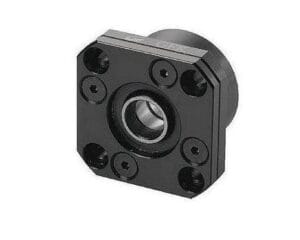
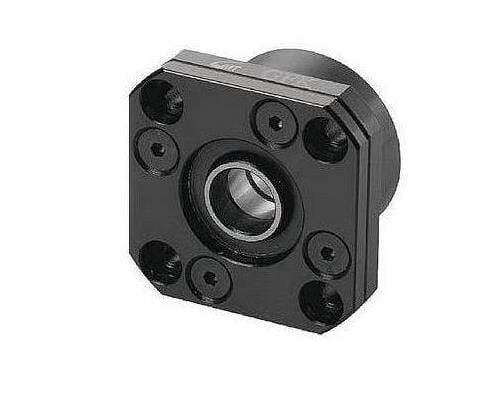
These supports are mounted on the drive side of the ball screw, i.e., the end where the motor is connected. Their primary functions are to fix the ball screw’s movement in both axial and radial directions and to provide high rigidity. They are typically designed using preloaded angular contact ball bearings, which offer high precision and load capacity. Preloading eliminates clearance in the bearings, reducing system response time and increasing positioning accuracy. The BK series generally has a more compact and standard mounting interface, while the FK series, with its flanged structure, can offer a wider mounting surface and easier integration in some applications. Both types prevent axial displacement that may occur when the ball screw rotates and effectively transmit torque from the drive motor to the ball screw. In selecting these bearings, the axial and radial load capacity, rigidity, and accuracy class required by the application are of critical importance.
BF (Ball Screw Supported Support) and FF (Flange Type Supported Support) Series (Supported End Supports):
These supports are mounted on the other end of the ball screw, i.e., the side that is free or merely supported relative to the fixed end. Their main tasks are to prevent deflection caused by the ball screw’s own weight and to carry radial loads. However, their axial load capacity is limited or non-existent. BF and FF series bearings typically use deep groove ball bearings. These bearings allow the ball screw to move axially in case of thermal expansion or contraction, preventing unwanted stresses from building up on the screw. This feature is vital, especially for long ball screws, as dimensional changes in the screw can lead to significant stresses between two fixed ends. The FF series, with its flanged structure, performs a similar function to the BF series but may differ in terms of ease of mounting or adaptability to specific designs. When selecting supported end supports, the length of the ball screw, its diameter, and expected thermal changes must be considered.
Selection Criteria and Application Areas:
The choice between BK/BF or FK/FF depends on the specific requirements of the application. For example, in applications requiring high precision and rigidity, such as CNC machine tools, robotic arms, precision positioning tables, and linear modules, the correct selection of fixed end supports plays a critical role. In systems using long ball screws, proper configuration of supported end supports is essential to manage thermal expansion. Both series offer models in various sizes and load capacities, providing engineers with a wide selection range. When making a selection, factors such as the ball screw’s diameter, lead, maximum operating speed, required positioning accuracy of the application, expected lifespan, and environmental conditions must be meticulously evaluated.
| Parameter | Value/Description |
|---|---|
| Bearing Type (Fixed End) | BK/FK Series (Preloaded Angular Contact Ball Bearings) |
| Bearing Type (Supported End) | BF/FF Series (Deep Groove Ball Bearings) |
| Axial Load Capacity (Fixed End) | High (Carries Bi-directional Axial Loads) |
| Axial Load Capacity (Supported End) | Very Low or None (Radial Support Only) |
| Radial Load Capacity | Available for Both Types (Higher Rigidity in Fixed End) |
| Thermal Expansion Management | Supported End (BF/FF) Allows Axial Movement |
| Rigidity | Fixed End (BK/FK) High, Supported End (BF/FF) Medium |
| Typical Applications | CNC Machines, Robotics, Precision Positioning Systems |
How to Select BK/BF and FK/FF Ball Screw End Supports: Field Considerations
- Load Calculations and Rigidity Requirements: Accurately calculating the static and dynamic axial and radial loads, as well as instantaneous impact loads, that the application will be subjected to forms the basis of bearing selection. Especially in fixed end supports (BK/FK), high axial loads and instantaneous impact loads must be considered. The expected positioning accuracy and repeatability of the system are directly related to the rigidity of the bearings. For applications requiring high rigidity, bearings with preloaded angular contact ball bearings should be preferred. Insufficient rigidity can lead to vibrations, positioning errors, and system instability.
- Thermal Expansion Management and Screw Length: Especially when long ball screws are used, thermal expansion or contraction of the screw length occurs during operation or due to changes in ambient temperature. If both ends of the screw are fixed, this can lead to severe stresses and bending in the screw. Therefore, for long screws, it is generally preferred to have one end fixed (BK/FK) and the other supported (BF/FF). BF/FF bearings absorb these stresses by allowing the screw to move freely in the axial direction. The screw length, operating temperature range, and thermal expansion coefficient of the screw material must be considered when selecting the supported end bearing.
- Mounting Precision and Alignment: Correct mounting of end supports is critical for system performance and lifespan. The bearings must be aligned concentrically and parallel with the ball screw. Misalignment causes excessive loading on the bearings, premature wear, increased friction, noise, and vibration. During mounting, the torque values specified by the manufacturer must be adhered to, and appropriate mounting tools must be used to prevent damage to the bearings. Furthermore, the flatness and rigidity of the surfaces where the bearing housings are mounted are also important.
- Environmental Conditions and Sealing: The environmental conditions in which the application operates (dust, moisture, chemicals, temperature changes) affect bearing selection. In aggressive environments, bearings with a higher protection class, special sealing elements, or made of stainless steel should be preferred. High temperatures can affect the viscosity and lifespan of the lubricant, while low temperatures can cause the lubricant to freeze. These factors directly affect the lifespan and maintenance intervals of the bearings.
- Lubrication and Maintenance Procedures: Correct lubricant selection and regular maintenance are crucial for the long and trouble-free operation of end supports. The manufacturer’s recommended lubrication type (grease or oil) and periodicity must be followed. Insufficient or incorrect lubrication increases friction, causes heat generation, and leads to premature wear of the bearings. During maintenance, any signs of wear, damage, or contamination in the bearings should be checked, and parts should be replaced if necessary.

How to Select BK/BF and FK/FF Ball Screw End Supports: Common Problems and Solutions
Since ball screw end supports are one of the most critical components of the system, it is possible to encounter various problems from time to time. Early diagnosis and correct solutions to these problems ensure the continuous operation and long lifespan of the system.
- Excessive Noise and Vibration:
- Problem: Unusually loud noises (humming, rubbing sound) or excessive vibrations occurring when the system is operating.
- Causes: Incorrect bearing selection (insufficient load capacity), incorrect mounting and alignment (eccentricity, parallelism error), contamination or damage in the bearings, insufficient or incorrect lubrication, excessive preloading.
- Solutions: Check and correct the alignment of the bearings. Check the lubrication status and, if necessary, replenish or replace with the correct lubricant. Inspect the bearings for damage or contamination, and replace the bearing if necessary. Check the mounting torques of the ball screw and the bearing.
- Decreased Positioning Accuracy and Backlash:
- Problem: The ball screw system struggles to reach the target position, repeatability errors, or backlash observed when changing direction of movement.
- Causes: Clearance caused by wear in the bearings of the fixed end support (BK/FK), insufficient rigidity of the bearings, loosening of mounting elements, wear in the ball screw itself.
- Solutions: First, check the clearance in the bearings of the fixed end support. This clearance should be minimal in preloaded bearings. Tighten loose fasteners. Evaluate whether the rigidity of the bearings is sufficient for the application; if necessary, choose a more rigid bearing type or size. If the bearings have reached the end of their life, replace the bearing unit.
- Premature Bearing Failure and Wear:
- Problem: Bearings wearing out faster than expected, showing signs of corrosion, or completely seizing.
- Causes: Overloading (load exceeding application requirements), contamination (dust, chips, moisture entering the bearing), insufficient or incorrect lubrication, high temperatures, incorrect mounting (impact damaging bearings), bending or warping of the screw.
- Solutions: Re-evaluate the application’s load requirements and review bearing selection. Check bearing seals and take additional protective measures against environmental contamination. Review the lubrication schedule and lubricant type. Monitor operating temperatures and take preventive measures against overheating. Check the straightness and alignment of the screw.
- Overheating:
- Problem: Bearings heating up more than normal during operation, becoming too hot to touch.
- Causes: Excessive preloading (especially at the fixed end), insufficient or incorrect lubrication, high friction (contamination, damage), misalignment, high-speed operation.
- Solutions: Adjust the bearing preload according to the manufacturer’s recommendations. Check the lubrication system and lubricant type. Inspect the bearings for contamination or damage. Check the alignment of the screw. If necessary, reduce the operating speed or use bearings suitable for higher speeds.
- Screw Connection Problems (Coupling and Between Bearing):
- Problem: Looseness, vibration, or noise in the coupling between the ball screw and the motor, or at the bearing connection point.
- Causes: Incorrect coupling selection (rigidity, tolerance), incorrect mounting of the coupling or bearing onto the screw, loosening of fasteners.
- Solutions: Check the type and size of the coupling for suitability with the ball screw and motor shaft. Tighten all connecting bolts according to the manufacturer’s torque values. Ensure that the fasteners between the screw and the bearing (e.g., nuts) are correctly installed and tightened.
How to Select BK/BF and FK/FF Ball Screw End Supports: Conclusion and Expert Advice
In industrial automation systems, the correct selection of BK/BF and FK/FF ball screw end supports is more than just a component preference; it is a strategic engineering decision that directly impacts the entire system’s performance, reliability, lifespan, and even operating costs. As we have detailed in this guide, relying solely on catalog values is not enough when making the right choice; a series of factors such as the application’s unique load profile, speed requirements, positioning accuracy, environmental conditions, and thermal management needs must be meticulously evaluated. Our many years of field experience show that the best results are achieved by considering the system as a whole and optimizing each component to work in harmony with one another.
As expert advice, we strongly recommend following the steps below in the ball screw end support selection process:
- Detailed Load and Speed Analysis: Precisely determine the highest static and dynamic axial/radial loads, instantaneous impact loads, and maximum operating speeds that the system will be subjected to. This data is the first step in determining the basic size and type of bearings.
- Rigidity and Accuracy Requirements: Clarify the positioning accuracy and repeatability levels required by your application. In cases requiring high accuracy and rigidity, BK/FK series bearings with preloaded angular contact ball bearings are indispensable.
- Thermal Expansion Management: Evaluate the effects of thermal expansion by considering the length of the ball screw and the expected operating temperature range. For long screws, having one end supported (BF/FF) is the most effective way to prevent unwanted stresses that may occur on the screw.
- Environmental Conditions and Protection: Select bearings with appropriate sealing and material properties, considering factors such as dust, moisture, chemicals, and temperature in the environment where the application operates. For aggressive environments, consider special protected or stainless steel options.
- Ease of Mounting and Maintenance: The ease of mounting the bearings and the simplicity of future maintenance processes should also be considered at the design stage. Accessibility and the availability of standard spare parts directly affect operating costs.
- Manufacturer Data and Technical Support: Always consult the technical data sheets of reliable manufacturers and seek expert technical support if in doubt. Calculation tools and software provided by manufacturers can greatly facilitate making the correct selection.
It should be remembered that the lifespan and performance of a ball screw system are only as strong as its weakest link. End supports are one of the most critical links in this chain, and the right investment will pay off many times over in terms of long-term system reliability and cost-effectiveness. In the continuously evolving world of industrial automation, it is possible to gain a competitive advantage and achieve operational excellence with the correct component selection.
FAQ
What is the main difference between BK/FK (fixed) and BF/FF (supported) ball screw end supports?
Fixed end supports (BK/FK series) are designed to provide high rigidity and carry both axial and radial loads, typically using preloaded angular contact ball bearings. Supported end supports (BF/FF series) primarily prevent screw deflection and carry radial loads, allowing for axial movement to accommodate thermal expansion, usually with deep groove ball bearings.
What criteria should be considered when selecting ball screw end supports?
Key factors include the application's load profile (static, dynamic, axial, radial), required positioning accuracy and repeatability, ball screw length and expected thermal expansion, environmental conditions (dust, moisture, chemicals), and maintenance considerations. For high precision, fixed supports are crucial, while long screws benefit from supported ends to manage thermal stress.
What are common problems encountered with ball screw end supports and how can they be resolved?
Common issues include excessive noise/vibration (due to misalignment, contamination, or improper lubrication), decreased positioning accuracy/backlash (from worn bearings or loose connections), premature wear (overloading, contamination, high temperatures), and overheating (excessive preload, poor lubrication). Regular maintenance, correct installation, and proper lubrication are essential for prevention.
How should thermal expansion be managed when using long ball screws with end supports?
For long ball screws, it's generally recommended to use a fixed end support (BK/FK) on the drive side and a supported/floating end support (BF/FF) on the other. This configuration allows the screw to expand and contract axially due to temperature changes without inducing excessive stress, while maintaining rigidity at the drive end.
How important is mounting precision for ball screw end supports?
Proper installation and alignment are critical. Misalignment can lead to premature wear, increased friction, noise, and reduced accuracy. Ensure concentricity and parallelism between the bearings and the ball screw. Adhere to manufacturer-specified torque values and use appropriate mounting tools to prevent damage to the bearings.