


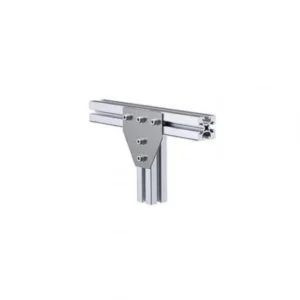
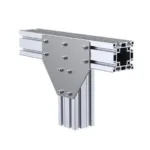
Three-Way Connector Plate 80×80 K10 Zinc
4.36$
In stock
In stock / available to order · 14-day return for standard unused products; conditions may vary for custom size/cut products.
Three-Way Connector Plate 80×80 K10 Zinc
Detailed Product Review
The Three-Way Connector Plate 80×80 K10 Zinc is a critical structural component designed for industrial automation systems. It provides simultaneous and rigid connections at corner and T-junction points of aluminum profile constructions, across three different axes (X, Y, Z). This connector plate is specifically designed for joining aluminum profiles with cross-sections of 80×80 mm and larger, offering direct assembly without requiring any pre-processing such as drilling, milling, or welding on the profiles. Its design is optimized to withstand high clamping forces via standard M8 or M10 bolts and nuts, minimizing the risk of localized deformation by distributing stress over a wide surface area at connection points. The primary function of the product is to enable fast, reliable, and repeatable assembly of modular structures, thereby enhancing the overall structural integrity and stability of the system under dynamic loads.
This connector element is manufactured from high-strength steel (compliant with ST37 standard), meeting the performance requirements for industrial applications in terms of mechanical strength and toughness. The K10 Zinc coating applied to its surface (electrolytic galvanization), in accordance with DIN 50979 standard, creates a superior corrosion resistance layer against humid, chemical, and corrosive environments. This coating significantly extends the product’s lifespan by protecting the steel surface from atmospheric oxidation and electrochemical corrosion. The three-way connection capability offers engineering flexibility, especially in the creation of complex three-dimensional frame structures such as machine frames, robotic cells, conveyor systems, safety barriers, and control cabinets. Production in accordance with Mermak CNC’s V2 Quality and Precision Standards guarantees consistency in the product’s dimensional tolerances and mechanical properties, ensuring high precision and reliability in system integration.
Advantages of the Three-Way Connector Plate 80×80 K10 Zinc
Direct Assembly Capability Without Machining: This connector plate allows for direct assembly at the end or intermediate connection points of aluminum profiles without the need for any additional mechanical processing such as drilling, milling, tapping, or welding. This feature drastically shortens the preparation stages in the assembly process, optimizes labor costs, and reduces the overall cycle time on the production line. The standard bolt holes are precisely positioned to align with the profile channels or surfaces, increasing assembly accuracy and minimizing the potential for human error, thus leading to more consistent and reliable structures.
High Structural Rigidity and Dynamic Load Resistance: Especially in industrial systems operating under vibration, impact, or high static and dynamic loads, this connector plate provides additional reinforcement and torsional rigidity at critical junction points of the profiles. Thanks to its high-strength steel construction and large connection surface area, it distributes stress concentrations, increasing the overall strength of the profile system and reducing the risk of deformation or fatigue during prolonged operation. This significantly extends the operational stability and lifespan of systems in applications such as machine frames, robotic transport systems, and conveyor belt structures.
Superior Corrosion Resistance and Environmental Durability: The K10 Zinc coating (electrolytic galvanization) applied to the product surface, in accordance with international standards like DIN 50979, effectively protects the steel surface against atmospheric moisture, industrial chemicals, saltwater vapor, and other corrosive agents. This coating provides electrochemical protection by acting as a sacrificial anode, preventing the steel material from rusting and ensuring the product maintains its mechanical and aesthetic integrity for many years, even in harsh industrial environments. This feature offers a critical advantage, particularly in outdoor applications or facilities with aggressive chemical vapors.
Technical Specifications and Capacity
FeatureValue/Description
Product Code / Barcode No8692024020793
Material CompositionHigh-Strength Steel (Compliant with ST37 standard, minimum yield strength 235 MPa)
Surface Protection LayerK10 Zinc Coating (Electrolytic Galvanization, corrosion resistance compliant with DIN 50979, 10-micron nominal thickness)
Dimensional Features80x80 mm nominal connection surface area, precise laser-cut tolerances
Connection ConfigurationThree-Way (Orthogonal connection capability in X, Y, and Z axes, ideal for corner and T-connections)
Assembly ProcedureDirect Connection with Standard M8/M10 Bolts and Nuts (No additional processing required on profiles, torque-controlled assembly recommended)
Profile Compatibility40x40 mm and larger aluminum profile systems (Fully compatible with 40×40, 45×45, 80×80 series)
Production Quality StandardMermak CNC V2 Quality and Precision Standards (Production processes compliant with ISO 9001 principles)
Technical Frequently Asked Questions (FAQ)
What is the contribution of a three-way connector plate to structural rigidity compared to two-way connectors?
Unlike two-way connectors, a three-way connector plate significantly increases structural rigidity by providing load transfer and force distribution along three orthogonal axes (X, Y, and Z) at the connection point. While two-way connectors typically resist bending and shear stresses only in one plane, the three-way design offers higher resistance against torsional moments and multi-axial loading. This enhances the overall stability and deformation resistance of the structure, extending its lifespan and maximizing operational reliability, especially in industrial applications involving dynamic loads, vibrations, or complex force vectors. The connection in the third axis restricts the degrees of freedom at the node, allowing the entire frame structure to exhibit a more integrated and monolithic behavior.
What is the corrosion resistance mechanism of K10 Zinc coating and its performance in specific industrial environments?
K10 Zinc coating is a protective layer applied to the steel surface via electrolytic galvanization, providing corrosion resistance through two primary mechanisms: barrier protection and sacrificial anode protection. Barrier protection occurs by physically isolating the steel surface from corrosive elements like atmospheric oxygen and moisture. Sacrificial anode protection is based on the principle of galvanic corrosion, where zinc, being a more active metal than steel, oxidizes preferentially to protect the steel if any damage occurs to the coating or the steel itself. K10 coating, compliant with DIN 50979 standards, performs highly in general industrial atmospheres, humid environments, and areas with mild chemical vapors. However, in highly concentrated acidic or alkaline environments, saltwater environments with high chloride ion concentration, or at high temperatures, the passivation layer of zinc can degrade, reducing its protective effectiveness. For such aggressive environments, additional passivation or alternative coating solutions should be considered.
What are the recommended torque values for M8/M10 bolts when using this connector plate, and how do these values affect structural integrity?
Applying appropriate torque values for M8 and M10 bolts is critical to ensure optimal structural integrity when connecting aluminum profiles with the Three-Way Connector Plate 80×80 K10 Zinc. Generally, a torque range of 25-30 Nm for M8 bolts and 45-55 Nm for M10 bolts is recommended. However, these values can vary depending on the bolt class used (e.g., 8.8 or 10.9), the type of nut, and the surface friction coefficient. Insufficient torque can lead to looseness at the connection point, self-loosening of the bolt under vibration, and consequently, reduced structural rigidity. Overtightening can cause permanent deformation of the bolt or nut threads, bolt breakage, or localized crushing of the connector plate or aluminum profile. The correct torque value creates sufficient preload force between the fasteners, preventing slippage of the connection under external loads and increasing dynamic fatigue life, thereby ensuring the long-term reliability of the system.
Can this connector plate be integrated with aluminum profile systems of different cross-sections, and what engineering considerations should be taken into account in such cases?
While the Three-Way Connector Plate 80×80 K10 Zinc is nominally designed for profile systems of 80×80 mm and larger, it can also be integrated with smaller cross-section profiles such as 40×40 mm or 45×45 mm using adapter elements or special intermediate pieces. In such complex integrations, the use of suitable adapter plates or blocks is necessary to ensure the wide surface area of the connector plate fully engages with the channels or surfaces of the smaller profiles. Engineering considerations include analyzing the stress concentrations that may occur at the junction of different profile cross-sections, aligning the bolt holes, and ensuring the compatibility of fasteners (bolts and nuts) with the profile channels. Furthermore, it should be noted that in the connection of profiles with different cross-sections, the load-bearing capacity of the smaller cross-section profile will determine the overall load limit of the system, and this must be taken into account in structural analyses. The Mermak CNC technical support team can provide detailed engineering consultancy for such specific integration scenarios.
| Weight | 900 Gr |
|---|---|
| Size | |
| Direction | 3 |
You must be logged in to post a review.


Reviews
There are no reviews yet.