
No products in the cart.


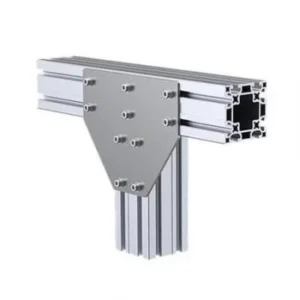
Three-Way Connection Plate 100×100 K10 Zinc
5.76$
Out of stock
📦 Category: Uncategorized
Mermak assuranceFrom factory to end user · importer / main dealer · strong stock
ImporterMain dealer / distributorStrong stockGood priceCorporate invoice
Contact us for stock information · 14-day return for standard unused products; conditions may vary for custom size/cut products.
Three-Way Connection Plate 100×100 K10 Zinc
INDUSTRIAL AUTOMATION PARTS | SUPERIOR PERFORMANCE SERIES
Detailed Product Review
The Three-Way Connection Plate 100×100 K10 Zinc is a critical structural component designed for industrial modular aluminum profile systems, specifically for creating 90-degree angular connections in three different axes at the intersection points of K10 series profiles with a 100×100 mm cross-section. This connection plate allows for direct assembly without the need for any pre-processing (drilling, milling, etc.) on the profiles, enabling a radical acceleration of assembly processes and optimization of labor costs. Precisely machined bolt holes ensure minimal clearance tolerance at connection points, enhancing the overall rigidity and dimensional accuracy of the system. This plays a fundamental role in minimizing cumulative tolerance errors, especially in automation systems, robotic cells, and optical alignment equipment that require precise positioning. The geometric design of the connection plate helps distribute loads evenly across three axes, reducing stress concentrations at individual connection points and maximizing the system’s performance under anticipated static and dynamic loads.
This connector is manufactured from high-quality industrial steel, with its surface treated with industrial zinc plating (galvanization). The zinc coating provides superior resistance to rust and corrosion by forming a barrier on the steel surface and acting as a sacrificial anode electrochemically. This feature ensures that the connection plate delivers long-lasting and reliable performance even in demanding industrial environments exposed to moisture, dust, light chemical vapors, or abrasive particles. For system integration, its holes are compatible with standard M8 or M10 bolts and nuts, allowing for easy adaptation and quick assembly into existing modular profile systems. Application areas cover a wide range, including machine frames, industrial safety enclosures, testing and measurement stations, conveyor systems, and automation cells. The connection plate significantly increases the system’s overall strength and operational stability, especially at points requiring structural reinforcement, by enhancing the profiles’ resistance to bending and torsion.
Advantages of the Three-Way Connection Plate 100×100 K10 Zinc
Precise Geometric Compatibility and Assembly Efficiency: The Three-Way Connection Plate is designed for millimeter-precise compatibility with 100×100 mm K10 series aluminum profiles. Its bolt holes are CNC machined according to industrial standards, eliminating the need for pre-drilling or machining the profiles. This feature significantly reduces assembly time, minimizes human error, and increases the efficiency of the assembly team. The high geometric accuracy achieved at connection points prevents cumulative angular and linear tolerance deviations, especially in multi-profile connections, ensuring the final structure maintains its intended dimensional and angular precision. This optimizes project completion times while also providing a significant reduction in labor costs.
High-Strength Structural Reinforcement and Load Distribution: This connection plate provides three-axis support at the intersection points of profiles, significantly increasing the system’s overall strength and rigidity. The connector’s design allows applied static and dynamic loads to be distributed evenly across three different profiles. This reduces stress concentrations on individual profile segments and enhances the structure’s resistance to bending, torsion, and shear stresses. In vibrating environments or systems carrying heavy loads, this reinforcement element minimizes the risk of profile flexing, deformation, or fatigue cracking. Consequently, in critical applications such as machine frames, supporting structures, and automation platforms, the system’s operational lifespan is extended, and maintenance needs are reduced.
High Corrosion Resistance and Environmental Durability with Zinc Plating: After being manufactured from high-quality industrial steel, the product’s surface undergoes industrial-standard zinc plating (galvanization). This coating forms a physical barrier that isolates the steel surface from atmospheric oxygen, moisture, and various chemical substances. Furthermore, because zinc is a more active metal than steel, in the event of micro-scratches or damage to the coating, the zinc acts as a sacrificial anode, protecting the steel electrochemically. This “cathodic protection” mechanism slows down or stops the progression of rust and corrosion. As a result, the connection plate maintains its structural integrity and aesthetic appearance for many years, even in demanding environments with high humidity, dust, oil vapors, or mild acidic/alkaline chemical exposure. This feature offers a critical advantage for challenging working conditions in industries such as food processing, chemicals, automotive, and general manufacturing.
Technical Specifications and Capacity
SpecificationValue/Description
MaterialHigh-Quality Industrial Steel (K10 Standard)
Surface TreatmentIndustrial Zinc Plating (Galvanization)
Dimensions100mm x 100mm (Plate Size)
Connection TypeThree-Way Angular Connection (90 Degrees)
Profile Compatibility100x100 K10 Series Aluminum Industrial Profiles
Mounting MethodWith Bolts and Nuts (Holes suitable for standard M8 or M10 bolts)
Corrosion ResistanceHigh (Contributes to IP ratings thanks to zinc plating)
Approximate Weight0.25 kg
Technical Frequently Asked Questions (FAQ)
What is the compatibility of the Three-Way Connection Plate with 100×100 K10 profile systems, and what are the optimal mounting torque values?
This connection plate is designed for full compatibility with 100×100 mm cross-section K10 series aluminum industrial profiles. The connection holes allow for the use of standard M8 or M10 bolts. The optimal mounting torque depends on the bolt class used (e.g., 8.8 or 10.9), the bolt diameter, and the compressive strength of the profile material. As a general guideline, a torque range of 25-30 Nm for M8 bolts and 45-55 Nm for M10 bolts is recommended to ensure sufficient tightness and strength of the connection. Excessive torque can lead to profile deformation or stripping of bolt threads, while insufficient torque can cause the connection to loosen and compromise structural integrity. Using a torque wrench during assembly is critical for ensuring uniform and repeatable tightness at connection points.
What is the mechanism of corrosion resistance of the zinc plating, and under which environmental conditions is the expected service life of this connection plate optimized?
The industrial zinc plating on the Three-Way Connection Plate provides corrosion resistance through two main mechanisms: barrier protection and cathodic (sacrificial anode) protection. Barrier protection occurs as the zinc layer physically isolates the steel surface from moisture, oxygen, and corrosive agents. Cathodic protection is based on the principle that because zinc is more electro-negative than steel, it oxidizes itself instead of the steel when the coating is scratched or damaged, thus protecting the steel. This mechanism delays or prevents steel corrosion. The service life of the connection plate is optimized in environments that are particularly dry and clean, with atmospheres close to neutral pH, and low temperature fluctuations. Corrosion rates may increase in aggressive environments with high humidity, salt spray, or intense acidic or alkaline chemical vapors. Coating thickness and quality, compliance with standards such as ISO 1461 or ASTM A123, directly affect the service life. Periodic visual inspections and maintaining surface integrity are recommended for longevity.
How does the three-way connection configuration affect structural integrity under dynamic loads, and in which vibration frequency ranges should its performance be evaluated?
The Three-Way Connection Plate is designed to enhance structural integrity under dynamic loads in modular profile systems. The high rigidity it provides at connection points shifts the system’s natural resonance frequencies to higher values. This reduces the risk of resonance, especially caused by machine vibrations or operational dynamic loads. The mass and rigidity of the connector contribute to the system’s overall damping capacity, helping to keep vibration amplitudes under control. Performance evaluation is typically conducted in the frequency range from 0 Hz (static loads) up to 500 Hz. In environments with continuous dynamic loads, such as robotic applications, conveyor systems, and CNC machines, the connection plate’s fatigue strength and the resistance of bolt connections to loosening are critical. The connection’s design optimizes load transfer and distributes stress concentrations, thereby extending fatigue life. Vibration analysis and finite element method (FEM) simulations can be used to evaluate the connection’s dynamic performance in detail for specific application scenarios.
What are the structural advantages of a three-way connection configuration compared to two-way connections, and what are their effects on stress distribution?
A three-way connection configuration offers significant structural advantages over two-way connections. While two-way connections are often sufficient for carrying planar loads, a three-way connection has the capacity to simultaneously manage loads and moments in three different axes (X, Y, Z axes). This significantly increases structural rigidity and torsional resistance, especially at corner joints or T-junctions. In terms of stress distribution, a three-way connection reduces stress concentrations on individual bolt connections or profile cross-sections by spreading applied loads over a larger surface area and to more profiles. This increases the overall strength of the connection point and extends its fatigue life. Furthermore, due to its multi-axis load-bearing capacity, it exhibits higher resistance to sudden impacts, vibrations, or complex load scenarios. This feature maximizes the system’s stability and reliability in critical applications such as robotic manipulator bases, heavy-load conveyor frames, or high-precision measurement platforms.
Mermak has 16 years of experience in the industrial automation sector. Our products are manufactured in the Ankara Uzay Sanayi factory and warehouse. Current stock quantities and prices are updated on our website. Stocked products are dispatched directly from our warehouse, eliminating production waiting times. We ensure careful packaging, meticulous invoice and document follow-up, and utilize reliable logistics partners. The Mermak team closely monitors the shipment process. Upon request, product videos and factory tours can be arranged via WhatsApp or other contact channels. We proudly supply to numerous countries including the United Kingdom, United States, Canada, Australia, Ireland, New Zealand, and South Africa, as well as similar countries and international markets.
| Weight | 990 Gr |
|---|---|
| Size |
You must be logged in to post a review.


Reviews
There are no reviews yet.