
No products in the cart.
%30 Discount


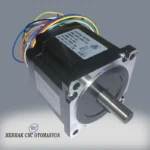
Nema 34 Stepper Motor 4.5 Nm
Original price was: 50.88$.35.66$Current price is: 35.66$.
High-performance NEMA 34 stepper motor with 4.5 Nm holding torque, ideal for precise motion control in CNC machines, automation, and robotics.
In stock
🔥 Special for Today Only %30 Discount Opportunity!📦 Category: 86x86 mm Stepper Motors and Drivers🏷️ NEMA Size: Nema 34🏷️ Brake Configuration: Standard🏷️ Shaft Diameter: 14 mm🏷️ Dimensions: 14🏷️ Torque: 4.5 Nm
Mermak assuranceFrom factory to end user · importer / main dealer · strong stock
ImporterMain dealer / distributorStrong stockGood priceCorporate invoice
In stock / available to order · 14-day return for standard unused products; conditions may vary for custom size/cut products.
Nema 34 Stepper Motor 4.5 Nm
INDUSTRIAL AUTOMATION PARTS | SUPERIOR PERFORMANCE SERIES
Detailed Product Review
This NEMA 34 hybrid stepper motor is an electromechanical converter that transforms electrical energy into precise angular movements, serving as a critical component for positioning and speed control in industrial automation systems. Its operating principle relies on the magnetic field generated by the current flowing through the stator windings, causing the rotor to rotate by a specific step angle. This particular motor offers a resolution of 1.8°/step, meaning it requires 200 steps for a full revolution. Its hybrid design combines the advantages of both variable reluctance and permanent magnet motors, providing high torque density, a lower step angle, and improved damping characteristics for smoother motion capabilities. The motor’s nominal operating torque of 4.5 Nm ensures sufficient power for dynamic positioning and stabilization of the shaft, especially when dealing with high-inertia loads or external forces. The holding torque of 5 Nm indicates the resistance of the shaft to rotation by an external force when the motor is energized, guaranteeing precise position maintenance.
The motor’s physical construction is designed to withstand the demanding conditions of industrial environments. It typically features a high-strength aluminum alloy housing, low-friction, long-life sealed bearings, and an optimized magnetic circuit. The NEMA 34 standard defines the motor’s 86×86 mm flange dimensions and mounting hole pattern, ensuring direct compatibility with standard industrial machine mounting hardware and chassis, which simplifies the integration process and enhances design flexibility. The 14 mm diameter shaft offers sufficient mechanical strength for high torque transmission and can be easily connected to standard couplings, pulleys, or planetary gearboxes. This motor is utilized in a wide range of high-performance applications, from the precise control of axial movements in CNC routers and milling machines, to the positioning of products on automated assembly lines, the millimeter-precise movement of optical heads in laser cutting and engraving machines, and the control of heavy print beds or extruders in industrial 3D printers. Electrically, its 2-phase structure and typical bipolar connection scheme (A+/A- and B+/B-) allow for easy interfacing with industrial drivers, simplifying integration into control systems.
Advantages of the Nema 34 Stepper Motor 4.5 Nm
High Torque Density and Precise Angular Control: With a nominal operating torque of 4.5 Nm and a holding torque of 5 Nm, this NEMA 34 stepper motor offers a remarkably high torque density relative to its compact physical size. This capability enhances the motor’s ability to rapidly accelerate, decelerate, and precisely position loads with high inertia. The basic step angle of 1.8°/step signifies that the motor can achieve an angular displacement of 0.005 radians with each electrical pulse. When combined with micro-stepping drivers, even smaller angular resolutions can be achieved, enabling linear positioning accuracy at the millimeter or even micron level. This precision is crucial in applications such as controlling cutting depth in CNC machines, focusing mechanisms in optical systems, or ensuring repeatable motion sequences in robotic joints, thereby minimizing error margins.
Industrial NEMA Standard Compatibility and Ease of Mechanical Integration: The NEMA 34 standard compliance, with its 86×86 mm flange dimensions, ensures direct compatibility with the widely used mounting interfaces in industrial automation and machine design. This standardization simplifies integration into existing systems and allows design engineers to quickly position the motor without needing to design custom adapters or mounting plates. The 14 mm diameter shaft provides sufficient strength for high torque transmission and can be seamlessly coupled with standard industrial couplings, gears, pulleys, and particularly 86HS45 compatible planetary gearboxes. This mechanical compatibility offers flexibility in system design and simplifies integration with various drive mechanisms, optimizing overall system setup time and cost.
Wide Electrical Compatibility and Control Flexibility: This stepper motor is designed to operate with a rated current of 5.6 Amps/phase and is compatible with driver voltages ranging from +24V to +50V DC. This broad tolerance in voltage and current allows for flexible integration with different power supplies and driver configurations. Specifically, when used with stepper motor drivers capable of 4 Amps and above, the motor can achieve its full torque potential, minimizing the risk of step loss even in high-speed applications. On the control side, it is compatible with a wide range of controllers, from PC-based CNC control software like Mach3, to industrial PLC (Programmable Logic Controller) systems, microcontroller-based prototyping platforms like Arduino, and dedicated pulse generator cards. This flexibility enables engineers to select the most suitable control architecture for their application requirements and easily adapt the system to the overall automation infrastructure.
Technical Specifications and Capacity
Feature
Value/Description
Motor Type
Hybrid Stepper Motor
NEMA Standard / Flange Size
NEMA 34 (86×86 mm)
Nominal Operating Torque / Holding Torque
4.5 Nm / 5 Nm
Rated Current / Phase Count
5.6 Amps / 2 Phase
Step Angle
1.8° / Step (200 steps/rev)
Shaft Diameter / Compatible Gearboxes
14 mm / 86HS45 Compatible Planetary Gearboxes
Technical Frequently Asked Questions (FAQ)
How does the use of micro-stepping affect the performance and resolution of this motor, and what are the potential limitations of this method?
Micro-stepping is a control technique that allows a stepper motor to move in smaller increments than its basic step angle (1.8° for this motor) by modulating the current in the phase windings to approximate a sinusoidal waveform. This results in smoother motion, reduced vibration and noise, and theoretically increased positioning resolution. For instance, using 1/16 micro-stepping can reduce the 1.8° step to 0.1125°, enabling positioning accuracy at the micron level in linear systems. However, micro-stepping has limitations: the achievable torque can decrease compared to full-stepping, especially at higher micro-step ratios. The effectiveness of micro-stepping also depends on the driver’s current control precision; inaccuracies can lead to step errors. At high speeds, the benefits of micro-stepping diminish, and the motor’s maximum step frequency becomes more critical.
When selecting a compatible stepper motor driver for this NEMA 34 4.5 Nm motor, what are the key considerations regarding current and voltage ratings?
When selecting a compatible stepper motor driver, the motor’s nominal current and voltage ratings are crucial. This NEMA 34 motor has a rated current of 5.6 Amps/phase. The driver must be capable of supplying this current per phase, typically adjustable via settings on the driver itself. Setting the driver current too low will limit the motor’s torque, while setting it too high can lead to overheating and damage. For voltage, the motor operates within a +24V to +50V DC range. Higher voltages allow the motor to produce more torque at higher speeds by reducing the current rise time, which is limited by winding inductance. However, the driver’s maximum input voltage and the motor’s insulation class must be considered to prevent damage. An ideal driver voltage optimizes high-speed performance while staying within safe operating limits for both the motor and the driver. Additionally, the driver’s micro-stepping capabilities, protection features (over-current, over-voltage, over-temperature), and control signal interface (pulse/direction) are important for integration and performance.
What are the thermal management requirements for continuous industrial operation of this motor, and what are the potential consequences of inadequate cooling?
Stepper motors generate heat due to current flowing through their windings. Effective thermal management is vital for the longevity and performance of this NEMA 34 motor during continuous industrial operation. With a rated current of 5.6 Amps/phase, the motor will dissipate a certain amount of heat. The motor’s casing temperature should ideally not exceed 80-90°C, as higher temperatures can degrade winding insulation and weaken permanent magnets, leading to torque loss. Inadequate cooling can cause the motor’s internal temperature to reach critical levels, potentially leading to short circuits in windings, degradation of bearing lubricant, and a reduced mechanical lifespan. Overheating can also decrease dynamic performance, causing step loss and positioning errors. Cooling can be achieved passively through heatsinks or adequate airflow, or actively using fans or liquid cooling systems, especially in high-duty cycle applications, high ambient temperatures, or enclosed spaces. Determining an appropriate cooling strategy based on the motor’s thermal resistance, ambient temperature, and operating conditions is essential for reliable long-term operation.
What is the significance of the 14 mm shaft diameter and NEMA 34 flange in terms of mechanical integration and load-bearing capacity?
The 14 mm shaft diameter of this NEMA 34 stepper motor is designed to provide sufficient mechanical strength and torsional rigidity for transmitting the motor’s 4.5 Nm torque. This shaft size is standard and robust for industrial applications at this torque level, balancing strength with motor size and cost. It ensures compatibility with a wide range of standard industrial couplings, gears, pulleys, and planetary gearboxes, simplifying mechanical design and assembly. The NEMA 34 flange, a 86×86 mm square interface, defines the motor’s mounting standard. This standardization allows direct compatibility with industrial chassis, mounting plates, and other mechanical components. The flange dimensions and mounting hole positions contribute to the motor’s ability to absorb vibrations and remain stable under load. The NEMA 34 size ensures secure mounting and resistance to forces encountered in high-torque applications. Together, these features enable reliable and efficient integration into mechanical systems, optimizing the overall load-bearing and motion control capacity.
Mermak has 16 years of experience in industrial automation. Our products are stocked and prepared from our Ankara Uzay Sanayi factory/warehouse. Current stock quantities and prices are updated on our website. Stocked products are dispatched directly from the warehouse, eliminating production waiting times. We ensure careful packaging and meticulous invoice/document follow-up. We partner with reliable logistics providers, and the Mermak team monitors the shipment process closely. Upon request, factory tours or product demonstrations via WhatsApp or other contact channels are available. We proudly supply industries in the United Kingdom, United States, Canada, Australia, Ireland, New Zealand, South Africa, and similar countries and international markets.
| NEMA Size | Nema 34 |
|---|---|
| Brake Configuration | Standard |
| Shaft Diameter | 14 mm |
| Dimensions | 14 |
| Torque | 4.5 Nm |
You must be logged in to post a review.
Taksit Tablosu
Related Products
 %46 DiscountStep Motor Nema 34 6.5 NmOriginal price was: 78.00$.42.01$Current price is: 42.01$.View
 %46 DiscountStep Motor Nema 34 8.5 NmOriginal price was: 86.40$.46.75$Current price is: 46.75$.View
 %44 DiscountBraked Stepper Motor Nema 34 8.5 NmOriginal price was: 169.20$.94.60$Current price is: 94.60$.View
Reviews
There are no reviews yet.