
No products in the cart.
%46 Discount


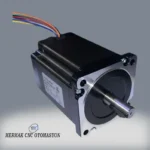
Step Motor Nema 34 8.5 Nm
Original price was: 86.40$.46.75$Current price is: 46.75$.
High-performance Nema 34 hybrid stepper motor with 8.5 Nm holding torque, designed for industrial automation requiring precise positioning and heavy load capacity. Features a 1.8-degree step angle and a 14mm keyed shaft.
In stock
🔥 Special for Today Only %46 Discount Opportunity!📦 Category: 86x86 mm Stepper Motors and Drivers🏷️ Torque: 8.5 Nm🏷️ NEMA Size: Nema 34🏷️ Shaft Diameter: 14 mm🏷️ Brake Configuration: Standard🏷️ Dimensions: 14
Mermak assuranceFrom factory to end user · importer / main dealer · strong stock
ImporterMain dealer / distributorStrong stockGood priceCorporate invoice
In stock / available to order · 14-day return for standard unused products; conditions may vary for custom size/cut products.
Step Motor Nema 34 8.5 Nm
INDUSTRIAL AUTOMATION PARTS | SUPERIOR PERFORMANCE SERIES
Detailed Product Review
This Nema 34 8.5 Nm hybrid stepper motor is an electromechanical actuator designed for industrial automation applications that demand high-precision positioning and heavy load-carrying capacity. Its fundamental operating principle involves sequentially switching the current through the stator windings to rotate the rotor in specific step angles. The 1.8-degree step angle offers 200 micro-steps per full revolution (in full-step mode) or higher resolution micro-stepping capabilities, enabling positioning accuracy at millimeter and even micron levels. The high holding torque of 8.5 Nm (1200 oz-in) signifies the motor’s ability to maintain its position even under external load when energized. This value significantly minimizes the risk of “step loss” in applications with dynamic load changes and high accelerations, directly impacting the system’s overall stability and production quality. It offers approximately four times the torque capacity of standard Nema 23 motors and twice that of standard Nema 34 (4.5 Nm) motors, demonstrating superior performance in systems with higher inertia loads.
The motor’s physical construction is optimized to withstand the demanding conditions of industrial environments. The 118 mm body length contributes to a larger magnetic circuit and increased winding volume, enhancing high torque production and thermal management. The 14 mm diameter keyed shaft prevents slippage between the shaft and connected mechanical components (pulleys, gears, etc.) during high torque transfer, improving power transmission efficiency and ensuring long-term, reliable operation. This motor is ideal for applications requiring high rigidity and power, such as Marble/Granite CNC Machining Centers, Heavy Gantry Plasma Cutting Bridges with gantry weights of 100 kg and above, and Metal Machining Mills. When integrated with a correctly selected digital stepper motor driver (e.g., DMA860H or MA860H) and an appropriate supply voltage (minimum 70V DC or 50V-80V AC), it can achieve a balance of precision and power close to closed-loop systems, even in an open-loop configuration, offering a cost-effective automation solution.
Advantages of Step Motor Nema 34 8.5 Nm
High Holding Torque and Step Loss Resistance: The nominal holding torque of 8.5 Nm represents the maximum static torque the motor can exert to maintain its position when the stator windings are energized. This high value is critical in systems operating under heavy inertial loads, cutting forces, or other external resistances. High torque makes the motor more resistant to sudden load changes and accelerations, minimizing the risk of step loss. This enhances machining accuracy, reduces production errors, and ensures continuous operational uptime, directly increasing overall system efficiency.
Mechanical Robustness and Longevity: The robust 118 mm body construction enhances the motor’s thermal management capacity, preventing overheating even during prolonged high-performance operations and extending winding life. The 14 mm diameter keyed shaft has high radial and axial load-bearing capacity, guaranteeing reliable and slip-free torque transfer to mechanical components (like couplings, pulleys). These structural features ensure the motor maintains its mechanical integrity under vibration, shock, and continuous load in industrial environments, significantly reducing maintenance needs and extending its operational lifespan.
Potential Technical Alternative to Servo Systems: Compared to costly servo motor systems, this Nema 34 8.5 Nm stepper motor offers the potential to achieve similar performance parameters in specific applications. When used with a suitable digital or closed-loop stepper motor driver and optimized supply voltage, its high torque and precise step angle can approach the positioning accuracy and dynamic response capabilities offered by servo motors. This integration provides a significant advantage in terms of cost-performance balance, enabling access to high-performance automation solutions for projects with budget constraints. When used with closed-loop drivers, position feedback allows for the detection and correction of step loss, further enhancing system reliability.
Technical Specifications and Capacity
Specification|Value/Description
NEMA Standard|Nema 34 (86 x 86 mm Flange Width)
Holding Torque|8.5 Nm (Newton-Meters) / 1200 oz-in (Ounce-inches)
Body Length|118 mm (Long Body)
Shaft Diameter|14 mm Keyway
Step Angle|1.8 Degrees (200 Steps/Revolution)
Phase Current (Parallel Connection)|~6.0A – 7.0A
Minimum Supply Voltage|70V DC or 50V AC – 80V AC
Technical Frequently Asked Questions (FAQ)
What is the technical significance of selecting the correct driver and supply voltage for this high-torque Nema 34 stepper motor?
The high inductance of this Nema 34 8.5 Nm stepper motor necessitates a high supply voltage to maintain torque performance, especially at higher speeds. Lower voltages (e.g., 24V DC) hinder the rapid rise of current in the motor windings, limiting the current from reaching nominal levels due to back EMF at high speeds. This significantly reduces the motor’s dynamic torque curve, leading to performance losses of up to 70% of its nominal torque. Furthermore, low-capacity drivers like the TB6600 cannot supply the motor’s nominal phase current of 6.0A – 7.0A (in parallel connection), preventing the motor from reaching its full potential. Therefore, using AC input drivers with high voltage and current capacity, such as the DMA860H or MA860H, along with a minimum supply of 70V DC or 50V-80V AC, is a critical engineering requirement for the motor to operate at maximum torque and precision across its entire speed range.
What are the technical advantages of an 8-wire stepper motor over 4 or 6-wire motors, and how do connection options affect performance?
An 8-wire stepper motor features a configuration where the start and end leads of each phase winding are brought out separately. This design offers significant flexibility by providing engineers with three main connection options: unipolar, bipolar series, and bipolar parallel. Unipolar connection offers lower torque and higher speed potential, while bipolar connections are preferred for higher torque production. In bipolar series connection, the two windings of each phase are connected in series; this results in higher inductance and thus lower high-speed torque but requires lower current. In bipolar parallel connection, the windings are connected in parallel; this configuration provides better torque performance at high speeds due to lower inductance but doubles the nominal current requirement. This flexibility allows system designers to optimize the motor’s electrical characteristics according to application requirements (high torque, high speed, low current consumption), a critical technical advantage that directly impacts system performance and energy efficiency.
What technical benefits does the 14mm keyed shaft structure of this Nema 34 8.5 Nm stepper motor offer in terms of torque transfer and mechanical durability?
The 14mm diameter keyed shaft structure is a critical engineering feature for mechanical connection reliability and durability in high-torque stepper motors. A keyed shaft provides a positive lock between the shaft and connected power transmission components like pulleys, gears, or couplings via a groove (keyway) on the shaft and a key that fits into this groove. Unlike friction-based connections (e.g., set screws), this mechanism eliminates slippage and backlash under high torque loads. Consequently, torque transfer efficiency is increased, system positioning accuracy is maintained, and wear on mechanical components is minimized. Furthermore, a relatively large shaft diameter like 14mm increases the motor’s radial and axial load-bearing capacity, reducing the risk of shaft bending or breakage in heavy-duty industrial applications. This significantly extends the motor’s overall operational life and system reliability, representing a considerable design advantage.
What are the technical implications of the 118mm body length of the Nema 34 8.5 Nm stepper motor on thermal management and performance continuity?
The body length of a stepper motor directly affects the amount of winding and, consequently, the power of the magnetic circuit. A long body, such as 118mm, accommodates a larger volume of copper windings, allowing for higher torque production. More importantly, this length enhances the motor’s thermal management capacity. A larger surface area allows for more effective dissipation of Joule heat (I²R losses) generated in the windings during operation to the environment. This prevents the motor from overheating during prolonged operation at high currents, reducing the risk of insulation breakdown and extending the motor’s lifespan. Since overheating can negatively affect magnetic material properties, leading to torque loss, optimized thermal management is a critical technical factor for the motor to sustain its nominal performance over a wide operating range. This long body design supports the motor in delivering continuous and reliable performance in demanding industrial environments. Mermmak has 16 years of experience, and our products are supplied to countries such as the United Kingdom, United States, Canada, Australia, Ireland, New Zealand, and South Africa, as well as similar international markets.
| Torque | 8.5 Nm |
|---|---|
| NEMA Size | Nema 34 |
| Shaft Diameter | 14 mm |
| Brake Configuration | Standard |
| Dimensions | 14 |
| Stepper Motor Shaft Diameter | 14 mm |
You must be logged in to post a review.
Taksit Tablosu
Related Products
 %34 DiscountNema 34 Stepper Motor Mounting Plate with KeywayOriginal price was: 7.42$.4.92$Current price is: 4.92$.View
 %52 DiscountBraked Stepper Motor Nema 34 8.5 NmOriginal price was: 169.20$.80.71$Current price is: 80.71$.View
 %46 DiscountStep Motor Nema 34 6.5 NmOriginal price was: 78.00$.42.01$Current price is: 42.01$.View
Reviews
There are no reviews yet.