































































Nema 34 Step Motor 12 Nm
Detailed Product Review
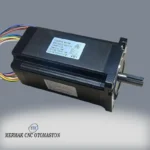
The NEMA 34 series 12 Nm Stepper Motor, offered by Mermak CNC, is an electromechanical converter designed to meet high-precision angular positioning and significant torque requirements in industrial motion control systems. This motor operates on the principle of interaction between the magnetic field generated by sequentially energizing the stator windings and the permanent magnets on the rotor. Each electrical pulse causes the motor to take a fixed angular step of 1.8 degrees, corresponding to 200 steps per full revolution, offering high-resolution positioning capability. The nominal holding torque of 12 Newton Meters (Nm) indicates the motor’s ability to maintain its position against external loads when energized, a critical parameter especially for applications requiring precise stopping, holding, or low-speed, high-force movement of heavy inertial loads. This torque value directly influences the motor’s dynamic performance, acceleration, and deceleration capabilities, determining the system’s overall response time and processing quality.
The structural integrity of this stepper motor is optimized for durability under industrial operating conditions. The housing is precision-machined from high-strength aluminum alloys with tight tolerances, protecting internal components from environmental factors while ensuring effective heat dissipation. The rotor consists of high-energy-density permanent magnets and a low-inertia design, while the stator windings are made from high-temperature resistant enameled copper wires. The NEMA 34 standard, with its 86×86 mm flange size, facilitates mechanical integration, allowing direct compatibility with existing industrial systems, gearboxes, and couplings. Electrical connection flexibility is provided by the 8-lead wire configuration, enabling the motor to be wired in bipolar series or bipolar parallel configurations according to application requirements. Series connection offers smoother torque at low speeds and less heat generation due to higher inductance, while parallel connection allows for torque maintenance at higher speeds due to lower inductance. These features make the motor suitable for a wide range of applications requiring high torque and positioning accuracy, such as CNC machining centers, industrial robotic systems, automated assembly lines, laser cutting, and welding equipment.
Nema 34 Step Motor 12 Nm Advantages
High Holding Torque and Load Capacity: The 12 Nm nominal holding torque of this NEMA 34 stepper motor provides superior performance, especially in systems subjected to high inertia or continuous external loads. This torque capacity allows the motor to maintain its position against cutting forces in heavy machining operations, enables robotic arms to perform precise movements with high payload capacity, and facilitates stable positioning of large masses in material handling systems. High torque also enables faster acceleration and deceleration profiles, shortening cycle times and increasing overall production efficiency, a critical factor in dynamic applications.
Advanced Electrical Flexibility and Drive Compatibility: The motor’s 8-lead wire configuration offers system integrators the flexibility to choose between bipolar series or bipolar parallel connection modes. Series connection, due to its higher inductance, provides smoother operation at low speeds, less resonance, and lower motor temperature, while parallel connection allows for better torque retention at high speeds and higher dynamic response due to lower inductance. This flexibility optimizes the motor’s adaptation to applications with different speed-torque requirements and increases its compatibility with a wide range of industrial stepper motor drivers, providing greater freedom in system design.
Industrial Standard Integration and Mechanical Durability: The NEMA 34 standard compliant 86×86 mm flange size and 14.0 mm output shaft diameter allow for easy mechanical integration of the motor into industrial automation equipment. This standardization guarantees compatibility with existing components such as mounting plates, gearboxes, and couplings, simplifying design and installation processes. The motor’s robust housing, high-quality bearings, and precision-machined shaft offer long-term durability against vibration, dust, and mechanical stress in harsh industrial environments. This structural robustness reduces maintenance needs and maximizes system uptime, lowering the total cost of ownership.
Technical Specifications and Capacity
Feature
Value/Description
Product Identification Code
86HS156-5608A14-B35 (Engineering Revision: 3.0)
Frame Standard / Flange Size
NEMA 34 (86 x 86 mm Mounting Size)
Nominal Holding Torque
12.0 Newton Meters (Nm)
Step Angle
1.8 Degrees (200 steps per full revolution)
Output Shaft Diameter
14.0 Millimeters (for coupling or gearbox connection)
Wiring Configuration
8-Lead (Suitable for Bipolar Series or Parallel connection)
Optimal Supply Voltage
60 – 80 Volts DC (Ideal for maximum efficiency and high-speed torque retention)
Technical Frequently Asked Questions (FAQ)
What are the fundamental electrical and performance differences between the bipolar series and parallel connection modes offered by the 8-lead wiring of this NEMA 34 stepper motor?
8-lead stepper motors have two separate windings per phase, allowing for different connection configurations. In bipolar series connection, the windings of each phase are connected end-to-end to form a single, longer winding. This increases the total inductance, resulting in higher torque production at low speeds, smoother operation with lower current requirements and less heat generation. However, the high inductance can cause the motor to lose torque more rapidly at high speeds. In bipolar parallel connection, the windings of each phase are connected in parallel. This configuration reduces the total inductance, allowing the motor to better maintain its torque at high speeds, as current can rise and fall more quickly in the windings. However, parallel connection requires higher current and potentially generates more heat. Choosing between these two connection types based on the required speed and torque profile of the application is critical for optimizing system performance.
When selecting a suitable stepper motor driver for this 12 Nm torque capacity motor, which electrical parameters are critical and why?
The most critical electrical parameters to consider when selecting a suitable driver for this 12 Nm NEMA 34 stepper motor are current and voltage capacities. Firstly, the driver must be able to continuously supply the motor’s nominal phase current (approx. 5.6 Amps for bipolar series connection) and the peak current required, especially when using bipolar parallel connection (approx. 7.9 Amps). The driver’s current capacity must be sufficient for the motor to produce its specified torque and exhibit its dynamic performance. Secondly, the driver’s supply voltage capacity should be compatible with the motor’s optimal supply voltage range of 60-80 Volts DC. A higher supply voltage helps the motor maintain its torque at high speeds by compensating for the current rise delay caused by the inductance of the windings. Additionally, the driver’s micro-stepping capabilities (e.g., 1/8, 1/16, 1/32 micro-steps) are important for providing smoother motion and higher positioning resolution. Finally, the driver’s overcurrent, overvoltage, and overtemperature protection mechanisms should be considered to ensure the long-term and safe operation of both the motor and the driver.
How does the rotor inertia value affect this stepper motor’s dynamic performance and application selection?
Rotor inertia is a measure of a motor’s resistance to changes in its angular velocity and has a direct impact on dynamic performance. High rotor inertia leads to longer acceleration and deceleration times, as it requires more torque to achieve the same angular acceleration. This can negatively affect the system’s response time, especially in applications requiring fast positioning or short cycle times. Conversely, in certain applications, such as directly driving large, inertial loads, a slightly higher motor inertia can contribute to overall system stability. The rotor inertia value of this NEMA 34 12 Nm stepper motor should be evaluated in conjunction with the inertia of the external load. The total inertia, along with the motor’s generated torque, determines the system’s maximum acceleration and deceleration rates. The rotor inertia value is a critical input parameter for engineering calculations to analyze system resonance frequencies and stability. It is also used to determine the maximum speed and acceleration limits at which the motor can operate without losing steps or exhibiting excessive vibration.
What is the effect of the motor’s optimal supply voltage range of 60-80V DC on torque performance, particularly in high-speed applications, and why is this range recommended?
The torque-speed curve of stepper motors is significantly affected by the supply voltage. Especially in high-speed applications, the inductive nature of the motor windings makes it difficult for the current to rise and fall rapidly. As the motor rotates, a back-electromotive force (back-EMF) is generated in the windings, which opposes the applied voltage, causing the winding current to decrease. At lower supply voltages, the effect of back-EMF becomes more pronounced, and the net voltage drop reduces the winding current, leading to a rapid loss of motor torque at high speeds. Using a higher supply voltage, such as 60-80V DC, provides more “headroom” voltage to counteract this back-EMF effect. This allows the current to reach its nominal level more quickly in the windings, maintaining the motor’s torque production capability even at higher speeds. This helps minimize the effect known as “inductive stall” and keeps the torque-speed curve flatter, enabling the motor to utilize its full potential in applications requiring high-speed positioning and machining. This optimal voltage range ensures both efficient operation and strong torque performance across a wide speed range.