
No products in the cart.


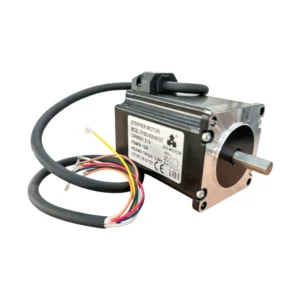
Nema 23 Step Motor 1.47 Nm 57Bhp79
44.56$
High-performance hybrid stepper motor for industrial automation, featuring NEMA 23 standard dimensions and 1.47 Nm holding torque.
Out of stock
📦 Category: 57x57 mm Stepper Motors and Drivers
Mermak assuranceFrom factory to end user · importer / main dealer · strong stock
ImporterMain dealer / distributorStrong stockGood priceCorporate invoice
Contact us for stock information · 14-day return for standard unused products; conditions may vary for custom size/cut products.
Nema 23 Step Motor 1.47 Nm 57Bhp79
INDUSTRIAL AUTOMATION PARTS | SUPERIOR PERFORMANCE SERIES
Detailed Product Review
The Nema 23 Step Motor 1.47 Nm 57Bhp79 is a hybrid stepper motor designed for applications requiring angular positioning and speed control in industrial automation systems. This motor operates on the principle of stepwise movement, where the rotor rotates incrementally with each electrical pulse by sequentially changing the magnetic field generated by the stator windings. Each electrical pulse rotates the motor’s rotor by a specific step angle; this model has a standard step angle of 1.8°, which equates to 200 steps per full revolution. This step-by-step motion capability offers high positioning accuracy and repeatability, even in open-loop control systems, as the motor’s locking into each step reduces the need for feedback mechanisms. The NEMA 23 standard physical dimensions indicate that the motor’s mounting flange is approximately 2.3 x 2.3 inches (57 x 57 mm), ensuring broad compatibility and easy integration in industrial applications. The nominal torque value of 1.47 Newton meters (Nm) refers to the motor’s capacity to resist rotational force applied to its shaft, providing sufficient power reserve for precise movement and holding of medium to high inertia loads.
This stepper motor, model code 57Bhp79, is manufactured using superior material engineering principles. The rotor and stator cores are made from special alloy steel with high magnetic permeability, optimizing magnetic flux density to enhance torque production and efficiency. The windings consist of enameled copper wires with high-temperature resistance, designed for thermal stability. The motor’s body is constructed from machined aluminum alloy, which optimizes heat dissipation and increases mechanical durability. The pre-installed 3M-type 24-tooth pulley on the shaft ensures direct compatibility with standard belt drive systems, simplifying mechanical design and assembly processes while minimizing the need for additional parts and processing costs. This integration is critical for industrial automation applications requiring precise motion control, such as CNC routers, 3D printers, laser cutting machines, robotic manipulators, and automated assembly lines. The motor’s 2-phase structure and recommended phase current of 4 Amps and above, with a supply voltage range of 24V-50V DC, offer compatibility with a wide range of drivers, providing flexibility in system design.
Advantages of Nema 23 Step Motor 1.47 Nm 57Bhp79
High Torque Capacity and Load Handling Capability: The 1.47 Nm nominal torque of this stepper motor signifies its ability to resist rotational movement and maintain its position against applied loads, especially under dynamic conditions or in high-inertia systems. This capacity allows the motor to provide precise control without losing steps in applications requiring rapid acceleration and deceleration, such as axis movements in CNC machines or carrying heavy end-effectors on robotic arms. High torque also ensures a significant holding torque when the motor is powered but stationary, preventing unwanted load movement during power outages or idle periods, thereby enhancing system stability. This feature directly impacts processing quality and operational reliability.
NEMA 23 Standard Compliance and Integrated Drive Solution: The NEMA 23 standard physical dimensions guarantee mechanical compatibility with commonly used mounting plates and brackets in industrial automation equipment. This standardization allows for easy interchangeability between motors from different manufacturers, increasing system design flexibility and simplifying maintenance. Furthermore, the factory-integrated 3M-type 24-tooth pulley on the shaft eliminates the need for external pulley mounting. This integrated solution reduces assembly time, lowers the cost of additional parts, and minimizes potential backlash between the pulley and the shaft, thereby enhancing the overall precision and rigidity of the drive system. The 3M-type belt profile is optimized for high torque transmission and low noise levels.
Superior Positioning Accuracy and Wide Driver Compatibility: This stepper motor offers a resolution of 200 full steps per revolution with its basic 1.8° step angle. When used with micro-step drivers, this resolution can be increased by factors of 1/2, 1/4, 1/8, 1/16, or higher, enabling the motor rotor to move in much smaller increments, thus achieving positioning accuracy at the millimeter or even micron level. This feature is crucial in applications such as surface finishing, optical alignment, and precision dispensing. The motor’s ability to operate seamlessly with drivers requiring 4 Amps and above phase current and a 24V-50V DC supply voltage range offers ease of integration with a broad spectrum of control architectures. This flexibility allows for compatibility with various control platforms, including Pulse Generator Cards, Arduino-based controllers, CNC control software like Mach3, and industrial PLC systems.
Technical Specifications and Capacity
FeatureValue/Description
Motor TypeHybrid Step Motor – Combines variable reluctance and permanent magnet principles for high torque and step accuracy.
Torque Value1.47 Nm (Newton meters) – Maximum continuous torque capacity the motor shaft can resist rotational movement.
NEMA SizeNEMA 23 – Industrial standardization indicating the motor’s front flange dimensions are approximately 57 x 57 mm (2.3 x 2.3 inches).
Step Angle1.8° (200 steps/rev) – The angular distance the motor rotor turns with each full pulse; smaller resolutions are achievable with micro-stepping modes.
Pulley Type3M-Type (24 Teeth) – Synchronous drive pulley integrated onto the shaft, compatible with standard 3mm pitch belt systems.
Recommended Driver Current4 Amps and above (per phase) – Minimum phase current required for the motor to achieve its nominal torque and optimal performance.
Recommended Driver Voltage24V – 50V DC – The supply voltage range for the motor driver; higher voltages can offer better torque performance at high speeds.
Technical Frequently Asked Questions (FAQ)
How is the positioning accuracy and repeatability optimized in open-loop control systems with this stepper motor?
Stepper motors inherently offer high accuracy in open-loop control systems because each pulse causes the motor to rotate a specific step angle, and the rotor is magnetically locked into that position. The 1.8° basic step angle of this model provides 200 full steps per revolution. To further enhance accuracy, using micro-step drivers is crucial. Micro-step drivers achieve this by sinusoidally adjusting the current in the phase windings, allowing the rotor to settle into intermediate positions between full steps. For example, a 1/16 micro-step setting reduces the effective step angle to 0.1125°, resulting in 3200 steps per revolution. Additionally, matching the motor’s inertia to the driven load’s inertia (inertia matching) helps prevent resonance effects, thereby avoiding step losses and improving repeatability. High-quality drivers provide more precise current regulation, minimizing motor vibration and noise, which positively impacts positioning accuracy.
What type of loads and acceleration requirements is the 1.47 Nm torque value suitable for?
The 1.47 Nm torque value offers a suitable performance range for precisely moving and positioning medium to high inertia loads. This torque level is ideal for applications such as moving the X, Y, and Z axes of CNC routers and milling machines, the extruder and print bed mechanisms of medium-sized 3D printers, the optical heads of laser cutting machines, or the joint movements of light to medium robotic arms. The motor’s dynamic torque is critical for overcoming the load’s inertia during acceleration and deceleration. 1.47 Nm allows for achieving fast and stable acceleration profiles in such applications. Furthermore, the motor’s nominal holding torque will be close to these values, providing sufficient rigidity to prevent unwanted load movement when powered or stationary. The load’s inertia, friction forces, and desired maximum acceleration values are the primary engineering parameters determining the suitability of this torque capacity.
What are the effects of the integrated 3M- 24-tooth pulley on system integration and mechanical performance?
The integrated 3M-type 24-tooth pulley on the shaft offers several advantages for system integration and mechanical performance. Ease of integration significantly reduces assembly time and labor costs by eliminating the need to source, mount, and align an external pulley. This is particularly beneficial for projects requiring mass production or rapid prototyping. Mechanically, the integrated design minimizes the risk of backlash and looseness between the pulley and the motor shaft, thereby increasing the overall rigidity and positioning accuracy of the drive system. The 3M-type (HTD – High Torque Drive) tooth profile ensures positive engagement between the belt teeth and the pulley teeth, enabling high torque transmission without slippage. The 24-tooth count, combined with a specific belt pitch (3mm), allows for precise calculation of the drive ratio and, consequently, the overall system resolution. This integrated pulley also contributes to reducing vibration and achieving smoother motion.
What design features are critical for the motor’s thermal management and longevity?
The thermal management and longevity of a stepper motor are directly related to the materials and engineering details used in its design. The aluminum alloy body of this motor effectively dissipates heat generated by the windings to the environment due to its high thermal conductivity, preventing overheating. The high-temperature resistant enameled copper wires used in the windings maintain their insulation properties even at high current densities, reducing the risk of short circuits and extending winding life. High-quality, low-friction bearings used internally ensure minimal wear and tear even during prolonged and high-speed operations, increasing mechanical lifespan. Furthermore, an optimized magnetic circuit design enhances motor efficiency, minimizing unnecessary heat generation. Proper driver selection and current setting also play a critical role in thermal management; operating the motor at or slightly below its nominal current values prevents overheating and extends the motor’s service life. Ambient temperature and the heat dissipation capacity of the mounting surface are also external factors affecting the motor’s thermal performance.
| Stepper Motor Step Angle | |
|---|---|
| Stepper Motor Flange Size | |
| Stepper Motor Torque | |
| Stepper Motor Wire Count | |
| Stepper Motor Shaft Diameter |
You must be logged in to post a review.
Taksit Tablosu
Related Products
 %59 DiscountNema 23 Stepper Motor Mounting Bracket - Aluminum MonoblockOriginal price was: 10.54$.4.31$Current price is: 4.31$.View
 %51 DiscountStep Motor Nema 23 2.2 NmOriginal price was: 34.80$.17.03$Current price is: 17.03$.View
 %47 DiscountNema 23 Step Motor 1.5 NmOriginal price was: 31.20$.16.46$Current price is: 16.46$.View
Reviews
There are no reviews yet.