
No products in the cart.
%100 Discount


8 Channel M5 Serrated Nuts – Pack of 1000
Original price was: 108.00$.0.10$Current price is: 0.10$.
High-performance serrated nuts for modular aluminum profile systems, ensuring secure and vibration-resistant connections.
In stock
🔥 Special for Today Only %100 Discount Opportunity!📦 Category: Channel 8 Knurled Nuts🏷️ Dimensions: 5🏷️ Slot Size: 8 Slots🏷️ Nut Type: Knurled Nut🏷️ Tooth Size: M5
Mermak assuranceFrom factory to end user · importer / main dealer · strong stock
ImporterMain dealer / distributorStrong stockGood priceCorporate invoice
In stock / available to order · 14-day return for standard unused products; conditions may vary for custom size/cut products.
8 Channel M5 Serrated Nuts – Pack of 1000
INDUSTRIAL AUTOMATION PARTS | SUPERIOR PERFORMANCE SERIES
Detailed Product Review
These 8 Channel M5 Serrated Nuts are precision-engineered fastening elements designed for creating critical connection points in modular aluminum profile systems used in industrial automation and machine construction. Their primary function is to provide a reliable and high-strength fixation within the T-slots of aluminum profiles, particularly 30×30 K8 sigma profiles, when used in conjunction with M5 metric standard bolts. The specially processed serrations on the nut’s surface embed into the inner surface of the profile channel during assembly, creating a high coefficient of friction and a form-fit locking mechanism between the nut and the profile. This mechanism actively prevents self-loosening under dynamic loads, continuous vibrations, or thermal expansion and contraction cycles. The serrated structure minimizes the reduction of bolt preload over time or due to external factors, directly impacting the system’s operational stability and long-term performance. The pack of 1000 units offers uninterrupted supply and cost-effectiveness for large-scale production lines, prototyping projects, and serial manufacturing needs.
Manufactured from a specially selected high-carbon steel alloy, these serrated nuts offer high strength and durability. The material choice enhances the nuts’ resistance to high tensile and shear stresses while ensuring the serrated structure effectively penetrates and maintains long-term grip on the aluminum profile surface. The zinc plating applied as a surface treatment significantly increases the nuts’ corrosion resistance against moisture, chemical vapors, and abrasive substances commonly encountered in industrial environments, thereby extending the fastener’s lifespan and reducing maintenance requirements. In terms of system integration, the nuts are dimensioned to perfectly fit the 8mm wide T-slots of 30×30 K8 sigma profiles and offer a standard interface with M5 metric bolts. Assembly flexibility allows the nuts to be easily inserted from the open end of the profile or from any point along the channel, providing significant time savings and operational ease in design and assembly processes. Application areas span a wide range, from automation systems like conveyor belts, robotic arms, CNC machines, and 3D printers where continuous movement and vibration are present, to custom machine manufacturing, test and measurement equipment, industrial shelving systems, and the construction of protective enclosures.
Advantages of 8 Channel M5 Serrated Nuts – Pack of 1000
High Vibration and Dynamic Load Resistance: With their specially designed serrations, these nuts embed into the softer surface of the aluminum profile when the bolt is tightened, creating a mechanical lock. This form-fit connection significantly increases the friction coefficient between the nut and the profile, effectively preventing the nut from loosening around its axis, especially under high-frequency vibrations, impact loads, or continuous dynamic stresses. This mechanism ensures the bolt preload is maintained for extended periods, preserving the connection’s structural integrity and the system’s overall reliability, even in critical industrial environments.
Modular System Integration and Assembly Flexibility: The design of these nuts allows them to be mounted by sliding them into the T-slots of 30×30 K8 sigma aluminum profiles either from the open end or directly from any point along the channel. This dual mounting capability offers significant flexibility to designers and assembly technicians; it allows fasteners to be easily added or removed even when modifying an existing structure or when the profile end is closed. This feature reduces assembly times, lowers labor costs, and simplifies engineering processes by increasing efficiency in production lines or field installations.
Long-Term Connection Stability and Low Maintenance Requirement: Manufactured from a high-carbon steel alloy, these nuts offer superior mechanical strength and wear resistance. The applied zinc plating provides an effective barrier and sacrificial protection against moisture, oxidation, and mild chemical effects common in industrial settings, enhancing corrosion resistance. The combination of the permanent grip provided by the serrated structure and the material properties ensures high stability throughout the connection’s operational life. This minimizes the need for frequent inspection, re-tightening, or replacement of fasteners, reducing the system’s total cost of ownership and decreasing planned/unplanned maintenance downtimes.
Technical Specifications and Capacity
Feature
Value/Description
Product Type
Serrated Nut
Thread Size
M5 (Metric 5)
Compatible Profile
30×30 K8 Sigma Aluminum Profile (8mm Channel Width)
Package Contents
1000 Pieces
Material
High-Carbon Steel Alloy
Surface Treatment
Zinc Plating (For Corrosion Resistance and Aesthetics)
Mounting Method
Insertion from profile end or top of channel
Key Feature
Serrated Structure to Prevent Self-Loosening
Technical Frequently Asked Questions (FAQ)
What does the term “8 Channel” signify regarding the mechanical compatibility of this serrated nut?
The term “8 Channel” refers to the nominal width of the T-slot in the aluminum profile into which this serrated nut is intended to be integrated. Specifically, when compatibility with 30×30 K8 sigma profiles is indicated, the “K8” designation signifies that the profile’s T-slot has a width of 8 millimeters. This nut is designed to fit precisely into profiles with an 8mm channel width. This sizing ensures the nut can slide freely within the channel while seating stably against the channel walls when the bolt is tightened, creating a form-fit connection that resists rotation. Correct channel width compatibility is a critical parameter that directly affects the connection’s load-bearing capacity and vibration resistance.
How does the self-loosening prevention mechanism of serrated nuts function under dynamic loads?
The self-loosening prevention mechanism of serrated nuts relies on two primary principles: increased friction and form-fit locking. When a bolt is tightened, the sharp serrations on the nut’s surface embed into the relatively softer surface of the aluminum profile, creating localized plastic deformation. This embedding generates a high static and dynamic coefficient of friction between the nut and the profile. Simultaneously, the serrations’ engagement with the profile surface provides mechanical resistance against rotational movement (form-fit). Under dynamic loads, vibrations, or thermal cycles, this enhanced friction and form-fit locking prevent the bolt preload from being overcome by loosening torques, thus preventing the connection from loosening and compromising the system’s structural integrity. This is a critical feature in industrial applications involving continuous movement and impact exposure.
What are the technical effects of the product’s High-Carbon Steel Alloy and Zinc Plating surface treatment on its performance and lifespan in industrial environments?
The high-carbon steel alloy imparts high tensile strength, hardness, and fatigue resistance to the nut, enhancing its ability to withstand heavy loads and repetitive stresses without deformation or fracture. This material choice supports the effective embedding of the serrations into the aluminum profile and ensures long-term grip, while maintaining the nut’s own structural integrity. The zinc plating creates a thin, protective layer on the nut’s surface, increasing its resistance to environmental factors. This coating delays corrosion, especially in humid or mildly corrosive industrial settings. Zinc acts as a sacrificial anode in galvanic corrosion scenarios, corroding preferentially to protect the underlying steel substrate. This combination extends the nut’s operational lifespan, reduces maintenance costs, and improves the overall reliability of the system.
In terms of load-bearing capacity and torque values in typical industrial applications, what limitations or advantages does the M5 thread size offer for these serrated nuts?
The M5 thread size indicates compatibility with a bolt having a nominal outer diameter of 5 millimeters according to metric standards. This size is commonly used in industrial applications where light to moderate loads are expected. When M5 bolts are manufactured from high-strength steel (e.g., grade 8.8 or 10.9), along with the nut’s high-carbon steel construction, they can handle significant tensile and shear loads. However, the ultimate load-bearing capacity of the connection is limited by the bolt’s strength grade, the aluminum profile’s resistance to shear or crushing, and the applied torque. Typical tightening torques for M5 bolts, depending on the grade and application requirements, can range from 5 Nm to 10 Nm. The serrated nuts ensure a secure grip at these torque values, preventing loosening, but it is critical to avoid over-torquing to prevent deformation of the profile’s T-slot. This size is advantageous for precision assemblies and compact designs; however, for very heavy structural loads, fasteners with larger thread sizes should be considered.
| Dimensions | 5 |
|---|---|
| Slot Size | 8 Slots |
| Nut Type | Knurled Nut |
| Tooth Size | M5 |
You must be logged in to post a review.
Taksit Tablosu
Related Products
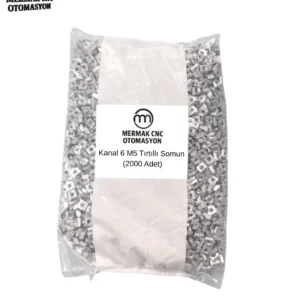 %74 DiscountChannel 6 M5 Serrated Nut (2000 Pcs)Original price was: 216.00$.55.30$Current price is: 55.30$.View
 %48 DiscountT-Slot Nut M5 45x45 K10Original price was: 0.30$.0.16$Current price is: 0.16$.View
 %70 DiscountT-Slot Nut M5 20x20 K6Original price was: 0.10$.0.02$Current price is: 0.02$.View
Reviews
There are no reviews yet.