
No products in the cart.
%44 Discount


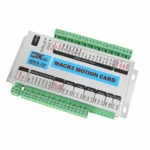
4 Axis USB Mach3 CNC Card 2000 kHz
Original price was: 426.24$.237.16$Current price is: 237.16$.
High-performance 4-axis CNC control card with 2000 kHz pulse output and Ethernet interface for Mach3 software.
In stock
🔥 Special for Today Only %44 Discount Opportunity!📦 Category: Mach3 Control Boards🏷️ Frequency: 2000 kHz🏷️ Number of Axes: 4-Axis🏷️ Communication System: Usb
Mermak assuranceFrom factory to end user · importer / main dealer · strong stock
ImporterMain dealer / distributorStrong stockGood priceCorporate invoice
In stock / available to order · 14-day return for standard unused products; conditions may vary for custom size/cut products.
4 Axis USB Mach3 CNC Card 2000 kHz
INDUSTRIAL AUTOMATION PARTS | SUPERIOR PERFORMANCE SERIES
Detailed Product Review
This 4-Axis Mach3 CNC Control Card is a hardware interface designed to provide precise motion control in industrial automation systems. Its primary function is to interpret G-code commands from Mach3 software and generate the high-frequency pulse and direction signals required for axial motion to connected servo or stepper motor drivers. The 2000 KHz (2 MHz) pulse output frequency capacity is critical, especially for stepper motors operating in micro-stepping mode and servo systems using high-resolution encoder feedback. This enables smoother, vibration-free, and highly accurate motor positioning. The Ethernet-based connection interface offers higher resistance to electromagnetic interference (EMI) compared to traditional USB connections, guaranteeing data integrity and communication stability even over long cable lengths in industrial environments. The card also supports advanced functions such as spindle speed feedback, PWM/analog voltage spindle control, and resume-after-power-loss processing, allowing for integrated management of complex CNC operations.
The physical construction of the product is designed with industrial durability and electrical protection principles in mind. The aluminum housing acts as an electromagnetic interference (EMI) shield, protecting internal electronic components from external noise and providing passive cooling to enhance the card’s thermal stability. All input and output ports (16 inputs, 8 outputs) are optically isolated. This isolation creates an electrical barrier between the control circuit and external field devices (sensors, limit switches, relays, etc.), preventing ground loops, protecting against voltage spikes, and improving the overall system stability. These technical features position the card as a reliable and precise control solution for a wide range of applications, including CNC routers, milling machines, laser cutting systems, plasma machines, and even industrial 3D printers. The differential signal output ensures optimal signal integrity with motor drivers, minimizing error rates during high-speed data transmission and maximizing motor performance.
Advantages of the 4 Axis USB Mach3 CNC Card 2000 kHz
2000 KHz Pulse Output for High-Resolution Motion Control: The 2 MHz pulse output frequency of this control card significantly enhances the ability to divide each full step of the motor into numerous micro-steps, especially when integrated with micro-step drivers. This results in smoother, vibration-free motor rotation, minimizing mechanical resonances and improving surface finish during machining. The high frequency also enables precise positioning and contour tracking even during high-speed axis movements, offering a critical technical advantage for machining complex 3D geometries and creating fine details.
Reliable Ethernet-Based Communication for Industrial Environments: The Ethernet interface offers a superior resistance mechanism against electromagnetic interference (EMI), common in industrial settings, compared to USB connections. The Ethernet protocol relies on error-checking mechanisms and differential signaling principles to ensure data packet integrity. Furthermore, transformer isolation prevents electrical noise from leaking into the data line. This architecture ensures uninterrupted and deterministic data communication without signal degradation, even over cable lengths up to 10 meters, maximizing the reliability of control signals during long-term and critical machine operations.
System Stability and Protection with Advanced Input/Output Isolation: All 16 input and 8 output ports on the card are optically isolated. This isolation creates an electrical barrier between the sensitive digital circuits of the control card and external field devices such as sensors, limit switches, emergency stop buttons, or relays. Opto-isolators prevent electrical noise, voltage fluctuations, or ground loops from reaching the control card, thereby increasing system stability and preventing damage to expensive electronic components. This engineering approach ensures long-term, error-free operation of the system, especially in high-noise industrial environments.
Technical Specifications and Capacity
Feature | Value/Description
Number of Axes | 4 Axes (Synchronized motion control)
Pulse Output Frequency | 2000 KHz (2 MHz) – For high-speed and precise positioning
Connection Interface | Ethernet – IP-based stable communication, up to 10 meters cable support
Input Ports | 16 Units (Optically isolated, strong anti-interference)
Output Ports | 8 Units (Optically isolated, strong anti-interference)
Spindle Control | PWM speed output, Pulse and Direction output, 0-10V Analog Voltage output
Technical Frequently Asked Questions (FAQ)
What are the key technical parameters to consider during the integration of this card with Mach3 software?
When integrating this control card with Mach3 software, the “Ports and Pins” settings are of paramount importance. For each axis (X, Y, Z, A), the correct Pin Numbers and Port Numbers must be assigned in the “Motor Outputs” tab. The polarity of the Pulse and Dir pins should be correctly configured as either “Active Low” or “Active High” according to the requirements of the motor drivers; otherwise, motors may move in the reverse direction or not respond at all. In the “Motor Tuning” section, the “Steps per Unit”, “Velocity” (maximum speed), and “Acceleration” values for each axis must be precisely adjusted based on the specifications of the motors and the mechanical system. To fully utilize the 2000 KHz pulse output frequency, the Mach3 “Kernel Speed” setting should be compatible with the highest frequency supported by the card (typically 25 KHz or higher, though for this external controller, this setting primarily affects Mach3’s internal processing speed), and the card’s own driver must be correctly installed. For the Ethernet connection, the card’s IP address and network settings must be compatible with the computer’s network configuration.
How is the effect of the 2000 KHz pulse output frequency on machining accuracy, especially in micro-stepping mode, technically explained?
The 2000 KHz (2 MHz) pulse output frequency is a critical parameter that directly impacts machining accuracy, particularly when stepper motors are operated in micro-stepping mode. Micro-stepping divides each full step of a stepper motor into smaller sub-steps, allowing for smoother and higher-resolution motor movement. For example, operating a 200-step motor in 1/16 micro-step mode requires 16 pulses per full step. A higher pulse frequency allows the motor driver to generate these micro-steps in shorter time intervals, enabling the motor to operate in micro-stepping mode even at higher speeds. This leads to smoother motion profiles by reducing mechanical vibrations and resonances. Consequently, it becomes possible to achieve more accurate toolpath following during machining, improve surface quality, and maintain precision at the micron level, especially when processing complex contours or fine details. The high frequency also improves the motor’s dynamic response and allows for sharper adjustment of acceleration/deceleration ramps.
With which engineering principles can the superior resistance of Ethernet-based communication to electromagnetic interference (EMI) in industrial environments, compared to USB connections, be explained?
The superior resistance of Ethernet-based communication to electromagnetic interference (EMI) in industrial environments, compared to USB, can be explained by several engineering principles. Firstly, Ethernet typically uses differential signaling, where data is transmitted as the voltage difference between two signals with opposite phases. When external noise affects both signal lines similarly, the distortion in the differential signal is minimized. Secondly, Ethernet ports are often equipped with internal transformer isolation. These transformers provide galvanic isolation between the control card and the network cable, preventing the formation of ground loops and blocking high-voltage spikes or common-mode noise from reaching the control card. Thirdly, Ethernet cabling (especially Shielded Twisted Pair – STP) is more resistant to external EMI due to its twisted-pair structure and shielding. Finally, the Ethernet protocol incorporates robust error-checking mechanisms, such as CRC (Cyclic Redundancy Check), to ensure the integrity of data packets. USB, on the other hand, generally uses single-ended signaling and lacks transformer isolation, making it more vulnerable to industrial noise and struggling to maintain signal integrity over long cable lengths.
What are the technical benefits provided by the optically isolated input/output ports on the card, in terms of system safety and stability?
Optically isolated input/output (I/O) ports offer critical engineering benefits for system safety and stability. Opto-isolators create an electrical barrier between the low-voltage, sensitive digital circuits of the control card and the high-voltage or noisy field devices in an industrial environment (sensors, limit switches, emergency stop buttons, relays, contactors). This galvanic isolation provides three main advantages: Firstly, it prevents the formation of ground loops. These loops, which can occur when devices with different ground potentials are connected, can cause noise and erroneous readings in control signals. Secondly, it protects the internal electronic components of the control card from voltage spikes or sudden current surges originating from field devices. This extends the card’s lifespan and reduces the risk of failure. Thirdly, it enhances signal integrity and accuracy by preventing electromagnetic interference (EMI) from infiltrating control signals. This makes sensor readings more reliable and actuator commands more precise, significantly increasing overall system stability and operational safety.
| Frequency | 2000 kHz |
|---|---|
| Number of Axes | 4-Axis |
| Communication System | Usb |
You must be logged in to post a review.
Taksit Tablosu
Related Products
 Relay Module 5V x 4 Relays w/ Opto-Isolation12.73$View
 %49 Discount3 Axis AKZ 250-USB3-NPN Mach3 Control BoardOriginal price was: 189.66$.97.66$Current price is: 97.66$.View
 %49 Discount3 Axis USB Mach3 Control Board 2000 kHzOriginal price was: 312.02$.160.66$Current price is: 160.66$.View
Reviews
There are no reviews yet.