


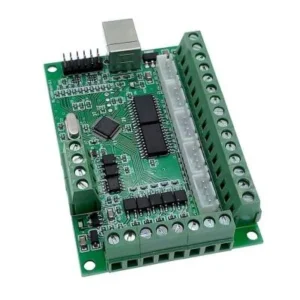
3 Axis AKZ 250-USB3-NPN Mach3 Control Board
Original price was: 189.66$.97.66$Current price is: 97.66$.
Out of stock
Contact us for stock information · 14-day return for standard unused products; conditions may vary for custom size/cut products.
3 Axis AKZ 250-USB3-NPN Mach3 Control Board
Detailed Product Review
The 3 Axis AKZ 250-USB3-NPN Mach3 Control Board is a high-performance interface card designed to manage motion control in computer-based numerical control (CNC) systems. This board interprets G-code commands from Mach3 software running on a control computer and generates precise pulse and direction signals for connected step or servo motor drivers. The USB Full Speed (USB 2.0/3.0 compatible) connection interface establishes a low-latency, high-bandwidth communication channel between the control computer and the board. This allows complex G-code paths to be processed at the millisecond level and transmitted to the motors, optimizing the dynamic response of the mechanical system. The primary function of the board is to act as a bridge, converting the virtual axis movement commands from Mach3 software into physical motor movements, providing high-resolution and smooth motion control with up to 500 kHz pulse output frequency, directly impacting machining accuracy and surface quality. Integrated NPN outputs provide a safe and stable interface with external relays or directly with NPN-compatible drivers, adhering to industrial standards.
The AKZ 250-USB3-NPN control board features a robust electronic structure designed for long-term, reliable operation in industrial environments. High-quality PCB material and industrial-grade electronic components provide resistance to electromagnetic interference (EMI) and thermal stability, ensuring consistent performance even under demanding production conditions. For system integration, the board includes 16 optocoupler-isolated input terminals (E-stop, limit switch, home switch, probe, MPG) and 8 optocoupler-isolated NPN output terminals (spindle control, coolant, mist, general purpose relays). This extensive I/O capacity allows for easy interfacing with various sensors, actuators, and peripherals, enabling the setup of a comprehensive machine control system. Application areas span a wide range, from CNC milling machines, lathes, and machining centers requiring high-precision part production on metal, wood, plastic, and composite materials, to laser cutting and engraving systems, 3D printers (additive manufacturing), and even basic motion control units for robotic manipulators. The board’s flexible design makes it suitable for diverse industrial scenarios such as prototyping, mold making, and mass production.
Advantages of the 3 Axis AKZ 250-USB3-NPN Mach3 Control Board
High-Bandwidth and Low-Latency USB Communication: The AKZ 250-USB3-NPN control board utilizes the USB Full Speed protocol, ensuring a stable and uninterrupted data flow with a theoretical bandwidth of 12 Mbps between the control computer and the board. This feature guarantees that complex G-code commands and axis movement data from Mach3 software are transferred to the board’s motion control processor in real-time with minimal latency. Low latency is critical, especially for high-speed contouring and precision machining operations, as any delay in the control loop can adversely affect machining accuracy and surface quality. The resistance to electromagnetic noise provided by the USB connection helps maintain data integrity in industrial environments and enhances the overall system stability. This optimizes machine axis synchronization and positioning accuracy.
High-Resolution Motion Control with 500 kHz Pulse Output Frequency: The control board’s maximum 500 kHz pulse output frequency capacity enables the connected step or servo motors to be controlled with very high speeds and, simultaneously, with micrometer precision. When combined with the micro-stepping resolution of a step motor driver (e.g., 1/16 or 1/32 micro-step) and the motor’s step angle, the 500 kHz pulse frequency allows for hundreds of thousands of micro-steps per second per axis. This high resolution provides a critical advantage in machining operations where fine details, complex geometries, and smooth surface quality are required. The high frequency supports smoother and more vibration-free motor operation while also allowing for higher feed rates, directly increasing production efficiency. Furthermore, it improves the speed and response time of the positioning loop in servo systems, offering more stable performance against dynamic load changes.
Advanced Machine Control with Comprehensive and Flexible I/O Integration: The AKZ 250-USB3-NPN board, with its 16 optocoupler-isolated inputs and 8 optocoupler-isolated NPN outputs, allows for the integration of a wide range of machine functions. The input terminals are used to connect critical safety and operational feedback devices such as emergency stop (E-stop) buttons, limit switches (upper and lower limits) for each axis, home switches, tool probes, MPG (Manual Pulse Generator) handwheels, and spindle speed feedback sensors. The optocoupler isolation minimizes signal distortion caused by external noise, preserving signal integrity. The output terminals are used to control actuators and auxiliary systems like spindle motor direction control, PWM signal for speed control, and activation of coolant (flood) and mist systems. NPN outputs are typically preferred for low-side switching and can interface directly with industrial relays or NPN-compatible drivers. This extensive I/O capacity enhances the machine’s automation level, ensures operator safety, and allows for the implementation of customized automation scenarios.
Technical Specifications and Capacity
FeatureValue/Description
InterfaceUSB Full Speed (USB 2.0/3.0 Compatible)
Number of Controlled Axes3 Axes (X, Y, Z)
Maximum Pulse Output Frequency500 kHz
Input Terminals (Optocoupler Isolated)16 (E-Stop, Limit Switch, Home Switch, Probe, MPG, etc.)
Output Terminals (Optocoupler Isolated NPN)8 (Spindle Direction, Mist, Flood Cooling, General Purpose Relays, etc.)
Spindle Control MethodPWM Signal Control or Step/Dir Control
Supported Operating SystemsWindows XP, 7, 8, 10 (32-bit and 64-bit)
Technical Frequently Asked Questions (FAQ)
What does the “NPN” output type on the AKZ 250-USB3-NPN board mean, and how does it affect system integration?
The term “NPN” indicates that the control board’s output terminals are NPN transistor-based. This means the outputs operate on the principle of “low-side switching.” When an NPN output is active, it pulls the corresponding terminal to ground (GND), and the connected load (e.g., a relay coil, an LED, or an NPN-compatible motor driver) must be connected to the positive terminal of the power supply. The load is connected between the output terminal and ground. This configuration is commonly used in industrial automation as it is more resistant to noise and generally considered a safer switching method. For integration, users must pay attention to this polarity when connecting external devices. For example, if a relay module is to be connected, the relay module’s trigger input should be connected to the positive supply, and the NPN output should pull this input to ground to activate the relay. This is a critical technical detail for ensuring the system’s electrical compatibility and reliability.
What is the direct technical impact of the 500 kHz pulse output frequency on CNC machining accuracy and surface quality?
The 500 kHz pulse output frequency refers to the control board’s capability to generate up to half a million pulse signals per second. This high frequency, especially in step motor-based systems, increases the motor’s micro-step resolution and, consequently, the resolution of axis movement. For instance, if a step motor driver operates in 1/16 micro-step mode and the motor’s step angle is 1.8 degrees, the 500 kHz frequency allows the axis to move in much smaller and more precise steps. This enables the toolpath to be followed more smoothly and continuously during machining, directly improving the surface quality of the machined part and minimizing ripple or vibration marks. Furthermore, the high pulse frequency allows motors to operate at higher speeds and more smoothly, ensuring positioning accuracy is maintained even at high feed rates, which directly increases production efficiency. In servo systems, this frequency leads to faster updates of the positioning loop and quicker response times, offering superior accuracy in high-speed contouring and complex geometry machining.
The full compatibility of the AKZ 250-USB3-NPN board with Mach3 software offers what technical advantages to the user, and what are the operating system requirements?
The full compatibility of the AKZ 250-USB3-NPN board with all versions of Mach3 offers users extensive control and automation flexibility. Mach3 is known for its standard G-code interpretation capabilities, advanced toolpath simulation, customizable interface, and comprehensive macro programming features. The integration of this board with Mach3 allows users to easily program complex machining operations, manage tool offsets, dynamically adjust speeds and feed rates, and synchronize various machine functions (spindle control, coolant systems). Full compatibility means the board meets all signal protocols and timing requirements specified by Mach3 at the hardware level, ensuring a stable and error-free operating environment. Regarding operating system requirements, the board is compatible with Windows XP, Windows 7, Windows 8, and Windows 10, in both 32-bit and 64-bit versions. This broad support allows for easy integration with existing computer systems, minimizing hardware upgrade costs while enabling users to benefit from the security and performance advantages of modern operating systems.
How do the board’s 16 input and 8 output terminals extend a CNC machine’s control capabilities beyond basic motion control?
The board’s extensive 16 input and 8 output terminals significantly enhance a CNC machine’s automation and safety capabilities beyond basic 3-axis motion control. The 16 input terminals are used to process feedback from sensors critical for machine safety, such as emergency stop (E-stop) buttons, individual limit switches for each axis (both positive and negative directions), tool probes, and home switches. These inputs ensure the machine stays within its safe operating envelope and prevent potential collisions or damage. They also allow for the integration of devices that provide operational convenience and precision, like MPG (Manual Pulse Generator) handwheels and spindle speed feedback sensors. The 8 output terminals are used to control actuators and auxiliary systems, such as starting/stopping the spindle motor, controlling its direction, adjusting speed via PWM signal, and activating coolant (flood) and mist systems. This broad I/O capacity enables users to develop their own custom automation scenarios (e.g., automatic tool changers, part loading/unloading systems) and integrate the machine into more complex production processes, thereby increasing overall efficiency and functionality.
You must be logged in to post a review.
Taksit Tablosu
Related Products
 Relay Module 5V x 2 Relays w/ Opto-Isolation6.36$View
 %53 Discount5 Axis CNC USB Control Board Mach3 Card GreenOriginal price was: 90.00$.42.00$Current price is: 42.00$.View
 Relay Module 5V x 4 Relays w/ Opto-Isolation12.73$View
Reviews
There are no reviews yet.