
No products in the cart.
%39 Discount


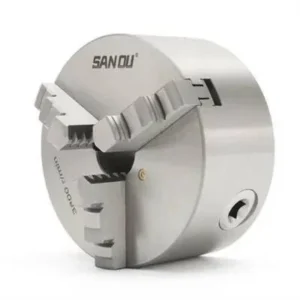
160 mm 3-Jaw Self-Centering Lathe Chuck
Original price was: 183.55$.111.97$Current price is: 111.97$.
High-precision 160 mm 3-jaw self-centering lathe chuck for industrial automation and CNC machining. Engineered for superior clamping force and durability.
In stock
🔥 Special for Today Only %39 Discount Opportunity!📦 Category: Lathe Chucks🏷️ Chuck Jaw Count: 3 Jaws🏷️ Dimensions: 160
Mermak assuranceFrom factory to end user · importer / main dealer · strong stock
ImporterMain dealer / distributorStrong stockGood priceCorporate invoice
In stock / available to order · 14-day return for standard unused products; conditions may vary for custom size/cut products.
The 160 mm Lathe Chuck, offered by Mermak CNC Technology Market, is a self-centering, three-jaw clamping device designed for the precise machining of cylindrical, conical, or planar surfaces in metalworking processes. This chuck securely holds the workpiece around a rotating axis with high accuracy, enabling the cutting tool to perform material removal operations. Its operating principle relies on a spiral scroll plate driven by a pinion gear mechanism. This scroll plate simultaneously moves three jaws radially, ensuring the workpiece is automatically aligned with the center axis. This self-centering feature minimizes workpiece clamping time while providing repeatable centering accuracy, ensuring consistency in machining quality. The chuck is optimized with engineering principles to ensure stable workpiece holding even at high speeds, translating to minimal run-out and maximum machining safety under dynamic loads.
The structural integrity of this lathe chuck is ensured by its high-quality cast iron body and hardened alloy steel jaws. Cast iron, with its high damping capacity, absorbs vibrations generated during machining, improving surface finish and extending tool life. The hardened alloy steel jaws offer high wear resistance and compressive strength, demonstrating superior resistance to deformation even during prolonged and intensive industrial use. The product’s system integration is designed according to standard connection dimensions, allowing for easy mounting directly to the spindle flange of lathes or with an adapter plate. Having undergone years of operational testing in Mermak’s own manufactured machinery and automation systems, the product’s suitability for industrial standards and demanding working conditions is confirmed. This 160 mm diameter chuck offers a wide range of applications, particularly for machining medium and large workpieces, on both conventional lathes and modern CNC lathes and machining centers.
Advantages of the 160 mm Lathe Chuck
Superior Machining Precision and Repeatability: This lathe chuck offers a repeatability accuracy of ≤ 0.06 mm, guaranteeing that workpieces are positioned within the same centering tolerance with every clamping. This low repeatability value minimizes run-out during machining, allowing for critical surface roughness (Ra, Rz values) and dimensional tolerances (IT class) to be maintained. Especially in mass production, it ensures consistency in the geometric and dimensional characteristics of each part, reducing scrap rates and improving final product quality. This precision creates a balanced machining environment that extends tool life and optimizes cutting forces.
Maximum Clamping Security and Dynamic Stability: The optimized jaw mechanism secures workpieces with a nominal clamping force of up to 25 kN, preventing slippage or ejection of the workpiece even at high speeds (up to 3000 RPM) and under heavy cutting conditions. This high clamping force maximizes the friction coefficient between the workpiece and the jaws, safely counteracting the torque generated by cutting forces. Dynamic balance is designed to minimize the effects of centrifugal forces at high rotational speeds on the jaws, reducing vibration and burr formation during machining. Consequently, operator safety is enhanced, and machining quality is preserved, ensuring the sustainability of precise tolerances.
High Durability, Wear Resistance, and Long Operational Life: The chuck body is manufactured from special alloy cast iron with high strength and vibration-damping properties. This material selection enhances the resistance of the chuck structure to deformation even under intensive industrial loads and ensures long-term operational stability. The jaws are made from hardened alloy steel with high hardness and toughness properties. This heat-treated steel exhibits superior resistance to wear from repetitive clamping-unclamping cycles and workpiece contact. From a material engineering perspective, this combination extends the fatigue life of the chuck components, widens maintenance intervals, and reduces the total cost of ownership (TCO), guaranteeing long-term operational continuity.
Technical Specifications and Capacity
Feature
Value/Description
Chuck Outer Diameter
160 mm
Chuck Type
3-Jaw Self-Centering
Maximum Safe Speed
3000 RPM (Revolutions Per Minute)
Repeatability Accuracy
≤ 0.06 mm (Diameter)
Body Material
High-Quality Cast Iron (High Damping Capacity)
Jaw Material
Hardened Alloy Steel (High Wear Resistance)
Nominal Clamping Force
Approx. 25 kN
Product Barcode Number
8692024002690
Technical Frequently Asked Questions (FAQ)
How does the repeatability accuracy (≤ 0.06 mm) of this self-centering lathe chuck directly affect machining tolerances?
Repeatability accuracy is a critical parameter that defines how consistently a workpiece can be positioned relative to the axis of rotation each time it is clamped in the chuck. A value of ≤ 0.06 mm means the workpiece can be positioned with a maximum radial deviation of 0.03 mm from the center axis. This deviation directly impacts workpiece run-out during machining. Low run-out allows the cutting tool to perform a more stable cutting operation at the point of contact with the workpiece. This directly improves the final product’s diameter tolerances, concentricity, and cylindricity. For instance, even for medium precision class (m) tolerances according to ISO 2768-1 standard, this level of repeatability minimizes the need for additional correction operations after machining, increasing production efficiency and reducing scrap rates. It also has a positive effect on tool life, as unbalanced cutting loads can accelerate tool wear.
What engineering factors influence the maximum safe speed limit of 3000 RPM, and what are the risks of exceeding this limit?
The maximum safe speed limit is determined by considering the dynamic stability, structural integrity, and safety factors of the lathe chuck and the attached workpiece. The primary engineering factors influencing this limit include: 1) Centrifugal Forces: At high speeds, centrifugal forces on the chuck jaws and the workpiece increase significantly. These forces tend to reduce the clamping force of the jaws, potentially causing the workpiece to be ejected from the chuck. 2) Material Strength: The yield and tensile strength of the chuck body and jaw materials determine their capacity to withstand these centrifugal forces. 3) Balancing: The static and dynamic balance of the chuck and workpiece directly affects the risk of vibration and resonance at high speeds. An unbalanced system can lead to excessive vibrations, damaging machine components and degrading machining quality. 4) Lubrication and Wear: Friction at high speeds can accelerate wear in the chuck mechanism and, in case of insufficient lubrication, cause temperature increases. Exceeding this limit can result in consequences such as workpiece ejection, structural failure of chuck components, damage to the machine spindle, and serious safety risks for the operator. Therefore, strict adherence to the specified 3000 RPM limit is critical for both equipment safety and operational safety.
What safety margin does the 25 kN nominal clamping force provide under different workpiece materials and cutting parameters?
The 25 kN (kilonewton) nominal clamping force is a parameter designed to ensure the lathe chuck can securely hold the workpiece against axial and radial cutting forces. This force determines the frictional force between the workpiece and the jaws. The frictional force (F_friction = μ * F_clamping), where μ is the coefficient of friction and F_clamping is the nominal clamping force, is the primary mechanism preventing workpiece slippage. Different workpiece materials (e.g., aluminum, steel, titanium) can have different coefficients of friction, and varying cutting parameters (feed rate, depth of cut, cutting speed) produce different cutting forces (F_cutting). A high clamping force of 25 kN provides a sufficient safety margin even for materials with low friction coefficients or aggressive machining conditions requiring high cutting forces. For example, the torque generated during heavy-duty material removal operations on high-strength steels can be safely managed by this clamping force. This preserves machining accuracy by preventing workpiece slippage during rotation, extends tool life, and prevents potential work accidents. In engineering calculations, the clamping force is typically determined with a safety factor of 2 to 3 times the cutting forces; 25 kN meets this factor for a wide range of applications.
What periodic maintenance procedures are recommended to ensure the long-term, precise operation of the 160 mm lathe chuck?
Regular and systematic periodic maintenance procedures are critical for sustaining the long-term and precise operation of the 160 mm lathe chuck. Recommended maintenance steps include: 1) Lubrication: The chuck mechanism (scroll plate, pinion gear, and jaw slides) must be regularly lubricated with high-viscosity, EP (Extreme Pressure) additive special chuck grease. This reduces friction, prevents wear, and provides corrosion protection. Lubrication frequency can be daily or weekly, depending on usage intensity. 2) Cleaning: At the end of each shift or after intensive use, it is important to clean chips, coolant residues, and other contaminants from the chuck surfaces and internal mechanism. Contaminants can restrict jaw movement and degrade precision. 3) Jaw Inspection: Jaws should be regularly visually inspected for wear, deformation, or damage. Deterioration of the clamping surfaces, in particular, can prevent the workpiece from being held securely. Jaws may need to be replaced or re-machined if necessary. 4) Fastener Check: The torque values of the mounting bolts connecting the chuck to the lathe machine should be periodically checked and tightened according to manufacturer specifications. Loose bolts can lead to vibration and loss of precision. 5) Run-out Check: Periodically, using a dial indicator, the run-out values of the chuck and workpiece should be measured to confirm that the chuck’s precision is being maintained. These procedures maximize the chuck’s operational efficiency, safety, and lifespan.
Mermak has 16 years of experience in the industry. Our products are stocked in our Ankara Uzay Sanayi factory/warehouse. Website stock quantities and prices are up-to-date. Stocked products are dispatched directly from our warehouse without production waiting times. We ensure careful packaging, meticulous invoice and document follow-up, and utilize reliable logistics partners. The Mermak team monitors the shipment process closely. Upon request, product videos and factory tours can be arranged via WhatsApp or other contact channels. We proudly supply our products to customers in the United Kingdom, United States, Canada, Australia, Ireland, New Zealand, and South Africa, as well as similar countries and international markets.
| Chuck Diameter | |
|---|---|
| Chuck Jaw Count | 3 Jaws |
| Dimensions | 160 |
You must be logged in to post a review.
Taksit Tablosu
Related Products
 %39 Discount100 mm Lathe ChuckOriginal price was: 97.90$.59.71$Current price is: 59.71$.View
 %30 Discount80x4 Sanou Lathe ChuckOriginal price was: 154.04$.107.83$Current price is: 107.83$.View
 %39 Discount250x3 Sanou Lathe ChuckOriginal price was: 334.46$.204.02$Current price is: 204.02$.View

Reviews
There are no reviews yet.