



































































Why Stepper Motors Are Strong at Low Speeds and Weak at High Speeds: A Technical Guide
📑 Table of contents (Click to open)
- Introduction and Technical Analysis
- Operating Principle and Technical Data
- Reasons for Strong Performance at Low Speeds
- Reasons for Weak Performance at High Speeds
- Solutions and Optimization Strategies for Industrial Applications
- 1. Increase Supply Voltage (Voltage Boosting)
- 2. Microstepping Drivers
- 3. Use of Geared Stepper Motors (Planetary Gearboxes)
- 4. Selecting Low Inductance Motors
- 5. Hybrid Stepper Motors
- 6. Closed-Loop Stepper Systems (Stepper with Encoder)
- 7. Consider Servo Drives for Very High-Speed Applications
- Practical Industrial Examples and Case Studies
- CNC Router Machine Z-Axis Control
- Automated Labeling Machines
- 3D Printing Extruder Drives
- Conclusion and Recommendations
- FAQ
Introduction and Technical Analysis
Stepper motors, indispensable components in industrial automation, stand out with their unique advantages, especially in applications requiring precise positioning and angular control. Widely used in robotic arms, CNC router machines, 3D printers, labeling machines, and medical devices, these motors are among the top choices for engineers due to their direct digital control capability and ability to take accurate steps without needing feedback. However, when examining the performance characteristics of stepper motors, a critical observation emerges: the impressive power and torque they exhibit at low speeds significantly diminish as the speed increases. This situation represents a significant limitation for system designers and application engineers, particularly in complex automation projects that also require high-speed movements. This detailed field guide and technical article will delve into the fundamental physical and electrical principles underlying this characteristic behavior of stepper motors, explain the reasons for this phenomenon from an industrial automation perspective, and present measures and solution strategies for optimal system performance. Our goal is to provide a comprehensive resource that helps field experts and engineers use stepper motors more consciously and effectively in their projects.
Operating Principle and Technical Data
Stepper motors are electromechanical devices that enable the rotor to rotate at specific angles through electrical pulses (steps) applied to the coil windings on the stator. Each electrical pulse causes the rotor to move by a fixed angle (step angle). This step-by-step movement offers the ability to control the motor’s position with very high precision. A typical stepper motor has multiple phase windings (usually 2 or 4 phases). These windings are energized in a specific sequence to create a rotating magnetic field within the stator. Permanent magnets or soft iron teeth on the rotor attempt to align with this magnetic field, causing the motor to move.

Reasons for Strong Performance at Low Speeds
The ability of stepper motors to produce high torque at low speeds is directly related to current control and the full formation of the magnetic field. At low speeds, the duration of each step is longer. This extended duration allows sufficient time for the driver circuit (typically a chopper driver) to inject enough current into the coil windings and for this current to reach its maximum (nominal) value. The current in the coils determines the strength of the magnetic field and thus directly affects the torque the motor will produce. When the current reaches its nominal value, the magnetic attraction force between the stator and rotor is maximized, and the motor provides its maximum torque to move or hold the load. Furthermore, at low speeds, since the motor’s rotational speed is low, the Back Electromotive Force (Back EMF) generated in the windings is negligible. Back EMF is a voltage induced in the windings as the motor rotates, acting in opposition to the applied voltage. At low speeds, the effect of Back EMF is minimal, allowing the driver voltage to deliver current to the coils more effectively, which translates to a stronger magnetic field and consequently higher torque.

Reasons for Weak Performance at High Speeds
Several fundamental physical principles explain why the torque of stepper motors drops dramatically as their speed increases:
- Back Electromotive Force (Back EMF): This is the most significant reason for torque drop at high speeds. Back EMF is a voltage generated in the windings of a motor, proportional to the motor’s rotational speed, and acting in opposition to the applied supply voltage. As the motor speed increases, the magnitude of the Back EMF also increases. This reduces the net voltage across the windings (V_net = V_supply – V_back_EMF). As the net voltage decreases, the current flowing through the windings (I = V_net / R_winding) decreases. When the current decreases, the strength of the magnetic field weakens, which in turn causes the motor’s producible torque to drop. At high speeds, Back EMF can become so large that it consumes a significant portion of the driver voltage, preventing sufficient current from flowing through the windings.
- Effect of Inductance and Current Rise Time: Stepper motor windings have significant inductance (L). Inductance is a property that opposes changes in current. It takes a certain amount of time for current to start flowing through a coil and reach its maximum value (τ = L/R, time constant). At low speeds, the time allocated for each step is much longer than this current rise time, so the current can reach its nominal value. However, at high speeds, the steps are very short, meaning the time available for the current to build up in the windings is significantly reduced. If the step duration is shorter than the time constant (τ), the current may not reach its full nominal value before the next step is initiated. This results in a weaker magnetic field and consequently lower torque. The faster the motor attempts to step, the less time the current has to fully establish itself, leading to a further reduction in torque.
- Core Losses (Iron Losses): At higher operating frequencies (which correspond to higher speeds in stepper motors), the magnetic core material experiences increased losses. These losses include eddy current losses and hysteresis losses. Eddy currents are circulating currents induced in the core material by the changing magnetic field, generating heat and consuming power that would otherwise contribute to torque production. Hysteresis losses arise from the energy required to repeatedly magnetize and demagnetize the core material as the magnetic field reverses direction. Both types of core losses increase with frequency, reducing the motor’s efficiency and available output torque at high speeds.
- Mechanical Limitations and Resonance: While not directly related to electrical principles, mechanical factors can also contribute to perceived weakness at high speeds. Stepper motors can experience resonance at certain speeds, leading to vibrations, noise, and even loss of steps. This resonance can make the motor appear to lose power or become unstable. Proper mechanical design, damping, and microstepping techniques can mitigate these issues, but they highlight that the motor’s usable torque can be limited by mechanical constraints at higher speeds.
- Driver Limitations: The performance of a stepper motor is also heavily dependent on its driver. At high speeds, the driver must be able to switch the current rapidly and provide sufficient voltage to overcome the Back EMF. If the driver’s voltage supply is insufficient or its switching speed is too slow, it will not be able to maintain the required current levels in the windings, leading to a drop in torque. Advanced microstepping drivers and higher supply voltages are often used to extend the high-speed performance of stepper motors.
Solutions and Optimization Strategies for Industrial Applications
Understanding the inherent limitations of stepper motors at high speeds is crucial for industrial B2B buyers and engineers. However, several strategies can be employed to mitigate these effects and optimize performance in CNC router machines, industrial automation, and other demanding applications:
1. Increase Supply Voltage (Voltage Boosting)
One of the most effective ways to improve high-speed torque is to increase the supply voltage to the stepper motor driver. A higher voltage helps to overcome the Back EMF more quickly and allows the current to rise faster in the windings. This enables the current to reach its nominal value even during shorter step durations at higher speeds. However, it’s essential to ensure that the driver and motor windings can safely handle the increased voltage without overheating or damage. Always consult the manufacturer’s specifications for maximum voltage ratings.
2. Microstepping Drivers
Microstepping is a technique where the current in the motor windings is controlled in a sinusoidal or quasi-sinusoidal manner, effectively dividing each full step into many smaller microsteps. While primarily used for smoother motion and reduced resonance, microstepping drivers can also improve high-speed performance by providing more precise current control and reducing current ripple, which can contribute to more consistent torque delivery across a wider speed range. Modern industrial CNC router machines widely utilize microstepping for enhanced precision and smoother operation.
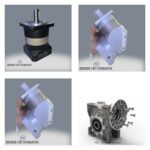
3. Use of Geared Stepper Motors (Planetary Gearboxes)
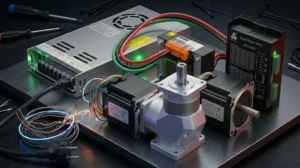
Integrating a planetary gearbox with a stepper motor is an excellent solution for applications requiring high torque at relatively lower output speeds. The gearbox reduces the output speed while multiplying the torque. This allows the stepper motor to operate at a higher, more efficient speed where its inherent torque is still strong, while the gearbox provides the necessary high torque at the output shaft. This is particularly useful for heavy-duty industrial CNC router applications, material handling systems, and other machinery where high force is required.
4. Selecting Low Inductance Motors
Motors with lower winding inductance will have a shorter electrical time constant (τ = L/R). This means the current can build up and decay faster, allowing the motor to respond more quickly to step commands and maintain higher current levels at increased speeds. When selecting a stepper motor for high-speed applications, prioritizing models with lower inductance can significantly improve performance. However, lower inductance often comes with a trade-off in other characteristics, so a balanced approach is necessary.
5. Hybrid Stepper Motors
Hybrid stepper motors combine features of permanent magnet and variable reluctance motors, offering improved performance over traditional permanent magnet types. They typically provide higher torque, better step accuracy, and improved high-speed characteristics due to their optimized rotor design and magnetic properties. For demanding industrial applications, hybrid stepper motors are often the preferred choice.
6. Closed-Loop Stepper Systems (Stepper with Encoder)
While traditional stepper motors are open-loop, closed-loop stepper systems incorporate an encoder to provide feedback on the rotor’s actual position. This allows the driver to detect and correct for lost steps, and in some advanced systems, dynamically adjust current to maintain torque. These systems bridge the gap between open-loop steppers and servo drives, offering the simplicity of stepper control with enhanced reliability and performance, especially at higher speeds where step loss is more likely.
7. Consider Servo Drives for Very High-Speed Applications
For applications that absolutely require very high speeds, high acceleration, and consistent torque across a wide speed range, industrial servo drives and servo motors are often a more suitable choice than stepper motors. Servo systems inherently use feedback (encoders) to precisely control position, speed, and torque, making them ideal for dynamic and high-performance CNC router machines, robotic systems, and other complex automation tasks. While typically more expensive, their performance benefits can justify the investment in critical applications.
Practical Industrial Examples and Case Studies
Let’s consider how these principles apply in real-world industrial scenarios:
CNC Router Machine Z-Axis Control
In a CNC router machine, the Z-axis often requires high torque for precise depth control during cutting, especially when plunging into material. At these low-speed, high-force operations, a stepper motor excels. However, for rapid tool changes or fast retracts, the Z-axis needs to move quickly. If a standard stepper motor is used without optimization, it might lose steps or lack the necessary speed. Implementing a higher supply voltage to the stepper driver or using a geared stepper motor can ensure both high torque at low speeds and sufficient speed for rapid movements, preventing production delays and ensuring cut quality.
Automated Labeling Machines
Automated labeling machines require precise, incremental movements to position labels accurately, but also need high speed to keep up with production lines. Here, a stepper motor is ideal for the precise label dispensing mechanism. However, if the motor needs to rapidly advance the label roll or quickly reposition, its high-speed torque drop can be an issue. Using a microstepping driver ensures smooth, accurate low-speed operation, while a higher voltage supply or a low-inductance motor can help maintain adequate torque for faster movements, ensuring efficient and accurate labeling.
3D Printing Extruder Drives
In 3D printers, the extruder drive needs to precisely control the filament feed rate (low speed, high torque) but also needs to retract the filament quickly (higher speed) to prevent oozing. A stepper motor is a common choice. However, if the retraction speed is too high for the motor’s high-speed torque, it might slip, leading to print defects. Optimizing the driver voltage and selecting a stepper motor with good high-speed characteristics are crucial for reliable 3D printing performance.
Conclusion and Recommendations
Stepper motors are invaluable components in industrial automation, offering unparalleled precision and control, particularly at low speeds. Their inherent characteristic of being strong at low speeds and weaker at high speeds is a fundamental aspect of their electromagnetic design, primarily driven by Back EMF and winding inductance. For industrial B2B buyers and engineers at Mermak CNC, understanding these principles is key to making informed decisions for optimal system design.
When designing or upgrading systems that utilize stepper motors, it is crucial to consider the entire speed-torque curve and the specific requirements of the application. For tasks demanding high torque at low speeds, standard stepper motors are often sufficient. However, for applications requiring a balance of precision, high torque, and increased speed, strategies such as increasing driver voltage, employing microstepping, utilizing geared stepper motors, or selecting low-inductance hybrid motors can significantly enhance performance. For the most demanding high-speed and dynamic applications, a transition to industrial servo drives may be the most appropriate solution.
By carefully analyzing the application’s needs and applying these optimization strategies, Mermak CNC customers can leverage the full potential of stepper motor technology, ensuring robust, precise, and efficient operation in their industrial CNC router machines, automation systems, and other critical equipment. For detailed technical consultation and to explore the best stepper motor and drive solutions for your specific industrial needs, we invite you to request a quote on WhatsApp. Our experts are ready to assist you in optimizing your motion control systems.
FAQ
Why are stepper motors strong at low speeds?
Stepper motors are strong at low speeds because the electrical current in their windings has sufficient time to reach its maximum (nominal) value. This creates a strong magnetic field and, consequently, high torque. At low speeds, the Back Electromotive Force (Back EMF) generated by the motor's rotation is also minimal, allowing the driver to effectively deliver current to the coils.
Why do stepper motors lose power at high speeds?
Stepper motors become weaker at high speeds primarily due to two factors: Back Electromotive Force (Back EMF) and winding inductance. As speed increases, Back EMF opposes the supply voltage, reducing the net voltage and thus the current in the windings. Additionally, at high speeds, the short step duration doesn't allow enough time for the current to fully build up in the inductive windings, leading to a weaker magnetic field and reduced torque.
What are the solutions to improve stepper motor performance at high speeds?
To improve high-speed performance of stepper motors, you can: 1) Increase the supply voltage to the driver, 2) Use microstepping drivers for smoother current control, 3) Integrate a planetary gearbox to multiply torque at lower output speeds, 4) Select motors with lower winding inductance, 5) Consider hybrid stepper motors, or 6) Implement closed-loop stepper systems with encoders.
What is Back EMF and how does it affect stepper motor torque?
Back EMF is a voltage generated in a motor's windings that opposes the applied supply voltage. Its magnitude is proportional to the motor's rotational speed. At high speeds, Back EMF becomes significant, reducing the effective voltage across the windings and limiting the current flow, which directly leads to a drop in motor torque.
Should I use a servo motor instead of a stepper motor for high-speed applications?
Yes, for applications requiring very high speeds, high acceleration, and consistent torque across a broad speed range, industrial servo drives and servo motors are generally more suitable. Servo systems offer precise feedback control and maintain high torque even at high RPMs, making them ideal for dynamic and demanding industrial CNC router and automation tasks.